
Blockchain Oracles: Chainlink and Bringing Offchain Data Onchain
A blockchain oracle is data and computing infrastructure that turns offchain facts—such as prices, reserves, weather, and match results—into verifiable inputs for smart contracts.
Smart contracts can directly read only the state of their own blockchain. They cannot independently access an exchange API, bank database, sensor, or website. Oracles collect data from external sources, have nodes verify, aggregate, and sign it, and then publish it onchain. This enables lending, derivatives, insurance, gaming, and real-world asset protocols to execute according to real-world conditions.
Chainlink is a leading oracle network. Its services have expanded from price data to low-latency Data Streams, Verifiable Random Function (VRF), Automation, Functions for external computation, Proof of Reserve, and the Cross-Chain Interoperability Protocol (CCIP). An oracle is therefore more than a “price feeder”; it is a set of standards connecting onchain and offchain systems.
For a broader view of how oracles relate to AI, DePIN, cross-chain systems, and modular networks, start with Web3 Trends in 2025: A Map of Emerging Sectors.
Why Do Blockchains Need Oracles?
Blockchain nodes must produce the same result from the same input, so a smart contract cannot let every node browse the internet independently. Web content can change over time, APIs may return different results by region, and servers can go offline. If validators receive different data, onchain execution cannot reach deterministic consensus.
An oracle converts uncertain external information into a definite onchain record. It specifies where data comes from, who reads it, how it is aggregated, when it is updated, how it is signed, and which address a contract should query. Nodes only need to verify the published onchain result rather than visit external sites themselves.
This creates the “oracle problem”: a blockchain can prove that a value was submitted, but the onchain record alone cannot prove that the original fact was correct. A secure oracle must diversify data sources and nodes, reduce single-point manipulation, and let applications check timestamps, outliers, and service status.
How Does an Oracle Data Pipeline Work?
The first step is selecting data sources. A price oracle may read centralized exchanges, decentralized exchanges, and professional market-data providers. Proof of Reserve may rely on custody accounts, asset issuers, and onchain addresses. Weather insurance depends on meteorological agencies and sensors.
The second step is data collection and standardization by nodes. Trading pairs, quote currencies, timestamps, volume, and precision differ across sources. Nodes must clean outliers, normalize formats, and prevent a low-liquidity market from distorting the overall result.
The third step is aggregation by the node network. Multiple independent nodes submit their observations, and the system produces a report through a median, weighted algorithm, or another consensus method. Chainlink Offchain Reporting lets nodes perform most communication offchain and submit the aggregate report in one transaction, reducing gas costs.
The fourth step is storing the result in an onchain contract. A consumer contract reads the latest value, round, and update time from a feed address. Updates may be triggered by a deviation threshold, a heartbeat, a user pull, or a specific event; not every change in market price is immediately written onchain.
The fifth step is application execution. Lending protocols calculate collateral ratios from prices, derivatives protocols settle positions, and insurance contracts determine whether an event occurred. Applications must handle stale data, zero prices, chain reorganizations, L2 sequencer outages, and extreme market conditions themselves.
How Do Chainlink Data Feeds Provide Prices?
Chainlink Data Feeds provide onchain reference data through multiple data sources and independent nodes. According to the official documentation, price feeds combine a decentralized data model with Offchain Reporting and are widely used for DeFi collateral valuation, perpetual trading, asset issuance, and risk controls.
The data-source layer first collects raw prices from multiple venues while accounting for volume, market depth, and anomalous trades. Node operators then independently retrieve results from professional data aggregators. Source decentralization and node decentralization address different problems: the former reduces manipulation by one exchange, while the latter reduces failure by one node.
Nodes agree on an aggregate report offchain and jointly sign it. An onchain aggregation contract verifies and stores the result. Consumers should not copy a feed address they find online; they should use the official contract-address page to confirm the network, trading pair, decimals, update rules, and risk classification.
3.1 What Are Heartbeats and Deviation Thresholds?
A heartbeat is the maximum interval after which an update should occur even when the price has not moved significantly. A deviation threshold triggers an update when the price has changed by a specified percentage relative to the previous answer. Together, they balance data freshness against onchain gas costs.
If the latest feed update predates the current block, that does not necessarily indicate a failure. The price may still be within both the deviation threshold and heartbeat window. Each application must set its own maximum acceptable staleness based on risk instead of assuming that any available value is safe to use.
3.2 Why Check the L2 Sequencer Uptime Feed?
On a rollup, a sequencer outage may temporarily prevent ordinary users from submitting or promptly updating transactions even while oracle prices continue to change. If a protocol liquidates positions immediately after the sequencer recovers, some users may not have had a reasonable opportunity to add collateral.
Chainlink provides L2 Sequencer Uptime Feeds so applications can detect sequencer interruptions and apply a grace period. This feed does not replace a price feed; it lets applications incorporate the chain's operating status into liquidation and trading logic.
What Is the Difference Between Push and Pull Oracles?
A push oracle has nodes proactively update an onchain contract according to time or deviation rules. Multiple applications can read the same feed directly, making integration straightforward. This model suits lending, asset valuation, and use cases that do not need subsecond data. The tradeoff is that continuous publication consumes gas, which limits update frequency.
A pull oracle keeps signed data reports offchain. A user or application retrieves a report when executing a transaction and submits it for onchain verification. Verification fees are paid only when the data is used, allowing higher frequency and lower latency, but the application must manage report retrieval, validation, and expiration.
Chainlink Data Streams use a pull design to provide low-latency market data that can be verified onchain. Pyth Core also supports a pull model in which users update prices. Its aggregate prices include confidence intervals, allowing applications to reject quotes that are too uncertain.
Neither model is universally superior. A lending protocol may prefer a stable, shared push feed, while high-frequency perpetual trading benefits more from low-latency data pulled on demand. Projects can also combine them, using a high-frequency stream as the primary path and a traditional feed as a risk reference or fallback condition.
What Problem Do Chainlink Data Streams Solve?
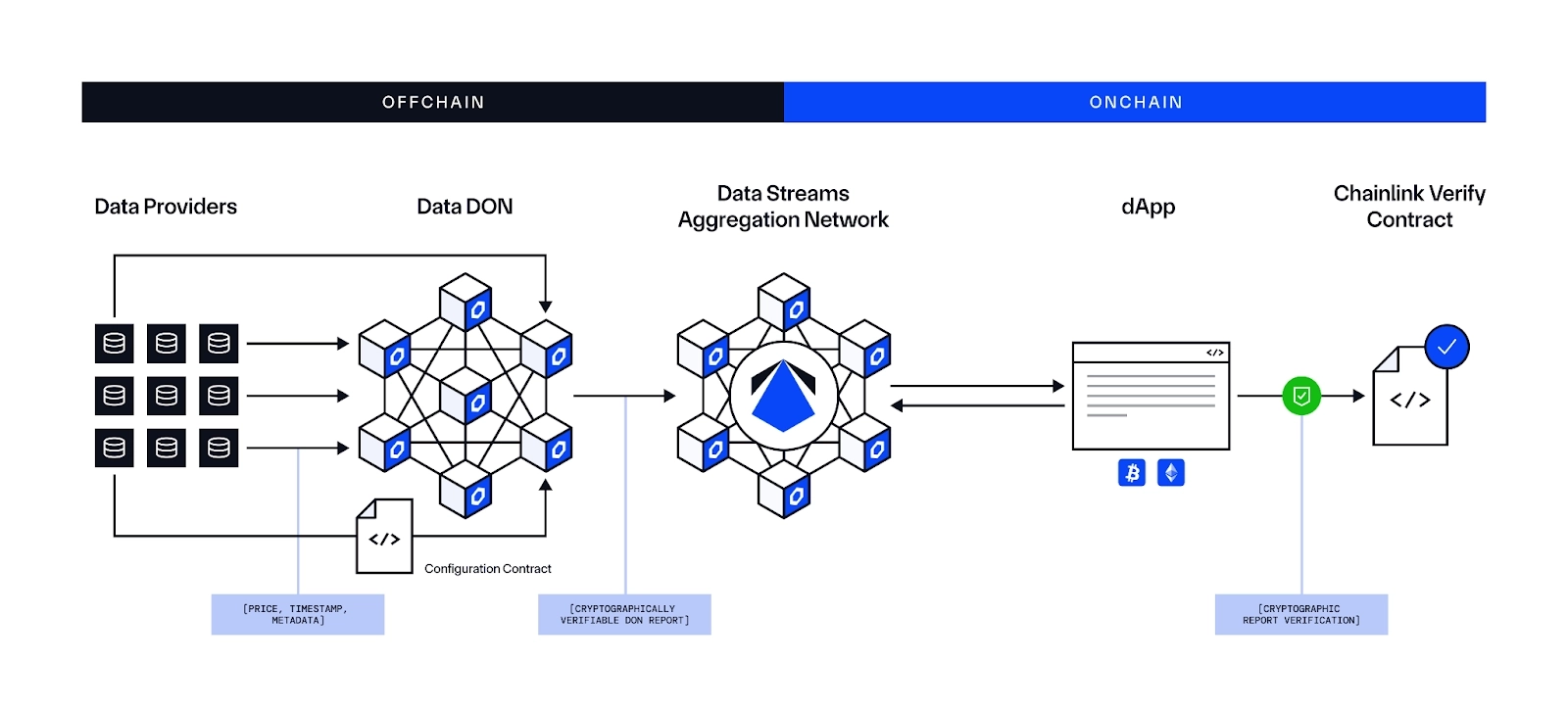
Data Streams target applications that require low-latency, high-frequency market data. The official documentation explains that a decentralized oracle network reaches consensus across multiple sources and signs a report. Applications retrieve the report on demand through an API or WebSocket, and it can ultimately be verified onchain.
Unlike traditional periodic pushes, a pull report does not have to be written to the blockchain immediately after every update. A trader can include the latest report when submitting an order, and the contract verifies its signature, feed ID, and timestamp before execution. This reduces latency and the ongoing cost of onchain updates.
Data Streams may also provide a mid-price, liquidity-weighted bid and ask prices, volatility, and market status. Commit-and-reveal-style flows can reveal trading data and the market report atomically at execution, reducing the chance that front-runners see the price and order combination in advance.
Low latency does not eliminate risk. Applications still need to examine the number of data sources, report time, market-open status, onchain verifier, maximum deviation, and API availability. Some specialized assets may use a single source, making staleness monitoring and alternative paths even more important.
Why Is Chainlink VRF Also an Oracle Service?
Secure randomness is difficult to generate onchain. If a result depends only on block time, hashes, or predictable parameters, validators, block builders, or users may influence it by choosing when to transact. NFT rarity, game draws, and random allocation therefore require verifiable randomness.
Chainlink VRF generates a random value and cryptographic proof for every request. A consumer contract can use the result only after the proof passes onchain verification. No individual node, developer, or user can alter the random output without invalidating the proof.
The current official documentation presents VRF v2.5 as the main version. Requests can be funded through a subscription or directly, with payment in LINK or a supported network's native token. Applications must also choose appropriate confirmation counts, callback gas, and request IDs so that chain reorganizations or callback failures do not disrupt the service.
VRF proves that the random number was correctly calculated from a particular key and input, but application logic can still be flawed. For example, a developer may allow repeated requests before a result returns or assign outcomes by return order instead of request ID, creating exploitable bias.
What Do Chainlink Functions and Automation Do?
Chainlink Functions lets smart contracts request external APIs and custom offchain computation. Code included in a request is executed by decentralized oracle network nodes in isolated environments, and their results are aggregated and returned onchain. This is useful for weather data, match results, authenticated APIs, and simple data transformations.
Decentralized execution by Functions does not automatically guarantee that the original API is correct. Developers remain responsible for data quality, availability, code security, and third-party dependencies. If every node calls the same faulty API, multiple nodes may consistently return the same wrong answer, so redundant sources and anomaly checks are essential.
Automation triggers smart contract functions when conditions are met, such as periodic settlement, liquidation checks, reward distribution, and maintenance tasks. A blockchain does not execute contracts on a clock by itself; someone must submit a transaction. The automation network monitors conditions and initiates onchain execution.
Functions answers “How do offchain data and computation enter a contract?” Automation answers “Who triggers the transaction when conditions are met?” Together, they can support parametric insurance, dynamic NFTs, and automated risk controls, but the consumer contract must still restrict callback sources, gas use, and duplicate execution.
What Other Data Can Oracles Provide?
Proof of Reserve feeds can publish data related to custodied assets, onchain reserves, or issuer liabilities, helping wrapped assets, stablecoins, and real-world asset protocols verify backing. They reflect only the selected sources and update time and are not equivalent to a complete financial audit or a legal guarantee of asset ownership.
SmartData feeds can provide real-world asset information such as net asset value, assets under management, reserves, and multivariable responses. Several values can be packaged into one update so tokenized funds and security-like products can read price, status, and other metadata together.
Rate and Volatility feeds can supply inputs for interest-rate, volatility, and risk models. Sports, weather, flight, and election data can serve prediction markets and insurance. Identity and compliance attestations may also connect to onchain applications through privacy-preserving oracles.
CCIP extends the oracle network's verification capabilities to cross-chain messaging and token transfers. Independent node networks confirm source-chain events before execution on the destination chain. To learn more about bridges, messaging protocols, and finality, read Cross-Chain Interoperability: Bridges, Messaging Protocols, and a Multichain Future.
What Are the Main Oracle Risks?
9.1 Data-Source Manipulation
If a price comes from a single or illiquid exchange, an attacker may use a flash loan or large trade to raise it briefly and then borrow against an incorrect valuation. A secure feed should aggregate multiple high-quality markets and account for volume, depth, and outliers.
9.2 Node and Key Risk
Nodes may go offline, collude, or expose signing keys. A decentralized oracle network should use independent operators, threshold signing, reputation, and monitoring so one organization cannot control enough nodes. Node count alone does not prove infrastructure independence.
9.3 Stale Data
Network congestion, API failures, market closures, or update thresholds may cause the latest answer to lag behind the real market. Consumer contracts must check update time, round, market status, and permitted delay instead of reading and using a value without validation.
9.4 Consumer-Contract Integration Risk
A project may use the wrong feed address, invert a trading pair, ignore decimals, fail to check for negative or stale values, or liquidate immediately after an L2 sequencer recovers. A correct oracle does not guarantee correct integration logic.
9.5 Governance and Upgrade Risk
Feeds, node sets, proxy contracts, and access controls may be upgraded. Users should examine administrators, multisigs, timelocks, pausing, and feed-deprecation procedures. If a project references a deprecated address, it may keep reading data that is no longer updated.
9.6 Distorted Underlying Markets
During a depeg, extreme volatility, or exchange outage, different markets may genuinely show multiple prices. An oracle cannot create a single “true price”; it can only produce a reference under a defined methodology. Applications need safeguards for unusual spreads, wider confidence intervals, and disappearing liquidity.
Oracle manipulation must also be distinguished from market manipulation. If an attacker uses a flash loan to alter an illiquid pool and a protocol reads that pool directly, the loss stems from fragile data design. If a decentralized feed accurately reports that several major markets crashed together, the protocol is facing market risk. The former requires better sources and aggregation; the latter calls for position limits, margin, and liquidation controls.
An oracle can also accurately report a price that is not executable. An asset may have a last traded price even after market depth has vanished, making it impossible to liquidate a large position at that value. Critical applications should therefore consider bids, asks, depth, volatility, and executable size rather than relying on one mid-price.
How Can Developers Use Oracles Safely?
First, choose a feed from the official address directory that matches the network, asset, and use case. Verify its proxy address, decimals, description, update rules, risk classification, and planned deprecation status. Do not copy an old address from a tutorial or forum.
Second, validate freshness. When reading an answer, check its update time, valid range, and the maximum delay permitted by the application. For assets that do not trade around the clock, handle market closures, holidays, and Market Status instead of treating the last close as a live price.
Third, implement circuit breakers. Limit single-block price changes, maximum borrowing value, liquidation size, and trading slippage. Pause high-risk functions when the primary feed is stale, the sequencer is offline, or sources diverge excessively.
Fourth, use independent references and monitoring. Critical protocols can compare the primary oracle with a time-weighted price, exchange index, and internal risk model. A reference is not necessarily an automatic replacement; it helps identify anomalies and trigger human or contract safeguards.
Fifth, protect callbacks and request state. Receiving functions for Functions, VRF, and Automation should verify the caller, record request IDs, prevent replay, and handle callback failure, insufficient gas, and out-of-order returns.
Sixth, rehearse oracle failures. Before launch, simulate a zero price, prolonged lack of updates, extreme deviations, chain reorganizations, node outages, and administrative upgrades. A protocol should define procedures for pausing, recovery, price rollback, and user appeals.
How Can Users Judge Whether a Project's Oracle Is Reliable?
Users can look for the oracle name, feed address, and risk parameters in project documentation. If a protocol merely says it “uses market prices” without disclosing sources, update timing, or anomaly handling, be cautious about depositing substantial funds.
On a block explorer, compare a feed contract's latest answer and timestamp with the address the project actually reads. A project advertising Chainlink does not necessarily use the same grade of feed for every asset; long-tail assets may rely on custom or single-source prices.
Also examine liquidation and pause mechanisms. Whether a protocol limits borrowing, pauses liquidation, applies a grace period, or waits for governance during a temporary oracle anomaly directly affects user losses. High yield cannot compensate for pricing and liquidation risk that cannot be understood.
AI agents may eventually read markets, weather, and onchain state automatically and initiate transactions, but they still depend on data sources, permissions, and execution limits. For more on how machines connect to onchain services, read AI + Crypto: Where Artificial Intelligence Meets Blockchain.
The Hotcoin ORACLE Six-Dimension Framework
The ORACLE checklist provides six dimensions for evaluating an oracle and its application integration. It is not a security rating and cannot replace code audits or risk management.
12.1 O: Origin—Where Does the Data Come From?
Identify original data providers, trading venues, APIs, or sensors. Review the number of sources, liquidity, market coverage, and conflicts of interest. Multiple nodes reading the same faulty source still constitute a single point of failure.
12.2 R: Reporting—How Is Data Reported?
Determine whether the system uses a push feed, pull report, request-response model, or event trigger. Understand its deviation threshold, heartbeat, timestamp, confidence interval, and onchain verification method.
12.3 A: Aggregation—How Is the Result Formed?
Review data cleaning, medians, weighting, outlier removal, and node consensus. The aggregation algorithm should suit the asset and must not let an illiquid market easily dominate the answer.
12.4 C: Consumers—How Does the Application Use It?
Check the consumer contract address, decimals, staleness validation, sequencer status, circuit breakers, and liquidation logic. Most losses in oracle incidents result from the combination of data and application behavior rather than an isolated feed failure.
12.5 L: Liveness—What Happens During an Outage?
Confirm fallback, pause, and recovery mechanisms for node failures, API outages, chain congestion, or market closures. Availability matters as much as accuracy; data that is not updating cannot support automated contracts indefinitely.
12.6 E: Emergency—Who Can Respond?
Review administrators, multisigs, timelocks, feed deprecation, node replacement, and incident announcements. Emergency authority can limit losses, but its scope should be transparent, distributed, and auditable.
Frequently Asked Questions
13.1 Does a Blockchain Oracle Predict the Future?
No. In a blockchain context, an oracle primarily delivers external data and computation results to smart contracts. It may report the outcome of a prediction market, but it is not itself a forecasting model or fortune-telling tool.
13.2 Does Chainlink Only Provide Cryptocurrency Prices?
No. Chainlink also provides reserve and real-world asset data, low-latency market data, verifiable randomness, automation, external computation, and cross-chain communication. Availability depends on the service and network described in the official documentation.
13.3 Why Can't a Smart Contract Call a Normal API Directly?
A blockchain requires all nodes to execute deterministically, while a normal API may go offline, change, or return different responses. An oracle retrieves, verifies, and aggregates the data before publishing a consistent result to an onchain contract.
13.4 How Often Do Chainlink Data Feeds Update?
There is no universal interval. Each feed updates according to its deviation threshold and heartbeat, and network congestion can also affect timing. Applications should consult the official parameters and latest timestamp for the target feed.
13.5 Which Is Safer, a Push Oracle or a Pull Oracle?
Security depends on data, nodes, verification, and application integration, not the push or pull mode alone. Push works well for shared reference data, while pull suits high-frequency reports on demand. Both require staleness and signature checks.
13.6 What Can Happen If an Oracle Price Is Wrong?
Consequences can include wrongful liquidation, excessive borrowing, incorrect derivatives settlement, stablecoin depegging, or improper insurance payouts. Protocols should use freshness checks, limits, circuit breakers, and pause mechanisms to contain the impact.
13.7 Does Using Chainlink Eliminate Oracle Risk?
No. A project may select an unsuitable feed, read an old address, ignore timestamps, or mishandle decimals. Underlying market anomalies, network congestion, and consumer-contract vulnerabilities also remain and must be evaluated separately.
Conclusion: The Value of Oracles Is Trusted Connectivity
Oracles give smart contracts access to prices, reserves, status, randomness, and computation beyond their own blockchain. They solve the interface problem between deterministic blockchains and a changing real world, but they also introduce risks in data sources, nodes, aggregation, updates, and application integration.
Chainlink Data Feeds serve shared onchain reference data; Data Streams support low-latency trading; VRF provides verifiable randomness; Functions connects APIs and computation; Automation triggers onchain tasks; and CCIP extends the model to cross-chain messages.
An oracle should not be judged only by its brand or number of nodes. Review whether sources are independent, reports are fresh, aggregation resists anomalies, consumer contracts have safeguards, and responsible parties can respond to outages or upgrades.
From the perspective of the Web3 Technology Stack: From Base-Layer Blockchains to Applications, oracles are critical middleware connecting protocols with the external world. They do not replace application risk controls, but they determine which facts smart contracts act upon.
Return to Web3 Trends in 2025: A Map of Emerging Sectors to place oracles, AI, DePIN, cross-chain interoperability, and real-world asset tokenization in one framework.
To connect to Web3 applications with a self-custody wallet, try Hotcoin Web3 Wallet. For mobile market data and trading tools, visit the Hotcoin App. For more educational content, visit Hotcoin.
Risk warning: This article is for education and information only. It is not investment, trading, smart contract development, cybersecurity, legal, or tax advice. Oracles may face data-source manipulation, node and key failure, stale data, network congestion, faulty aggregation, consumer-contract vulnerabilities, and administrative or upgrade risk. Before using a protocol, verify its latest official documentation, feed addresses, update times, risk parameters, audits, and emergency procedures, and commit only assets you can afford to lose.
Lettura consigliata
Visualizza altro

Service@hotcoin.com
Product@hotcoin.com
Business@hotcoin.com
Casecn@hotcoin.com