
How Much Are Bitcoin Trading Fees? A Detailed Calculation Guide
There is no universal Bitcoin trading fee. The amount usually depends on the trading platform, account tier, Maker/Taker classification, and actual trade value. The simplest formula for spot fees is: Trading fee = Trade value × Applicable fee rate. However, a true cost comparison must also account for the bid-ask spread, slippage, and any later withdrawal fee.
If you are just starting to buy BTC, first read the Complete 2026 Guide to Buying Bitcoin (BTC), then calculate what each trade will actually cost.
What Do Bitcoin Trading Fees Include?
For most BTC users, the main distinction is between a trading fee and a withdrawal fee.
A trading fee is charged when you buy or sell BTC and is usually calculated from the executed trade value and applicable rate. A withdrawal fee applies when you move BTC from a trading platform to an external wallet. They are not the same charge.
Your actual trading cost may also be affected by the bid-ask spread and slippage. Therefore, “How much does the platform charge?” and “How much does buying BTC really cost?” are not exactly the same question.
A simple way to express this is:
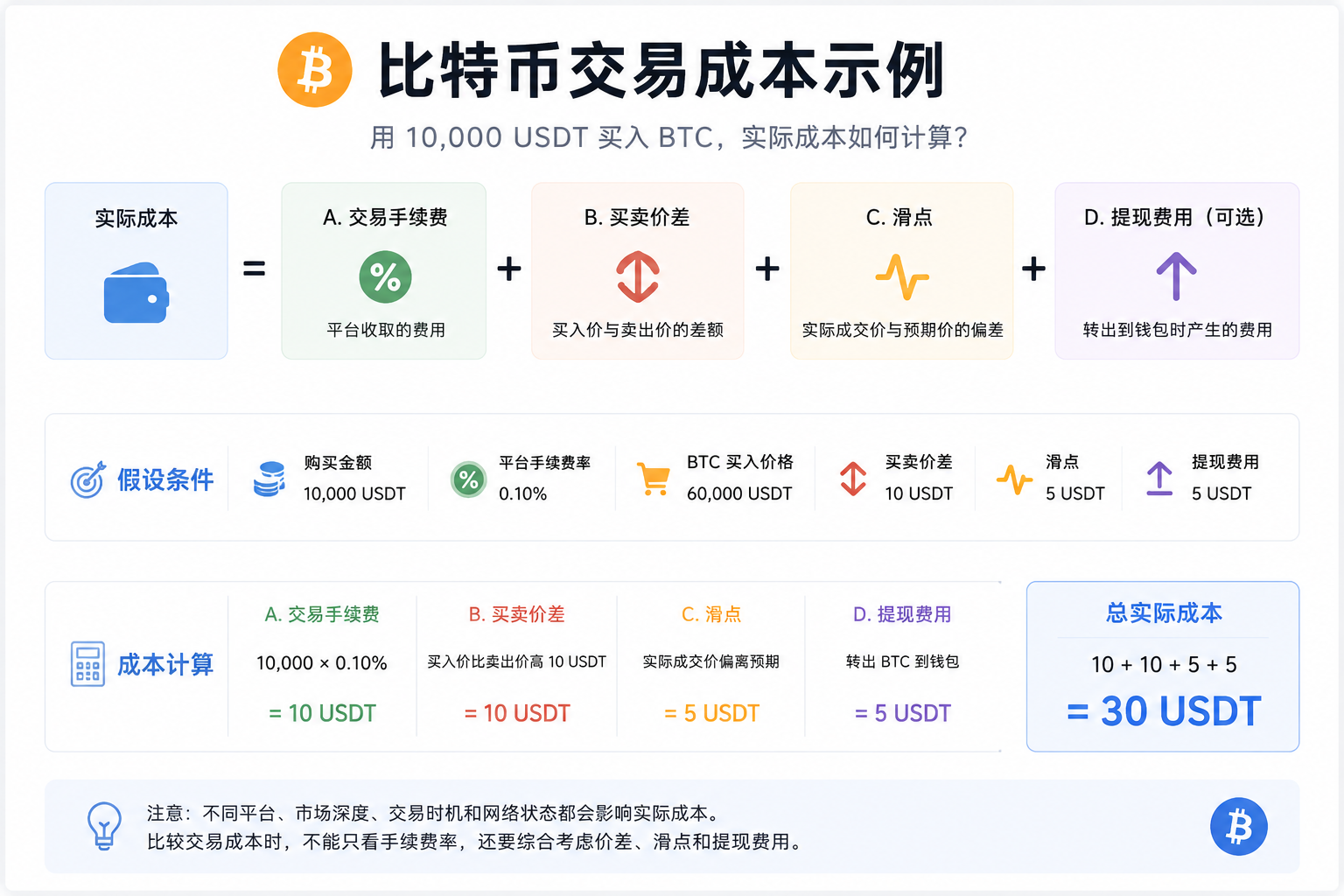
Actual trading cost ≈ Trading fee + Bid-ask spread + Slippage
If you later transfer the BTC out, you must also include the withdrawal cost.
How Are BTC Trading Fees Calculated?
Spot trading fees can usually be calculated with this formula:
Trading fee = Trade value × Fee rate
For example, suppose you use 10,000 USDT to buy BTC and your applicable fee rate is 0.1%:
10,000 × 0.1% = 10 USDT
The fee for that trade is therefore 10 USDT.
If the trade value is 5,000 USDT at the same 0.1% rate:
5,000 × 0.1% = 5 USDT
At the same rate, a larger trade generates a higher absolute fee.
The way the fee is deducted can vary by platform. A platform may deduct it from the quote asset or from the BTC you receive. Always use the final fee shown on the platform’s order page as the authoritative amount.
What Is the Difference Between Maker and Taker Fees?
Many cryptocurrency trading platforms use a Maker/Taker fee model.
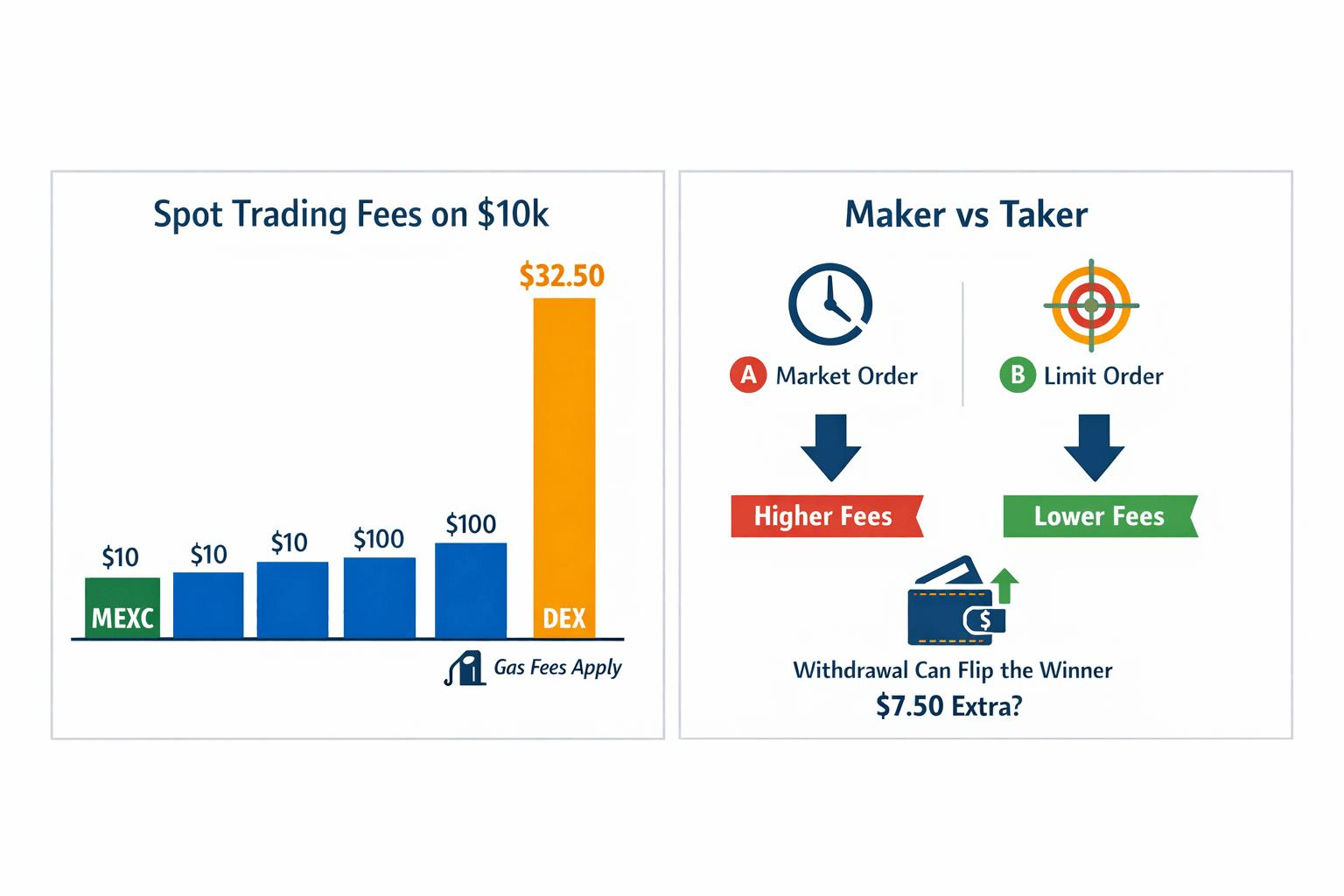
A Maker provides liquidity to the order book. If an order does not immediately match an existing order and instead remains on the order book waiting for a counterparty, it is usually classified as a Maker order.
A Taker trades directly against an order already on the book and immediately consumes market liquidity.
Maker and Taker rates vary across platforms. Some platforms charge Makers less, but this should not be assumed to apply everywhere.
One common misconception is:
A limit order is not necessarily a Maker order.
If a limit order immediately matches an existing order when submitted, it may still be classified as Taker. You therefore cannot determine the final fee solely from whether an order is labeled “market” or “limit.”
What matters is the platform’s definition of how the order was executed and the rate currently assigned to your account.
What Is a Typical Bitcoin Trading Fee?
There is no single BTC trading fee rate that applies to every platform.
Platforms may set different rates based on user tier, 30-day trading volume, Maker/Taker status, and the specific trading product.
Consequently, a statement such as “the BTC trading fee is 0.1%” should not be interpreted as a 0.1% rate for every user.
A more accurate process is:
Check the current fee schedule → Confirm your account tier → Confirm the trading product → Determine Maker/Taker status → Calculate the actual fee.
For long-term or high-frequency traders, differences caused by account tier and trading volume can have a meaningful effect on cumulative costs.
Why Does a Lower Fee Not Always Mean a Lower Trading Cost?
This is an important point when comparing BTC trading platforms.
Assume:
Platform A: 0.08% trading fee
Platform B: 0.10% trading fee
Platform A appears cheaper at first glance.
However, if Platform A has a wider BTC bid-ask spread, the price you actually pay for BTC may be higher.
For that reason, platform comparisons should consider more than the quoted fee rate:
Total trading cost = Fee + Spread + Slippage
The fee is the amount explicitly charged by the platform. The spread is the difference between the bid and ask prices, while slippage is the difference between the expected price and the actual execution price.
For a small trade, the fee may be the most visible cost. For a large trade or an illiquid market, the spread and slippage can be equally important.
If you are comparing BTC trading platforms, see Where Is the Safest Place to Buy Bitcoin? A BTC Platform Comparison. Focus on fee structure, liquidity, and withdrawal rules instead of only the lowest advertised rate.
How Do You Calculate the True Cost of a BTC Trade?
Suppose you plan to use 10,000 USDT to buy BTC.
If the platform charges a 0.1% trading fee:
Trading fee = 10,000 × 0.1% = 10 USDT
That does not mean your entire trading cost is only 10 USDT.
If the execution also involves a bid-ask spread and slippage, the final cost of buying BTC will exceed the fee-only calculation.
A more practical comparison is:
Use the same 10,000 USDT → Check the actual execution price on each platform → Calculate the BTC received → Compare the total cost.
This is closer to real trading conditions than merely asking whether 0.08% or 0.1% is lower.
How Do BTC Withdrawal Fees Differ From Trading Fees?
Trading fees and withdrawal fees should be calculated separately.
A trading fee is charged when you buy or sell BTC and is usually based on the executed trade value.
A withdrawal fee is charged when you transfer BTC from a trading platform to an external wallet. Its amount may depend on the platform’s rules and the withdrawal network.
For example, you may pay a trading fee when buying BTC and later pay another charge when moving that BTC to your wallet. The transfer-related charge is a withdrawal cost, not part of the earlier trading fee.
If you plan to hold BTC long term and eventually move it to a personal wallet, compare withdrawal rules as well as trading rates.
How Can You Reduce Bitcoin Trading Fees?
Reducing BTC trading costs involves more than finding the lowest headline rate.
First, understand the Maker/Taker rates and tier rules for your account. If the platform provides volume-based rates, high-frequency users should pay particular attention to account tiers.
Second, avoid unnecessary frequent trading. Even when each fee is small, repeated buying and selling can create a significant cumulative cost.
Third, do not ignore the spread. A platform with a lower fee may still cost more if its actual execution spread is wider.
Finally, review market depth and likely execution before submitting a large order so that insufficient liquidity does not create substantial slippage.
Bitcoin Fee Calculation Checklist
When comparing two platforms, the simplest useful method is not to compare rates alone. Instead, simulate the same trade amount on both platforms, then compare the BTC ultimately received and the total cost.
FAQ
Are Bitcoin Trading Fees Fixed?
No. Rates vary among platforms, and the same platform may apply different rates based on user tier, volume, trading product, and Maker/Taker status.
How Much Is the Fee to Buy 10,000 USDT of BTC?
At a 0.1% applicable rate, the trading fee is 10 USDT. The formula is 10,000 × 0.1% = 10 USDT. The actual deduction method depends on the platform’s trading rules.
Which Has a Lower Fee, Maker or Taker?
There is no universal answer. Many platforms charge Makers less than Takers, but you must check the current fee schedule. A limit order is also not necessarily classified as Maker.
Is the Platform With the Lowest Fee Always the Best Value?
Not necessarily. The bid-ask spread and slippage also affect the actual trading cost. Compare the amount actually paid to complete the same trade rather than only the quoted fee rate.
Is a BTC Withdrawal Fee Part of the Trading Fee?
No. A trading fee usually applies when buying or selling BTC, while a withdrawal fee relates to moving BTC from the platform to an external wallet. They should be calculated separately.
Risk warning: Bitcoin is highly volatile, and trading can result in loss of principal. The figures in this article only demonstrate fee calculations and do not represent the actual rate of any particular platform. Fee rules may change by platform, region, account tier, and product. Check the platform’s latest fee schedule and order page before trading.
Lettura consigliata
Visualizza altro


service hotcoin.com
producthotcoin.com
businesshotcoin.com
casecnhotcoin.com