
Spot Bitcoin ETFs Explained: A Milestone for Institutional Adoption
A spot Bitcoin ETF holds Bitcoin and trades on a securities exchange. Investors buy shares in a trust rather than BTC that they can withdraw to a wallet.
It connects Bitcoin price exposure with brokerage accounts, securities exchanges, and traditional custody processes, which is why it is often described as a milestone for institutional adoption. That milestone reflects a change in market access; it does not guarantee Bitcoin's price, liquidity, or security.
What Exactly Is a Spot Bitcoin ETF?
The US market commonly calls these products “spot Bitcoin ETFs,” although their more precise legal structure is generally an exchange-traded commodity trust, or ETP. The trust primarily holds Bitcoin and calculates its net asset value using a specified pricing benchmark. Investors trade shares issued by the trust on a securities exchange, and the share price seeks to reflect Bitcoin's price performance after fees.
The underlying asset distinguishes a spot product from a futures product. A spot product primarily holds BTC, while a futures product holds or otherwise gains exposure to Bitcoin futures contracts. Futures products are also affected by contract expirations, rollovers, and differences between spot and futures prices.
These spot ETPs must register their offerings and classes of securities under the US Securities Act of 1933 and Securities Exchange Act of 1934 and are subject to antifraud rules. However, they generally are not registered as investment companies under the Investment Company Act of 1940, so investors cannot assume that every protection applicable to ordinary mutual funds and registered ETFs also applies to them.
Why Did the United States Approve Spot Bitcoin ETPs in 2024?
On January 10, 2024, the US Securities and Exchange Commission approved rule changes submitted by several exchanges to list spot Bitcoin ETPs. The approvals covered exchange rules and the arrangements for listing and trading the products; they did not endorse Bitcoin itself.
The SEC had previously rejected similar applications several times. In the Grayscale case, the US Court of Appeals for the District of Columbia Circuit found that the SEC had not adequately explained why it treated Bitcoin futures ETPs differently from the proposed spot product. The court therefore vacated the earlier decision and remanded the matter for further review.
The SEC subsequently analyzed price correlations between the spot Bitcoin market and the CME Bitcoin futures market. The listing exchanges share surveillance information with CME through an intermarket surveillance organization. On that basis, the SEC determined that the arrangement could help detect manipulation that might affect both spot prices and CME futures prices.
Regulatory access addresses securities listing, disclosure, and market-surveillance issues. Spot Bitcoin trading remains distributed across many platforms worldwide, so price volatility, custody failures, and manipulation in the underlying market do not disappear.
How Does a Spot Bitcoin ETF Work?
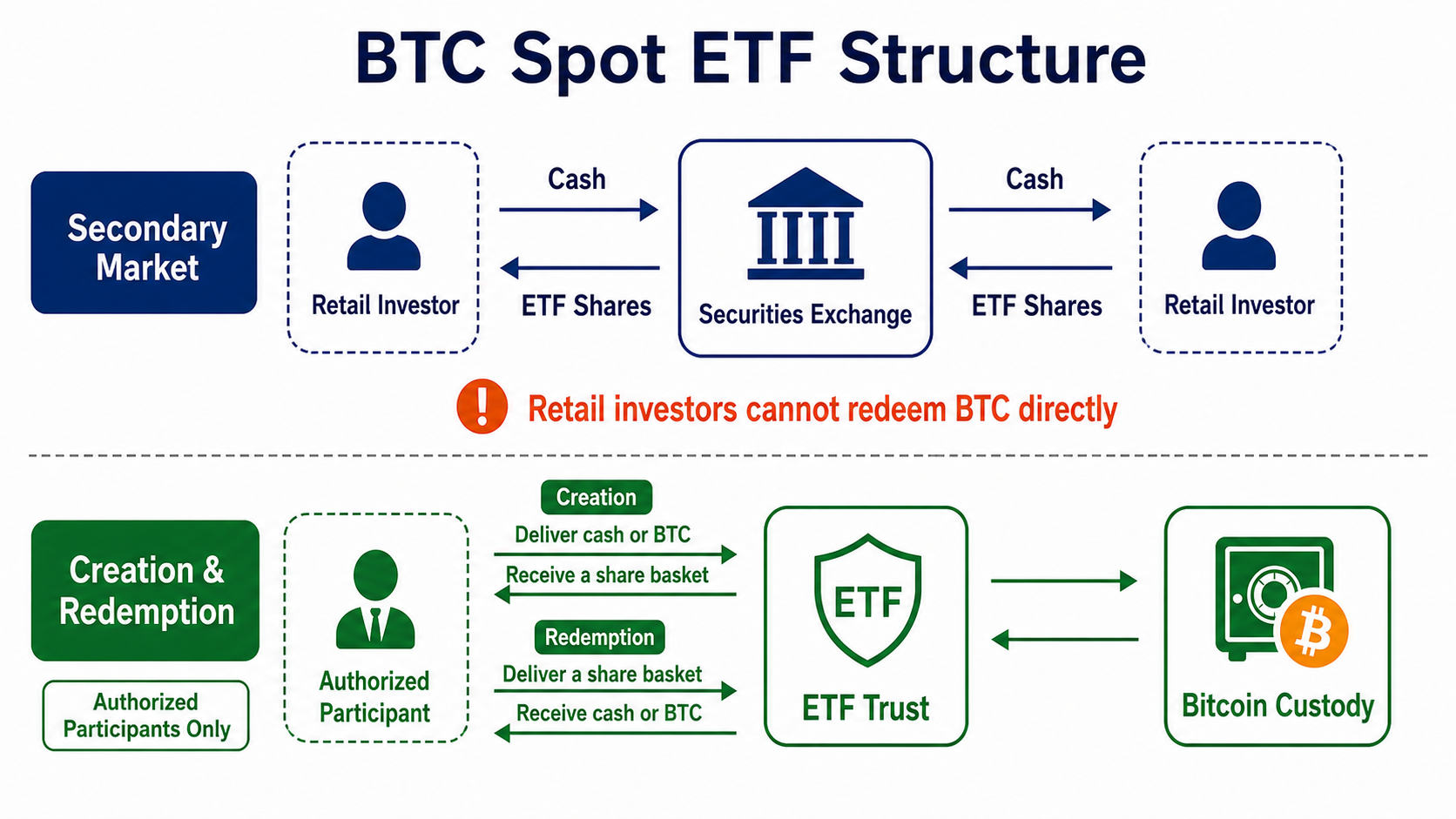
The product structure generally includes a sponsor or trustee, a trust, a Bitcoin custodian, a cash custodian, an index or pricing benchmark, authorized participants, and market makers. Ordinary investors only trade shares in the secondary market. Only authorized participants can create or redeem baskets of shares directly with the trust.
The basic process is as follows:
- An authorized participant submits an order to create a basket of shares and delivers cash or Bitcoin as specified in the product documents.
- After receiving the assets, the trust issues the corresponding shares, while a designated custodian safeguards the Bitcoin.
- The authorized participant brings the shares to the securities market, where market makers continuously quote bid and ask prices.
- The process runs in reverse for a redemption: the trust cancels the shares and delivers cash or Bitcoin according to the applicable rules.
The first US spot Bitcoin ETPs used cash creation and redemption when approved in 2024. On July 29, 2025, the SEC also approved in-kind creation and redemption for the relevant products. In-kind transactions allow Bitcoin to enter or leave a trust directly and may reduce spreads, slippage, and other friction caused when the trust trades BTC in the market to process orders. To determine whether a particular product has enabled the feature and whether it supports cash or in-kind transactions, investors still need to review its current prospectus and creation-redemption documents.
| Creation or redemption method | What an authorized participant delivers or receives | Main operational difference |
|---|---|---|
| Cash | US dollars | The trust or execution agent must buy or sell BTC in the market |
| In kind | BTC | BTC can move directly into or out of the trust's custody account |
An ordinary holder cannot exchange a small number of ETF shares with the trust for BTC. Selling shares in the secondary market normally produces cash in the investor's brokerage account.
Why Can ETF Shares Track Bitcoin's Spot Price?
The trust calculates its net asset value using a pricing benchmark. Creation and redemption by authorized participants, together with arbitrage by market makers, help keep the secondary-market price close to the net asset value per share. If shares trade materially above NAV, an authorized participant may create and sell new shares. If they trade below NAV, it may buy shares and redeem them. Whether a trade is worthwhile also depends on the spread, transaction fees, creation and redemption thresholds, and the speed at which assets can be moved.
“Close” does not mean identical. ETF shares are quoted during the trading hours of a securities exchange, whereas the spot Bitcoin market operates continuously. BTC can move sharply while the securities market is closed, and the ETF may gap when trading resumes. Intraday supply and demand can also produce temporary premiums or discounts.
It is important to distinguish three prices when reading product data:
| Price | What it represents | Common misunderstanding |
|---|---|---|
| Bitcoin spot price | A BTC quote from one platform or a composite index | There is no single transaction price for the global market |
| NAV per share | The trust's net assets divided by shares outstanding | It is generally calculated at a specified time using a benchmark, not traded continuously |
| ETF market price | The price at which investors actually trade shares on an exchange | It is affected by bid-ask spreads, supply and demand, and trading hours |
Where Do Fees and Tracking Error Come From?
A spot Bitcoin ETF generally seeks to reflect the performance of BTC after product fees and liabilities rather than reproduce every quote on a particular trading platform. Even without an active trading strategy, its long-term performance may trail that of an equivalent amount of directly held BTC.
The sponsor fee is the most consistent source of divergence. Because the trust does not generate operating revenue, it may periodically sell a small amount of BTC to pay expenses. The amount of BTC represented by each share therefore declines over time. Promotional fee waivers may also expire, so investors should not rely only on the advertised introductory rate.
Other differences arise from the timing of benchmark prices and actual trades, trading costs for cash creations and redemptions, transfer costs for in-kind transactions, assets and liabilities, market premiums or discounts, and the investor's own brokerage commissions and bid-ask spreads. A lower fee rate does not necessarily produce the lowest actual holding cost; liquidity, spreads, and historical premiums or discounts also matter.
The following relationship provides a framework for understanding holding results:
Investor's actual return ≈ change in BTC benchmark price - product fees - tracking difference ± premium or discount at purchase and sale - transaction costs
This expression is a cost-review framework, not a return forecast. Each product uses different benchmarks, fees, and creation-redemption arrangements.
How Is an ETF Different From Directly Holding BTC?
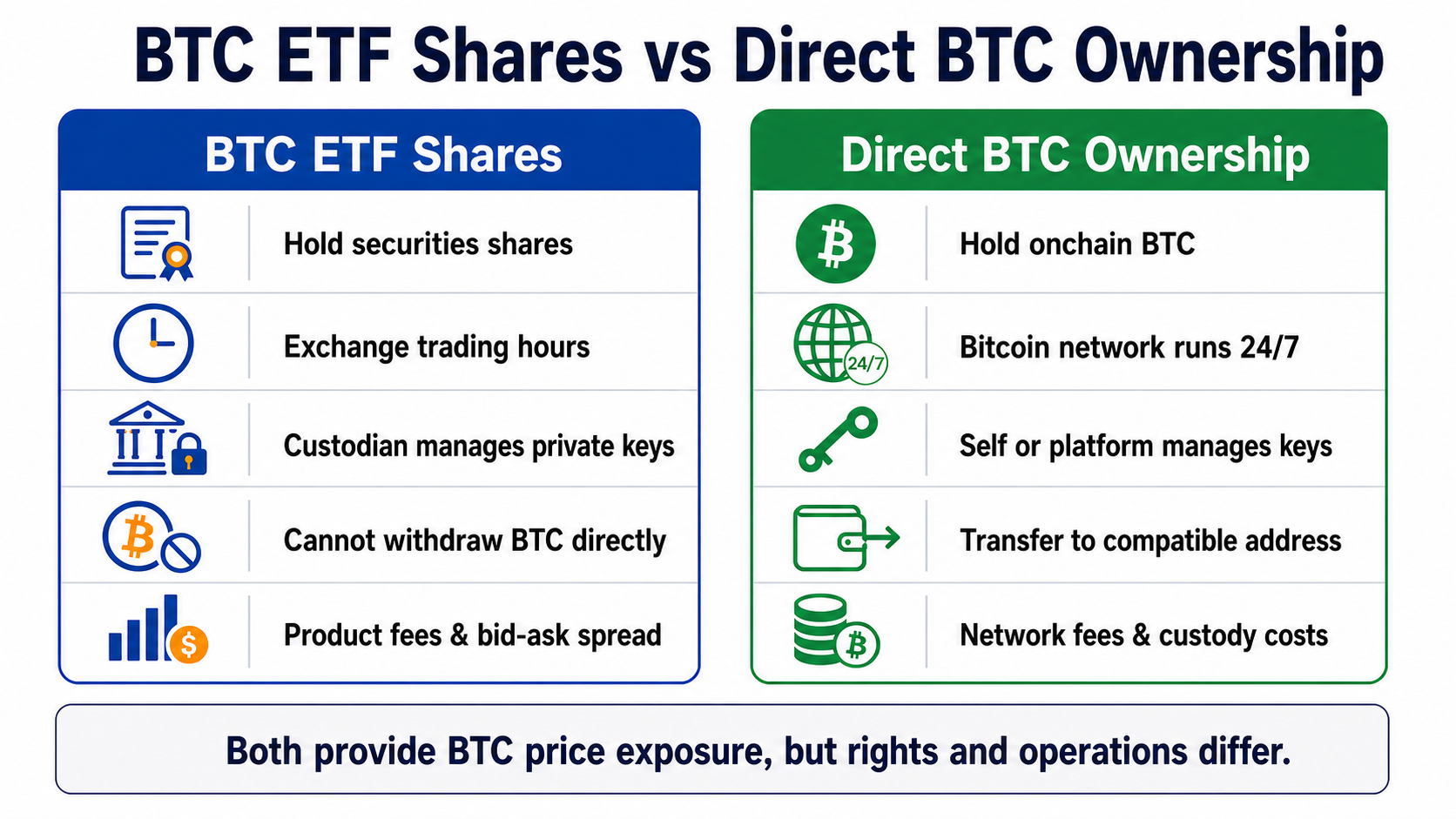
Buying an ETF transfers private-key management to the product's custody system in exchange for the convenience of trading through a securities account. When holding BTC directly, the holder or a platform selected by the holder controls the private keys and can transfer the asset through the Bitcoin network. The two methods may provide similar price exposure, but they do not confer the same asset rights.
| Comparison | Spot Bitcoin ETF | Directly held BTC |
|---|---|---|
| What is held | Securities issued by a trust | BTC on the blockchain |
| Trading venue | Securities exchanges and brokerage accounts | Crypto-asset platforms or on-chain transfers |
| Trading hours | Limited to securities trading days and sessions | The Bitcoin network operates continuously |
| Private keys | Managed by the custody system chosen by the trust | Managed by the holder when self-custodied, or entrusted to a platform |
| Withdrawal and payment | Ordinary investors cannot withdraw shares as BTC | BTC can be sent to a compatible Bitcoin address |
| Ongoing costs | Sponsor fee, bid-ask spread, and possible brokerage costs | Network fees, trading spreads, and custody service fees, depending on the method |
| Main dependencies | Sponsor, trustee, custodian, broker, and exchange | Wallet implementation, private-key management, network, and selected service providers |
An ETF also does not automatically distribute forked assets, airdrops, or other on-chain rights to shareholders. Their treatment depends on the product documents and the sponsor's decisions.
What Should You Check When Comparing Spot Bitcoin ETFs?
Products in the same category track similar assets, but their legal documents, custody arrangements, and trading quality can still differ. Review them in this order:
- Confirm first that the product actually holds spot BTC rather than futures, swaps, or shares of another ETP.
- Review which markets make up the pricing benchmark, when valuation occurs each day, and what fallback method applies if the benchmark is disrupted.
- Identify the Bitcoin custodian, cash custodian, and trade-execution providers; check whether they are affiliated and how private keys and trading balances are segregated.
- Read the current sponsor fee, the expiration date of any waiver, unusual expenses, and the method used by the trust to pay its costs.
- Check whether cash and in-kind creation and redemption have actually been enabled, along with the basket size and authorized-participant arrangements.
- Compare trading volume, bid-ask spreads, premiums and discounts, and tracking results instead of treating one day's volume as a measure of long-term execution quality.
- Confirm that the broker supports the product, identify the applicable trading hours, and review the tax treatment in the jurisdiction of the account.
To first understand BTC issuance and the UTXO structure, return to the classification framework in the Crypto Asset Guide. To compare another type of US spot crypto ETP, continue with ETH ETFs vs. BTC ETFs.
Frequently Asked Questions
Does a Spot Bitcoin ETF Disclose Every Custody Address?
Not necessarily. Issuers generally disclose holdings, net asset value, and custody arrangements, but whether they publish all on-chain addresses depends on product policy. Even when certain addresses can be observed, their ownership, liabilities, and transfer status must be verified; an on-chain balance alone does not prove that all shares are fully backed.
Does a Zero Promotional Fee Mean There Is No Long-Term Management Fee?
No. A waiver generally has an expiration date, an asset threshold, or other conditions. Read the current prospectus and distinguish among the standard rate, promotional rate, and rate that applies after the promotion ends.
Do ETF Shareholders Receive New Assets Created by a Bitcoin Fork?
Not necessarily. Shareholders do not directly control the trust's private keys. Whether forked assets are supported, sold, abandoned, or included in the trust's value depends on the custodian's capabilities and the product documents.
Does a Bitcoin Halving Automatically Increase the Value of Spot Bitcoin ETF Shares?
No. A halving changes the new block subsidy; it does not directly change the amount of BTC held by the trust. The value of ETF shares mainly depends on BTC's market price, the assets represented by each share, fees, and any premium or discount.
Lettura consigliata
Visualizza altro



Service@hotcoin.com
Product@hotcoin.com
Business@hotcoin.com
Casecn@hotcoin.com