
Bitcoin Deep Dive: From the Whitepaper to Digital Gold
Bitcoin is a peer-to-peer electronic cash system that operates without a central clearing party. It uses digital signatures to prove spending authorization, proof of work to order transaction history, and UTXOs to record spendable balances.
The central problem addressed by the whitepaper was not how to create a faster payment database, but how to prevent the same digital asset from being spent twice on an open network. The digital gold narrative that emerged later rests on scarce issuance, verifiable ownership, and censorship-resistant settlement rather than on a definition used directly in the whitepaper.
What System Did the Whitepaper Propose?
Bitcoin describes an electronic coin as a chain of digital signatures. A payer signs the previous transaction together with the next owner's public key. The recipient can verify the signature chain, but still needs a public ledger to determine whether the same output has already been spent.
Nodes collect transactions into blocks, while miners search for a block-header hash that meets the difficulty target. Other nodes validate the transactions and proof of work, then treat the valid chain with the greatest cumulative work as the leading history. For a complete explanation of PoW, read Proof of Work Explained.
This design shifts trust away from a single recordkeeper and toward public rules, cryptographic proofs, and distributed computing power. It still depends on software implementations, network propagation, and users' key management, so it is not entirely free of trust assumptions.
How Do UTXOs Record Bitcoin Balances?
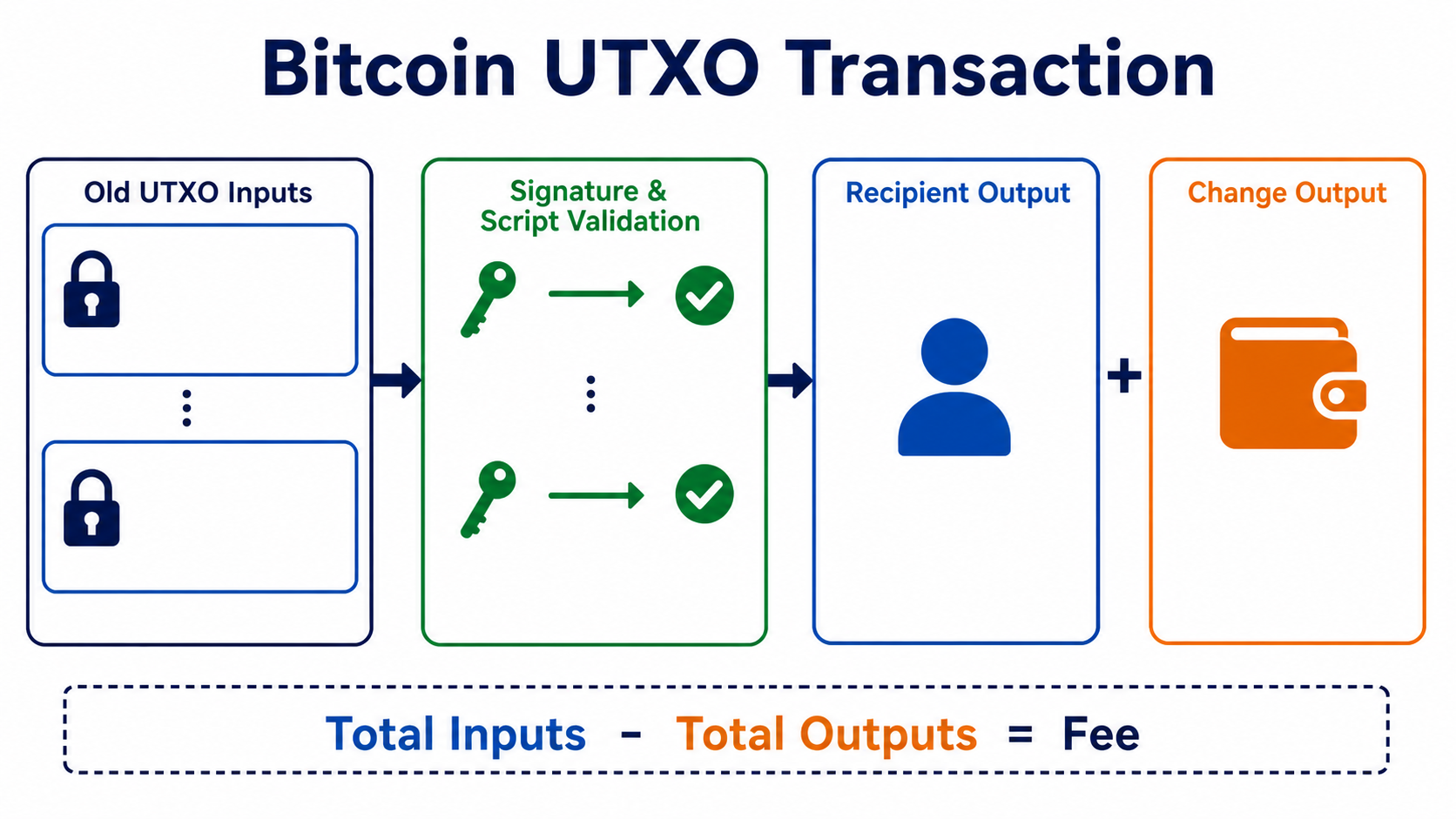
The Bitcoin protocol does not store account balances directly. The balance shown by a wallet is the sum of the unspent transaction outputs it controls.
A transaction references one or more existing UTXOs as inputs, supplies signatures or script data that satisfy their locking conditions, and creates new outputs. When the payment amount is smaller than the total value of the inputs, the wallet will usually send the remainder to its own change address.
| UTXO characteristic | Practical meaning |
|---|---|
| An output must be spent in full | Part of a UTXO cannot simply be deducted as a balance |
| Multiple inputs can be combined | A large payment can consolidate several smaller UTXOs |
| Multiple outputs can be created | One transaction can pay a recipient and return change |
| There is no separate fee field | The miner fee is the total input value minus the total output value |
| Parallel validation is clearer | Transactions that do not reference the same input do not compete for one account balance |
The number of UTXOs affects a transaction's byte size and fee. If a wallet accumulates too many small outputs, consolidating them later may require a larger transaction.
Why Is Bitcoin's Supply Verifiable?
New block rewards decline according to the protocol's schedule, and nodes reject blocks that create more coins than permitted. Bitcoin's total supply is often summarized as approximately 21 million BTC, but the more important point is that any full node can independently enforce the issuance rules.
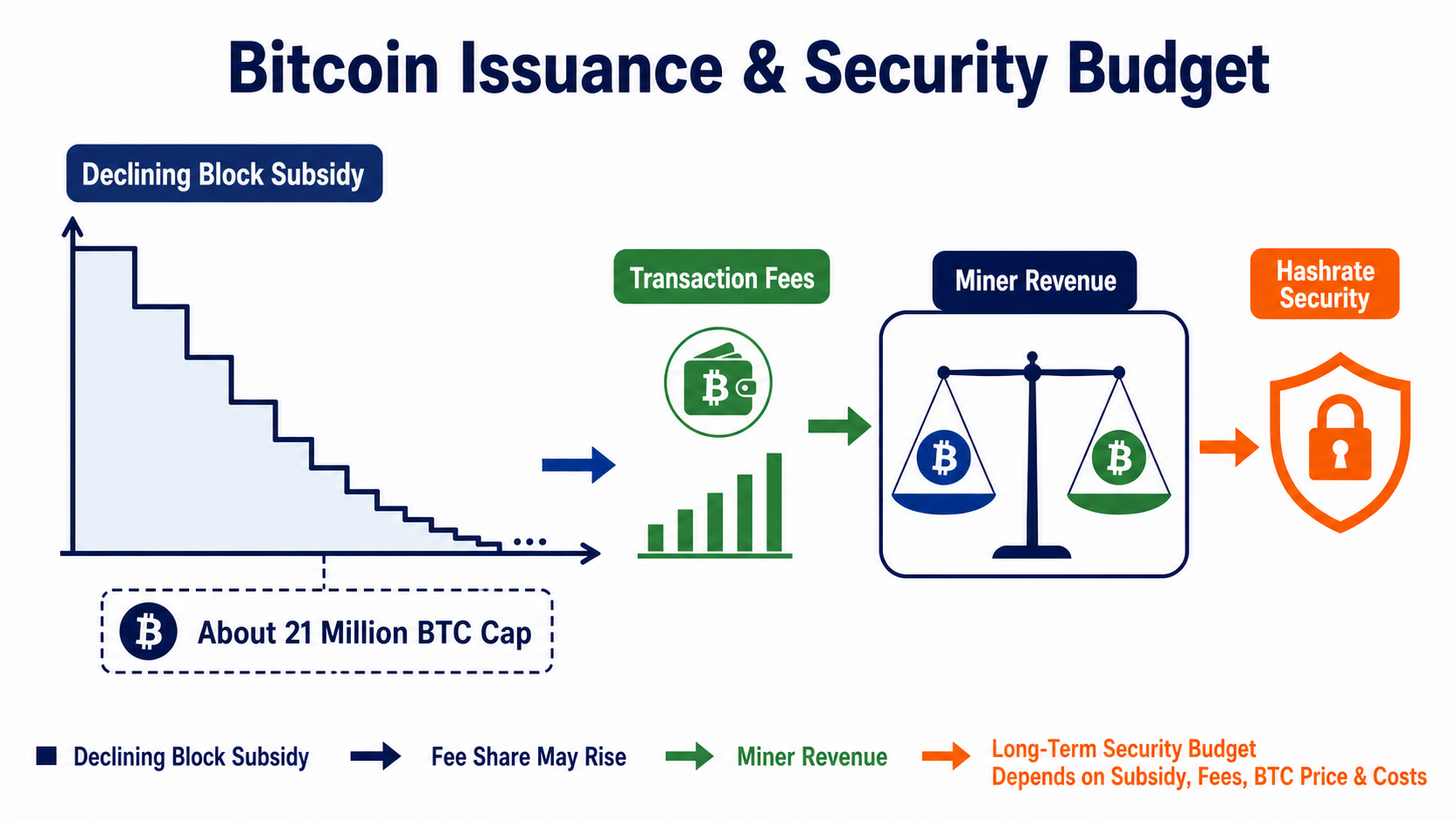
As the block subsidy falls with each halving, fees may account for a larger share of miner revenue. The long-term security budget depends on the BTC price, demand for block space, mining costs, and competition for hash power; it cannot be inferred from the supply cap alone.
Fixed rules are not the same as rules that can never change. Protocol upgrades depend on whether users, nodes, miners, and developers can reach sufficient consensus. Participants who reject new rules can continue running older software, potentially resulting in a failed upgrade or a network fork.
Which Properties Support the Digital Gold Narrative?
Digital gold is a market narrative that summarizes Bitcoin's scarcity, divisibility, global transferability, and self-custody. Like gold, its supply expansion is constrained; unlike gold, Bitcoin depends entirely on digital keys, networks, and protocol consensus.
| Property | How Bitcoin implements it | Limitations to consider |
|---|---|---|
| Scarcity | Nodes verify the supply cap and block rewards | Supply rules do not guarantee a market price |
| Portability | Private keys can control on-chain assets | Lost private keys are usually unrecoverable |
| Verifiability | Nodes can audit transaction history and supply | Ordinary users often rely on wallets or third-party nodes |
| Divisibility | BTC can be divided into smaller units | Fees affect small on-chain payments |
| Censorship resistance | Transactions can be broadcast to a peer-to-peer network | Mining pools, network gateways, and fiat on-ramps may still face restrictions |
The digital gold label does not mean that Bitcoin's price can only rise, nor does it mean that Bitcoin and gold have the same volatility, regulation, or custody characteristics.
How Can the Bitcoin Network Scale?
The base layer prioritizes verifiability and rule stability, so each block can process only a limited number of transactions. Payment channels can keep repeated updates off-chain and use the base layer only when they open, close, or encounter a dispute. Sidechains and other protocols introduce different asset-locking and validation assumptions.
Scaling solutions should not be compared by speed alone. Users should also determine who controls the assets, whether they can exit unilaterally, whether the data is available, and what is required to return to the Bitcoin main chain after a failure.
For Bitcoin's position among major public blockchains, return to the 2025 Major Public Blockchain Ecosystem Overview. To compare it with a general-purpose smart contract path, read the Ethereum Deep Dive.
Frequently Asked Questions
Does Satoshi Nakamoto Own or Control the Bitcoin Network?
No single identity can change the rules followed by every node merely by virtue of being Bitcoin's creator. Software changes must actually be adopted by node operators, miners, wallets, and other participants.
Can a Bitcoin Transaction Be Reversed?
The protocol has no credit-card-style chargeback. An unconfirmed transaction may be replaced or become invalid, while a confirmed transaction still carries some probability of a chain reorganization. The deeper the confirmation, the more cumulative work is generally required to rewrite it.
Must Bitcoin Be Purchased as a Whole Coin?
No. Bitcoin can be transferred in smaller units, and wallets and trading platforms can display fractional amounts. The minimum practical amount is also affected by transaction fees and dust rules.
Are Lost BTC Reissued?
No. The protocol cannot determine whether a private key is temporarily offline or permanently lost, so it does not reallocate outputs that can no longer be spent.
Lettura consigliata
Visualizza altro


service hotcoin.com
producthotcoin.com
businesshotcoin.com
casecnhotcoin.com