
Base Chain: Inside Coinbase's Layer 2 Strategy
Base is an Ethereum Layer 2 built by Coinbase. It executes transactions off-chain to cut costs, then hands transaction data and state proofs back to Ethereum. It serves Coinbase products, and it is also an open network any developer can build on.
Base connects fiat on-ramps, account experiences, wallets, and on-chain applications to a single low-cost execution network while still relying on Ethereum for data availability and final settlement. That framing explains its place in the Coinbase product stack far better than "an exchange launched a chain."
What Role Does Base Play in Coinbase's Strategy?
Coinbase started out mainly as a centralized trading and custody service, and Base extends part of that product experience onto a public blockchain. Users can reach Base through Coinbase-related entry points, but the on-chain addresses, contracts, and applications are not reserved for Coinbase customers.
The arrangement does three things:
- Base gives payments, trading, social, and asset issuance a shared on-chain execution environment, so each product does not have to pick infrastructure on its own.
- Coinbase accounts, on- and off-ramps, and developer tooling lower the operational barrier to reaching on-chain applications.
- Base anchors batch data and proofs to Ethereum instead of standing up a fully independent L1 consensus network.
"Built by Coinbase" does not mean "every application on Base is operated or backed by Coinbase." Third-party applications carry their own contracts, permissions, and asset risk, and users still need to check each protocol.
How Does Base Handle Transactions and Proofs Today?
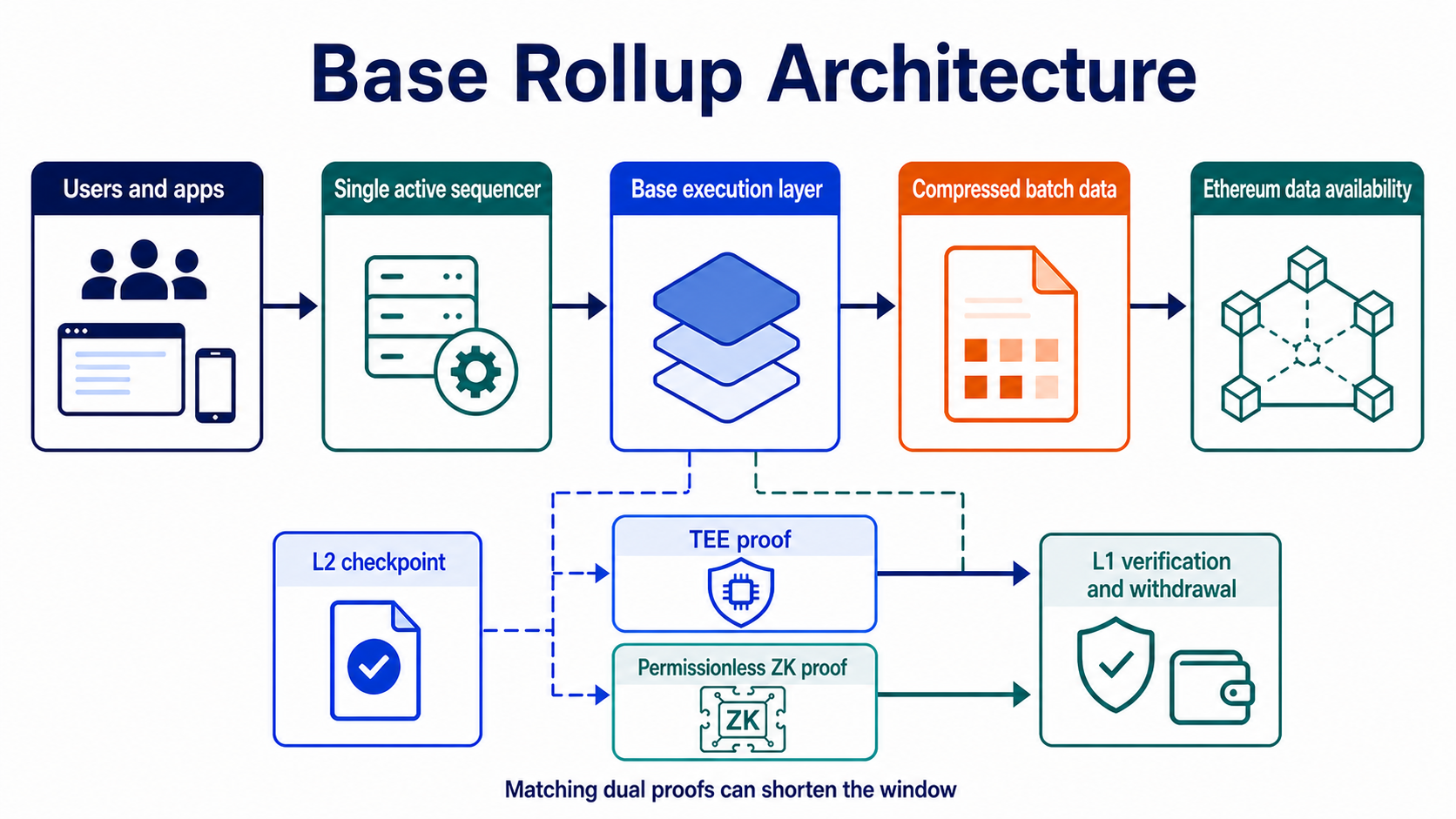
Base is an Ethereum rollup. The current protocol is made up of sequencing, execution, batching, proving, and bridging components.
The sequencer takes in transactions and issues fast pre-confirmations, then publishes compressed L2 data to Ethereum. Verifying nodes can rebuild and execute Base state from that L1 data. A single active sequencer still handles most block production on Base, so the low-latency experience and the worst-case censorship-resistance path have to be judged separately.
The Azul upgrade, live since May 2026, moved withdrawal checkpoints to a multi-proof design. The routine path can use trusted execution environment attestations, and any qualifying participant can also run a ZK proof path to back a correct claim or overturn an incorrect one. When both proof types support the same state, the protocol can use a shorter settlement window; when only one path is available, the longer window still applies.
That means the old shorthand that "Base only uses OP Stack interactive fault proofs" is no longer complete. Base is still a rollup, but its current proof system has to be read from the Azul documentation rather than mapped onto the older OP Mainnet flow.
What Is the Difference Between Confirmation, Settlement, and Exit on Base?
Transferring value or calling a contract inside Base does not mean waiting days for every transaction. Sequencer pre-confirmation, L2 blocks, data posted to Ethereum, Ethereum finality, and bridge withdrawals are separate stages.
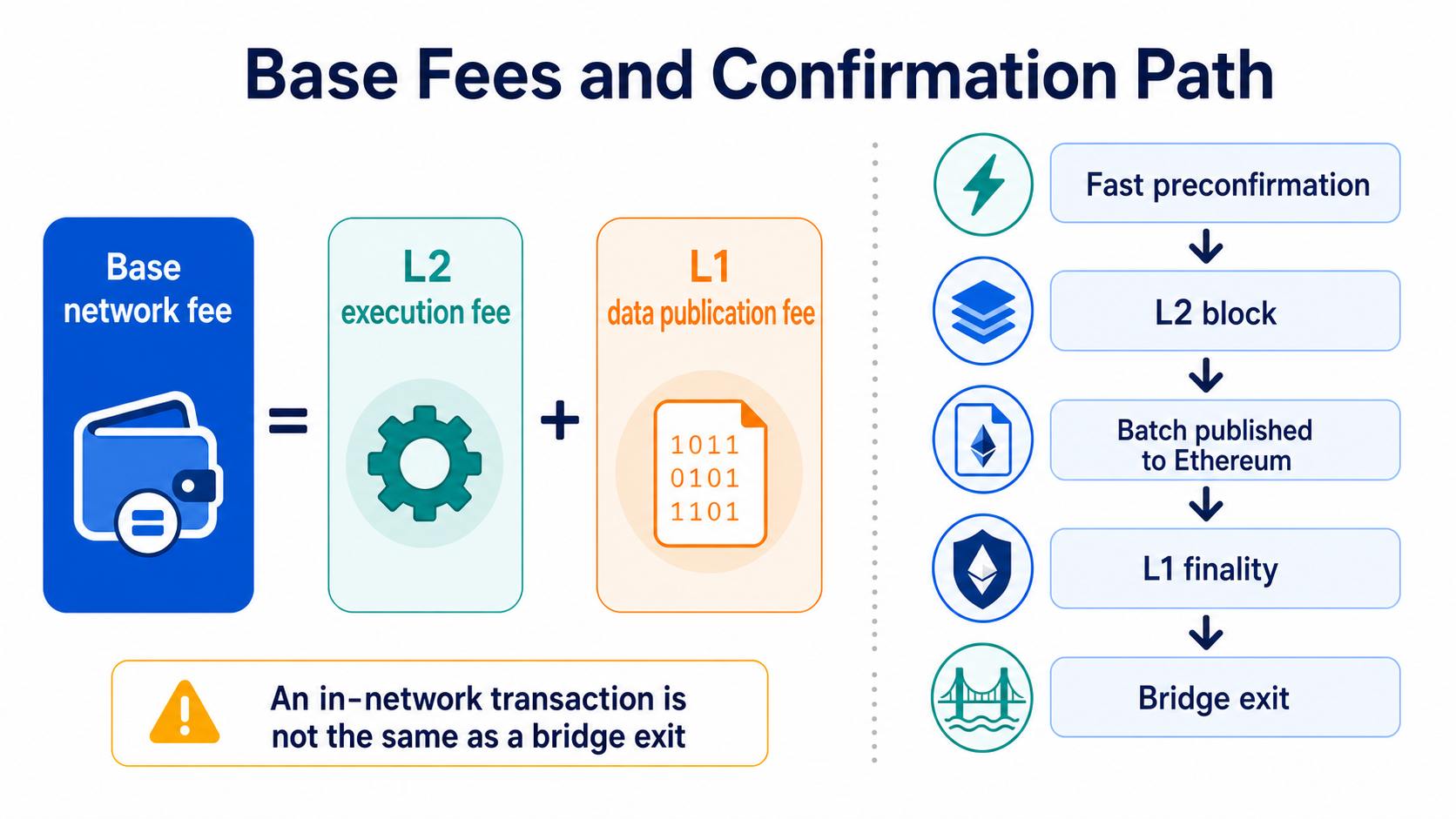
| Stage | What it means | What to watch for |
|---|---|---|
| Fast pre-confirmation | The sequencer has committed to the current transaction ordering | Fast response, but not yet equivalent to final L1 settlement |
| L2 block confirmation | The transaction is included in a Base block | Applications can update state here, but data publication still matters |
| Batch publication | The information needed to reconstruct state has been posted to Ethereum | The L1 data state is easier to verify independently |
| L1 finality | The Ethereum block carrying the batch is finalized | Confirmation at the level of Ethereum consensus |
| Bridge exit | The withdrawal checkpoint meets the proof and waiting rules | Timing depends on the current proof mix and bridge process |
So "Base withdrawals always take seven days" is another oversimplification. The older single-proof path used a longer window, while the Azul design offers a shorter target window when both proofs agree. Before acting, treat the status and timing shown by the official bridge as the authority.
How Are Gas Fees Calculated on Base?
Base transactions normally pay network fees in ETH. The total is made up of two main parts:
Base network fee = L2 execution fee + L1 data publication fee
The L2 execution fee depends on how much contract work a transaction does and on the local fee market, while the L1 data fee tracks compressed transaction size, Blob pricing, and protocol coefficients. A complex swap usually costs more gas than a plain transfer, and application fees and slippage can sit on top of the network fee.
Base has publicly explored a network token, but as of the official material checked for this article, no confirmed launch date, design, or governance detail has been given. Whatever happens with other tokens later, ETH is still the gas asset for ordinary network transactions today. Any page claiming that users must buy a so-called "official Base gas token" should be checked against official announcements first.
Is Base Decentralized Yet?
Base has opened up a permissionless proving path and spread approval of core upgrades across a security council, but that does not mean every component is already fully decentralized.
| Permission or component | What to focus on today |
|---|---|
| Sequencer | A single active sequencer provides most ordering and pre-confirmation |
| State proofs | Azul combines TEE attestations with a permissionless ZK multi-proof design |
| Contract upgrades | A Coinbase signer set and an external security council jointly approve key upgrades |
| Data availability | L2 batch data is published to Ethereum so nodes can rebuild state |
| Application layer | Every application still carries its own admin, oracle, and contract risk |
Stage labels measure rollup maturity and how far the training wheels have been removed, not a simple safety score. A security council reduces unilateral upgrade risk while also showing that key contracts retain governance powers.
What Should You Check Before Using Base?
Confirm Base mainnet, the chain ID, and the official explorer first, then make sure the wallet holds a small amount of ETH for gas. When withdrawing from a trading platform, you must select the Base network, and Ethereum mainnet, OP Mainnet, and other OP Stack chains cannot be treated as the same network.
With stablecoins, also confirm whether the token is the issuer's native version, the standard bridged version, or a third-party wrapped asset. With third-party applications, review the contract address, approval scope, and admin permissions individually.
For the full rollup taxonomy, see A Complete Guide to Layer 2 Scaling Solutions. To pick a network by fees, ecosystem, and exit path, read How to Choose an L2 Network.
FAQ
Do I need a Coinbase account to use Base?
No. Base is a public blockchain, and any compatible wallet can connect to the network directly. A Coinbase account may offer a convenient on- and off-ramp, but it is not a protocol requirement for reading the chain or calling public contracts.
Why do Base addresses look identical to Ethereum addresses?
Both use the EVM address format, and the same private key derives the same address, but balances and transaction histories belong to different networks. An identical address is no substitute for selecting the right network.
Is Coinbase responsible for every project on Base?
No. Base provides network infrastructure, while third-party projects manage their own contracts and business. An application appearing on an ecosystem page does not mean the assets are protected or the contracts are free of flaws.
Can an Ethereum explorer show the full details of a Base transaction?
Base transaction details are mainly viewed on a Base explorer. Ethereum shows batch data, proofs, and bridge contract interactions, but a single L2 user transaction usually does not appear as a one-to-one L1 execution transaction.
Lettura consigliata
Visualizza altro


service hotcoin.com
producthotcoin.com
businesshotcoin.com
casecnhotcoin.com