
AI Agents and Crypto: How Autonomous On-Chain Finance Works
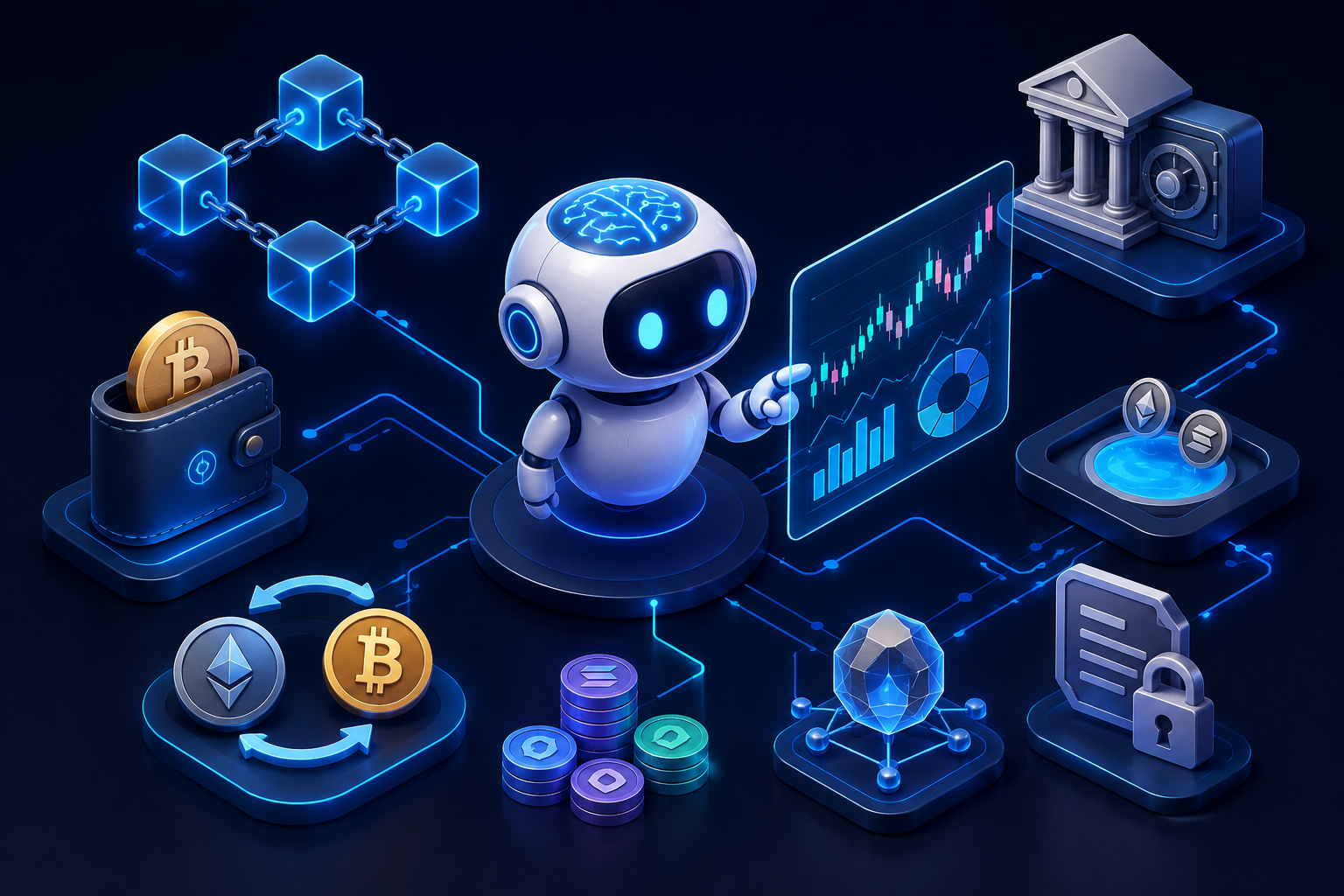
AI agents and crypto combine artificial intelligence’s ability to analyze information and make decisions with blockchain’s ability to execute and settle transactions programmatically. In autonomous on-chain finance, an AI agent can monitor market data, evaluate opportunities, manage a wallet, interact with DeFi protocols, and execute transactions according to predefined objectives and risk constraints—turning financial workflows from human-triggered actions into continuously operating software systems.
What Are AI Agents in Crypto?
An AI agent is software designed to pursue a defined objective by observing information, reasoning about possible actions, using external tools, and executing tasks with limited human intervention. In crypto, its operating environment can include blockchain networks, wallets, decentralized exchanges (DEXs), lending protocols, oracles, and other smart contracts.
The key distinction from a conventional trading bot is adaptability. A rules-based bot might execute a swap whenever Bitcoin reaches a predetermined price. An AI agent can potentially combine multiple inputs—price movements, liquidity, volatility, portfolio exposure, transaction costs, and protocol conditions—to determine which action best fits its objective.
Ethereum describes AI agents as systems capable of interacting with blockchain networks, controlling on-chain wallets, executing transactions, and performing financial or operational tasks independently.
What Is On-Chain Finance?
On-chain finance refers to financial activity whose transactions and settlement occur through blockchain infrastructure. DeFi replaces traditional intermediaries with smart contracts that can hold assets and execute programmed functions.
Smart contracts provide the execution layer. They do not independently understand financial goals; instead, they execute functions according to their programmed logic when transactions or qualifying conditions reach them. This creates an important division of labor:
AI provides adaptive decision-making; blockchain provides programmable settlement.
How Does an Autonomous Crypto Agent Work?
First, the agent gathers data. Inputs can include on-chain balances, token prices, liquidity, trading volume, lending rates, collateral ratios, gas costs, and historical market information. Some information is obtained directly from blockchain contracts, while other computation and data processing occur off-chain.
Second, the AI model analyzes these inputs. It can evaluate whether portfolio conditions have changed, compare available DeFi strategies, identify a potential arbitrage opportunity, or determine whether a lending position requires adjustment.
Third, the agent converts analysis into an actionable decision. For example, it might decide to reduce exposure to a volatile asset, move capital to another liquidity pool, or rebalance a portfolio.
Fourth, the agent executes the decision through a wallet and smart contract. Ethereum documentation distinguishes between reading blockchain data and writing state-changing transactions: reads can be performed without gas, while writes require signed transactions and transaction fees.
Finally, the agent monitors the result and repeats the process. This creates a feedback loop rather than a single automated transaction.
Ethereum’s 2026 AI trading-agent tutorial demonstrates this basic pattern: collect market information, submit relevant information for AI analysis, receive a recommendation, trade according to that recommendation, and repeat.
Where Can Autonomous On-Chain Finance Be Used?
The most practical applications are those where decisions are repetitive, data-intensive, and governed by measurable constraints.
Portfolio rebalancing allows an agent to monitor asset allocations and automatically restore target weights when markets move.
Yield optimization allows agents to compare lending markets or liquidity pools and potentially redirect capital when risk-adjusted opportunities change.
Automated trading enables agents to analyze market conditions and interact with DEXs without requiring a human to manually submit every order.
Risk management is particularly important in leveraged DeFi. An agent can monitor collateral levels, borrowing costs, liquidity, and other indicators and initiate predefined defensive actions when thresholds are approached.
Agent-to-agent finance represents a broader development in which autonomous software can purchase data, computing resources, or other services and settle payments programmatically. Recent research describes this as an emerging financial infrastructure requiring machine identities, authorization, payment mechanisms, verification, reputation, and accountability.
The opportunity, however, should not be confused with proven performance. A 2026 empirical study of DeFi investment agents found that the current ecosystem remains early and heterogeneous, with significant gaps between claims of autonomy, actual autonomous execution, profitability, and stakeholder alignment.⁸
What Makes Autonomous Finance Different?
Traditional DeFi is highly programmable but generally deterministic: a smart contract follows its coded rules. AI agents add a probabilistic decision-making layer before execution.
That changes the architecture from:
User → Protocol → Transaction
to:
Data → AI Agent → Risk Controls → Wallet → Smart Contract → Blockchain
The agent can therefore become an active financial operator rather than merely a user interface.
Should AI Agents Be Given Full Financial Autonomy?
Generally, autonomous finance should be designed around bounded autonomy rather than unrestricted control.
The primary risk is that an AI model can make an incorrect decision while possessing the technical ability to execute it. Smart contracts may execute exactly as programmed, but they do not determine whether the underlying AI decision was economically sensible. Blockchain transactions can also be irreversible, making poorly constrained automation particularly consequential.
A robust architecture therefore separates intelligence from authorization. Agents can receive spending limits, approved protocols, transaction-size limits, asset restrictions, emergency stops, and session-based permissions. Ethereum's current AI-agent guidance highlights smart accounts, spending limits, whitelists, session keys, and contract-level restrictions as mechanisms for constraining autonomous behavior.
The strategic decision is consequently not whether AI agents can transact on-chain—they can—but how much authority they should receive and under what verification rules.
For users and investors, the most important evaluation criteria are therefore:
-
Autonomy: Can the agent actually execute transactions, or does it only generate recommendations?
-
Data quality: What market, blockchain, and external data does it use?
-
Execution: Which wallets, protocols, chains, and smart contracts can it access?
-
Risk controls: Are spending limits, whitelists, and emergency mechanisms enforced?
-
Transparency: Can users audit the agent’s transactions and operating rules?
-
Performance: Does the system demonstrate risk-adjusted results rather than relying on token speculation or marketing claims?
AI agents and crypto create a new model of financial automation in which AI interprets changing conditions while blockchain executes and records financial actions. The result is autonomous on-chain finance: systems capable of continuously observing markets, making decisions, allocating capital, and interacting with financial protocols.
The technology is promising, but the strongest applications will not be defined by maximum autonomy. They will be defined by measurable objectives, high-quality data, verifiable execution, strict authorization, and transparent risk management. Autonomous finance becomes useful when intelligence is paired with enforceable constraints—not when software is simply given unrestricted access to capital.
References
-
Chainlink. “Understanding AI Agents in Crypto.” Chainlink, 2026.
-
Ethereum.org. “AI Agents.” Ethereum.org, updated May 15, 2026.
-
Pomerantz, Ori. “Make Your Own AI Trading Agent on Ethereum.” Ethereum.org, February 13, 2026.
-
Gong, Hui. “Agent-to-Agent Finance: Blockchain Payments and Trust Infrastructure for Autonomous AI Agents.” arXiv, June 30, 2026.
Lettura consigliata
Visualizza altro
What are Centralized Stablecoins and Decentralized Stablecoins?
Basic Concepts
A Quick Guide to Types of Cryptocurrency Custody Solution
Basic Concepts
The Rise of On-Chain Equities in 2026: Why Tokenized Stocks Are Becoming the Next Evolution of Investing
Basic Concepts

E-mail del servizio clienti
Service@hotcoin.com
feedback sul prodotto
Product@hotcoin.com
cooperazione commerciale
Business@hotcoin.com
Casella di posta giudiziaria
Casecn@hotcoin.com
chi siamo
prodotto
Servire
supporto
©2017-2026