
What is the Bitcoin White Paper?
The Bitcoin White Paper was published in 2008 by Bitcoin’s creator, Satoshi Nakamoto, under the title "Bitcoin: A Peer-to-Peer Electronic Cash System." This white paper outlines Bitcoin’s foundational concepts, operational principles, and technical details, establishing Bitcoin as a decentralized digital currency.
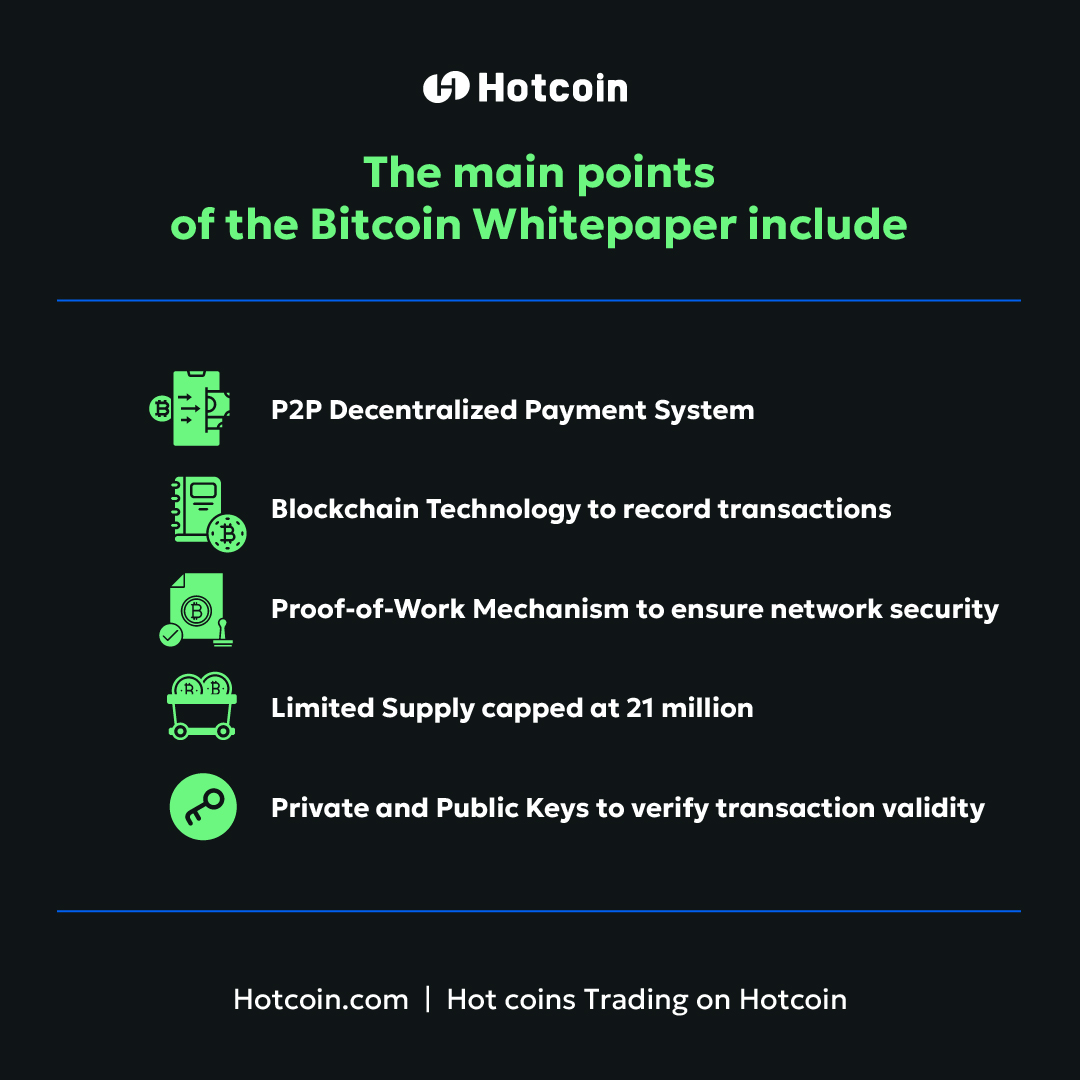
The main points of the white paper include the following:
Decentralized Payment System: The white paper proposed a payment system that does not require central institutions or banks, allowing users to transfer value directly between each other. This structure embodies a "peer-to-peer" (P2P) characteristic.
Blockchain Technology: The Bitcoin white paper introduced the concept of blockchain, describing how a distributed ledger can be used to record transactions. Each transaction is recorded in a "block," and each block is linked sequentially over time to form a "blockchain," ensuring data security and transparency.
Proof-of-Work Mechanism: The white paper introduced a proof-of-work algorithm to prevent the double-spending problem and to ensure network security. Miners compete to solve complex mathematical problems to generate new blocks, thereby earning Bitcoin rewards.
Limited Supply: The total supply of Bitcoin is capped at 21 million to ensure scarcity, emulating the properties of scarce resources like gold. This design gives Bitcoin anti-inflationary properties.
Private and Public Keys: The white paper explains the use of cryptographic technology to ensure transaction security. Each user has a private key and a public key; the private key is used to sign transactions, and the public key is used to verify transaction validity.
The Bitcoin white paper is considered a foundational document in the fields of blockchain and cryptocurrency. It not only spurred the development of Bitcoin but also inspired the emergence and growth of various other blockchain technologies and digital currencies.
Lettura consigliata
Visualizza altro


Service@hotcoin.com
Product@hotcoin.com
Business@hotcoin.com
Casecn@hotcoin.com