
Hotcoin Research | The World Cup Ignites Prediction Markets: From Betting Tools to Real-World Pricing Infrastructure
Introduction
Following the start of the 2026 World Cup, prediction markets quickly became one of the most talked-about topics in the crypto industry. Football itself is nothing new, nor are predictions about champions, dark horses, scorelines, or qualification paths. The real change is that these judgments that used to stay on social media, forums, traditional sports wagering, and sports odds are being transformed into tradable, observable, and real-time market prices by platforms such as Polymarket, Kalshi, and predict.fun.
If the 2024 US election proved that prediction markets can serve as a real-time gauge of political expectations, then the 2026 World Cup will make prediction markets face scrutiny from mass users, compliance platforms, exchanges, wallets, institutional traders, and regulatory agencies for the first time in the global sports scene. Prediction markets are evolving from a trading tool centered around hot events to a probabilistic pricing layer for real-world events, and the core of future industry competition will shift from market quantity to user access points, liquidity networks, and regulatory capabilities.
I. The World Cup Ignites Prediction Markets: Why Sports Have Become the Ideal Gateway for Mainstream Adoption
Prediction markets are not a new concept. Their basic mechanism is to split a future event into tradable contracts, where users can purchase "Yes" or "No" shares. The contract price usually fluctuates between $0 and $1, and the price can be understood as the market's pricing of the probability of a certain outcome. In the past few years, prediction markets have gained mainstream attention through the US election, macro data, geopolitics, regulatory decisions, crypto-related events, and corporate news. Many times, the price changes of Polymarket even reflect changes in market expectations earlier than traditional media reports, polls, and expert comments.
As of June 18, 2026, the monthly trading volume of Polymarket and Kalshi, the two largest prediction market platforms in the world, has reached nearly 20 billion dollars, while the combined monthly trading volume of the two was only about 2 billion dollars a year ago. In just one year, the overall trading volume of the industry has increased nearly tenfold.
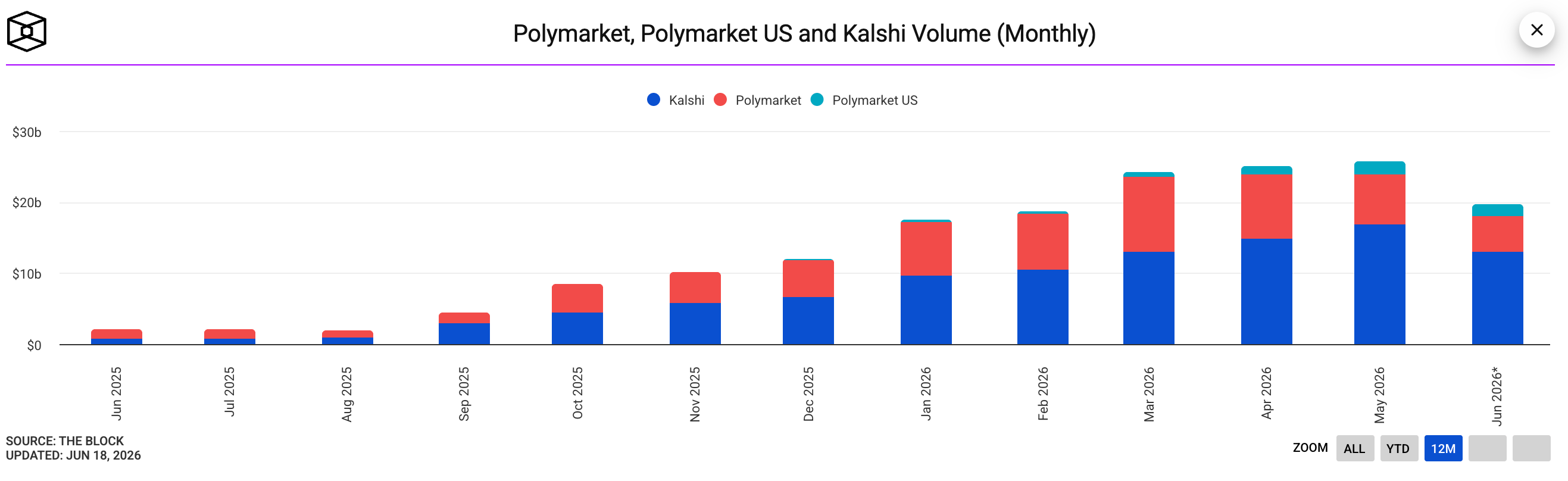
Source: https://www.theblock.co/data/decentralized-finance/prediction-markets/polymarket-and-kalshi-volume-monthly
However, for a long time, prediction markets have also had obvious bottlenecks.
-
First, many events have high cognitive thresholds, such as the Federal Reserve's policy path, court rulings, geopolitical conflicts, and corporate regulatory matters, which are not suitable for ordinary users.
-
Second, the on-chain prediction market requires a wallet, USDC, on-chain authorization, gas, cross-chain and order book understanding capabilities, and the cost for ordinary users is higher.
-
Third, although political, war, regulatory, and other events have high transaction value, they are also more likely to trigger legal and ethical disputes.
The World Cup has helped address some of these challenges.
-
First, sports enjoy universal appeal. Even casual fans can understand who wins, who loses, who advances from the group stage, who reaches the quarterfinals, and who may ultimately win the tournament. Compared with macroeconomic indicators or political prediction contracts, the cognitive cost of the World Cup market is lower.
-
Second, sports generate a constant stream of information. Pre-match lineups, injury updates, red and yellow cards, goals, substitutions, tactical changes, and group standings will all affect market prices in real time. Participants are not only trading the final result, but also the evolving market consensus as new information emerges.
-
Third, sports events are inherently social. The World Cup naturally has discussions, debates, social sharing, fan allegiances, and emotional resonance. Prediction markets turn this social discussion into a quantifiable, tradable, and verifiable probability curve, transforming spectators from passive viewers into active participants.
-
Fourth, the settlement of sports events is relatively clear. Compared to political commitments, geopolitical events, or vague regulatory statements, football match results, standings, and qualification paths usually have official data sources, and settlement disputes are fewer. This makes the World Cup an ideal scenario for testing market infrastructure, liquidity, settlement mechanisms, and user experience.
The trading structure of prediction markets reflects this trend as well. Since 2024, sports, political, and crypto-related markets have contributed 91% of Kalshi's trading volume and 90% of Polymarket's trading volume. Among them, the sports market accounts for about 80% of Kalshi's total trading volume and about 39% of Polymarket's total trading volume. During the World Cup, prediction markets not only remained within Polymarket itself but also began to expand beyond Polymarket into exchanges, wallets, and ecosystem platforms. Gate has integrated with Polymarket, and Bitget Wallet has also integrated with Polymarket, making it possible for users to participate in real-world event trading directly from their wallets. In addition, Binance Wallet has integrated with Predict.fun, a decentralized prediction market application built on BNB Smart Chain (BSC). It can be seen that prediction markets are gradually evolving from an independent application to a basic functional module of exchanges, wallets, and information platforms.
This suggests that the next phase of competition in prediction markets is no longer about market creation, but about control over user access and distribution. Polymarket provides underlying liquidity and event markets, CEX provides account systems, USDT balances, trading interfaces, and user access; wallets may expand prediction markets from an asset-management gateway to a real-world event participation gateway. Users do not necessarily need prior knowledge of crypto to participate in prediction markets. Many may enter through an interest in the World Cup and, through simple prediction, experience their first on-chain interaction.
II. Growth and Retention: Can Trading Volume Translate Into Lasting Capital Retention?
The World Cup has significantly amplified prediction market data, but any analysis of prediction markets must look beyond trading volume. In order-book markets such as Polymarket, cumulative trading volume represents the notional value of contracts traded. It does not imply that an equivalent amount of new capital has entered the market, nor does it reflect an equivalent level of market conviction regarding a particular outcome.
As of 19:03 on June 17, 2026 (Beijing time), Polymarket's "World Cup Winner" market shows that the cumulative trading volume of the event is about $2.58 billion, the market liquidity is about $535 million, and the open interest is about $46.18 million. The World Cup Winner market alone has become one of Polymarket’s largest liquidity hubs.
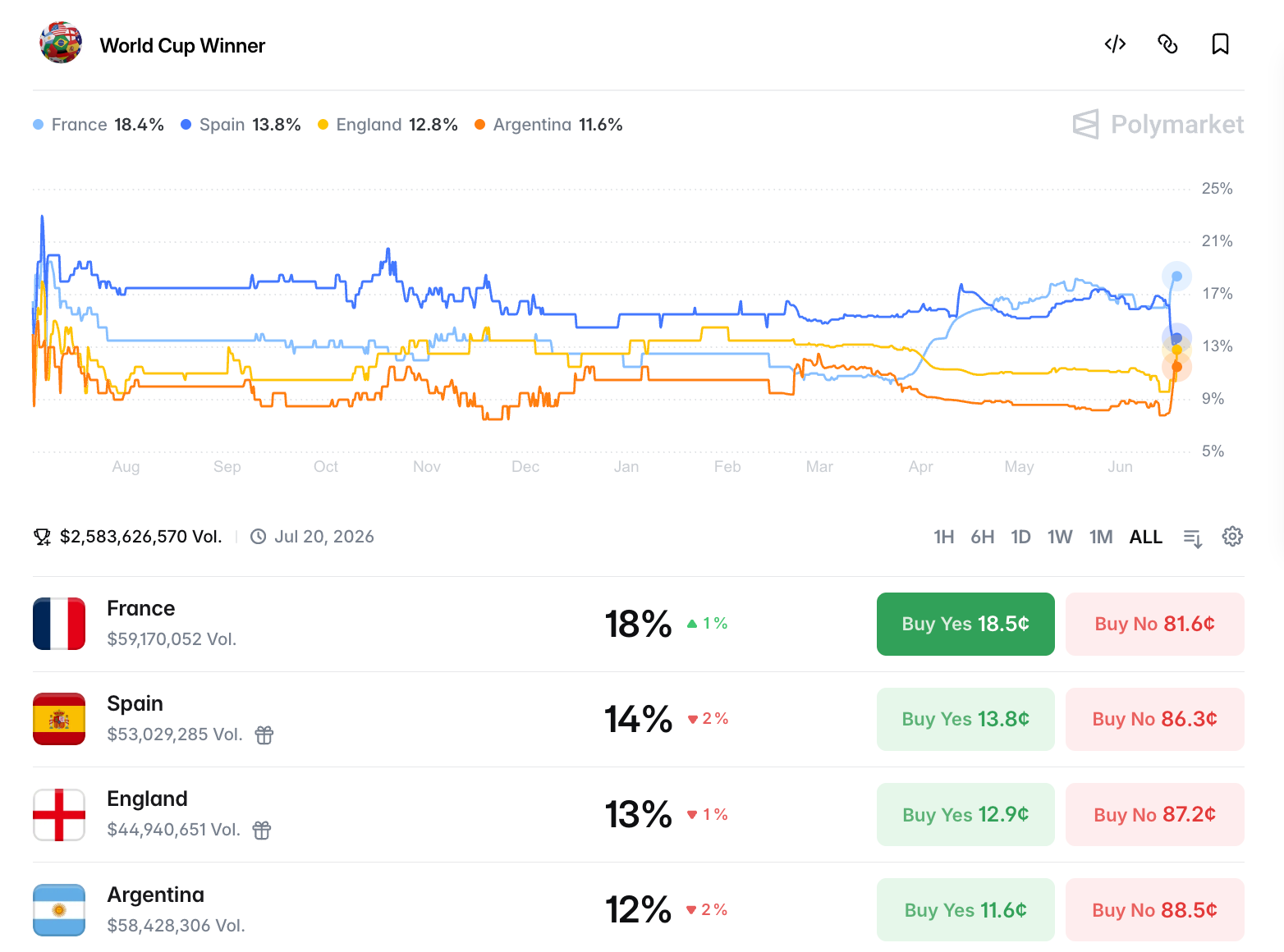
Source: https://polymarket.com/event/world-cup-winner
The most striking comparison is that cumulative trading volume is approximately 56 times greater than open interest. This means that the $2.58 billion trading volume does not represent $2.58 billion of capital actively positioned on the World Cup winner. Rather, it includes market making, position turnover, arbitrage activity, short-term trading, liquidity incentive programs, and the repeated deployment of the same capital.
What is more telling is the divergence between the trading volume and the implied probability of different teams. According to Polymarket's data, at the same time, France, Spain, England, and Argentina are the teams with the highest implied probability in the market, but not all of these popular teams have the highest trading volume. The World Cup winner probability of teams such as South Korea, the US, Cote d'Ivoire, Australia, and Congo (Kinshasa) is significantly lower than that of France, Spain, and Argentina, but their cumulative trading volume is higher. This does not mean that the market views South Korea or DR Congo as more likely World Cup winners. Rather, it highlights that trading volume reflects turnover intensity rather than the strength of market conviction.
Several factors may explain this phenomenon.
-
First, low-priced contracts are more likely to have high-frequency turnover. Contracts with extremely low probability have prices close to 0, and users can buy a large number of shares with a small amount of capital. Even small price movements can generate large percentage gains or losses, attracting short-term traders.
-
Second, liquidity rewards may alter trading behavior. During the World Cup, Polymarket introduced liquidity rewards aimed at increasing market depth. While these rewards help improve spreads and order-book depth, they may also encourage market makers to quote, trade, and rebalance positions more frequently in response to incentive rules, thereby inflating nominal trading volume.
-
Third, contracts on popular teams do not necessarily generate the highest turnover. The probabilities of favorites tend to remain relatively stable and trade within narrower price ranges, making them less likely to produce extreme volatility and high-frequency arbitrage opportunities than underdog teams.
-
Fourth, multiple binary contracts amplify nominal trading volume. The World Cup winner market is not a single multi-outcome market, but rather a collection of separate Yes/No contracts tied to individual teams. Users can trade Yes or No positions across multiple teams simultaneously, while market makers can quote across multiple markets and hedge risk between teams, further increasing aggregate trading volume.
Therefore, to assess the quality of prediction market growth, we cannot only look at nominal trading volume, but also observe open interest, active addresses, net deposits, market depth, bid-ask spreads, liquidity retention, post-match user retention, and migration of different categories. This is also the first hurdle prediction markets must overcome on the path from trend-driven products to financial infrastructure: if the market can only create impressive nominal trading volume, but cannot convert traffic into real users, lasting capital, and sustainable liquidity, then the World Cup is more like a traffic peak rather than a long-term turning point.
III. Competition for User Entry Points: Liquidity, Regulation, and Ecosystem Expansion
During the World Cup, competition in prediction markets was no longer solely about Polymarket’s growth, but increasingly about the competition between different expansion strategies. As prediction markets gradually move from crypto-native products to popular financial products, the industry is forming four representative expansion paths: liquidity-driven path represented by Polymarket, compliance-driven path represented by Kalshi, ecosystem-driven path represented by predict.fun, and channel-driven path represented by exchanges and wallets.
From a longer-term perspective, the focus of competition in prediction markets is also changing. The core of early competition was market quantity and event coverage, while as products gradually mature, the factors that truly determine the industry landscape will become user entry points, liquidity network effects, and distribution capabilities. The performance of various platforms during the World Cup is essentially verifying the growth efficiency and long-term competitiveness of different paths.
3.1 Liquidity-Driven: Polymarket Builds Network Effects in Event Trading
The core advantage of Polymarket is not only having more event markets, but also the liquidity network effects that have gradually accumulated over the past few years. Similar to exchanges, the deeper the liquidity, the higher the efficiency of price discovery, and the more willing users are to participate in trading. More users and trading volume will attract market makers to provide deeper order books and lower trading costs, further strengthening the platform's advantages. This positive feedback mechanism makes liquidity one of the most important competitive moats in prediction markets.
During the World Cup, Polymarket's leading position was further strengthened. Since the start of the World Cup, the cumulative transaction volume of Polymarket-related events has exceeded $1.7 billion, and the transaction volume in the past 24 hours has exceeded $63 million. At the same time, the platform continued to expand football-related resources during the events, established cooperative relationships with sports ecosystems such as OneFootball and Liga MX, and further expanded its content and user reach capabilities.
However, what is more noteworthy is that the value of Polymarket is extending from trading platforms to information platforms. When users want to know the market expectations of a real-world event, Polymarket has gradually become the default reference point for some crypto users. Its price not only serves trading behavior, but also begins to be quoted by media, research institutions, and social platforms, becoming a visual expression of market consensus. From this perspective, Polymarket's competitive advantage is no longer just "owning the market", but building a probability pricing network around real-world events.
3.2 Compliance-Driven: Kalshi Opens Traditional Financial Markets
If Polymarket represents the development path of the crypto-native prediction market, then Kalshi is exploring a completely different path: incorporating prediction markets into the traditional financial regulatory framework. Kalshi is an event contract platform under the US CFTC regulatory framework. Its long-term goal is not to compete for on-chain users, but to position event contracts as standardized financial products similar to options and futures. In this model, prediction markets are no longer seen as a crypto application, but as a new risk management and price discovery tool in traditional financial markets.
During the World Cup, Kalshi's sports market trading activity significantly increased. Kalshi's daily sports nominal trading volume reached $1.09 billion and exceeded $1 billion for two consecutive days, while Polymarket's daily sports nominal trading volume was about $350 million during the same period. Although the statistical caliber of different platforms is not completely consistent, this data still reflects that compliance platforms are attracting a large number of traditional financial users into event trading.
For the entire industry, the significance of Kalshi lies not in short-term trading volume, but in testing a key question: whether prediction markets can become a regulated financial product. If the answer is yes, then the potential user base of prediction markets will expand from crypto users to a wider range of traditional financial investors, and its market size will also gain new growth space.
3.3 Ecosystem-Driven: predict.fun Validates the Distribution Power of a Super Ecosystem
Unlike Polymarket's liquidity advantage and Kalshi's compliance advantage, predict.fun represents an ecosystem-driven development path. As a native prediction market on BNB Chain, the growth model of predict.fun does not rely entirely on independent customer acquisition, but more on the distribution channels and user base provided by the Binance ecosystem. During the World Cup, predict.fun launched the Predict Cup campaign with a total prize pool of $2 million and promoted it through channels such as Binance Wallet. After the World Cup started, the daily active users of the platform reached 20,000, and the daily transactions exceeded 180,000.
Compared to traditional prediction market platforms, the uniqueness of predict.fun lies in its closer proximity to ecosystem applications rather than independent products. Users do not need to actively search for prediction market platforms, but instead engage in prediction activities in an ecosystem environment where they already hold assets and have completed account system construction.
This model has some similarities with the super application logic of the mobile Internet era. Users do not necessarily enter the ecosystem because of prediction markets themselves, but passively discover and use prediction markets' functions within the ecosystem. For the industry, this means that future competition may not only occur in the protocol layer and product layer, but also in the ecosystem and distribution layers. In the long run, the distribution ability of the ecosystem may become one of the important ways to acquire new users for prediction markets.
3.4 Channel-Driven: Exchanges and Wallets Are Reshaping User Entry Points
In addition to independent prediction market platforms, exchanges and wallets are also becoming important forces for industry expansion. Gate's integration with Polymarket, Bitget Wallet's integrated prediction market services, and some wallets conducting prediction activities around the World Cup all reflect a common trend: prediction markets are being embedded into the existing cryptocurrency product system.
Taking Hotcoin as an example, the platform has launched a prediction market product that allows users to trade on topics such as crypto asset prices and football matches, while also introducing World Cup-themed campaigns. Compared with traditional on-chain prediction markets, its product design places greater emphasis on accessibility: users can participate directly with USDT in their platform accounts, without the need to create separate wallets, manage on-chain assets, or pay gas fees.
For most retail users, the biggest obstacle to participating in prediction markets is often not the prediction itself, but the operational friction associated with wallet creation, cross-chain transfers, gas payments, and transaction approvals. When exchanges and wallets encapsulate these complex processes, users can directly participate in event transactions using familiar account balances and user interfaces, and their experience will be closer to spot or futures trading, rather than traditional on-chain applications.
From an industry perspective, exchanges and wallets control the most mature distribution channels and asset entry points. As prediction markets gradually become a standard product feature, they may not need to exist in the form of independent applications, but are more likely to be widely embedded in exchange and wallet systems like Swap, yield products, staking, or payment functions. This means that the growth of prediction markets in the future is likely to rely not entirely on a single platform, but on more channels for continuous education and distribution to users.
The comparison of the four paths is as follows:
| Path | Representative Platform | Core Advantage | Key Challenge |
| Liquidity-Driven | Polymarket | Network Effects and Deep Liquidity | Compliance and Regulation |
| Compliance-Driven | Kalshi | Regulatory Approval and Institutional Participation | Speed of Innovation |
| Ecosystem-Driven | predict.fun | BNB Ecosystem Distribution | User Retention |
| Channel-Driven | Exchanges & Wallets | User Entry Points and Capital Retention | Product Commoditization |
In short, from Polymarket, Kalshi to predict.fun, and then to the collective entry of exchanges and wallets, a clear industry trend is forming: prediction markets are shifting from product competition to competition for user entry points. The World Cup is merely a catalyst in this competition for user entry points, not its end state. What is really worth paying attention to is which platforms can convert short-term traffic into long-term users after the World Cup heat fades, and which entry points can evolve into lasting user habits. For prediction markets, this may be more important than the trading volume itself.
IV. The Financialization of Prediction Markets: Opportunities, Risks, and Regulatory Challenges
The World Cup has validated the growth potential of prediction markets and accelerated its financialization process. In the past few years, prediction markets have largely been viewed as experimental products in the cryptocurrency industry, with relatively limited user base, market depth, and social influence. However, as global events such as the US election and the World Cup continue to drive user growth, prediction markets are gradually shedding the label of "niche prediction tools" and evolving into a financial asset class. In this process, the industry has gained new growth space and has also begun to face regulatory, manipulation, and market structure issues that have long existed in traditional financial markets.
4.1 From Information Tool to Pricing Layer: Prediction Markets Are Becoming a Mechanism for Price Discovery
The most important value of prediction markets is not providing trading opportunities, but providing prices. Traditional financial markets can continuously price stocks, bonds, commodities, exchange rates, and interest rates, but for a large number of real-world events, the market often lacks a unified and real-time pricing mechanism. For example, whether a certain bill can be passed, whether a company will complete its listing, whether a candidate can win the election, or whether a team can ultimately win the World Cup. Under the traditional system, these judgments mainly rely on expert analysis, media surveys, or institutional predictions. Prediction markets convert fragmented information, opinions, and expectations into continuously changing market prices, turning probabilities themselves into tradable assets.
In the past few years, Polymarket's performance in the US election, macro policies, technology company events, and sports events has demonstrated this potential. More and more media outlets are citing prediction market prices as an important reference indicator for market expectations, and their role is gradually approaching that of forward-looking indicators in traditional financial markets such as interest rate curves, implied volatility of options, or credit spreads. If the market continues to expand, prediction markets may become more than just trading platforms, but also an important price discovery layer for real-world events. From this perspective, what prediction markets trade is not the event itself, but the market's consensus on future outcomes.
4.2 Sports Validate High-Frequency Demand, but Also Blur the Line Between Prediction Markets and Gambling
The rapid growth of trading volume during the World Cup proves the important value of sports markets for prediction markets. Compared with low-frequency events such as presidential elections and macro policies, sports events have natural advantages: low barriers to understanding, high event frequency, clear results, and strong global attention. Events such as the World Cup, Champions League, NBA, NFL, and MLB can continuously provide a large number of tradable events throughout the year, freeing prediction markets from dependence on a few major political events.
For the industry, this means that prediction markets may, for the first time, support recurring day-to-day trading activity. However, this advantage is also accompanied by controversy. As the proportion of the sports market continues to increase, the boundary between prediction markets and traditional sports betting is becoming blurred. Whether it is user behavior or trading experience, some sports prediction markets are already highly similar to sports betting products.
This is also one of the core issues that current regulatory agencies are concerned about. If prediction markets are mainly driven by sports trading, their regulatory attributes may be closer to gambling products; while if their core functions are information aggregation and probability pricing, it is more likely to be classified as a financial product or event contract market. Whether the industry can establish clear product boundaries in the future will directly affect the regulatory environment and long-term development space of prediction markets.
4.3 Institutional Capital Is Entering as Prediction Markets Emerge as a New Asset Class
In the past, prediction markets were mainly driven by retail users, and their function was more to express opinions and participate in hot event discussions. However, as the market size expands, more and more professional trading institutions begin to regard prediction markets as a new asset class and trading venue.
Recently, multiple overseas media reported that commodity hedge fund Moreton Capital has established a dedicated prediction market trading department and plans to introduce external funds to carry out related strategies. At the same time, some quantitative trading teams have also begun to focus on event-driven trading, cross-platform arbitrage, news trading, and probabilistic pricing models.
The entry of institutions means that prediction markets are shifting from an interest-driven market to a capital-driven market. From the perspective of asset attributes, there are significant differences between prediction markets and traditional financial assets: Equities trade on future corporate cash flows; bonds trade on interest-rate and credit risk expectations; commodities trade on supply-and-demand dynamics; prediction markets trade future event outcomes. This unique characteristic gives prediction markets the potential to become an independent asset class. If a mature market-making system, derivatives ecosystem, and risk management tool are formed in the future, prediction markets may evolve into a new asset class comparable to options markets or event-driven investment strategies.
4.4 The Wisdom of Crowds Is Not Always Crowd-Driven: Prediction Markets Are Becoming More Professionalized
Prediction markets have long been regarded as an embodiment of the "wisdom of crowds". Their core premise is that the independent views of a large number of participants allow market prices to more accurately reflect future outcomes than expert predictions. However, as institutions and professional traders enter, the market structure is changing.
Relevant research on Polymarket shows that during the sample observation period, whale accounts, high-frequency traders, and highly active professional traders together contributed more than 80% of the nominal trading volume, while the trading share occupied by ordinary users was relatively limited. This phenomenon means that prediction market prices are increasingly likely to be driven by a few professional participants rather than a broad public consensus.
From the perspective of market efficiency, this may not necessarily be a bad thing. Professional market makers can improve liquidity, quantitative institutions can accelerate price discovery, and high-frequency traders can reduce bid-ask spreads. However, at the same time, the market may also see a growing concentration of informational advantages, liquidity monopoly, and pricing power concentrated in a few institutions. Whether the future market will evolve into a "wisdom-of-crowds market" or a "professionally driven market" remains to be seen.
4.5 Regulatory and Manipulation Risks: Key Challenges on the Path to Financialization
With the expansion of prediction markets, the problems it faces are becoming more and more similar to traditional financial markets. The most important challenges come from insider information and market manipulation.
Compared with the stock market, prediction markets often revolve around the outcome of a single event, and its price is extremely sensitive to key information. For example, companies' listing plans, policy release dates, internal news of sports events, regulatory approval results, etc., may create significant informational advantages. When a few participants grasp key facts in advance, prediction markets may have significant information asymmetry problems. At the same time, due to limited liquidity in some markets, large amounts of funds may also affect price trends through concentrated trading activity, thereby affecting the credibility of market signals.
For regulatory agencies, prediction markets are different from securities and gambling, and their legal positioning is still evolving. The ongoing review of the sports prediction market by the US CFTC, discussions around event-contract regulation in Europe, and different attitudes towards political prediction markets in various countries all indicate that the industry is still in the formation stage of regulatory frameworks. For prediction markets, the biggest challenge in the future may not be technical issues, but how to establish a balance between openness, market efficiency, and regulatory requirements.
V. Outlook and Conclusion: Can Prediction Markets Become Real-World Pricing Infrastructure?
The World Cup will eventually come to an end, and the traffic surge will gradually fade. However, for prediction markets, the real important issue is not how much trading volume was created during the World Cup, but what remains after the World Cup ends.
In the past year, major global events such as the US election, crypto ETFs, macro policy events, and the World Cup have jointly pushed prediction markets into the mainstream view. However, historical experience has shown that hot events can bring traffic, but may not necessarily precipitate long-term value. Whether prediction markets can emerge from cyclical hotspots ultimately depends on whether they can establish stable user demand, sustained liquidity, and widely recognized price discovery capabilities. From the current development stage, the industry still needs to answer five key questions in the future.
5.1 Can User Demand Extend Beyond Sports to a Broader Range of Real-World Events?
The World Cup has proven that sports markets have strong user acquisition capabilities, but sports cannot represent the full value of prediction markets. If users are only active during the World Cup, European Cup, or US election, then prediction markets are still essentially an event-driven product, and their growth is highly dependent on event cycles. A truly mature prediction market should be able to gradually migrate users from sports events to broader real-world issues such as macroeconomics, financial markets, technological innovation, regulatory policies, corporate events, and social hotspots.
In the long run, the core competitiveness of prediction markets lies not in how many popular events it covers, but in whether it can become a daily tool for users to navigate future uncertainty. When users begin to get used to judging the future through market prices rather than expert opinions, prediction markets truly have long-term value.
5.2 Can Trading Volume Translate Into Sustainable Liquidity?
Most of the growth during the World Cup is reflected in trading volume. However, trading volume itself does not fully reflect market quality. In the development process of financial markets, indicators with real long-term value often include open interest, order book depth, bid-ask spread, capital retention, and market maker participation. These indicators together determine the liquidity quality and price discovery efficiency of the market.
For prediction markets, the key to the future is not to create higher nominal trading volume, but to establish a deeper, more stable, and more sustainable liquidity pool. Only when liquidity can persist across a single event cycle can prediction markets break away from the hotspot-driven mode and enter the development stage of a mature financial market.
5.3 Can Prices Become a Credible Reflection of Market Consensus?
The greatest value of prediction markets comes from price. Whether it is the US election, the World Cup winner, or macro policies and corporate events, market prices continue to convey probabilistic judgments about future outcomes to the outside world.
However, the more widely the price is quoted, the higher the importance of its accuracy and credibility. Market prices do not naturally represent the truth, including factors such as informational advantages, liquidity premiums, sentiment fluctuations, capital costs, and trading behavior biases. Therefore, in the future, the industry needs to continue to verify a core question: Are prediction market prices more accurate than traditional surveys, expert predictions, and media opinions?
If prediction markets can prove their stable and verifiable predictive ability in long-term practice, their role will be upgraded from a trading tool to a public information infrastructure. Conversely, if prices are subject to long-term manipulation, sentiment, or insufficient liquidity, their financial value will also be limited.
5.4 Can Market Integrity Support Mainstream Adoption?
Every financial market ultimately depends on trust. For prediction markets, one of the biggest challenges in the future is not technology, but market governance.
With the continuous influx of institutional funds, platforms need to establish more comprehensive market monitoring, insider-trading surveillance, abnormal account review, conflict of interest disclosure, dispute resolution mechanisms, and user protection mechanisms. Especially in sensitive areas such as politics, regulation, corporate events, and sports events, market integrity will directly determine whether prediction markets can be recognized by regulatory agencies, institutional investors, and mainstream society. Historically, all successful financial markets have gone through a process from rapid expansion to rule governance. Prediction markets cannot bypass this stage either.
5.5 Can Prediction Markets Become a New Financial Infrastructure Layer?
From a longer-term perspective, the greatest long-term opportunity of prediction markets may not lie in the trading itself. The problem prediction markets attempt to solve is the pricing of future-event probabilities. If sufficient liquidity can be established in the future, pricing accuracy can be continuously verified, and regulatory recognition can be obtained, then prediction markets may become a pricing layer for uncertainty in the real world. At that time, prediction markets will provide not only trading opportunities, but also a new way of organizing information and a decision-making framework.
From enterprise strategy formulation to investment decision-making, from macro analysis to public policy discussions, the market-based probability judgments about the future may become an important reference. This is also the fundamental difference between prediction markets and traditional gambling products.
Conclusion
The explosive growth during the World Cup has brought prediction markets into the global spotlight for the first time in the form of a popular product. On the surface, people are trading World Cup winner outcomes, game results, and qualification probabilities; but at a deeper level, the market is really trading judgments about the future.
From Polymarket's liquidity network to Kalshi's compliance-driven approach, from predict.fun's ecosystem expansion to exchanges such as Hotcoin, integrating prediction markets into their existing product suites, the industry is evolving from a crypto-native experimental product into a mainstream financial tool. The World Cup may be just one important milestone in this broader transformation.
In the long run, the value of prediction markets lies not only in providing trading opportunities but also in providing a sustained mechanism for pricing real-world uncertainty. If search engines solve the problem of information discovery, and financial markets solve the problem of asset pricing, then prediction markets attempt to solve the problem of pricing future-event probabilities.
About Us
Hotcoin Research, the core research and investment arm of Hotcoin Exchange, is dedicated to turning professional crypto analysis into actionable strategies. Our three-pillar framework—trend analysis, value discovery, and real-time tracking—combines deep research, multi-angle project evaluation, and continuous market monitoring.
Through our Weekly Insights and In-depth Research Reports, we break down market dynamics and spotlight emerging opportunities. With Hotcoin Elite Picks—our exclusive dual-screening process powered by both AI and human expertise—we help identify high-potential assets while minimizing trial-and-error costs.
We also engage with the community through weekly livestreams, decoding market hot topics, and forecasting key trends. Our goal is to empower investors of all levels to navigate cycles with confidence and capture long-term value on Web3.
Risk Disclaimer
The cryptocurrency market is highly volatile, and all investments carry inherent risks. We strongly encourage investors to remain informed, assess risks thoroughly, and adhere to strict risk management practices to protect their assets.
Connect with Us
Website:https://www.hotcoin.com/en_US/learn/index/
X: x.com/HotcoinAcademy
Email: labs@hotcoin.com
Lettura consigliata
Visualizza altro
Hotcoin Research | When the Flywheel Reverses: The Truth Behind DAT and Its Structural Risks
In-depth Research

Hotcoin Research | Uncovering the Influence of Macroeconomics: Correlation Analysis between US Economic Indicators and Crypto Market Fluctuations
In-depth Research

Hotcoin Research | Unlocking Trillions: How the U.S. 401(k) Pension Plan Could Drive the Next Long-Term Crypto Bull Market
In-depth Research
Assistenza Clienti
service hotcoin.com
feedback sul prodotto
producthotcoin.com
cooperazione commerciale
businesshotcoin.com
Forze dell'ordine
casecnhotcoin.com
Chi siamo
prodotto
Servizi
Supporto
© 2017-2026 Australian Hotcoin Global Exchange Pty Ltd