
Hotcoin Research | The Lobster Craze Goes Viral: When OpenClaw Takes Over Crypto Wallets, Is It a Passive-Income Tool or a Security Trap?
TL;DR
-
What is OpenClaw? : OpenClaw is a task-oriented AI agent framework that moves AI from simply “talking” to actually “taking action.”
-
How it works: Users send natural-language commands, and OpenClaw interprets intent, writes executable code, and iterates until the task is completed.
-
Crypto use cases: As an “information + execution” assistant, it can monitor markets, analyze data, and place trades around the clock.
-
Risks and limitations: Security vulnerabilities and malicious plugins | Hardware requirements and API costs | Centralization and compliance risks.
-
Outlook: OpenClaw may reshape how investors operate, but strict security controls should be in place.
I. Understanding OpenClaw: The AI Agent Behind the “Lobster” Craze
Since the beginning of 2026, few AI topics have generated as much attention as OpenClaw. The trend of “raising lobsters” has quickly become a cultural phenomenon, fueling intense FOMO across tech communities. In less than four months, OpenClaw accumulated more than 300,000 GitHub stars, surpassing long-established infrastructure projects such as React and Linux, becoming the most-starred runnable software project in GitHub history.
Its influence has expanded into crypto. Senpi AI, a trading agent built on OpenClaw, generated more than $185 million in trading volume on Hyperliquid. Related meme tokens such as $LOBSTER, $CLAWD, and $OPENCLAW have also sparked speculative waves in the market. While most people are asleep, AI agents are already betting on Polymarket and trading perpetuals on Hyperliquid. This is no longer science fiction. It is currently happening.
OpenClaw is an open-source AI agent framework designed to run fully in a local environment. It was created by Austrian developer Peter Steinberger, who grew frustrated with the limitations of chatbots that could only converse but not act. Inspired by the concept of vibe coding, he set out to build what the community now calls a “working lobster” — an AI system that evolves from simply generating language to actually executing tasks.
OpenClaw Development Timeline
From its release in November 2025 to its breakout in early 2026, OpenClaw’s growth has been unprecedented in open-source history. React took 13 years to reach 243,000 stars, and Linux took more than 30 years to accumulate 218,000 stars. OpenClaw crossed the 300,000 mark in less than four months.
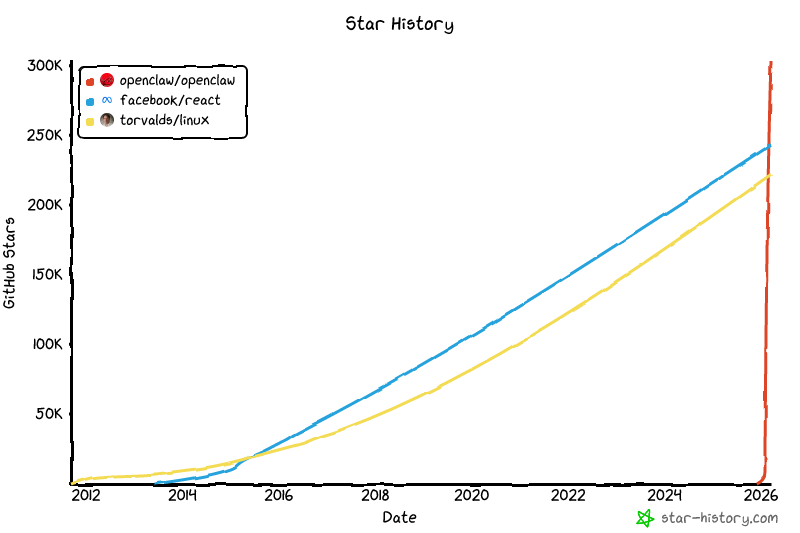
Source: https://www.star-history.com/
OpenClaw’s development can be divided into four stages:
-
Project launch and early setbacks (November 2025): OpenClaw began as a weekend project called ClawdBot, launched by Peter Steinberger on November 25, 2025. The original name paid tribute to Anthropic’s Claude model, while the “lobster” theme became part of its identity and community culture.
-
Explosive growth and renaming controversy (January 2026): By mid-January 2026, the project experienced explosive growth. However, as the original name was considered too close to Claude, the team received a trademark warning from Anthropic on January 27 and was forced to rename the project Moltbot. Just days later, on January 30, the team officially rebranded it again as OpenClaw to better emphasize its open-source nature while preserving its lobster-themed identity. During this period of peak attention, related meme tokens also launched and saw sharp short-term price increases.
-
Security crisis and team restructuring (February 2026): Rapid adoption was accompanied by major security concerns. In early February, OpenClaw was exposed to a high-risk remote code execution (RCE) vulnerability. Around the same time, the ClawHavoc supply-chain attack revealed that roughly 12% of the skills in the ClawHub plugin ecosystem contained malicious code. Google also reportedly suspended a large number of OpenClaw-related user accounts, creating further uncertainty in the community. In response, the team partnered with VirusTotal on February 7 to begin automated security scanning of skill packages. After a turbulent stretch, Peter announced in mid-February that he had joined OpenAI, and the project was subsequently transferred to an open-source foundation, with sponsorship from OpenAI, but operational independence is preserved.
-
GitHub dominance and ecosystem breakout (March 2026): By March, OpenClaw reached a new level in both technical adoption and ecosystem expansion. On March 2, Crypto.com launched an Agent Key feature tailored for OpenClaw, while GitHub stars surpassed 250,000, officially overtaking React. On March 7–8, the project released a major update that included native support for GPT-5.4, pushing stars close to 280,000. Meanwhile, Moltbook, an AI-native social platform within the broader OpenClaw ecosystem, was announced as an acquisition target by Meta on March 10.
Why OpenClaw Captured So Much Attention
For regular users and investors, OpenClaw offers several compelling features:
-
Stronger privacy protection: The software runs on your own computer, Mac, or VPS. Data does not have to be uploaded to the cloud, which significantly improves privacy.
-
Seamless chat-based interaction: Users can issue commands through familiar messaging apps such as Telegram, WhatsApp, and Discord.
-
Powerful skill extensibility: OpenClaw uses a modular Skills system, similar to an app store. Each skill is an independent capability package. ClawHub currently hosts more than 5,400 skills, covering browser automation, on-chain execution, Lightning Network payments, and much more.
Crypto embraced OpenClaw so quickly because crypto investing is fundamentally a game of information + execution. In the past, investors needed to watch charts constantly, write code, and manually confirm trades. Now, they can simply type a message like: “Check Trump’s probability on Polymarket. If it rises above 60%, buy $500.” An AI agent can then fetch the data, analyze the signal, and execute the trade automatically. In that sense, OpenClaw has transformed execution into an automated workflow, something many retail investors have long dreamed of.
II. How OpenClaw Works: A Fully Automated Loop from Perception to Self-Correction
From the user’s perspective, OpenClaw’s workflow is remarkably simple. A user sends a natural-language command through a chat app such as Telegram or Discord, and OpenClaw acts like a personal assistant: it interprets the request, writes and runs executable code, and keeps correcting itself until the task is completed.
The Core Architecture
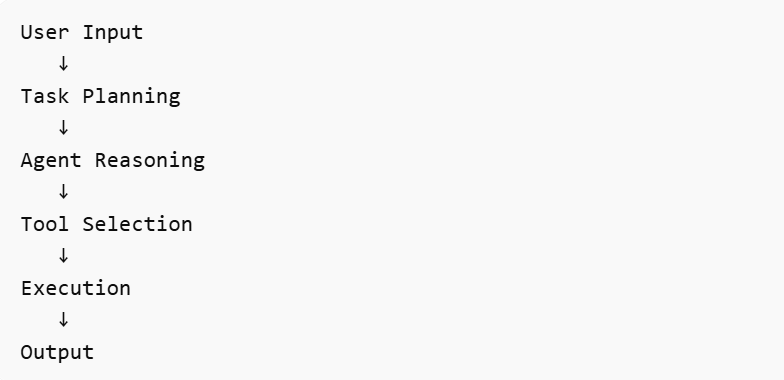
At its core, OpenClaw is built around a self-hosted gateway. Users run a Node.js process on a PC or server to connect various chat channels. When a message comes in through an authorized platform such as WhatsApp, Telegram, or Discord, the gateway forwards it to a configured AI model such as Claude, GPT, or Gemini. The model interprets the instruction and can then use tools to execute shell commands, call web APIs, read and write files, send emails, or control a browser.
Its architecture adopts a multi-agent routing design, allowing it to support multiple models while isolating different sessions and roles. The gateway handles session management, routing, and security policies; the execution engine handles task logic; and ClawHub provides packaged tool integrations through skills. Users can define data storage methods and permission settings, including allowlists and identity binding. The system supports both local and cloud-based distributed deployment.
OpenClaw has launched iOS and macOS clients with support for voice-based wake-up and push notifications. Android nodes are reportedly in development, with the potential to access device cameras, GPS, and local storage in the future, thus unlocking even broader use cases.
The Logic Behind the System
OpenClaw’s operating logic can be simplified into a dynamic loop of perception, reasoning, execution, and self-correction.
-
The Core Task Loop
-
Intent interpretation: A large language model analyzes the user’s request and determines what needs to be done.
-
Plan generation: The system writes the Python scripts or shell commands needed to accomplish the goal.
-
Execution: The generated code is run directly in the local environment, interacting with files, systems, or APIs.
-
Validation: The system reviews the output to determine whether the task succeeded.
-
Self-repair: If an error occurs, the AI analyzes the logs, rewrites the code, and tries again.
-
-
Event Triggering (Tick System)
-
Wake-up: The system can be triggered either by a user message or by a scheduled cron task.
-
Queueing: Tasks enter a lane queue, ensuring they are executed one at a time to avoid system conflicts.
-
Sleep mode: Once a task is completed and the current state is saved, the system returns to a low-power standby mode.
-
-
Memory and Lifecycle Management
-
Identity Loading: OpenClaw reads files such as
SOUL.mdandTOOLS.mdto define the agent’s persona and available capabilities. -
Memory compression: When conversation history becomes too long, the system summarizes prior context to reduce memory load and prevent context degradation.
-
Autonomous feedback: OpenClaw can work asynchronously in offline-style workflows. For example, it can fix bugs while the user sleeps and then generate a summary of what it completed.
-
In simple terms, OpenClaw behaves like a 24/7 software assistant: it receives a task, writes code, runs tests, fixes errors, and continues until the objective is achieved.
III. OpenClaw in Crypto: An Automated “Information + Execution” Assistant
In crypto and finance, OpenClaw is increasingly functioning as an information + execution assistant, automating repetitive tasks that previously required constant attention and manual action. Its value lies not in inventing new financial products, but in streamlining workflows and saving time.
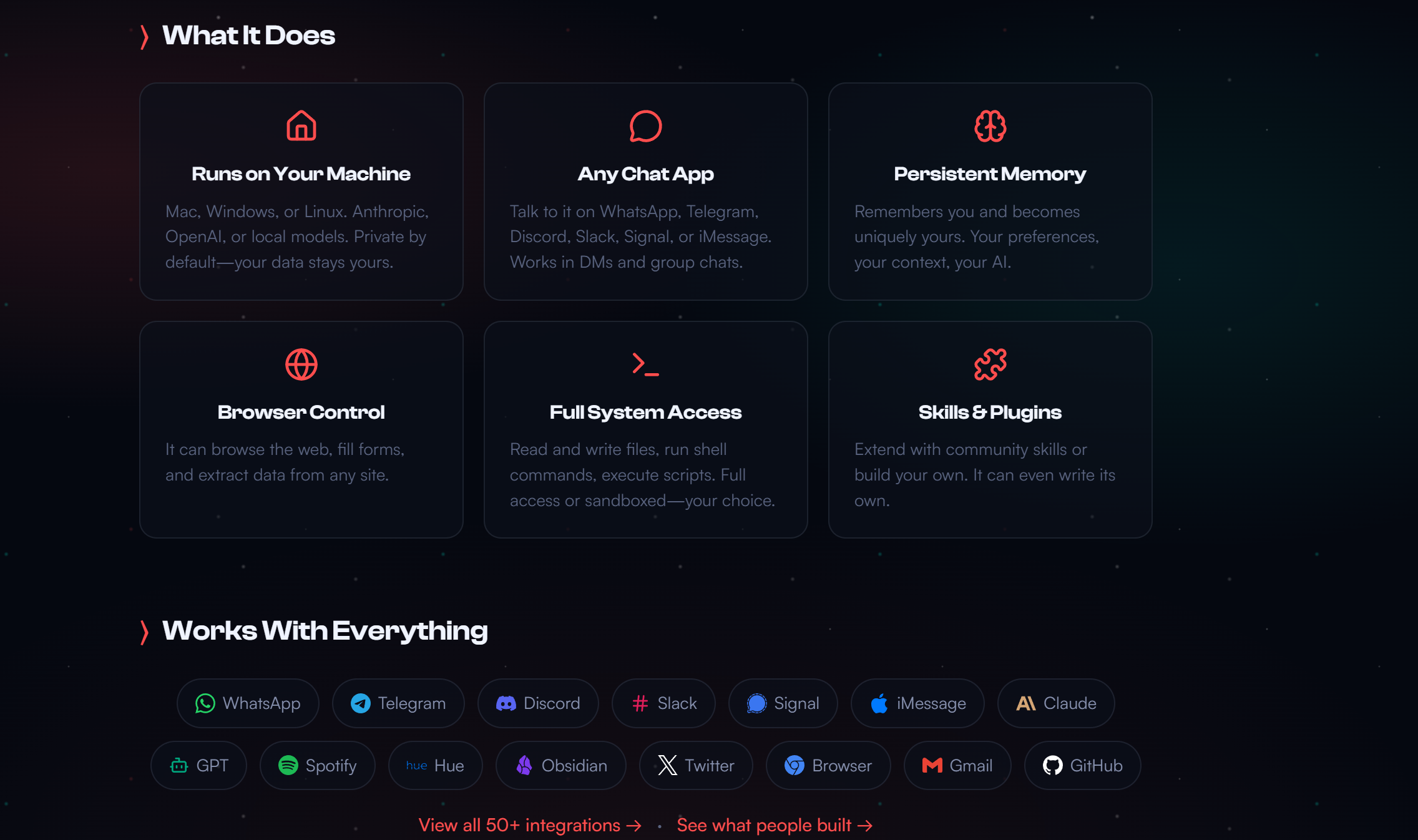
Source: https://openclaw.ai/
DeFi and Data Automation
Searching terms like crypto, DeFi, or trading on ClawHub reveals hundreds of ready-made skills.
-
On-chain operations and asset management: General-purpose on-chain skills can support Aave deposits, Jupiter swaps, and wallet management.
-
Token issuance and revenue tools: Skills such as BankrBot support one-click token launches, automated transaction-tax capture, and funding wallets for agents. The ecosystem has also seen the emergence of AI-driven launch and trading platforms such as Clawnch and ClawPump, many of which are oriented toward meme-token speculation.
-
Data analysis: Data skills can pull real-time on-chain information and analyze it through Dune dashboards or similar tools.
-
Liquidity deployment and yield farming: Agents can monitor yields across pools and automatically deploy or harvest capital. For example, a user might instruct OpenClaw to allocate funds to the highest-APY USDC pool on Base and compound daily. The system could then fetch DeFiLlama data at regular intervals and execute the strategy automatically.
Exchange Integration and Automated Trading
Mainstream exchanges have already begun integrating OpenClaw-related workflows, significantly lowering the barrier to entry.
-
Crypto.com: On March 2, 2026, Crypto.com introduced an Agent Key feature specifically designed for OpenClaw. Users can supply a budget-controlled key and then instruct OpenClaw via Telegram to perform actions such as converting 1,000 USDT into BTC. The design emphasizes risk controls: a hard weekly budget cap, trading-only permissions, no withdrawals, and chat confirmation for every transaction. Users can also halt all trading immediately by sending the command “stop all trading.”
-
Bitget: Bitget upgraded its Agent Hub with new Skills + CLI modules optimized for OpenClaw. Users can reportedly complete setup in just a few minutes, with support for spot, futures, margin, conditional orders, and batch orders. AI agents can monitor markets around the clock and automatically follow high-performing traders when conditions align.
-
Hyperliquid: Although Hyperliquid has yet to announce native integration, third-party tools have already filled the gap. In February 2026, Senpi.ai launched a personal trading agent offering 31 tools specifically designed for Hyperliquid. It supports one-click deployment, private-key custody workflows, and both fully autonomous and confirmation-based modes. Community-built open-source skills such as HyperLiquid-Claw have also made it easier to automate high-leverage perpetual strategies.
Prediction Markets: AI as a Probability Trader
Prediction markets are one of OpenClaw’s most mature application areas. PolyClaw, built by Chainstacklabs, has become a widely used community tool. It can scan markets, analyze odds, identify arbitrage opportunities, calculate implied probabilities, and hedge across platforms.
Kalshi also has a mature skill ecosystem. Some developers have even designed dual-agent systems, where one agent specializes in news and sentiment analysis while another executes the bets. As Polymarket’s weekly trading volume overtook Kalshi in 2026, AI agents played an increasingly visible role in market activity.
Social Media Analysis and Portfolio Management
-
Social sentiment analysis: AI agents can scrape public content from X, Reddit, or Telegram groups and use NLP tools to detect shifts in sentiment, potentially identifying price signals early.
-
Portfolio management: Users can define rules to evaluate and rebalance positions dynamically. Agents can connect to RPC endpoints, read balances, and use tools such as Pandas to model optimal trade sequences and generate Sharpe-ratio-style reports.
-
AI-native social platforms: Moltbook, built specifically for AI agents, allows bots to exchange code, information, and even commentary about their human users. It began as an experimental project in late January and quickly became a large-scale testbed for AI as a social actor rather than just a utility layer. Meta announced its acquisition on March 10. OpenAI CEO Sam Altman has reportedly suggested that even if the site proves short-lived, the underlying technical direction offers an early glimpse of the future.
IV. The Dark Forest: Risks and Limitations That Cannot Be Ignored
For all its efficiency gains, giving an AI agent control over highly sensitive operations is inherently risky. In crypto terms, this is very much a journey through the dark forest.
1) Security Vulnerabilities and Malicious Attacks
-
OpenClaw runs within a single Node.js process and can hold highly privileged permissions. Security firms such as CrowdStrike and Bitdefender have reportedly warned that this creates serious risk exposure.
-
The core threats include prompt injection, tool abuse, identity spoofing, and broader forms of agent manipulation.
-
Research indicates that at least 71 malicious plugins disguised as trading tools appeared within ClawHub. These plugins were capable of stealing private keys and transferring funds to attacker-controlled wallets.
-
Malicious websites may exploit the ClawJacked vulnerability to hijack local agents through WebSocket connections. Cisco’s security team also reportedly identified unaudited skills that secretly exfiltrated Discord chat histories.
2) Hardware Barriers and API Costs
-
OpenClaw is far from plug-and-play. The setup process remains technically demanding, and some users have complained that it takes days just to achieve stable deployment.
-
Memory usage can reach hundreds of megabytes, making it unsuitable for lower-end hardware and limiting broader deployment at scale.
-
Using advanced LLM APIs such as GPT-5 can be expensive. Some reports suggest that even relatively simple interactions may cost more than $10, creating meaningful cost pressure for smaller teams and individual users. Complaints about both setup complexity and operating costs remain common.
3) Centralization and Compliance Risks
-
Although the framework is open source, its core inference capabilities still rely heavily on centralized model providers such as OpenAI and Anthropic. Peter Steinberger’s move to OpenAI has fueled concerns that the ecosystem could become more dependent on specific platforms over time.
-
From a compliance perspective, local deployment helps address certain privacy concerns, but once a plugin-related incident leads to leaked data or stolen assets, legal responsibility becomes far less clear. The use of AI agents in financial activity must still comply with jurisdiction-specific rules, and future regulation is likely to bring tighter guidance around these products.
-
If users rely on third-party agent platforms such as Senpi for asset operations, they also face platform and counterparty risk.
Official Responses and Defensive Recommendations
To address these issues, the founding team and broader community have introduced controls such as permission allowlists, user pairing codes, and skill review mechanisms.
OpenClaw has also partnered with VirusTotal to automatically scan skills on ClawHub, flagging and blocking suspicious code. However, these measures are still largely reactive.
As a result, the strongest recommendations from the community and security experts remain straightforward:
-
Never give an AI agent full private-key access
-
Use API keys with strict budget limits
-
Require manual confirmation for sensitive actions
-
Deploy the system in an isolated environment, such as a virtual machine
In short, OpenClaw should still be treated as software that is powerful, but not fully trustworthy.
V. Outlook: A Revolutionary Tool Reshaping the Investment Paradigm
OpenClaw successfully pushed AI beyond information retrieval into real-world execution. It can complete complex tasks behind a simple chat interface, marking a significant shift in how users interact with software.
Some forecasts suggest that AI execution assistants will accelerate in 2026, enter mainstream households by 2027, become routine tools by 2028, and evolve into a form of social infrastructure by 2030.
At the infrastructure level, standards such as ERC-8004 and x402, along with dedicated smart wallets, are being developed to support seamless payments and contract interactions for autonomous agents. These developments could eventually standardize agent-to-agent economic activity.
That said, real adoption still needs time to prove itself. The current AI agent + crypto ecosystem remains at a relatively basic stage. Much of today’s activity is still driven by speculative tokens, while deeper DeFi use cases are only beginning to emerge.
The true turning point will arrive when agents can safely and autonomously complete complex financial tasks, and perhaps even coordinate with or “hire” other agents. In that process, OpenClaw as a pioneer will define the standards of a matured agent economy.
Conclusion
OpenClaw is a transformative tool that combines information advantages with execution efficiency, and makes both accessible to everyday users. Investors no longer need to be programmers to participate in increasingly automated markets. They simply need to learn how to direct the agent.
That does not eliminate risk. In fact, risk remains inseparable from opportunity. But one thing is increasingly clear: the tools of the future are already here.
About Us
Hotcoin Research, the core research and investment arm of Hotcoin Exchange, is dedicated to turning professional crypto analysis into actionable strategies. Our three-pillar framework—trend analysis, value discovery, and real-time tracking—combines deep research, multi-angle project evaluation, and continuous market monitoring.
Through our Weekly Insights and In-depth Research Reports, we analyze market dynamics and highlight emerging opportunities. With Hotcoin Selects—our exclusive dual-screening process powered by both AI and human expertise, we help identify high-potential assets while minimizing trial-and-error costs.
We also engage with the community through weekly livestreams, decoding market hot topics, and forecasting key trends. Our goal is to empower investors of all levels to navigate cycles with confidence and capture long-term value on Web3.
Risk Disclaimer
The cryptocurrency market is highly volatile, and all investments carry inherent risks. We strongly encourage investors to remain informed, assess risks thoroughly, and adhere to strict risk management practices to protect their assets.
Connect with Us
Website:https://www.hotcoin.com/en_US/learn/index/
X: x.com/HotcoinAcademy
Email: labs@hotcoin.com
Lettura consigliata
Visualizza altro
Hotcoin Research | Play-to-Earn WEB3: Humanity Protocol — Building a Bridge Between the Real World and Digital Identity
In-depth Research

Hotcoin Research | Uncovering the Influence of Macroeconomics: Correlation Analysis between US Economic Indicators and Crypto Market Fluctuations
In-depth Research

Hotcoin Research | The On-Chain Stock Trading Era Begins: A Deep Dive into the Tokenized Equities Boom
In-depth Research

E-mail del servizio clienti
Service@hotcoin.com
feedback sul prodotto
Product@hotcoin.com
cooperazione commerciale
Business@hotcoin.com
Casella di posta giudiziaria
Casecn@hotcoin.com
chi siamo
prodotto
Servire
supporto
©2017-2026