
Hotcoin Research | Pre-IPO Products Aren’t Always Stocks: What Is the Crypto Market Really Trading?
TL;DR
The Core of Pre-IPO: Crypto markets are transforming private-company valuation expectations into publicly tradable products.
Asset Structures: Most Pre-IPO products are not real equity ownership, but synthetic exposure to prices, economic rights, or event expectations.
Market Routes: Exchanges focus on “contract-based trading,” on-chain platforms on “asset tokenization,” while prediction markets trade “event probabilities.”
Three Core Tensions: Liquidity Democratization vs Genuine Equity Ownership, Price Discovery vs Sentiment Amplification, RWA Expansion vs Regulatory Conflict
Outlook & Conclusion: What Pre-IPO markets are really trading may not be stocks themselves, but expectations around future valuations.
In the past few years, the main focus of RWA has been on US Treasury bonds, money market funds, private credit, real estate income rights, and tokenized stocks. Their common objective is to bring off-chain assets on-chain, giving users lower-friction access to real-world financial exposure. However, since April 2026, as IPO expectations surrounding super-unicorns such as SpaceX, OpenAI, and Anthropic have gained momentum, Pre-IPO has become a more widely discussed segment of the RWA market.
1. The Core of the Pre-IPO Boom: The Productization of Valuation Expectations in the Cryptocurrency Market
Pre-IPO investing is not a new concept in traditional finance. Accredited investors can participate in unlisted company equity through secondary markets, SPVs, private equity funds, employee share transfers, or specific wealth management channels. However, these channels usually have high barriers to entry, opaque information, long lock-up periods, weak liquidity, and are generally subject to accredited investor requirements. What sets the crypto market apart is its ability to transform a narrative that has not yet been fully priced into a tradable product. In the past, this ability was reflected in the pre-market of new coins, airdrop points, futures of unlisted projects, meme assets, and prediction markets, but now it has migrated to the valuation of unlisted companies. The apparent driver behind the rise of Pre-IPO trading is the growing IPO expectations surrounding SpaceX, OpenAI, and Anthropic. The deeper reason is the obvious structural mismatch between traditional private equity markets and cryptocurrency markets.
-
First, SpaceX, OpenAI, and Anthropic are among the most globally watched technology assets. Market interest extends beyond financial returns to include industry narratives such as commercial aerospace, AI infrastructure, large-model computing, enterprise automation, robotics, defense technology, and satellite internet. These narratives have strong viral appeal and are suitable for being packaged as tradable themes by crypto trading platforms.
-
Second, the traditional Pre-IPO market has high entry barriers. It is difficult for ordinary users to directly obtain actual shares of SpaceX or OpenAI. Even if there is a secondary share transfer, it may require a higher minimum investment amount, accredited investor status, complex subscription documents, longer lock-up period, and limited exit channels. Private companies often restrict share transfers through company articles of association, shareholder agreements, pre-emption rights, board approval, and other means. This closed nature makes "whether or not to participate before going public" itself a scarce narrative.
-
Third, crypto exchanges have productization capabilities. For exchanges, pre-IPO exposure can be structured as perpetual contracts, pre-market contracts, subscription certificates, stock tokens, or event contracts. These products do not necessarily require physical settlement of the underlying shares, but can also establish price markets around valuation expectations. Their essence is to convert the uncertainty of future IPOs into prices that can be traded today.
-
Fourth, the current cryptocurrency market is looking for trading themes that are more closely related to the real world. In the past cycle, the market relied more on native token narratives, such as Layer 1, DeFi, NFT, GameFi, AI Agent, and meme. What makes Pre-IPO different is that it connects crypto trading infrastructure with some of the world's most closely watched private companies, allowing users to not only trade on-chain projects but also trade views on the future valuation of traditional tech giants. The names of SpaceX, OpenAI, and Anthropic carry strong brand recognition, which can quickly attract the attention of non-traditional RWA users. For exchanges and on-chain platforms, Pre-IPO represents a product direction that combines market attention, trading volume, user acquisition, and brand differentiation.
Therefore, the reason why IPO expectations such as SpaceX and OpenAI triggered Pre-IPO transactions is not that the cryptocurrency market suddenly gained a large number of real unlisted stocks, but because these IPO expectations provide a strong enough tradable narrative. Trading platforms break down this narrative into contract prices, subscription quotas, on-chain tokens, prediction markets, and liquidity pools. The pre-IPO boom is essentially the productization of "pre-IPO valuation expectations" in the cryptocurrency market.
2. Asset Structure of Pre-IPO: What Do Users Really Buy?
Most pre-IPO products today are not equivalent to “unlisted company stocks”. In most cases, what users buy is not traditional equity ownership, but a financial mapping designed around IPO expectations, valuation changes, or future liquidity events. From the perspective of asset structure, the market today can be roughly divided into four categories: synthetic price exposure, economic rights mapping, fund portfolio assets, and prediction market event contracts. Different structures determine the rights, risk boundaries, and price logic that users ultimately have.
2.1 Synthetic Price Exposure
Such products are essentially derivative instruments built around valuation expectations. Users receive exposure to price fluctuations, not the company's real equity.
Its common forms include perpetual contracts, index-based pricing mechanisms, and OTC valuation references. Platforms usually refer to private equity valuations, financing round prices, secondary market transaction information, or internal pricing models to anchor the valuation of an unlisted company and then convert it into a tradable price. This means that users do not acquire ownership rights and cannot demand the exchange of real stocks. Its benefits and risks mainly come from the market's repricing of future IPO valuations.
The key advantages of this structure include high liquidity, strong trading efficiency, the ability to go long or short, and direct access to a mature contract trading infrastructure. However, the core problem is that due to the absence of an open spot market, the price lacks a strong anchoring mechanism. Once market sentiment deviates from the fundamentals, the price may deviate significantly, and there is a lack of effective arbitrage mechanisms to correct it.
2.2 Economic Rights Exposure
Compared to simple price contracts, this type of product is closer to "on-chain mapping of private equity". Its core logic is usually to indirectly obtain economic benefits from an unlisted company through SPV (Special Purpose Vehicle), fund shares, income rights agreements, or forward equity arrangements, and then tokenize the equity and provide it for market transactions.
What users obtain is no longer just the price fluctuations themselves, but some kind of economic exposure linked to the underlying equity. In theory, this structure is closer to a real Pre-IPO investment, as there may be actual holdings, SPV arrangements, or future income rights behind it. However, it is also more likely to raise legal and regulatory concerns. Unlisted companies usually have strict restrictions on share transfers. If the underlying equity cannot be formally recognized, the legal validity and feasibility of the relevant tokens will be challenged.
Therefore, the greatest risk of such products does not necessarily come from price fluctuations, but from whether the underlying equity really exists, whether it is enforceable, and whether the structure itself is recognized by the company or regulators.
2.3 On-Chain Funds or Portfolio Assets
Some Pre-IPO products do not directly anchor to a single company, but provide risk exposure in the form of a "fund portfolio". This structure is closer to an on-chain themed fund or a tokenized VC asset portfolio. Users receive portfolio exposure that includes multiple unlisted companies, rather than a single company equity.
Its advantage lies in risk diversification. Compared with betting on the IPO time and valuation changes of a certain company, the portfolio structure can reduce the volatility impact caused by a single event. However, at the same time, the risk borne by users has shifted from "company risk" to "fund risk". Product pricing is influenced not only by the underlying assets, but also by the fund's NAV, liquidity, discount and premium, issuance structure, and secondary market trading behavior. Therefore, this type of product is more like a "highly volatile theme fund" rather than a traditional single Pre-IPO stock.
2.4 Prediction Markets and Event Probabilities
There is another type of product that does not trade equity or price, but directly trades the "IPO event itself". Users trade the results of events such as whether a company will IPO, when it will IPO, and who will IPO earlier. Its essence is closer to probability markets or information markets.
This type of product does not involve real equity, nor does it emphasize economic equity, so its legal structure is usually clearer. However, it cannot replace real equity exposure, and is more of an expression of market expectations. Its core value lies in transforming the originally difficult-to-quantify IPO expectations into real-time tradable market probabilities.
Overall, most pre-IPO products today are "financial mappings built around IPO expectations" rather than real stocks themselves. What the crypto market is really doing is not simply copying the traditional equity market, but repackaging private equity valuations, financing expectations, and IPO events into liquid, tradable, and leveraged financial products.
3. Pre-IPO Market Route: Three Paths of Exchanges, On-Chain Platforms, and Prediction Markets
With the continuous rise in popularity of unlisted companies such as SpaceX, OpenAI, and Anthropic, Pre-IPO is gradually evolving from a "niche private equity market" to a new crypto trading vertical. However, the current market has not formed a unified pattern. Different platforms have different understandings of Pre-IPO: some platforms regard it as a new contract trading target; some platforms hope to tokenize private equity assets; and some platforms pay more attention to the probability expression of the IPO event itself. The current market has gradually formed three different development routes: the "derivatives-based trading" route of exchanges, the "asset tokenization" route of on-chain platforms, and the "event-probability market" route of prediction markets.
3.1 Exchanges: The Derivatives Route of Pre-IPO
For exchanges, Pre-IPO is more like a "new trading target" rather than a traditional equity business. Its core logic is to use the existing perpetual contract infrastructure to convert the valuation expectations of unlisted companies into tradable prices. Most of these products are settled using USDT or USDC and directly use mature contract trading infrastructure, including margin systems, funding rates, liquidation mechanisms, risk limits, and order book liquidity systems.
Representative platforms include Binance, Bybit, Hotcoin, and Trade.xyz on Hyperliquid. On May 17th, SPCX launched Trade.xyz, with a trading volume of about $33 million in the first 24 hours, and an open interest reached approximately $21.8 million. Binance launched Pre-IPO perpetual contracts on May 21st, and successively launched perpetual contracts based on the expected open market valuation of SpaceX and OpenAI. Hotcoin has launched not only SPACEX and OPENAI, but also ANTHROPIC and ANDURIL pre-market perpetual contracts, providing users with pre-market trading options for these high-profile assets before their public listings.
-
The biggest advantage of this route is efficiency. The exchange already has a mature user base and liquidity network, so it can quickly convert "IPO expectations" into high-frequency trading markets. Users do not need to wait for a real IPO or understand complex legal structures; they only need to participate in the market, like trading BTC or AI concept coins.
-
However, the problem is also obvious. Due to the lack of a continuous public spot market for unlisted companies, Pre-IPO contracts naturally lack price anchors. Platform prices often rely on financing valuations, media reports, off-exchange transaction information, internal models, and market sentiment. Once the IPO is delayed, the valuation is revised down, or market expectations are reversed, the price may undergo a drastic repricing.
Therefore, the exchange route is ultimately a sentiment-driven market built around IPO expectations.
3.2 On-Chain Platforms: The Asset Tokenization Route of Pre-IPO
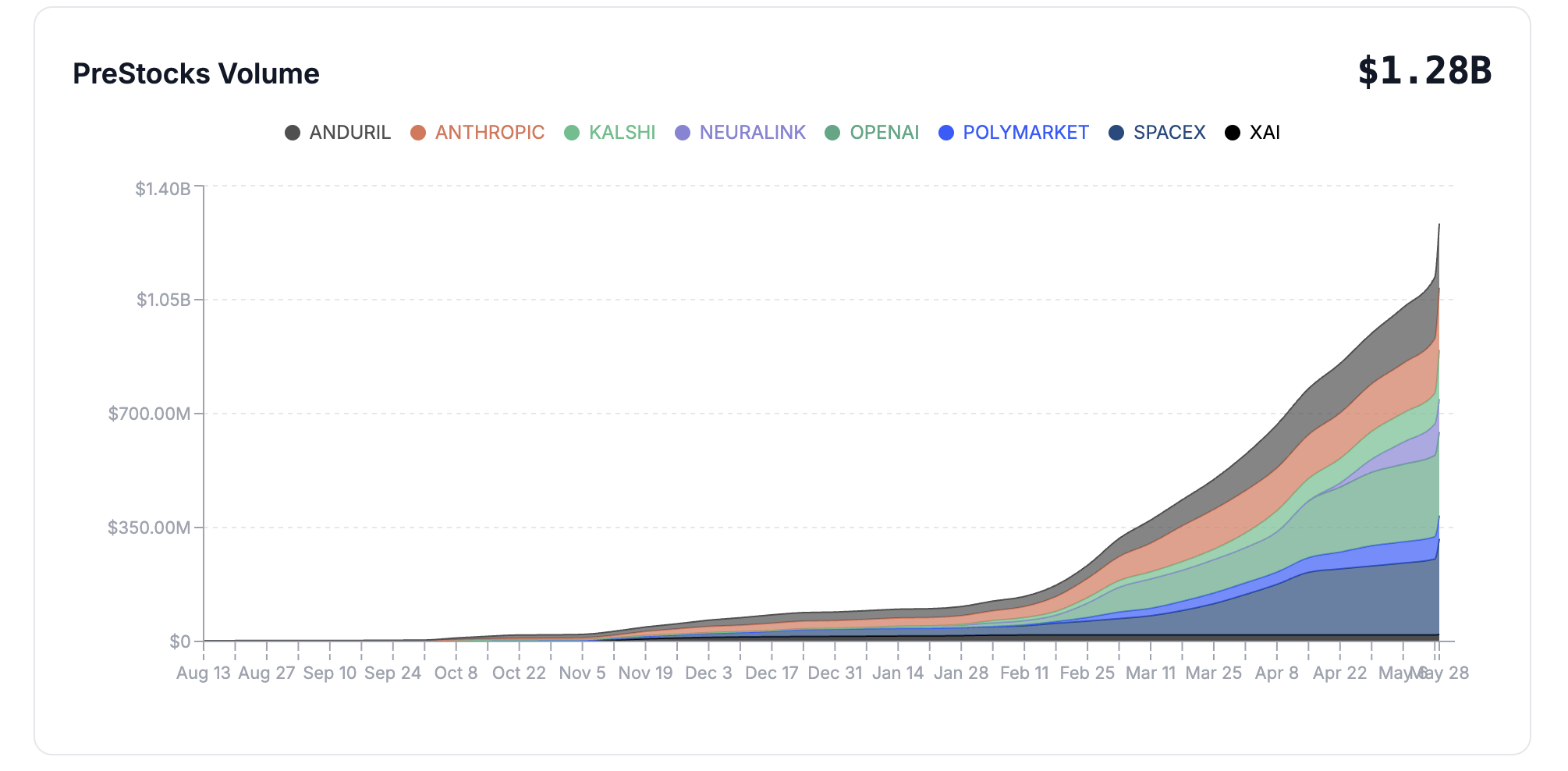
Compared to exchanges that emphasize "trading", on-chain platforms pay more attention to "assets themselves moving on-chain". For example, PreStocks provides Pre-IPO tokens that can be traded 24/7 through SPV exposure; VCXx launched by xStocks and Fundrise attempts to bring VC portfolio assets from companies such as SpaceX, OpenAI, Anthropic, Databricks on-chain. Bitget's preOPAI and Gate's SPCX essentially belong to this type. Currently, PreStocks has become one of the most active platforms in the on-chain pre-IPO market. Public data shows that the cumulative trading volume of PreStocks has exceeded $1.20 billion.
Source: https://prestocks.com/stats
Compared with the contractual route, the goal of asset tokenization is not only to provide transactions, but also to truly integrate unlisted assets into the on-chain financial system.
-
Once these assets are tokenized, they can theoretically further enter the DeFi ecosystem, such as being held by wallets for a long time, traded on DEXs, used as collateral, entering lending protocols, and being combined into new structured products. This means that Pre-IPO is no longer just a "short-term trading theme", but may become part of the new generation of on-chain RWA assets.
-
However, at the same time, the challenges faced by this route are more complex. As unlisted companies usually restrict stock circulation, whether on-chain tokens truly correspond to underlying rights, whether SPVs have legal holdings, and whether users have enforceable rights will continue to be scrutinized by the market and regulators. PreStocks' risk warning clearly emphasizes that the relevant tokens only provide economic exposure and do not confer ownership, voting rights, dividend rights, or information rights, nor do they represent official issuance or authorization of the relevant companies.
This means that even if the product name is OpenAI or SpaceX, it does not mean that the user actually holds the corresponding stock. Therefore, the core of the real competition in the on-chain route is not just liquidity, but who can establish the "on-chain private equity asset standard" recognized by the market first.
3.3 Prediction Markets: The Event Probability Route of Pre-IPO
In addition to trading and asset mapping, prediction markets represent a completely different approach. Platforms such as Polymarket do not attempt to solve the problem of "how equity exposure is brought on-chain", but directly regard IPO itself as a tradable event. For example: "Will SpaceX IPO before OpenAI?"; "Will OpenAI go public before a certain time?"; "Will a company delay its IPO?" etc.
User transactions are no longer based on the company's value itself, but on the market's probability judgment of event outcomes. The advantage of this model lies in its simple structure, clear legal boundaries, and natural suitability for information games and market expectation expression.
However, its limitations are equally obvious: the prediction market cannot provide real economic equity, nor can it replace users' direct exposure to valuation increases. Therefore, it is more like the "information market" of IPO narrative rather than a traditional capital market.
In the long run, the competition among these three routes is essentially about who can take the lead in transforming "unlisted assets" into a new liquid market. The exchange route emphasizes trading efficiency and market sentiment; the on-chain route emphasizes asset tokenization and DeFi integration; the prediction market emphasizes information pricing and event probability. They may not necessarily replace each other, but are more likely to coexist in the long run. The deeper change behind this is that the cryptocurrency market is trying to redefine how unlisted assets should be discovered, priced, traded, and turned into liquid markets. Traditional private equity markets have long belonged only to VC, PE, and high-net-worth investors. The emergence of Pre-IPO means that IPO expectations, financing valuations, and private equity assets are being repackaged by the cryptocurrency market into open trading products for global users.
4. The Three Core Tensions of Pre-IPO: Structural Conflicts Between Liquidity, Valuation, and Regulation
The rapid rise of Pre-IPO is not just a new trading hotspot, but the crypto market is trying to incorporate "unlisted assets" into the public liquidity system. In this process, the market has indeed opened up the participation threshold that used to only belong to VCs and high net worth investors, and for the first time, IPO expectations can be traded globally in real time like crypto assets. However, at the same time, it has also begun to expose increasingly obvious structural contradictions.
4.1 Liquidity Democratization vs Genuine Equity Ownership
The most attractive aspect of Pre-IPO to the market is that it allows ordinary users to participate in the valuation growth of super unicorns such as OpenAI, SpaceX, and Anthropic for the first time in advance. In the past, these assets stayed in the private equity market for a long time, and ordinary investors could hardly reach them. However, the cryptocurrency market attempts to transform the originally closed private equity valuation into globally tradable assets through perpetual contracts, SPV exposure, mirror assets, or VC portfolio tokens.
From the perspective of market structure, this is indeed a kind of "liquidity democratization". For the first time, IPO expectations have been publicly priced, and users can also trade unlisted company expectations like trading BTC or AI concept coins for the first time.
However, the problem is that the traditional private equity system was never designed for "public liquidity". Many companies have strict restrictions on share transfers, employee stock circulation, and SPV arrangements, and some companies even explicitly oppose unauthorized tokenized exposures. Therefore, although the market has obtained liquidity, users often only obtain price mapping, economic rights exposure, or future income agreements, rather than true equity stakes in the company.
In other words, the biggest contradiction in Pre-IPO is not whether it can be traded, but whether the asset being traded in the market is real, executable, and recognized.
4.2 Price Discovery vs Sentiment Amplification
Supporters usually believe that Pre-IPO provides an earlier price discovery mechanism. In the past, the valuation of unlisted companies stayed more in financing news, over-the-counter, and institutional quotes. However, when these assets enter the open market, the market can form implied valuations, liquidity discounts, and IPO expectations in real time for the first time.
But the question is, are these prices "discovering value" or "amplifying emotions"?
Unlike listed companies, most unlisted companies do not have a continuous public spot market, nor do they have standardized financial disclosures, unified valuation systems, and mature arbitrage mechanisms. The prices of many platforms are essentially still driven by valuations from recent funding rounds, off-exchange transfer prices, media reports, and market sentiment. This means that the prices of the same company may have huge deviations between different platforms for a long time, and the market lacks effective arbitrage mechanisms to correct them.
Therefore, Pre-IPO can easily evolve from "valuation trading" to "expectation trading". Especially when exchanges begin to introduce leverage, perpetual mechanisms, and high-frequency liquidity, market trading is often not about the company's fundamentals themselves, but about the emotional game of the market for the "next super IPO myth".
4.3 RWA Expansion vs Regulatory Conflict
Another issue that is more easily underestimated is the relationship between Pre-IPO and RWA. Currently, the market generally tends to view Pre-IPO as the next stage of expansion for RWA, that is, from “on-chain stable-income assets” to “on-chain high-growth equity assets”.
However, there is actually a fundamental difference between the two. In the past few years, mainstream RWA has focused more on US Treasury bonds, money market funds, and income-generating assets, which usually have clear ownership structures, stable cash flows, and mature legal frameworks. By contrast, many pre-IPO products are often backed only by SPVs, economic rights agreements, or mirrored exposures, leaving complex and vague legal boundaries between these products and traditional securities.
Therefore, the regulatory issues faced by Pre-IPO are not on the same level as traditional RWA. The real challenge is not whether assets can be brought on-chain, but whether unlisted equity can be publicly traded. For regulatory agencies, once these products begin to be traded to global users and map to real company valuations, it is easy to touch on issues such as securities attributes, information disclosure, and cross-border sales. As for underlying companies, what the cryptocurrency market is doing is essentially establishing a global public trading market before the company goes public.
In the long run, the real test of Pre-IPO may not be market trading demand itself, but whether the cryptocurrency market truly has the ability to legally, transparently, and sustainably bring liquidity to unlisted equity.
5. Outlook and Conclusion: Pre-IPO is the new boundary of RWA and the refinancialization of IPO expectations
5.1 Moving from “Stock Trading” to “Valuation Trading”
Pre-IPO is likely to become an important branch of the cryptocurrency market in the next few years, but its ultimate development direction may not necessarily return to traditional stock market logic.
From the current market structure, most products do not truly solve the problem of bringing genuine equity ownership on-chain, but instead establish new trading markets around "future valuation". Whether it is Binance's pre-market perpetuals, PreStocks' SPV exposure, or Polymarket's IPO event market, they are essentially doing the same thing: putting valuation expectations that originally only existed in the primary market and VC circle into the public liquidity system in advance.
This means that the core of Pre-IPO may not necessarily be "letting everyone hold unlisted stocks", but more likely: letting everyone trade "future listing expectations" in advance. Therefore, the future market is likely to diverge towards two routes.
-
The first type is the "synthetic expectation market". It does not emphasize the delivery of real equity, but allows users to trade valuations, IPO timing, and market sentiment. This route is closer to the original logic of the cryptocurrency market and easier to scale because it does not need to deal with complex stock transfer and company authorization issues, but the premise is to establish more transparent reference prices, index rules, and risk disclosure mechanisms.
-
The second type is the "real equity mapping market". This direction is closer to RWA, hoping to bring real unlisted equity into the on-chain financial system through SPV, fund structure, or on-chain securitization arrangements. If this model can solve custody, audit, investor suitability, and cross-border compliance issues, then the future on-chain world may really have unlisted equity assets that can be held, used as collateral, or integrated into other products over the long term.
In other words, what the crypto market is trying to do is not simply to replicate NASDAQ, but to establish a global valuation trading market in advance of the IPO. What is truly being refinancialized behind this may not be equity itself, but the market's expectations for "future growth".
5.2 Conclusion: What Users Buy Through Pre-IPO May Not Be Stocks
Returning to the original question of this article: Do Pre-IPO products give users actual stocks?
The answer is: in most cases, no.
Most products in the current market are closer to price exposure, economic rights mapping, SPV exposure, fund portfolio assets, or the probability expression of IPO events themselves. What users trade is often not actual shareholder status, but expectations around future valuation, future listing, and future liquidity. This also determines the essential difference between Pre-IPO and traditional stock markets. It may become the next stage of expansion for RWA, allowing global users to publicly participate in the valuation cycle of super unicorns for the first time. It may also evolve into another round of high-volatility market centered around "future imagination" due to equity mismatch, valuation failure, and regulatory conflicts.
The true significance of Pre-IPO may not lie in giving everyone access to OpenAI before its IPO, but in enabling the crypto market to openly trade future valuations for the first time.
About Us
Hotcoin Research, the core research and investment arm of Hotcoin Exchange, is dedicated to turning professional crypto analysis into actionable strategies. Our three-pillar framework—trend analysis, value discovery, and real-time tracking—combines deep research, multi-angle project evaluation, and continuous market monitoring.
Through our Weekly Insights and In-depth Research Reports, we analyze market dynamics and highlight emerging opportunities. With Hotcoin Selects—our exclusive dual-screening process powered by both AI and human expertise, we help identify high-potential assets while minimizing trial-and-error costs.
We also engage with the community through weekly livestreams, decoding market hot topics, and forecasting key trends. Our goal is to empower investors of all levels to navigate cycles with confidence and capture long-term value on Web3.
Risk Disclaimer
The cryptocurrency market is highly volatile, and all investments carry inherent risks. We strongly encourage investors to remain informed, assess risks thoroughly, and adhere to strict risk management practices to protect their assets.
Connect with Us
Website:https://www.hotcoin.com/en_US/learn/index/
X: x.com/HotcoinAcademy
Email: labs@hotcoin.com
Lettura consigliata
Visualizza altro
Hotcoin Research | Why did Sun Ge’s entry into WBTC cause controversy? An article analyzing BTC anchor coins and their security
In-depth Research
Hotcoin Research | The DeFi 0 Threshold Era Is Coming: Observations and Analysis of the Abstraction and Intention Tracks
In-depth Research

Hotcoin Research | Analyzing Crypto Prediction Markets, Represented by Polymarket: Source of Truth or On-Chain Casino?
In-depth Research

E-mail del servizio clienti
Service@hotcoin.com
feedback sul prodotto
Product@hotcoin.com
cooperazione commerciale
Business@hotcoin.com
Casella di posta giudiziaria
Casecn@hotcoin.com
chi siamo
prodotto
Servire
supporto
©2017-2026