
Hotcoin Research | Crypto ETFs Enter 2.0: From Spot Exposure to the Asset Management Era
Introduction: What HYPE ETFs Tell Us About Crypto ETF 2.0
Since the approval of U.S. spot Bitcoin ETFs in 2024, crypto ETFs have become one of the most important gateways for traditional capital to access digital assets. From BTC and ETH to SOL, XRP, and more recently HYPE-related products built around Hyperliquid, crypto ETFs have expanded beyond simple price tracking to encompass staking rewards, protocol growth, index allocation, and actively managed strategies. As a result, the competitive landscape of crypto ETFs is evolving from a focus on providing asset exposure to delivering yield, investment strategies, and differentiated portfolio solutions.
Recently, both 21Shares and Bitwise launched HYPE-related products. Some are designed to hold spot HYPE while seeking to capture on-chain staking rewards, while others provide leveraged exposure to the asset. Although these products are built around the same underlying token, they offer fundamentally different risk-return profiles. This raises an important question: when ETFs begin packaging staking rewards, protocol economics, and investment strategies, are investors still buying the token itself, or are they purchasing a financial product redesigned by the issuer?
I. From BTC to HYPE: Why Are Crypto ETFs Becoming More Complex?
Using the U.S. market as a reference, the evolution of crypto ETFs can be divided into four distinct stages. While physically backed crypto ETPs existed in other jurisdictions before the United States entered the market, the approval of U.S. futures-based ETFs marked the beginning of a formal domestic regulatory pathway.
-
Stage 1: Indirect Exposure Through Futures: On October 19, 2021, ProShares launched BITO, the first Bitcoin futures ETF in the United States. Rather than holding BTC directly, BITO gains exposure through CME Bitcoin futures contracts. The product addressed key regulatory and custody challenges, but introduced new limitations, including rollover costs, futures-spot basis risk, and tracking error.
-
Stage 2: Direct Ownership Through Spot ETFs: In January 2024, asset managers including BlackRock, Fidelity, ARK 21Shares, and Bitwise launched spot Bitcoin ETFs. Spot Ethereum ETFs followed in July of the same year. Unlike futures-based products, spot ETFs directly hold the underlying asset, allowing fund performance to track spot market prices more closely. As a result, competition shifted from regulatory approval to factors such as management fees, liquidity, custody capabilities, and tracking efficiency.
-
Stage 3: Expansion of Underlying Assets: Following the launch of BTC and ETH ETFs, the range of eligible underlying assets began to expand significantly. From late 2024 through 2026, issuers extended their filings and product offerings to assets such as SOL, XRP, HYPE, SUI, DOGE, and DOT. Crypto ETFs were no longer limited to the most established assets, but increasingly expanded into public blockchain ecosystems, protocol tokens, and other high-profile digital assets.
-
Stage 4: Expansion of Yield and Investment Strategies: The market has now clearly entered a fourth stage characterized by the expansion of yield generation and investment strategies. Products such as SOL staking ETFs, HYPE staking ETFs, the 2x Long HYPE ETF, and crypto index ETFs address different investor needs, including staking rewards, leveraged exposure, diversified portfolio allocation, and yield-enhancement strategies. The evolution does not stop there. Crypto ETFs have also begun moving into active management. For example, the 21Shares Active Crypto ETF (TKNS) no longer passively tracks a single token or index. Instead, the fund manager dynamically adjusts allocations across crypto assets and related instruments based on market conditions, valuation levels, liquidity, and risk factors.
Several clear commercial forces are driving this evolution. Spot BTC and ETH ETFs have already developed highly concentrated market structures, making it increasingly difficult for new entrants to compete with undifferentiated products alone. As a result, issuers are seeking new ways to attract assets through lower fees, staking rewards, leverage, active management, and exposure to emerging assets. At the same time, many PoS tokens generate staking rewards, while protocol tokens may derive value from transaction fees, buyback programs, and ecosystem incentives. An ETF that merely tracks price performance may leave part of the asset’s economic value untapped. In this sense, Crypto ETF 2.0 represents the application of traditional asset management frameworks such as indexing, leverage, active management, and yield enhancement to digital assets on a much broader scale.
II. What Are ETFs Really Packaging? From Price Exposure to Asset Management Tools
The evolution of crypto ETFs from BTC futures products to HYPE-related funds reflects more than just an expansion of underlying assets. It also represents an expansion in product functionality and sources of return. When ETFs move beyond simple price tracking, an important question emerges: what exactly are investors buying?
2.1 Spot ETFs: Lowering Ownership Barriers While Sacrificing On-Chain Functionality
Spot ETFs represent the most straightforward ETF structure. The fund directly holds the underlying token, while investors gain exposure through ETF shares whose value reflects the fund’s net asset value (NAV). This structure eliminates many of the challenges associated with direct ownership, including wallet management, private key security, custody arrangements, compliance requirements, and tax reporting.
However, ETF investors generally do not enjoy the same utility as direct token holders. An investor cannot withdraw BTC held within a spot ETF to a personal wallet, nor can they use ETH, SOL, or HYPE held by the fund to participate in DeFi applications, governance processes, payment networks, or other on-chain activities. ETF shares provide economic exposure through the securities market, but they do not confer direct control over the underlying on-chain assets.
2.2 Staking ETFs: Bringing On-Chain Yield Into Funds While Introducing New Intermediary Risks
Staking ETFs seek to address one of the major limitations of spot ETFs—the inability to capture on-chain yield. Take 21Shares’ THYP as an example. The fund tracks the price of HYPE while staking a portion of its holdings to generate additional rewards. As of June 10, 2026, THYP had approximately $61.85 million in AUM and charged a management fee of 0.30%. Bitwise’s BHYP follows a similar approach, with HYPE holdings expected to be staked through Bitwise Onchain Solutions. Any staking rewards generated accrue to the fund rather than being distributed directly to investors, and such rewards are not guaranteed.
At first glance, staking ETFs may appear to be little more than spot ETFs with an additional yield component. In reality, they introduce several new layers of risk. Fund managers must select validators or staking service providers, manage lock-up and unstaking periods, and ensure sufficient liquidity to meet ETF creation and redemption requests. If validators experience downtime, engage in misconduct, or are subject to slashing penalties, fund assets may be affected. Likewise, large-scale redemptions during lock-up periods could create liquidity mismatches within the fund structure.
2.3 Leveraged ETFs: Packaging a Daily Trading Strategy Rather Than a Long-Term Investment
Leveraged ETFs differ fundamentally from spot ETFs. The objective of the 21Shares 2x Long HYPE ETF (TXXH), for example, is to deliver twice the daily performance of HYPE—not twice its long-term cumulative return. To achieve this objective, the fund primarily relies on swaps, futures, and options rather than directly holding HYPE. Its mandate is designed around daily performance targets rather than long-term investment outcomes. As of June 12, 2026, TXXH managed approximately $6.16 million in AUM and charged a management fee of 1.89%, substantially higher than THYP.
In strongly trending markets, compounding effects may amplify returns. In volatile and range-bound markets, however, frequent portfolio rebalancing can create volatility drag that erodes performance over time. As a result, even if HYPE eventually returns to its original price level, TXXH may still experience significant losses due to the path of daily price movements. For this reason, leveraged ETFs should not be viewed as a more aggressive version of a long-term HYPE investment. Instead, they are trading instruments designed primarily for short-term tactical exposure.
2.4 Protocol-Asset ETFs: Exposure to Protocol Growth Without Equity Ownership
The significance of HYPE-related ETFs extends beyond the token itself. They represent one of the first attempts to introduce protocol assets to a broader traditional investor base.
The investment thesis behind HYPE is closely linked to Hyperliquid’s trading volume, fee generation, token buybacks, staking activity, and ecosystem expansion. Compared with BTC, HYPE more closely resembles an on-chain economic network supported by measurable business metrics. Traditional investors can analyze Hyperliquid’s trading activity, revenue generation, market share, buyback programs, user growth, and the development of the HyperEVM ecosystem to form a view on the token’s potential value.
Yet protocol tokens remain fundamentally different from equities. HYPE holders have no legal claim on Hyperliquid’s cash flows. Buyback mechanisms can change over time, and governance rights differ substantially from shareholder rights in traditional corporations. Purchasing THYP is therefore not equivalent to investing directly in Hyperliquid as a company. This highlights one of the defining limitations of ETF 2.0: ETFs can package protocol economics into a security that fits within traditional brokerage accounts, but they cannot automatically transform tokens into equity ownership.
2.5 Actively Managed ETFs: From Selecting Assets to Selecting Strategies
Active management represents the next stage in the evolution of crypto ETFs. Rather than tracking a single asset or predefined index, the 21Shares Active Crypto ETF (TKNS) allows portfolio managers to actively select and adjust exposures across crypto assets and related investment instruments. As of June 12, 2026, TKNS had approximately $207,000 in AUM, charged a management fee of 1.05%, and recorded daily trading volume of only around $138.
In theory, active management is well-suited to the crypto market, where technological innovation, sector rotation, and asset differentiation occur at a much faster pace than in traditional financial markets. At the same time, active management shifts a significant portion of investment risk from the assets themselves to the decision-making ability of the portfolio manager. The modest size of TKNS today illustrates an important reality: the existence of an actively managed crypto ETF does not necessarily mean that the market has embraced the product.
III. After the ETF Boom: Why Do Winners Capture Most of the Capital?
The reality of Crypto ETF 2.0 is not one of evenly distributed growth across products and assets. Instead, it is characterized by rapid product expansion alongside increasing concentration of capital. As more issuers enter the market, crypto ETFs are gradually moving beyond the product innovation phase and into an era defined by scale competition.
3.1 Crypto ETFs Are Expanding Rapidly
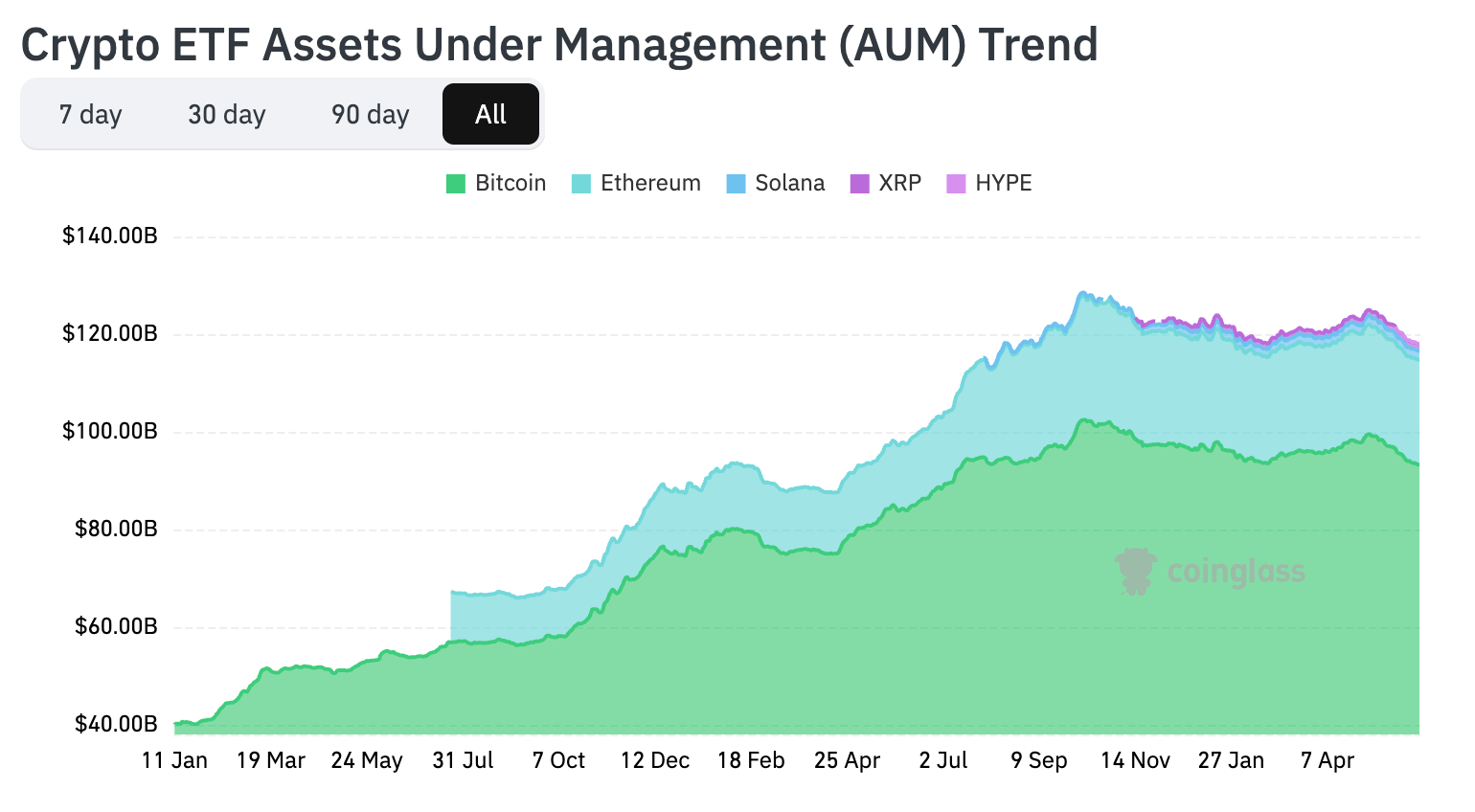
Since the approval of spot Bitcoin ETFs in the United States in 2024, the crypto ETF market has entered a period of rapid expansion. According to data from Morningstar Direct cited by The Wall Street Journal, asset managers have launched approximately 130 new crypto ETFs, while another 155 digital asset ETFs are either awaiting approval or in development. As of June 12, 2026, the 32 crypto ETFs tracked by CoinGlass collectively managed approximately $118.07 billion in assets across 11 issuers. The AUM trend shows that total assets grew from less than $40 billion following the launch of U.S. spot Bitcoin ETFs in January 2024 to nearly $130 billion at their peak. Although crypto ETFs experienced cumulative net outflows of approximately $5.49 billion over the past month, total AUM has remained above $100 billion. This suggests that crypto ETFs have evolved from an emerging product category dependent on short-term capital inflows into a market segment supported by a substantial and relatively stable asset base.
Source: https://www.coinglass.com/etf
Product diversity has expanded significantly as well. Beyond spot BTC and ETH ETFs, the market now includes ETFs linked to SOL, XRP, HYPE, and other crypto assets, alongside staking ETFs, leveraged ETFs, actively managed ETFs, and index-based products. As a result, ETFs are gradually evolving from simple price-tracking vehicles into comprehensive investment products that provide exposure to yield generation, investment strategies, and protocol growth.
3.2 The Matthew Effect in the ETF Industry
The ETF industry is inherently driven by network effects. An increase in the number of products does not necessarily result in a more even distribution of capital. For investors, an ETF’s competitiveness is determined not only by its underlying asset exposure, but also by factors such as liquidity, trading depth, and transaction costs. Larger ETFs typically attract higher trading volumes and more active market-making participation, resulting in tighter bid-ask spreads and lower trading friction.
This creates a powerful positive feedback loop:
-
Larger funds tend to enjoy better liquidity.
-
Better liquidity leads to tighter spreads.
-
Tighter spreads make products more attractive to institutional investors.
-
Additional inflows further strengthen scale and liquidity.
Today, Bitcoin and Ethereum ETFs account for approximately 97% of total crypto ETF AUM. While SOL, XRP, and HYPE ETFs have expanded the universe of investable crypto assets, their combined share of industry assets remains below 3%. This highlights two developments occurring simultaneously within the crypto ETF market. On the one hand, the number of products and the range of underlying assets continue to expand rapidly. On the other hand, capital remains heavily concentrated in BTC and ETH. At the same time, assets continue to flow toward ETFs managed by a small number of leading asset managers, while smaller funds face increasing difficulty attracting investor attention and capital. For institutional investors, liquidity is often more important than product innovation. Even when multiple ETFs provide similar exposure, capital typically gravitates toward the largest and most actively traded funds.
3.3 The "Winner-Takes-Most" Dynamic of Traditional ETFs
This phenomenon is not unique to crypto ETFs. Rather, it reflects a long-standing characteristic of the broader ETF industry. In the U.S. equity ETF market, for example, the SPDR S&P 500 ETF (SPY), Vanguard S&P 500 ETF (VOO), and iShares Core S&P 500 ETF (IVV) collectively account for the vast majority of assets tracking the S&P 500 Index. Although numerous products track the same benchmark, assets continue to concentrate in a small number of funds with the deepest liquidity and largest asset bases. The reason is straightforward: for institutional investors, scale, liquidity, and execution efficiency often matter more than marginal differences in management fees. As a result, the ETF industry naturally exhibits a winner-takes-most dynamic.
Crypto ETFs appear to be following a similar path. From spot BTC ETFs to HYPE-related products, innovation remains important. However, the factors most likely to determine long-term success are still AUM, liquidity, and market depth.
3.4 Crypto ETFs May Be Entering an Elimination Phase
According to FactSet data, BlackRock's IBIT accounts for nearly 60% of the U.S. spot Bitcoin ETF market, while Fidelity's FBTC holds approximately 13%. Together, the two products control roughly 72% of total market assets.
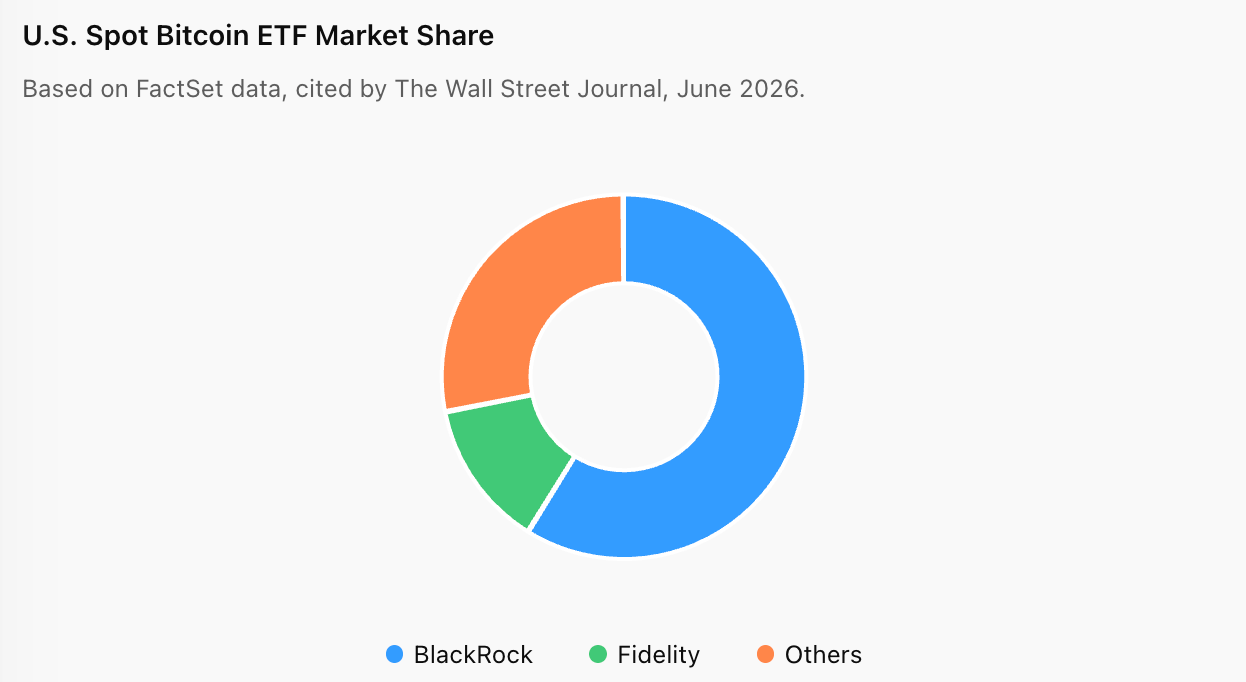
Such a highly concentrated market structure suggests that newly launched ETFs will face increasingly intense competition. Industry participants generally believe that an ETF needs approximately $25 million to $100 million in AUM to support the costs associated with issuance, custody, compliance, auditing, and market making, while maintaining a sustainable business model over the long term. For smaller funds with limited trading activity, the inability to attract consistent inflows may eventually lead to liquidation or closure. As an increasing number of similar products enter the market, the crypto ETF industry may gradually transition from a race to launch products into a process of market consolidation and elimination.
IV. The Four Structural Tensions of ETF 2.0
The significance of Crypto ETF 2.0 extends far beyond the growing number of products or the expanding range of underlying assets. More importantly, it is reshaping how investors access and interact with crypto assets. From spot ETFs to staking ETFs, protocol-asset ETFs, and actively managed products, crypto assets are becoming increasingly integrated into traditional financial markets. Yet this integration is not an unqualified positive. It introduces a new set of structural tensions that sit at the intersection of traditional finance and crypto-native systems.
4.1 ETFs Make Crypto Easier to Buy, but Harder to Use
The greatest contribution of ETFs is accessibility. Investors can gain exposure to crypto assets through brokerage accounts, retirement accounts, and traditional wealth management platforms without having to manage wallets, safeguard private keys, pay gas fees, or navigate on-chain security risks. For many traditional investors, purchasing a BTC ETF, ETH ETF, or THYP is significantly more convenient than directly holding the underlying asset.
However, that convenience comes at a cost. When investors purchase an ETF, they gain economic exposure to the asset rather than full participation in its ecosystem. Whether the underlying asset is BTC, ETH, or HYPE, ETF investors generally cannot participate in governance, receive airdrops, use DeFi applications, or engage with other forms of on-chain activity.
In other words, ETFs make crypto assets easier to invest in while simultaneously distancing investors from the underlying crypto economy. For an industry built around open participation, self-custody, and permissionless access, this creates an inherent tension.
4.2 ETFs Bring Yield Into Brokerage Accounts, but Add New Layers of Intermediation
The emergence of staking ETFs represents one of the most significant innovations of the ETF 2.0 era. Products such as THYP, BHYP, and various SOL staking ETFs attempt to incorporate on-chain staking rewards into traditional investment vehicles. As a result, investors can potentially earn both price appreciation and staking-related yield without managing wallets or operating validator infrastructure. From a capital efficiency perspective, this is an attractive proposition.
Yet yield does not come without trade-offs. In a native blockchain environment, users can choose validators, determine staking allocations, and directly manage associated risks. Within an ETF structure, those decisions are delegated to fund managers, custodians, and third-party service providers.
As a result, the yield remains, but control becomes increasingly centralized. Investors benefit from a simpler user experience, but become more dependent on the judgment and operational competence of issuers, custodians, and validator operators. As staking ETFs continue to grow, the concentration of validation power among a small number of institutions may itself become an important industry concern.
4.3 ETFs Make Protocols Easier to Value, but Cannot Solve the Ownership Problem
The rise of protocol-asset ETFs introduces a new question for traditional capital markets: How can investors gain exposure to crypto protocols?
Hyperliquid provides a useful example. The value of HYPE is closely tied to the growth of the underlying protocol, including trading activity, fee generation, ecosystem expansion, and network adoption. Products such as THYP and BHYP allow traditional investors to gain exposure to these dynamics through familiar ETF structures. In this sense, ETFs lower the barriers to investing in crypto protocols and make protocol valuation more accessible to traditional markets.
However, a fundamental limitation remains. Unlike equities, protocol tokens generally do not represent ownership. Token holders typically lack legal claims on protocol cash flows and do not enjoy the same rights afforded to corporate shareholders. Even if an ETF accumulates a substantial HYPE position, investors ultimately benefit only from changes in token value rather than ownership of the underlying protocol.
As a result, ETFs can securitize exposure to protocol economics, but they cannot securitize protocol ownership. This remains one of the defining distinctions between protocol-asset ETFs and traditional equity ETFs. While ETFs can help traditional capital markets understand and allocate capital to crypto protocols, they cannot fully replicate the ownership structure and shareholder rights embedded in equity markets.
4.4 ETFs Accelerate Industry Maturity, but May Dilute Crypto-Native Characteristics
From a broader perspective, ETFs are helping move the crypto industry into an asset management era. Historically, crypto investing emphasized self-custody, direct ownership, governance participation, and on-chain engagement. Investors interacted directly with protocols, signed transactions, and actively participated in blockchain ecosystems. Today, an increasing share of capital accesses crypto through ETFs. In the future, as actively managed ETFs, index ETFs, yield-enhancement products, and multi-asset crypto strategies continue to develop, investors may care less about which blockchain an asset runs on or what technology powers it. Instead, attention may increasingly focus on fund performance, portfolio construction, and risk-adjusted returns.
The investment framework is gradually changing: Previously, investors bought BTC and held it. Today, they buy BTC ETFs. Tomorrow, they may buy diversified crypto strategy portfolios without interacting with the underlying assets at all. This evolution could attract substantial amounts of traditional capital, improve market liquidity, and contribute to industry maturation. At the same time, it may weaken some of the crypto-native characteristics that originally distinguished the asset class.
At its core, ETF 2.0 is driving the convergence of crypto assets and traditional finance. Yet this convergence reflects a deeper and enduring tension between financialization and decentralization. ETFs may ultimately serve as a bridge between these two worlds, but in doing so, they are also redefining the original value proposition of crypto assets.
V. Outlook: Crypto ETFs Are Entering the Asset Management Era
The development of crypto ETFs has moved beyond the regulatory question of whether they can be approved and into a new phase focused on how they compete. If ETF 1.0 addresses how traditional investors could gain exposure to crypto assets, ETF 2.0 is beginning to answer a different question: How will crypto assets be integrated into the global asset management ecosystem?
5.1 Competition Will Shift from Asset Expansion to the Race for AUM
Over the past two years, the primary battleground for crypto ETFs has been asset expansion. The market progressed from BTC and ETH to SOL, XRP, HYPE, and a growing range of digital assets. Issuers competed to launch the first approved product and secure first-mover advantages in emerging categories.
As the number of products continues to increase, however, the focus of competition is gradually shifting from expanding asset coverage to attracting and retaining capital. In the ETF industry, the number of products is ultimately less important than the amount of capital they attract. Liquidity, trading depth, brand recognition, and distribution capabilities all eventually translate into one metric: assets under management. Institutions with stronger issuance capabilities, broader distribution networks, and greater market credibility are likely to attract a disproportionate share of future inflows.
The experience of traditional ETF markets suggests that a small number of leading products often capture the majority of assets, while many similar offerings struggle to achieve meaningful scale. The crypto ETF market is likely to follow a similar path. Going forward, the key measure of success may gradually shift from the number of products launched to the size of assets accumulated.
5.2 Yield-Oriented and Strategy-Based Products May Become the New Mainstream
As spot ETFs mature, products that merely provide price exposure may find it increasingly difficult to differentiate themselves. Future innovation is therefore likely to center on yield generation and investment strategies.
On one hand, staking ETFs are likely to continue expanding. By incorporating on-chain rewards into fund returns, issuers can offer investors an additional source of return beyond price appreciation alone. The market may eventually see a broader range of staking ETFs built around SOL, HYPE, and other PoS-based networks.
On the other hand, strategy-driven products are likely to become increasingly diverse. Actively managed ETFs, index ETFs, leveraged ETFs, yield-enhancement strategies, and multi-asset portfolios are bringing well-established asset management frameworks into the crypto market. As a result, investors may increasingly focus not only on what assets they own, but also on how those assets are managed.
This evolution suggests that competition among crypto ETFs will gradually shift from competition between underlying assets to competition between asset management capabilities.
5.3 Crypto Assets Are Being Repackaged as Traditional Financial Products
From a longer-term perspective, the growth of crypto ETFs represents part of the broader financialization of digital assets. BTC ETFs are often positioned as digital gold. ETH ETFs are increasingly presented as exposure to smart contract infrastructure. THYP and BHYP offer access to Hyperliquid's protocol growth and potential staking rewards. TKNS, meanwhile, resembles a traditional actively managed investment fund.
For an increasing number of traditional investors, understanding wallets, private keys, gas fees, and on-chain interactions may no longer be necessary. Nor do they need to hold the underlying tokens directly. Instead, ETFs provide exposure to the assets, yields, or investment strategies associated with those tokens through familiar investment vehicles. This lowers the barriers to participation, but also increases the distance between investors and the underlying blockchain ecosystems.
Looking ahead, the crypto market may evolve into two parallel systems. One will consist of ETFs, mutual funds, and asset management products designed for institutions and traditional investors. The other will remain rooted in on-chain protocols and decentralized finance, serving native crypto users. ETFs may ultimately become one of the most important bridges connecting these two worlds.
Conclusion
The significance of ETF 2.0 lies not simply in the emergence of more crypto ETFs but in the broader transformation of how crypto assets are packaged, valued, and incorporated into the global asset management system.
From spot Bitcoin ETFs to HYPE staking ETFs, and from actively managed funds to strategy-based products, investors are no longer purchasing tokens alone. They are increasingly buying financial products that have been structured, packaged, and risk-managed by professional institutions.
The crypto market is undergoing a transition from on-chain assets to allocatable assets. ETFs may not change blockchain technology itself, but they are changing how global capital gains exposure to the crypto asset class.
About Us
Hotcoin Research is the research and insights division of Hotcoin, dedicated to turning professional research into actionable investment insights.
Through Weekly Insights and In-Depth Research Reports, we help investors understand market trends, underlying dynamics, and emerging opportunities across the digital asset ecosystem. Our Elite Picks series combines AI-assisted screening with analyst-driven research to identify promising assets and help investors evaluate opportunities more efficiently.
Through regular livestreams, our research team provides timely analysis of market developments and major industry trends. We believe that informed decision-making and a long-term perspective can help investors navigate market cycles and capture lasting value in Web3.
Risk Disclaimer
The cryptocurrency market is highly volatile, and all investments carry inherent risks. We strongly encourage investors to remain informed, assess risks thoroughly, and adhere to strict risk management practices to protect their assets.
Connect with Us
Website:https://www.hotcoin.com/en_US/learn/index/
X: x.com/HotcoinAcademy
Email: labs@hotcoin.com
Lettura consigliata
Visualizza altro
Hotcoin Research | Play and Earn Web3: Castile - A New Era of 3A Idle RPG in the Fantasy Cthulhu Universe
In-depth Research

Hotcoin Research | The Second Battlefield of the AI Supercycle: A 24/7 On-Chain Price Discovery Experiment
In-depth Research

Hotcoin Research | WEB3 Earnings:: Exploring Apeiron: A Revolutionary Blockchain Game Blending Mythology and Modern Gameplay
In-depth Research

E-mail del servizio clienti
Service@hotcoin.com
feedback sul prodotto
Product@hotcoin.com
cooperazione commerciale
Business@hotcoin.com
Casella di posta giudiziaria
Casecn@hotcoin.com
chi siamo
prodotto
Servire
supporto
©2017-2026