Advanced Futures Strategies: Hedging, Risk Locking and Calendar Spreads
Hedging, business hedging and calendar spreads are advanced uses of futures trading. Their core purpose is to manage price risk with derivatives rather than to chase directional profit. A hedge protects a spot position from an adverse price move; a business hedge lets a company or institution lock in a future buying or selling price and remove uncertainty; a calendar spread captures the price gap between contracts with different expiry dates. What these three strategies share is that they are direction-neutral: profit and loss do not depend on a call on one-way price action, but on changes in the spread, the basis or the relationship between prices. In a crypto market dominated by institutional investors, basis trading and similar arbitrage strategies have become an important link between the spot and futures markets.
Hedging: Using Futures to Protect Your Spot Position
A hedge is essentially a futures position that runs opposite to your spot position, so that gains and losses on the derivative offset the price movement of the spot asset.

Short hedge: protecting coins you already hold
If you hold BTC or ETH in your spot wallet and do not plan to sell in the near term, but you are worried about a price decline, you can open a short futures position. When the market falls, your spot holdings show an unrealized loss, while the profit on the short futures position offsets part or all of that loss.
Example: in early 2025, while BTC was consolidating in the 69,000–70,000 USD range, many institutional investors used perpetual futures to short-hedge their spot holdings while waiting to see how macro policy would develop.
Long hedge: locking in a future purchase price
If you plan to buy an asset in the future but expect the price may rise before then, you can open a long futures position in advance to lock in the current price and avoid missing the upside.
The core value of hedging is that it separates two decisions: whether to hold an asset, and whether to carry price risk. With a hedge, you can keep your long-term allocation while temporarily reducing how much price volatility affects your account.
Business Hedging: Locking In Certainty About Future Prices
Hedging for business purposes is the scaled-up application of hedging at the level of companies and institutions. Its goal is to lock in future buying and selling prices and remove uncertainty, not to profit from price swings.

How hedging works in traditional finance
In traditional commodity markets, hedging is standard practice for companies that need to withstand price volatility. A copper processor, for example, takes a forward order and then faces the risk that rising raw material prices will erode its margin. The traditional approach is to buy futures as a hedge, but holding a long position for a long time ties up a large amount of margin and is capital-inefficient.
A more advanced solution: a copper processor can hedge at low cost with an accumulator option strategy, earning income continuously within a set price range to subsidize raw material costs; in one such operation the accumulation lowered the cost of each ton of raw material by about 4,579 yuan.
Hedging in the crypto market
In crypto, delivery futures are often used for structured hedging. Because delivery futures have a fixed expiry date and charge no funding fee, they are well suited to managing price risk around a specific point in time, such as a token unlock or a portfolio rebalance.
Large institutions hedge at scale through basis trading: they buy BTC in the spot market or through an ETF and sell an equivalent amount of futures, earning the basis by which futures trade above spot. This strategy is delta-neutral. The short position is not a directional bet against the market, but a way to offset the risk exposure of the spot holdings.
Calendar Spreads: Capturing the Gap Between Expiry Dates
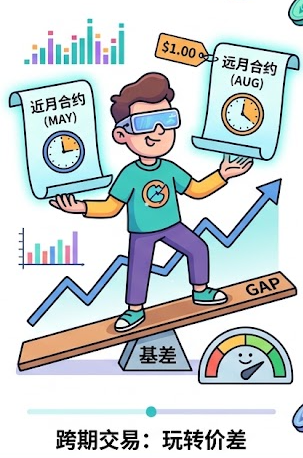
A calendar spread trades the price gap between contracts on the same asset with different expiry dates. It does not bet on whether the price will rise or fall in absolute terms, but on whether the gap between the near-month contract and the far-month contract widens or narrows.
The basic logic of a calendar spread
In a normal market, the far-month contract trades higher than the near-month contract (contango), because it includes carrying costs and time value. Under unusual market sentiment, the opposite can happen and the far month trades below the near month (backwardation).
Buy spread: buy the far-month contract and sell the near-month contract. This profits when the spread widens, which corresponds to an expectation that sentiment turns bullish or that carrying costs rise.
Sell spread: sell the far-month contract and buy the near-month contract. This profits when the spread narrows, which corresponds to an expectation that sentiment turns bearish or that the liquidity premium falls.
Exchanges usually offer a spread trading function that supports spreads between spot and perpetual futures, spot and delivery futures, perpetual and delivery futures, and delivery contracts with different expiry dates. Its main advantage is atomic execution: both legs fill at the same time, removing the multi-leg risk of one leg filling while the other does not.
The cost advantage of spread trading
Compared with manually executing two offsetting trades on the order book, using the spread trading function can halve your fees outright, which noticeably lowers trading costs over time for large or high-frequency traders.
Dual-Side Position Mode: The Infrastructure Behind Advanced Strategies
Executing hedging, business hedging and calendar spread strategies requires being able to hold long and short positions in the same contract pair at the same time. Hotcoin supports dual-side position mode, which lets users hold long and short positions in the same contract simultaneously.
Isolated margin mode: the margin for the long and short positions is independent, and liquidation prices are calculated separately.
Cross margin mode: the long and short positions share the account margin, and unrealized profits and losses offset each other. This is exactly what a hedging strategy needs: once the gains and losses of the two sides cancel out, what remains is the risk exposure that is genuinely open.
FAQ
Q1: How much margin does a hedge require?
It depends on the position mode and leverage settings. In isolated mode, the margin for long and short positions is calculated separately; in cross mode, both sides share a single margin pool and unrealized profits can automatically cover unrealized losses. Cross mode is more common for hedging strategies because it lets gains and losses offset naturally.
Q2: How is a calendar spread different from ordinary directional trading?
A calendar spread does not bet on the absolute direction of the price, but on the change in the spread between two contracts. Even if the price rises sharply, your profit and loss depends mainly on whether the spread between the two contracts widens or narrows, not on whether BTC itself goes up or down. The key advantage is that it is direction-neutral: it is not directly affected by a one-way trend in the underlying asset.
Q3: What is the difference between business hedging and an ordinary hedge?
Hedging is the broader concept and covers any operation that uses derivatives to offset risk exposure. Business hedging usually refers to systematic risk management at the level of a company or institution, with a clear commercial purpose such as locking in procurement costs or offsetting inventory depreciation. It is larger in scale and more structured as a strategy.
Related guides:
The Complete Futures Trading Guide: From Basics to Risk Control
What Is a Funding Rate? The Price-Anchoring Mechanism of Perpetual Futures
Cross Margin vs Isolated Margin: Differences and How to Choose
Recommended reading:
Lettura consigliata
Visualizza altro