What Is Injective (INJ) and How to Buy It?
Injective is a Layer 1 blockchain designed specifically for financial use cases, with built-in order book, derivatives and RWA modules. Its goal is to bring trading, lending and asset management all on-chain.
INJ is the network's native token, used for staking, governance and fee burning. Its narrative has expanded from a "DeFi public chain" to "on-chain financial infrastructure," but competition is intense.
Key Takeaways
- Injective is a finance-focused L1 offering a native order book, derivatives, RWA and EVM compatibility.
- The network uses Tendermint consensus, enabling fast transaction confirmations suitable for high-frequency financial applications.
- INJ is used for staking, governance and burn auctions. Total supply is 100 million, and the token is already largely in full circulation.
- Risks include public chain competition, ecosystem adoption, regulation and market volatility.
What Is Injective?
Injective's defining feature is "built-in financial primitives": developers can directly call order book, derivatives and oracle modules instead of building from scratch. It is also EVM-compatible, making it easier for Ethereum developers to migrate.
INJ's economic model includes staking, governance and burn auctions: part of network fees is used to buy back and destroy INJ, creating deflationary pressure. Validators and delegators secure the network, while holders participate in governance.
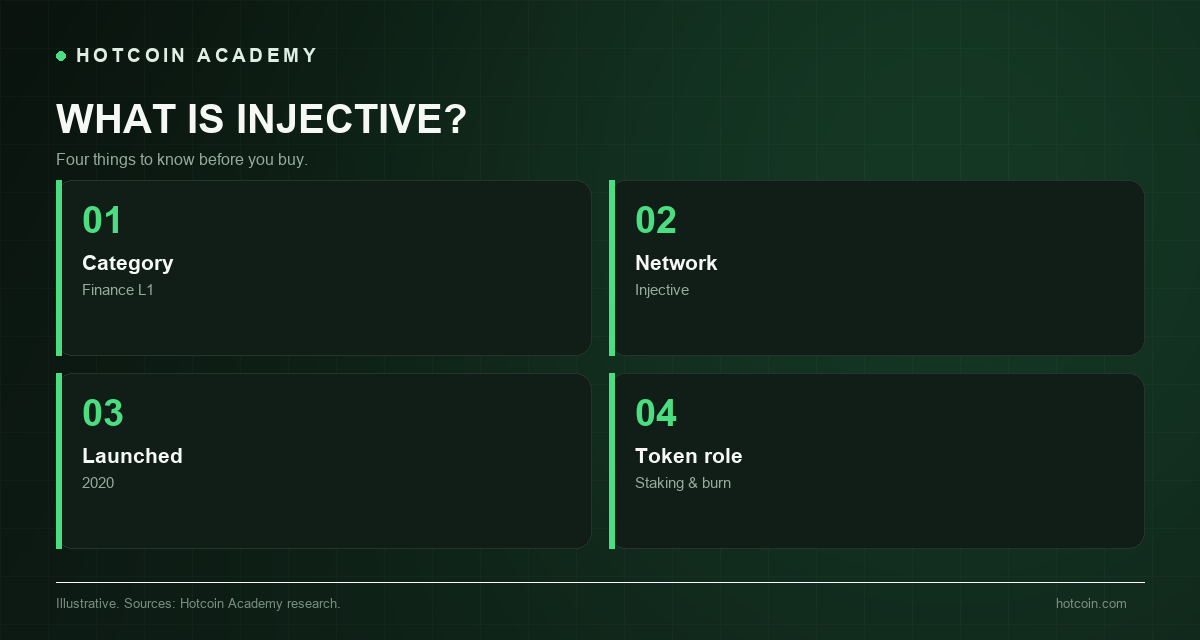
Illustration: Four basic facts about Injective.
Injective also targets RWA, FX and prediction markets as growth areas, attempting to replicate multiple traditional finance scenarios on-chain.
How Does Injective Work?
Injective's operation can be broken down into three parts:
- Staking: Delegate INJ to validators to help secure the network and earn rewards.
- Governance: Vote on parameters, upgrades and the ecosystem fund.
- Burning: Fees enter burn auctions, reducing INJ's circulating supply.
INJ Tokenomics
INJ has a total supply of 100 million and is already largely in full circulation. Token value is tied to network fees, staking demand and ecosystem activity; the deflation mechanism is only supplementary.
| Item | Data |
|---|---|
| Token name | Injective (INJ) |
| Total supply | 100 million |
| Circulating supply | About 100 million |
| Market cap | About $835 million |
| Current price | About $8.35 |
| Drawdown from all-time high | About -84% |
Data from CoinGecko, November 11, 2026; INJ is close to full circulation.
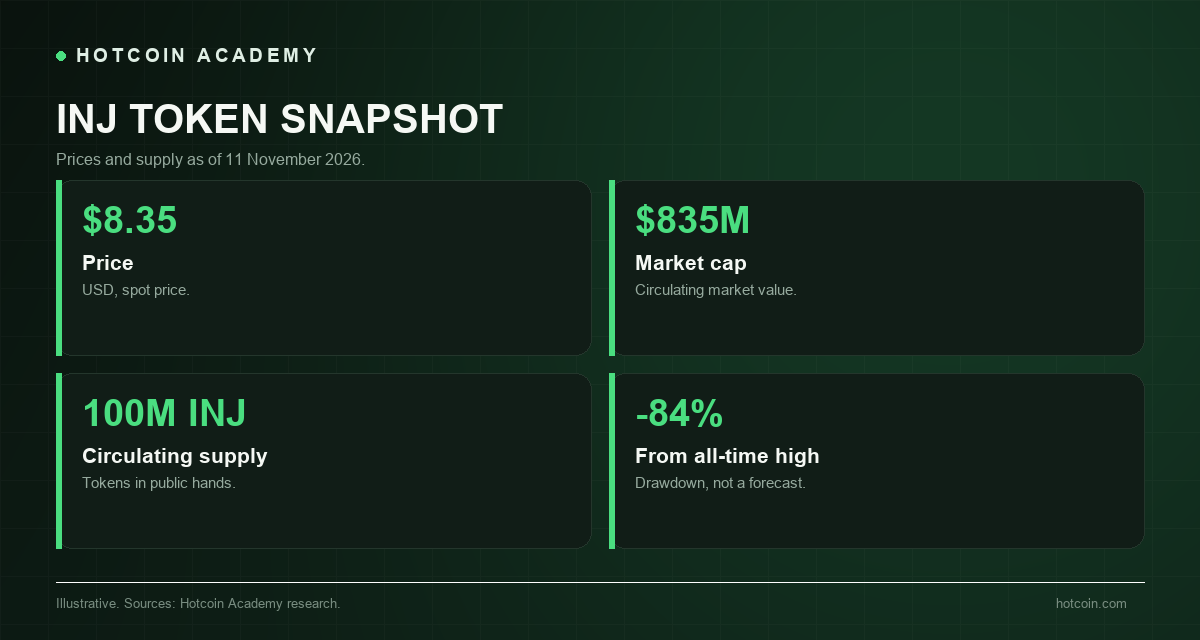
Illustration: INJ market data snapshot (November 11, 2026).
Injective in 2026: Status and Risks
In 2026, Injective continues to push RWA and institutional partnerships, but the public chain sector is highly competitive: Ethereum L2s, Solana and specialized finance chains are all competing for the same developers and liquidity.
INJ is down about 84% from its high, with a market cap of about $835 million. Deflation can reduce supply, but it cannot replace real demand; without enough transactions and developers, burning only slows selling pressure.
- Public chain competition: Developers and liquidity are being absorbed by leading ecosystems.
- Ecosystem dependence: DeFi activity is concentrated in a few applications, limiting resilience.
- Regulatory risk: RWA and derivatives involve securities and derivatives regulation.
- Market volatility: INJ is fully circulating, so price is more influenced by demand and sentiment.
How to Buy INJ?
If you already understand Injective's mechanics and risks and decide to participate with a small amount, you can follow these steps to buy INJ on Hotcoin.
- Register and KYC: Complete Hotcoin account registration and identity verification.
- Deposit: Deposit USDT, or use a supported fiat on-ramp.
- Search for the trading pair: Search INJ/USDT in the spot market.
- Place an order: Choose a market or limit order, confirm fees and slippage, then buy.
- Withdraw: For long-term holding, consider withdrawing to a self-custody wallet and verify the contract address.
Common Misconceptions
- Treating "deflation" as a guarantee of price increases.
- Looking only at partnership announcements, not on-chain volume and fees.
- Equating the narrative of a finance public chain with actual adoption.
FAQ
What is Injective? Injective is a finance-focused Layer 1 blockchain with built-in order book, derivatives and RWA modules. INJ is its native token.
What is INJ used for? It is used for staking, governance and fee burning. Part of network fees is used to buy back and destroy INJ.
How is Injective different from Ethereum? Injective builds financial primitives into the chain and is EVM-compatible; Ethereum is more general-purpose, and financial applications need to be built separately.
Is INJ suitable for long-term holding? This article does not make that judgment. If considering holding, track on-chain volume, ecosystem adoption and token burn data.
Conclusion
Injective is one of the most complete projects on the "finance public chain" path: order book, derivatives, RWA and EVM compatibility all on one chain. Its challenge is not technology, but whether the ecosystem can achieve scale.
For INJ holders, on-chain fees and developer growth are more telling than narrative.
Risk warning: This article is for educational and informational purposes only and does not constitute investment advice. Crypto assets are highly volatile, and new and small-cap tokens carry higher liquidity risk; investors may lose all principal. Please do your own research and manage your position size.
Inirerekumendang pagbabasa
Tingnan ang higit pa