Slippage and MEV: The Hidden Costs of DEX Trading
When you trade on a DEX, the quote shown on the page is not necessarily the price you end up getting. Price impact, slippage, gas and MEV can all add to your real trading cost. Slippage sets the worst price move you are willing to accept, while MEV lets other participants profit from information about your on-chain trade.
Understanding these concepts is the key to judging whether a DEX trade is actually expensive, and why you sometimes receive less than you expected.
What is slippage in DEX trading?
Slippage is the difference between the price you expected and the price you actually got.
Say you use 1,000 USDC to buy ETH and the confirmation screen estimates 0.30 ETH. If the market moves while the transaction waits for confirmation and you end up with only 0.297 ETH, that gap between the result and your original expectation is slippage.
Note that slippage is not exactly the same as "the market charged you extra".
On an AMM-based DEX, your own order size can create price impact in the first place, and on top of that the market price may keep moving between submission and on-chain confirmation. Together these factors determine your final fill price. Uniswap's own documentation clearly separates price impact from price slippage: the first comes mainly from how your trade affects liquidity, the second from the change between the expected price and the executed price.
What is the difference between price impact and slippage?
These are the two concepts DEX beginners confuse most often.
A simple way to think about it:
Price impact = how much your own trade pushes the price against you.
Slippage = how far the executed price drifts from your expectation between the quote and the fill.
Here is a simple example.
Suppose an ETH/USDC pool is fairly shallow and you want to buy a large amount of ETH.
The first layer of effect comes from your own trade:
Large order size → heavy liquidity consumption → the ETH/USDC ratio in the pool shifts → worse fill price
That is price impact.
Then you submit the transaction and wait for the block to confirm. During those few seconds, the ETH market price moves again.
The market keeps moving → the final execution price shifts further
That part falls under the execution-price change covered by slippage.
So even if you set slippage to 0.5%, it does not mean your price impact is also 0.5%. Price impact and slippage are two different dimensions of the problem.
Why does slippage usually get worse with larger trades?
The core reason is liquidity depth.
Imagine a pool that holds a relatively limited amount of liquidity:
A 100 USDC trade may barely move the pool price;
A 1,000 USDC trade starts to show a price impact;
A 100,000 USDC trade may noticeably shift the asset ratio inside the pool.
For an AMM, the trading price changes as the ratio of assets in the pool changes. That means the same pair has no single fill price that applies to every trade size.
Uniswap's official material makes the same point: the deeper the liquidity, the lower the price impact of a given trade size, and the shallower the liquidity, the higher the price impact.
So when you judge the cost of a large trade, do not look only at the token price on the page. Also look at the relationship:
trade size ÷ available liquidity
What does slippage tolerance mean?
Slippage tolerance on a DEX page means:
"I will accept this much price deviation at most. If the final price drifts further than that, do not execute this trade."
For example, you want to buy a token and the current quote estimates you will receive 100 units.
If you set maximum slippage to 1%, your execution normally has to satisfy a corresponding minimum received amount. If the price moves beyond the allowed range, the trade may simply fail instead of filling at a worse price.
So slippage tolerance is essentially a user protection parameter.
Uniswap's developer documentation explains the same thing: slippage tolerance defines the range of execution price change a user accepts, and if the final price falls outside it, the transaction reverts.
What goes wrong if slippage is set too low or too high?
Set too low: the trade may fail
Suppose the market is moving quickly and you set slippage tolerance very low.
After you submit, even a small price move can push the execution price outside your allowed range.
The result:
The trade never fills, but some of the on-chain costs already incurred may be unavoidable.
So a low slippage setting is not automatically better. It simply imposes a stricter requirement on your fill price.
Set too high: you may accept a very bad fill
If you set slippage very high just to avoid failed trades, the risk flips the other way.
Setting 20% maximum slippage means that, if other conditions are met, you may accept a fill clearly worse than your original expectation.
Uniswap's current guidance also warns that slippage set too low can cause failed trades, while slippage set too high can leave you with noticeably fewer tokens than the preview showed.
Therefore:
Lower slippage is not always better, and higher slippage does not always mean an easier fill.
A sensible setting should match the token's liquidity, your trade size and how volatile the market is.
Why do some tokens need unusually high slippage?
If you trade mainstream, highly liquid tokens, you normally do not need an unusually high slippage tolerance.
But some small-cap tokens may have:
thin liquidity;
wide bid-ask spreads;
token transfer taxes;
dynamic fees;
special contract logic;
violent market swings.
In these cases, users may find that low slippage simply will not fill.
There is an important trap here:
A failed trade ≠ you should keep raising slippage.
If the root cause is a high sell fee charged by the token contract, or trading restrictions built into the token itself, raising slippage may only make you accept a worse price.
Uniswap's official troubleshooting material also notes that tokens with variable buy/sell fees or special transfer logic can cause swaps to fail.
So when you meet an unusual token, the first step is to work out why it failed, not to push slippage straight up.
What is MEV?
MEV stands for Maximal Extractable Value, and it can be understood as:
extra value that participants capture during block production and transaction ordering by changing or exploiting the order in which transactions execute.
In a public on-chain trading environment, a swap usually does not go from submission to final confirmation instantly.
The transaction may first enter a pending state and then wait to be included in a block.
During that window, other participants may see the transaction information and try to exploit:
your trade size;
the direction of your trade;
the expected fill price;
the state of the liquidity pool;
transaction ordering;
and other details to find a profitable opportunity.
So the cost of a DEX trade is not limited to swap fees and gas.
Sometimes the transaction ordering itself becomes a source of cost.
Why does MEV affect ordinary users?
The most typical case is a user about to make a large swap.
Say a user wants to:
100,000 USDC → ETH
Once the trade is submitted to a public trading environment, other participants who can see it in advance may conclude that this large buy order will push the ETH price up in the relevant liquidity pool.
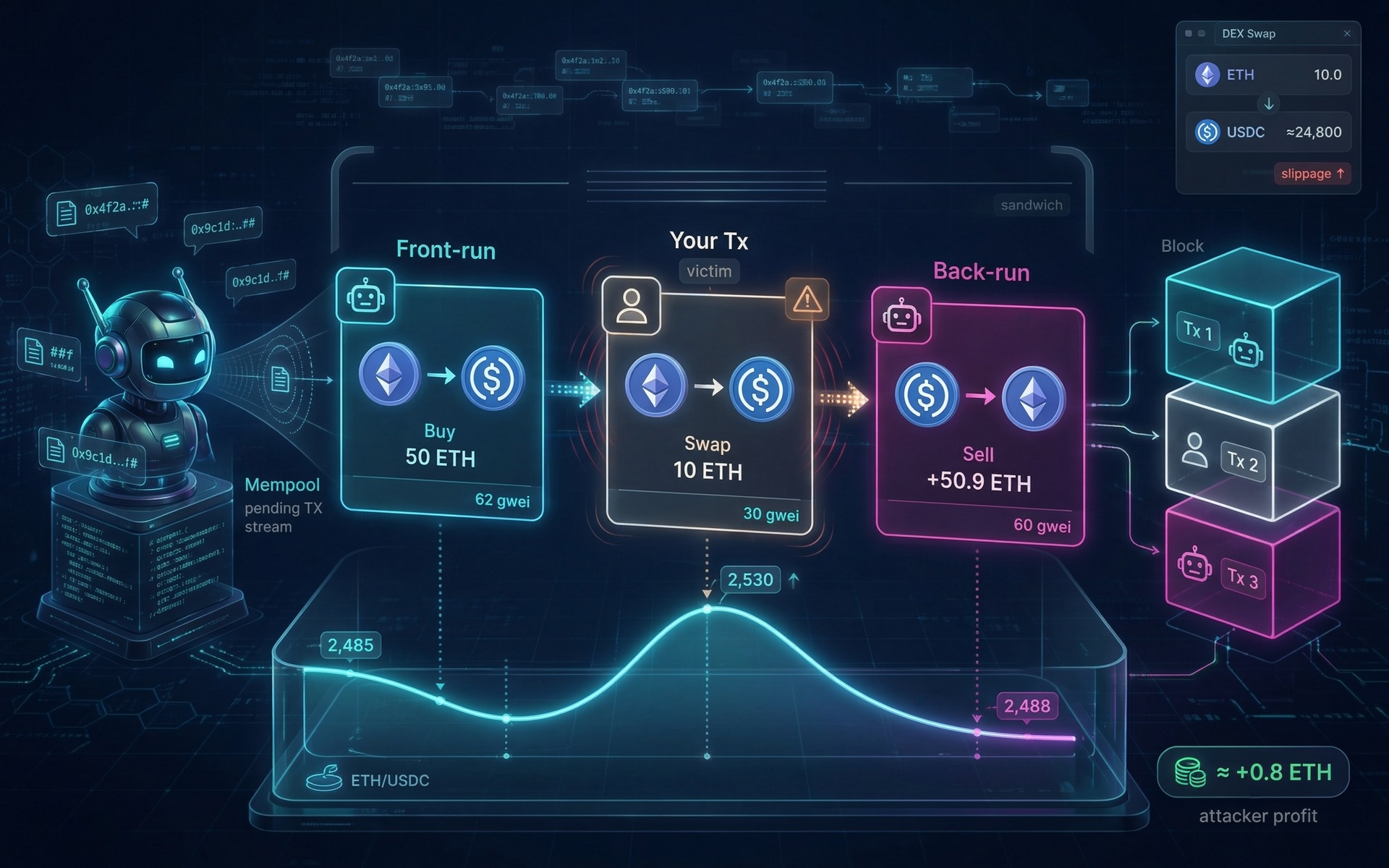
The attacker may then try to place their own trades before and after the user's transaction.
Simplified, the sequence might look like:
attacker buys → user's large buy order → attacker sells
The attacker profits from the price move their trades help create around the user's order.
This classic strategy is the sandwich attack.
If you want to understand exactly how an attacker profits from an ordinary swap through "front-run + user trade + back-run", read on here: Sandwich Attacks: How Your DEX Trade Gets Front-Run.
Why do large trades attract more MEV attention?
Because large trades can move the market price more visibly.
Imagine a pool with limited liquidity:
Small trade → very little price effect
Large trade → may visibly move the price inside the pool
For anyone trying to profit from transaction ordering, the second kind of trade is clearly more valuable.
That is why the following trades deserve extra attention with respect to MEV:
large swaps;
low-liquidity tokens;
highly volatile markets;
large orders in a public trading environment;
trades that can noticeably move the price of a liquidity pool.
It is also why you cannot simply assume:
"A DEX has no centralized matching engine, so front-running cannot happen there."
Decentralization does not automatically remove the transaction ordering problem.
Are MEV and slippage the same thing?
No.
They often appear together, but they are entirely different concepts.
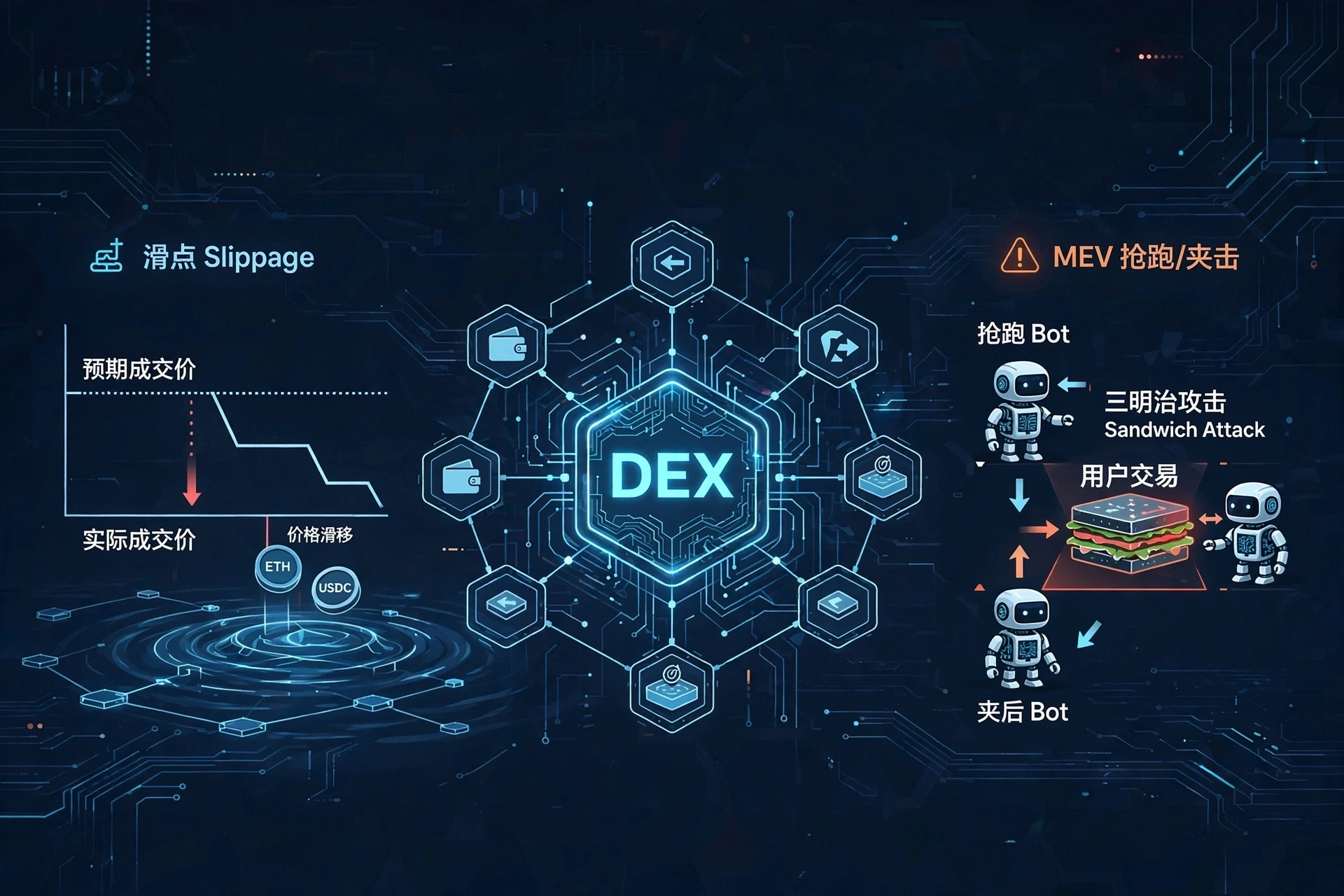
They are also connected.
For example:
Large trade → high price impact → a more valuable MEV opportunity → may further affect the actual execution price
So when you analyse DEX trading costs, do not fixate on a single number.
How do you work out the real cost of a DEX trade?
A practical framework works well:
real trading cost ≈ swap fee + price impact + execution price deviation + gas + potential MEV loss
This is not a strict accounting formula; it is a framework to help users analyse trading costs.
For example:
Suppose you are about to swap 10,000 USDC.
The trading page shows:
Swap fee: 20 USDC;
Price impact: 0.4%;
Gas: 10 USDC;
and the final execution price ends up somewhat worse than expected.
What really matters is not:
"the fee is only 20 USDC."
It is:
"for this 10,000 USDC swap, how much less of the target asset did I end up receiving?"
That is also why you cannot compare DEXs on trading fees alone.
A DEX with lower fees but thinner liquidity and higher price impact may end up costing you more overall.
Can DEX aggregators solve slippage and MEV?
DEX aggregators can reduce part of the cost, but they cannot remove every risk.
For example, 1inch's Pathfinder compares multiple DEXs and liquidity sources and can split a trade, which reduces part of the price impact. 1inch states explicitly that Pathfinder distributes a trade across multiple liquidity sources to reduce negative price impact.
That matters most for large trades.
Suppose:
DEX A: good liquidity for the first part of the order
DEX B: better liquidity for the rest
The aggregator can split one trade across different liquidity sources instead of pushing the whole size through a single pool.
But an aggregator cannot create liquidity out of nothing.
If a token has only one very shallow pool, no matter how sophisticated the routing algorithm is, it cannot fully solve the shortage of liquidity.
1inch also states clearly that for low-liquidity tokens with only a single liquidity source, Pathfinder cannot optimise price impact away.
How do trading models like Fusion handle MEV?
Beyond traditional aggregated swaps, some trading protocols have started to adopt intent-based trading.
Take 1inch Fusion as an example: the user submits a trading intent, and resolvers then compete to fill the order. Resolvers execute the trade and compete for orders through mechanisms such as a Dutch auction. 1inch currently highlights MEV protection and gasless execution as two of Fusion's main features.
The approach differs visibly from a traditional swap:
Traditional model:
user → router → on-chain transaction → block confirmation
Intent model:
user expresses intent → resolvers compete → a resolver executes → trade completes
One goal of this design is to reduce the chance that a user's order is front-run once it is exposed to a public trading environment.
But note this as well:
MEV protection ≠ every on-chain risk disappears.
Trades are still affected by market prices, the token contract, liquidity and how the protocol executes orders.
How can ordinary users reduce slippage?
Five angles to work with.
1. Avoid large trades in low-liquidity markets
The larger your trade relative to available liquidity, the more visible the price impact usually is.
2. Compare different trading routes
Do not assume a particular DEX always offers the best price.
Different DEXs, different pools and different routes can produce different final results.
3. Do not raise slippage blindly
When a trade fails, find out why first.
If liquidity is the problem, raising slippage may only get you filled at a worse price.
4. Watch out for network congestion
The longer a submitted transaction waits, the more likely the market environment is to change.
Where network conditions allow, sensible execution settings help reduce unnecessary price deviation.
5. Consider aggregation or intent trading for large trades
For larger swaps, compare what aggregators deliver and, depending on your situation, consider trading models built with MEV protection.
How can you reduce MEV risk in DEX trading?
No method lets an ordinary user avoid MEV completely in every on-chain environment, but you can reduce your exposure.
First: cut back on unnecessarily large single trades
Where liquidity allows, consider a more sensible trade size.
Second: choose trading models with MEV protection
Some aggregators and trading protocols already offer mechanisms such as intents, solvers and private order flow.
Third: pay attention to how the trade is executed
Do not look only at "how many tokens I end up with". Also look at:
Order routing → slippage → price impact → execution method
Fourth: be wary of low-liquidity tokens
Low liquidity means greater price impact and can also make a trade a more attractive MEV target.
Fifth: do not treat "higher slippage" as "better"
High slippage does raise your fill tolerance, but it can also widen the room for price loss.
A practical DEX trade cost checklist
Before you click Swap, work through this order:
① Check liquidity
Is there enough liquidity?
↓
② Check price impact
Will my trade visibly move the price?
↓
③ Check the quotes
How many tokens do I actually receive on different routes?
↓
④ Check slippage
How much execution price deviation am I willing to accept?
↓
⑤ Check gas
Is the network cost reasonable?
↓
⑥ Check the trading model
Is there a more suitable aggregation or MEV protection option?
↓
⑦ Confirm last
Verify the token, the amount, the network, the approval and the trade parameters, then sign.
This order beats staring at "what is the fee" when judging whether a DEX trade is worthwhile.
FAQ
What does 1% slippage on a DEX mean?
It usually means the user allows the final execution price to deviate from the expected price within a certain range. The exact behaviour depends on the DEX and the trading model. If the final price falls outside the allowed range, the trade may fail rather than fill at a worse price.
Is lower slippage always better?
Not necessarily. Slippage that is too low can cause failed trades, especially when the market is volatile or liquidity is thin, while slippage that is too high means you are willing to accept a larger price deviation. A sensible setting depends on trade size, liquidity and market volatility.
Is lower price impact always better?
From an execution standpoint, lower price impact usually means your trade disturbs the market price less. But it still has to be weighed together with fees, gas and the number of tokens you actually receive.
Why is my price still worse than expected when I set 1% slippage?
Because slippage tolerance is not a "fixed fill price". It only allows the trade to execute within a certain range of price change, and the actual result is also affected by price impact, market moves, liquidity and the trading route.
Will MEV make my trade fail outright?
MEV itself does not equal a failed trade. It is mainly about the value transfer that can occur through transaction ordering and execution. But if the market moves while you wait for confirmation, or the trade conditions exceed your slippage tolerance, the trade may fail because its protection conditions are triggered.
Does using a DEX aggregator mean there is no MEV?
No. Aggregators can reduce part of the risk through routing, order splitting or specific trading models, but they cannot guarantee that MEV is fully eliminated. The actual protection depends on the trading model you use and the underlying network.
Summary
The cost of a DEX trade goes far beyond the fee shown on the page.
What really matters is:
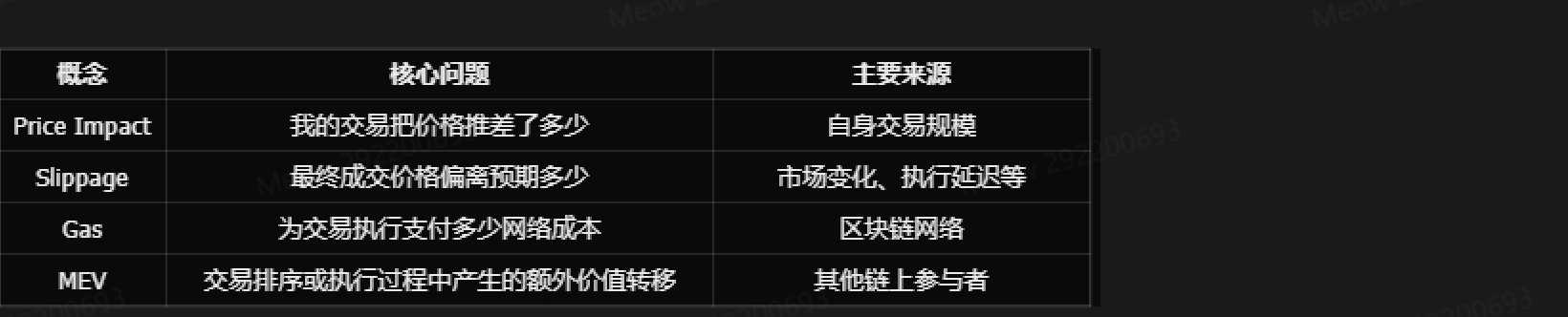
price impact → slippage → gas → MEV → the amount you finally receive.
Price impact comes mainly from how your own trade size affects liquidity; slippage sets how much price movement you accept between submission and execution; gas is the on-chain execution cost; and MEV involves other participants capturing value from transaction ordering and market information.
So to judge whether a DEX trade is worthwhile, the most important thing is not to hunt for the platform with the "lowest fee", but to look at:
is there enough liquidity, is price impact high, is slippage sensible, is gas reasonable, and does the execution method carry extra risk.
For small trades in mainstream, deeply liquid tokens these costs may be negligible; but as trade size grows, liquidity thins or the market swings quickly, the hidden costs can grow noticeably.
Above all, remember: higher slippage does not make a trade easier to fill, lower fees are not automatically better value, and DEX aggregators cannot guarantee zero slippage or zero MEV.
In on-chain trading, what really matters is converting a "quote" into a "final execution result" before judging the cost.
Crypto assets and DeFi trading carry significant risk. Price volatility, thin liquidity, smart contracts, token contracts, approvals, MEV, network congestion and execution deviations can all lead to financial loss. This article is for educational and mechanism-explanation purposes only and does not constitute investment or trading advice.
Inirerekumendang pagbabasa
Tingnan ang higit pa