GE Stock Price | Live Chart, Market Cap and FAQs
In the U.S. stock market, GE now refers to the stock of GE Aerospace, a listed company.
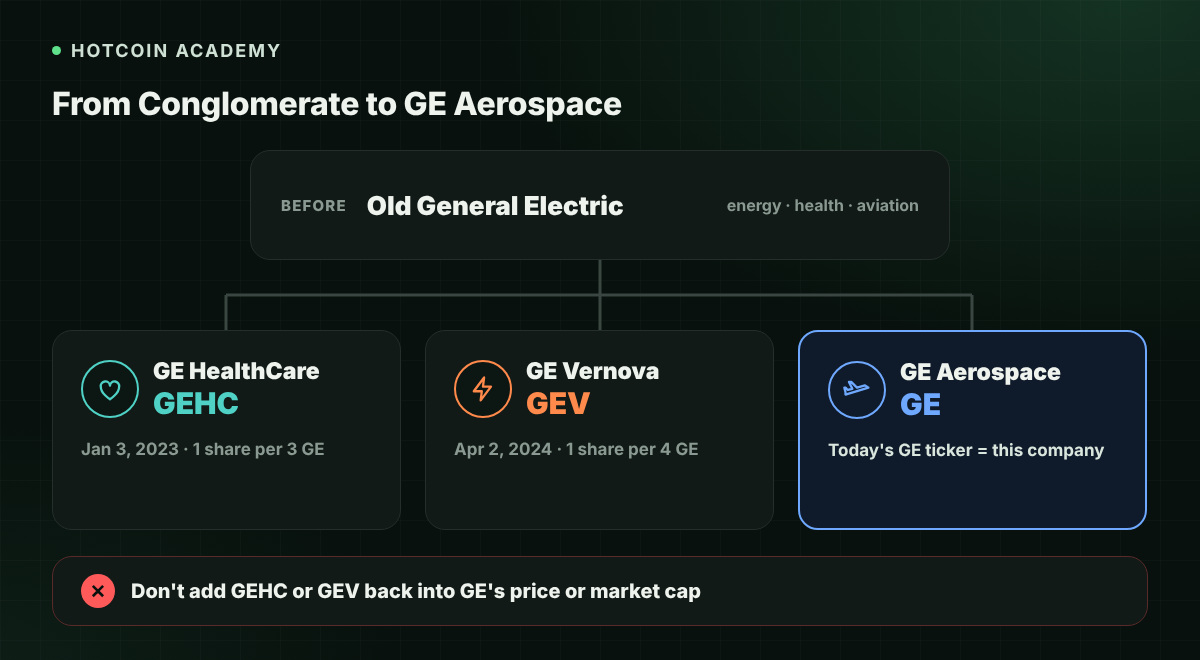
The former General Electric conglomerate has spun off GE HealthCare (ticker GEHC) and GE Vernova (ticker GEV), which have their own tickers. Reading this stock with the old impression that "the conglomerate, appliances, power generation and medical equipment are all part of GE" will lead to a wrong view of the company.
The live chart and market cap on the page should come from the latest market data feeds and change with trading. A figure at a single moment should not be treated as a long-term conclusion.
Key Takeaways
- Ticker GE now refers to GE Aerospace, listed on the New York Stock Exchange. It is not the spun-off healthcare company (GE HealthCare, ticker GEHC) or energy company (GE Vernova, ticker GEV).
- The company reports mainly through Commercial Engines & Services and Defense & Propulsion Technologies.
- The live chart reflects exchange trading. Regular trading hours are 9:30–16:00 New York time; pre-market and after-hours prices are not the official closing price.
- Market cap is generally estimated as "share price × shares outstanding" and reflects only this aerospace company, not the value of the spun-off companies.
Which Company Is GE Today?
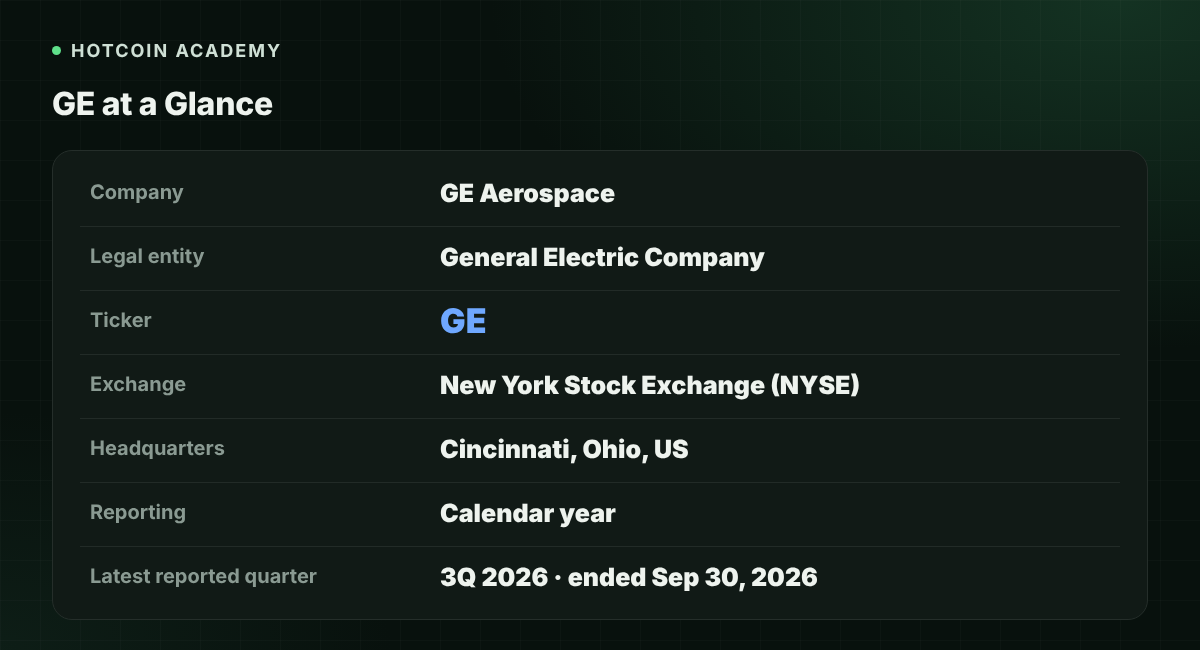
GE Aerospace is a company focused on aircraft engines, propulsion systems and related services, headquartered in Cincinnati, USA. Its stock is listed on the New York Stock Exchange under the ticker GE. The company reports on a calendar-year basis.
Historically, General Electric was a conglomerate spanning energy, healthcare and aviation. The company has since completed its separations: according to its investor relations page, on January 3, 2023, GE common stockholders received 1 share of GE HealthCare (ticker GEHC) for every 3 shares held; on April 2, 2024, they received 1 share of GE Vernova (ticker GEV) for every 4 shares held. After the separations, the company operates as GE Aerospace, and its stock continues to trade on the NYSE under the ticker GE; the legal entity name remains General Electric Company. GE on today's quote page refers only to this aerospace company; the now-independent healthcare or energy businesses must not be added back. Some third-party quote pages may still list renewable energy, power and other spun-off businesses among GE's operating segments. That is the pre-separation description and cannot be used to understand today's GE stock price.
| Item | Details |
|---|---|
| Company name | GE Aerospace (legal entity name: General Electric Company) |
| Ticker | GE |
| Exchange | New York Stock Exchange (NYSE) |
| Headquarters | Cincinnati, Ohio, USA |
| Reporting cycle | Calendar year |
| Latest reported quarter | Q3 2026, ended September 30, 2026 |
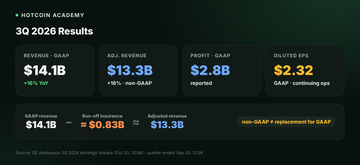
According to GE Aerospace's third-quarter earnings release published on October 20, 2026, GAAP total revenue for the quarter was $14.1 billion, up 16% year over year; adjusted revenue was $13.3 billion, up 18% year over year. The reconciliation table in the same release states that the difference is mainly $0.833 billion of revenue from the insurance business, which is in run-off: GAAP total revenue includes this revenue, while adjusted revenue excludes it to show the continuing aerospace business. Adjusted revenue is a non-GAAP measure and is not a substitute for total revenue reported under accounting standards. The figures above come from the company's published release and will be updated in later quarters; please refer to the latest filings.
How Does GE Aerospace Make Money?
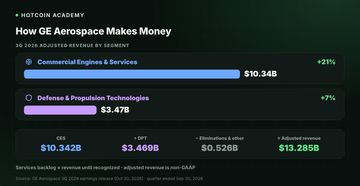
In the third quarter of 2026, the company reported the following segments on an adjusted revenue basis:
| Segment | Adjusted revenue for the quarter | Year over year |
|---|---|---|
| Commercial Engines & Services | $10.342 billion | Up 21% |
| Defense & Propulsion Technologies | $3.469 billion | Up 7% |
| Eliminations and other | -$0.526 billion | — |
| Total adjusted revenue | $13.285 billion | Up 18% |
When reading this report, note both GAAP and non-GAAP measures. For example, GAAP profit for the quarter was $2.8 billion, and diluted earnings per share from continuing operations were $2.32; the release also provides non-GAAP measures such as adjusted earnings per share. Non-GAAP figures help show operating trends but are not a substitute for results reported under accounting standards.
The commercial engines business generally includes revenue from new engine deliveries and subsequent maintenance and parts services. Service contracts and backlog help explain future demand, but they enter revenue only when recognized under the rules and cannot be treated directly as profit already earned.
How to Read GE's Live Chart
"GE stock price" here means the trading price of GE Aerospace on the NYSE, not a broad search result for the letters GE, and it does not include the charts of GE HealthCare or GE Vernova.
- Check the trading session first: Regular U.S. trading hours are 9:30 to 16:00 New York time. The corresponding Beijing time differs by 12 or 13 hours depending on daylight saving time; use the time zone shown on the page.
- Distinguish the latest price from the closing price: The latest price is the most recent trade. The change is usually calculated against the previous trading day's official close. Pre-market and after-hours liquidity is often thin, so such prices should not be treated as a confirmed closing result.
- Consider volume and the day's high and low: These help judge whether the day's moves were active, but they alone do not prove a trend has formed.
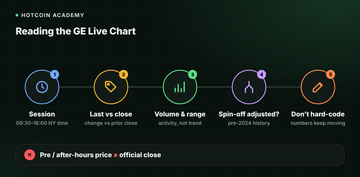
- Check the company when comparing long-term charts: Spin-offs change the asset scope a listed company represents. Treating the pre-spin-off conglomerate's chart directly as the long-term performance of today's aerospace company may distort conclusions. Confirm whether the chart has been adjusted for the spin-offs.
- Use the page's real-time data: This article does not hard-code the stock price, change or market cap at any single moment.
How to Read Market Cap
Market cap is generally estimated as follows:
Market cap ≈ current share price × shares outstanding
Market cap here covers only GE Aerospace itself. The separately listed companies have their own prices and share counts; they should not be added back to GE's market cap, nor should the old conglomerate-era market cap be compared directly with today's without adjustment.
The share count basis follows the explanation on the quote page; buybacks, share issuance or employee exercises can change the number of shares. Market cap is not cash on the company's books, nor does it equal the amount that would be received by selling all shares at once at the displayed price.

Common Misconceptions
- "GE is still the old General Electric that does everything": Ticker GE now refers to GE Aerospace; healthcare and energy businesses have been spun off as separate listed companies.
- "Adding the three companies' market caps together equals the old General Electric": After the spin-offs, capital structure, debt and valuations have all changed independently; a simple sum is meaningless.
- "The after-hours price is the next day's opening price": Trading is thinner in extended hours, and the opening price still awaits the regular session's matching.
FAQs
Q1: Is today's GE still the old General Electric conglomerate? No, it is not a company with the same business scope. Ticker GE now refers to GE Aerospace, which mainly operates aircraft engines, propulsion systems and related services. GE HealthCare (ticker GEHC) and GE Vernova (ticker GEV) are separately listed under their own tickers.
Q2: On which exchange is GE listed? GE Aerospace is listed on the New York Stock Exchange under the ticker GE.
Q3: Does GE's market cap include the spun-off companies? No. Market cap on quote pages is generally calculated only from GE Aerospace's share price and share count.
Q4: Do pre-market or after-hours GE prices count as the official closing price? No. The official closing price generally corresponds to the end of the regular trading session; extended-hours prices are a separate period of trading.
Q5: Can the share price alone tell whether GE is expensive? No. The share price does not include information such as share count, the mix of engine delivery and service revenue, margins or debt, and cannot by itself be a basis for buying or selling.
Conclusion
Today's GE stock price corresponds to GE Aerospace, an aerospace company listed on the NYSE, not the spun-off healthcare or energy businesses. When looking at this stock, first confirm the company and the revenue mix of commercial engines and defense, then return to the quote page for the live price and market cap; these figures change with the market and should be based on the page's real-time display and the company's latest announcements.
If you also want to distinguish "watching a listed company's quotes" from "trading price-linked products on different platforms," you can start with What is the difference between Hotcoin TradFi and traditional brokers (Interactive Brokers, Tiger, Futu)? Fees, trading hours and thresholds compared.
Risk warning: This article is for educational and informational purposes only and does not constitute investment advice or a recommendation to buy or sell. The financial figures come from the company's published reports or earnings releases and may be updated by later filings. U.S. stock prices are highly volatile and may cause partial or total loss of principal. Please refer to the company's latest announcements and the real-time data on your page, and make decisions carefully based on your own risk tolerance.
Inirerekumendang pagbabasa
Tingnan ang higit pa