How Are Ethereum Gas Fees Calculated? Money-Saving Guide
The core Ethereum gas fee formula is the amount of gas actually used multiplied by the effective gas price. Under Ethereum's current fee mechanism, the effective price is mainly determined by the Base Fee and Priority Fee. The protocol sets the Base Fee, while the Priority Fee rewards validators. A higher fee does not necessarily mean that more value is being transferred: transaction complexity and network demand matter too.
What Is an Ethereum Gas Fee?
An Ethereum gas fee is the execution fee paid to use the Ethereum network. Gas is not a token; it measures how much computation a transaction requires. Gas Price is the amount of ETH paid for each unit of gas and is usually quoted in Gwei.
In simple terms:
- Gas = how much computation the operation needs
- Gwei = the price of each unit of computation
- Gas Fee = computation used × price per unit
Sending 0.01 ETH therefore does not necessarily cost less than sending 10 ETH. For a standard ETH transfer, the execution method matters more than the amount transferred. Ethereum documentation commonly uses 21,000 Gas for a standard ETH transfer, while complex smart-contract operations consume more.
The key point is that fees are generally based on the computation Ethereum must perform and the current price of that computation, not simply on the amount sent.
What Is the ETH Gas Fee Formula?
The basic formula is:
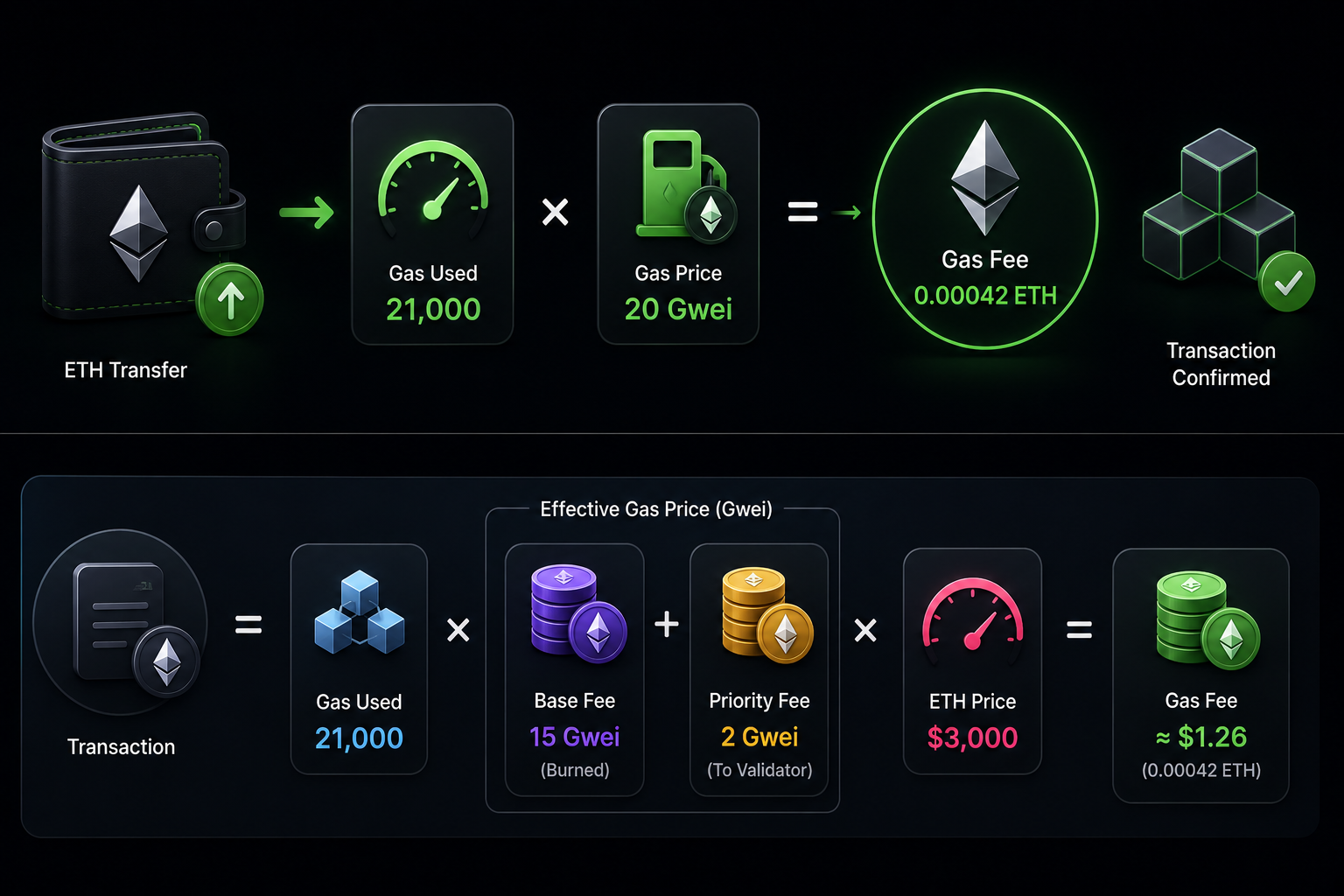
Gas Fee = Gas Used × Effective Gas Price
Under EIP-1559:
Effective Gas Price = Base Fee + Priority Fee
In a simple case:
Gas Fee ≈ Gas Used × (Base Fee + Priority Fee)
For example, a standard transfer using 21,000 Gas with a 10 Gwei Base Fee and a 2 Gwei Priority Fee costs:
21,000 × (10 + 2) = 252,000 Gwei = 0.000252 ETH
You must also distinguish this from Max Fee. Max Fee is the highest price per unit of gas that you authorize; it does not mean the entire amount will be charged. The actual payment depends on the Effective Gas Price when the transaction is included, and unused headroom is not part of the final cost.
The practical rule is therefore: actual gas cost = Gas Used × Effective Gas Price, not Gas Limit × Max Fee. The latter is closer to the maximum amount that may be reserved than the final charge.
What Is Gwei, and How Much ETH Is 1 Gwei?
1 Gwei = 0.000000001 ETH, or 10⁻⁹ ETH. Therefore, 1 ETH = 1,000,000,000 Gwei.
Ethereum uses Gwei because expressing gas prices directly in ETH would require many decimal places. One Gwei is much easier to read than 0.000000001 ETH.
Use this formula:
Gas Fee (ETH) = Gas Used × Gas Price (Gwei) ÷ 1,000,000,000
For illustration only, assume Gas Used = 21,000 and Gas Price = 20 Gwei:
21,000 × 20 ÷ 1,000,000,000 = 0.00042 ETH
To estimate the fiat value, multiply by the current ETH market price:
Gas Fee (USD) = Gas Fee (ETH) × ETH/USD price
For illustration only, if the fee is 0.00042 ETH and ETH is priced at 3,000 USDT:
0.00042 × 3,000 = 1.26 USDT
This converts an abstract Gwei quote into a more intuitive cost.
What Are Base Fee, Priority Fee, and Max Fee?
Understanding these three terms is essential.
The Base Fee is adjusted by the protocol according to block usage. It rises when demand is high and falls when demand declines. Under EIP-1559, the Base Fee is burned, while the Priority Fee incentivizes validators to process a transaction.
Max Fee is more like your maximum budget. For illustration, suppose Base Fee = 20 Gwei, Priority Fee = 2 Gwei, and Max Fee = 50 Gwei.
If the transaction executes at an Effective Gas Price of 22 Gwei and uses 21,000 Gas, the fee is:
21,000 × 22 = 462,000 Gwei = 0.000462 ETH
It is not:
21,000 × 50 = 1,050,000 Gwei
A high Max Fee displayed by a wallet does not mean the maximum will necessarily be charged.
What Is the Difference Between Gas Limit and Gas Used?
- Gas Limit is the maximum amount of gas you allow the transaction to consume.
- Gas Used is the amount the transaction actually consumes.
If Gas Limit is 50,000 but Gas Used is 35,000, the final cost is based on the 35,000 Gas actually used, not automatically on 50,000.
Ethereum documentation explains that Gas Limit caps the computation a transaction may consume. Complex smart-contract transactions generally need a higher limit. A high limit therefore does not by itself mean the fee will be high.
Focus on expected Gas Used × Effective Gas Price.
Why Do Different Ethereum Transactions Have Different Fees?
There are two main reasons: transactions consume different amounts of gas, and the gas price varies over time.
A simple ETH transfer and a complex smart-contract interaction require very different amounts of computation. Actual consumption depends on the transaction and contract implementation, so no fixed figure applies permanently to every transaction. More complex smart-contract operations normally require more computing resources.
Sending ETH, swapping ETH, minting an NFT, and calling a complex contract may therefore consume very different amounts of gas even on the same Ethereum mainnet.
Why Can Ethereum Gas Fees Suddenly Become Expensive?
The main cause is increased demand for block space. Ethereum block space is limited, so when more users submit transactions at the same time, they compete for that capacity. Higher demand tends to raise the Base Fee. The protocol adjusts it according to the previous block's gas usage, subject to a per-block adjustment limit.
A high fee does not mean Ethereum has arbitrarily decided to charge more. The better model is: higher demand for computation → stronger competition for block space → higher Base Fee → more ETH required for the same transaction.
When demand falls, the Base Fee can fall too. Gas fees are dynamic, not fixed.
Is the Gas Fee Related to the ETH Price?
Yes, but not directly.
Gas is paid in ETH. If the ETH price rises, the USD or USDT cost rises even when Gas Used and Gwei are unchanged.
For illustration, assume a transaction uses 21,000 Gas at 20 Gwei:
21,000 × 20 ÷ 1,000,000,000 = 0.00042 ETH
At 2,000 USDT per ETH, that costs 0.84 USDT. At 4,000 USDT per ETH, it costs 1.68 USDT. Gas consumption and Gwei are unchanged, but the USDT cost doubles.
To judge whether gas is expensive, consider Gas Used, Gwei, and the current ETH price together.
How Can You Check the Current Ethereum Gas Fee?
Do not use historical Gwei figures from an article to decide what to pay now. Gas fees change with network demand.
You can check:
- the gas estimate on your wallet's transaction screen;
- network gas data from an Ethereum block explorer;
- a real-time gas tracker;
- the estimated fee shown when submitting the transaction.
Most wallets automatically recommend a fee based on network conditions, so users rarely need to calculate Priority Fee from scratch.
Instead of asking, “What is a normal Ethereum gas fee?”, ask, “How much gas does this specific transaction need right now?” A basic transfer and a smart-contract interaction can cost different amounts even when submitted at the same time.
How Can You Save on Ethereum Gas Fees?
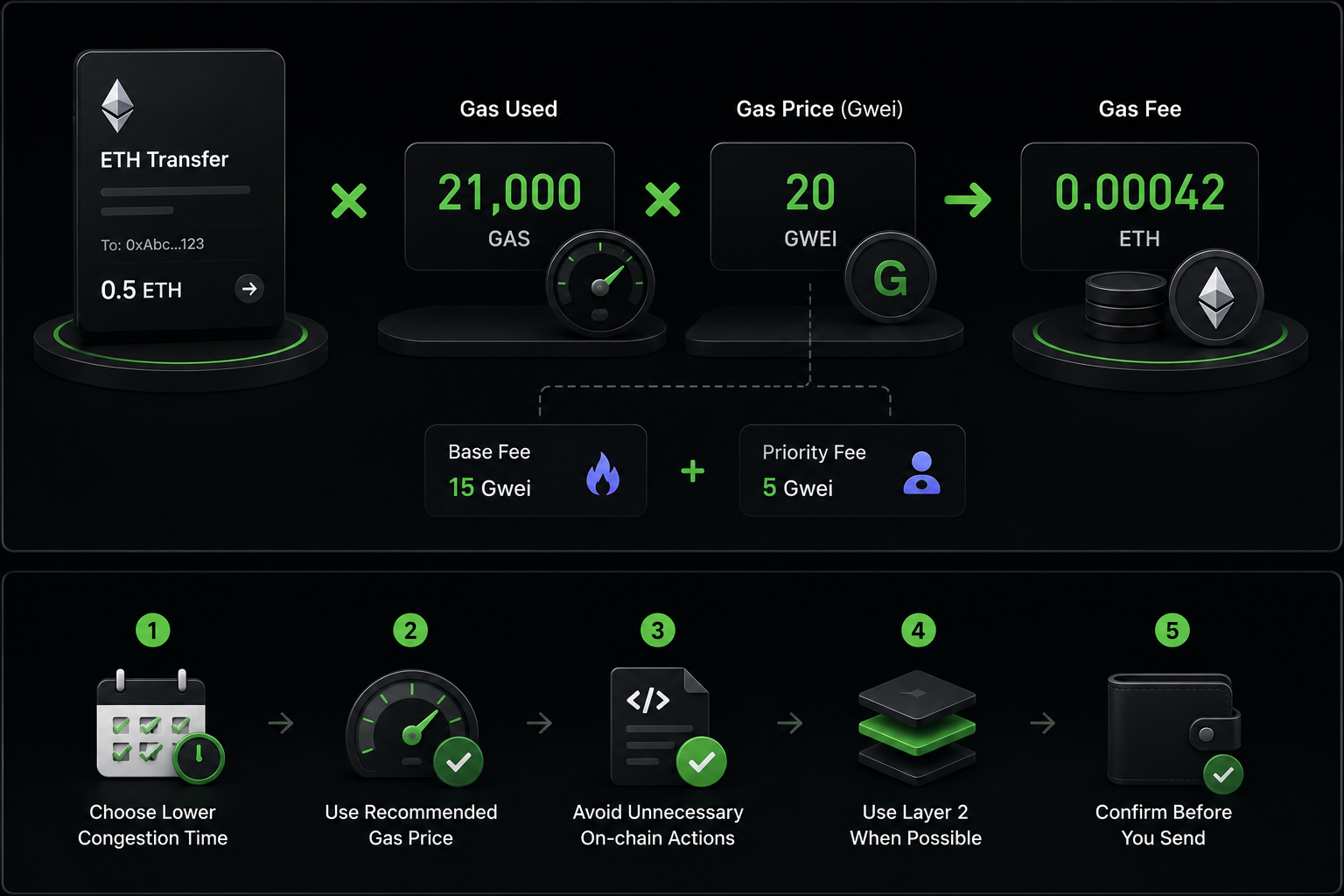
Saving gas is not simply about setting the lowest possible Gas Price. It is about avoiding unnecessary gas consumption and, where practical, avoiding periods of high demand.
Choose a Period of Lower Network Demand
Because Base Fee changes with network usage, a non-urgent transaction may cost less when demand is lower. Check current conditions before deciding whether to submit it.
However, “late at night is always cheaper” and “weekends are always cheaper” are not reliable rules. Watch current demand rather than following a fixed schedule.
Do Not Set the Fee Blindly Low
An excessively low Priority Fee may delay processing or keep a transaction from entering a block when expected. Lower fees can reduce the likelihood that validators select the transaction.
The goal is not “as low as possible,” but “do not overpay while still meeting the transaction's timing needs.”
Avoid Congested Periods for Non-Urgent Transactions
For transfers, wallet organization, non-urgent swaps, and other operations that can wait, check gas conditions first. If a transaction must be completed immediately, prioritize timely execution rather than the absolute lowest fee.
Avoid Submitting the Same Transaction Repeatedly
Do not keep submitting transactions merely because confirmation takes more than a few seconds. During congestion, duplicate submissions or incorrect handling of a Pending transaction can create more complexity.
First confirm whether the transaction was broadcast, its current status, and whether the wallet still shows Pending.
Check the Gas Estimate Before Confirming
Wallets generally show an estimated fee before submission. Do not click Confirm without checking the estimated fee, whether the transaction must happen now, and whether the fee is large relative to the transaction value.
If you are moving a very small amount and gas materially undermines the transaction's economics, proceeding may not make sense.
Can You Switch to Layer 2 When Gas Is Expensive?
If the application and operation support Layer 2, you can consider an Ethereum Layer 2 network.
One purpose of Layer 2 is to process some transactions away from Ethereum mainnet while using Ethereum as the underlying security and settlement layer, reducing the cost of executing every action directly on mainnet.
Layer 2 is not “free Ethereum.” Each network has its own fee structure, and when moving assets from an exchange or wallet, you must confirm that the receiving side supports the selected network.
Before using a Layer 2, confirm:
- The target application supports it.
- Your wallet supports the network.
- The counterparty or exchange supports deposits and withdrawals on that network.
Do not switch networks solely because a fee looks cheaper.
Is an Exchange ETH Withdrawal Fee the Same as Ethereum Gas?
No.
When you buy ETH on an exchange and withdraw it to a wallet, the displayed withdrawal fee is not necessarily identical to the actual on-chain gas fee.
An exchange may charge a fixed or dynamic fee under its own withdrawal rules, while the network fee depends on Ethereum transaction execution. Exchange withdrawal fee ≠ Ethereum gas fee.
If your goal is simply to move ETH from an exchange to a wallet, check the actual fee and supported network shown on the withdrawal page.
Is the Gas Fee Refunded If a Transaction Fails?
Not necessarily. Even when execution fails, gas must still be paid because validators and the network consumed resources while processing the transaction. Failed transaction ≠ no gas cost.
If a contract call reverts because its conditions are not met, the computation already performed still consumes gas.
Before submitting a high-gas contract transaction, check:
- whether the contract interaction is correct;
- whether the wallet has enough funds;
- whether the transaction parameters are correct;
- whether the slippage setting is appropriate;
- whether the target contract is operating normally.
Avoiding unnecessary failed transactions is itself an effective way to save gas.
Why Does the Wallet Estimate Differ From the Final Fee?
A wallet normally shows a pre-submission estimate. The final fee depends on the Gas Used and Effective Gas Price at execution. If estimated and actual Gas Used differ, or estimated and actual Effective Gas Price differ, the final amount will differ too.
Max Fee is a ceiling, not the amount that must be paid. Use the completed transaction data rather than only the estimate to determine the final cost.
After completion, inspect Transaction Details → Gas Used → Effective Gas Price → Transaction Fee to see exactly how much ETH was spent.
A Complete Gas Fee Calculation Example
This example combines the formulas above. It is for illustration only and does not represent current gas prices or costs.
Assume a standard ETH transfer has Gas Used = 21,000, Base Fee = 15 Gwei, and Priority Fee = 2 Gwei.
Effective Gas Price: 15 + 2 = 17 Gwei.
Actual gas fee: 21,000 × 17 = 357,000 Gwei.
Converted to ETH: 357,000 ÷ 1,000,000,000 = 0.000357 ETH.
At an assumed ETH price of 3,000 USDT: 0.000357 × 3,000 = 1.071 USDT.
The illustrative cost is therefore 0.000357 ETH, or about 1.071 USDT. Actual Gas Used, Base Fee, Priority Fee, and ETH price will vary.
How Do You Decide Whether a Gas Fee Is Expensive?
Do not look only at Gwei. Consider Gas Used × Gwei × ETH price.
For example, a transaction needing 200,000 Gas at 10 Gwei can cost more than a standard transfer needing 21,000 Gas at 20 Gwei:
- Transaction A: 200,000 × 10 = 2,000,000 Gwei
- Transaction B: 21,000 × 20 = 420,000 Gwei
Transaction A has the lower Gwei price but the higher final cost. Low Gwei ≠ low gas fee; actual consumption × Effective Gas Price determines the result.
Ethereum Gas Fee Money-Saving Checklist
- Check current network gas before transacting.
- Avoid high-demand periods for non-urgent transactions.
- Do not set Priority Fee blindly low.
- Confirm transaction parameters to reduce failures.
- Understand the difference between Gas Used and Gas Limit.
- Do not mistake Max Fee for the final fee.
- Pay particular attention to actual gas consumption in large or complex operations.
- If supported, compare the real costs of different Layer 2 networks.
- Distinguish an exchange withdrawal fee from Ethereum network gas.
- After completion, check the actual Transaction Fee rather than only the wallet estimate.
Frequently Asked Questions
Is Ethereum Gas Fee Fixed?
No. It changes with network demand, transaction complexity, Base Fee, and Priority Fee.
How Much Gas Does an ETH Transfer Need?
A standard native ETH transfer usually needs 21,000 Gas. Smart-contract interactions generally consume more, so confirm the actual transaction type.
Is Gas Fee Calculated From the Amount Sent?
Usually not. Gas primarily reflects the computation required. Under the same transaction type and network conditions, sending 0.1 ETH and 1 ETH does not make the fee scale proportionally with value.
Is a Lower Gas Price Always Better?
No. An excessively low Priority Fee can slow confirmation. The goal is to reduce unnecessary cost while meeting timing requirements.
Do Failed Ethereum Transactions Still Cost Gas?
Yes. Computation already consumed must still be paid for even when execution fails.
Why Do Transactions Submitted at the Same Time Cost Different Amounts?
They may consume different amounts of gas. A native ETH transfer, ERC-20 transfer, and smart-contract interaction have different computational complexity, so the final fee can differ even at the same Gas Price.
Risk Warning
Ethereum gas fees change dynamically. Every calculation in this article is illustrative and does not represent current or future costs.
On-chain transactions can also involve slippage, smart-contract risk, incorrect network selection, and irreversible transfers.
Do not make an unnecessary transaction simply because gas appears low. For small balances, reconsider the operation if fees represent a large share of the amount.
If You Are Preparing to Buy BTC on Hotcoin for the First Time
Continue reading:
Inirerekumendang pagbabasa
Tingnan ang higit pa