What Is DeFi 2.0? Protocol-Owned Liquidity
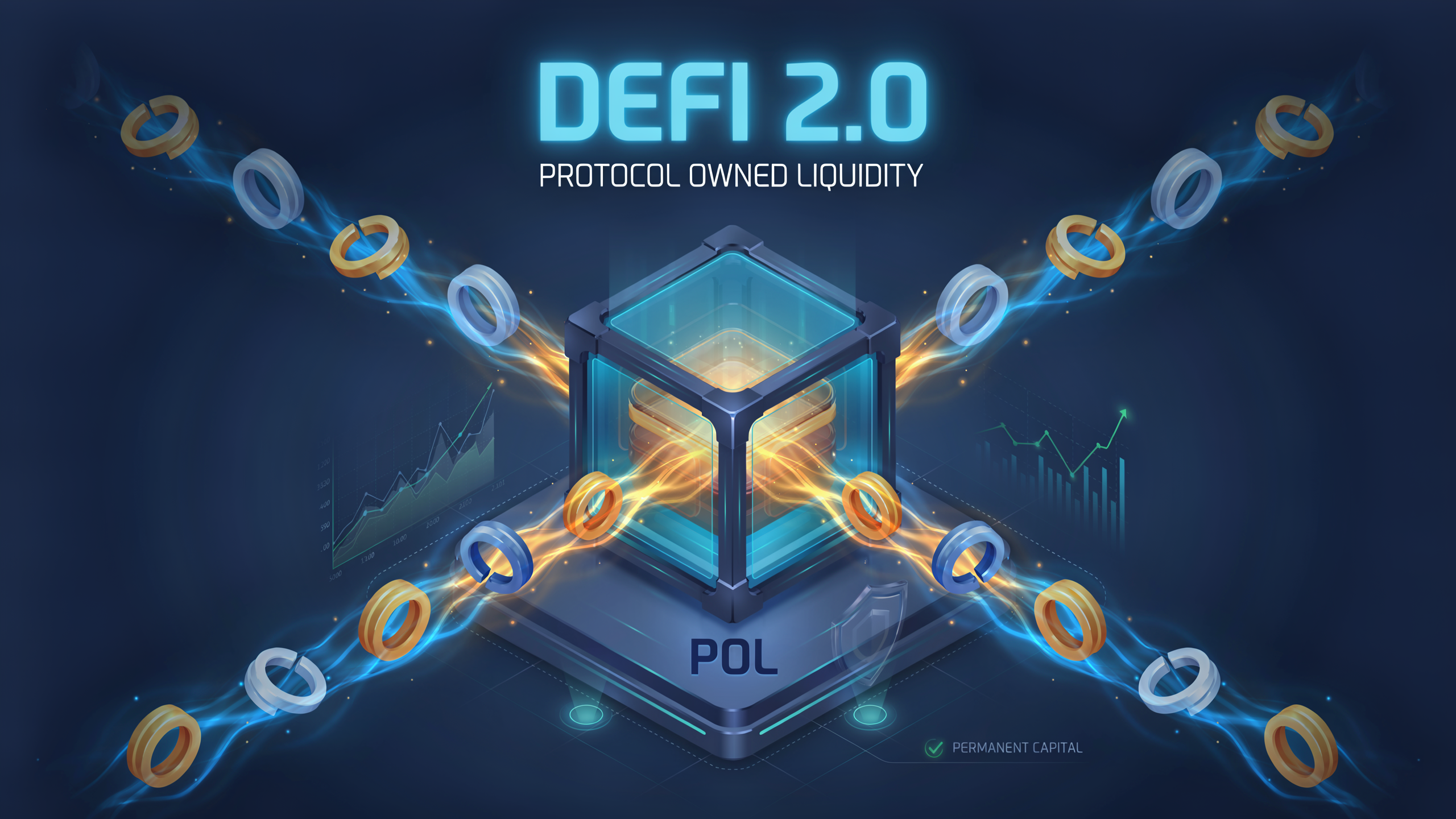
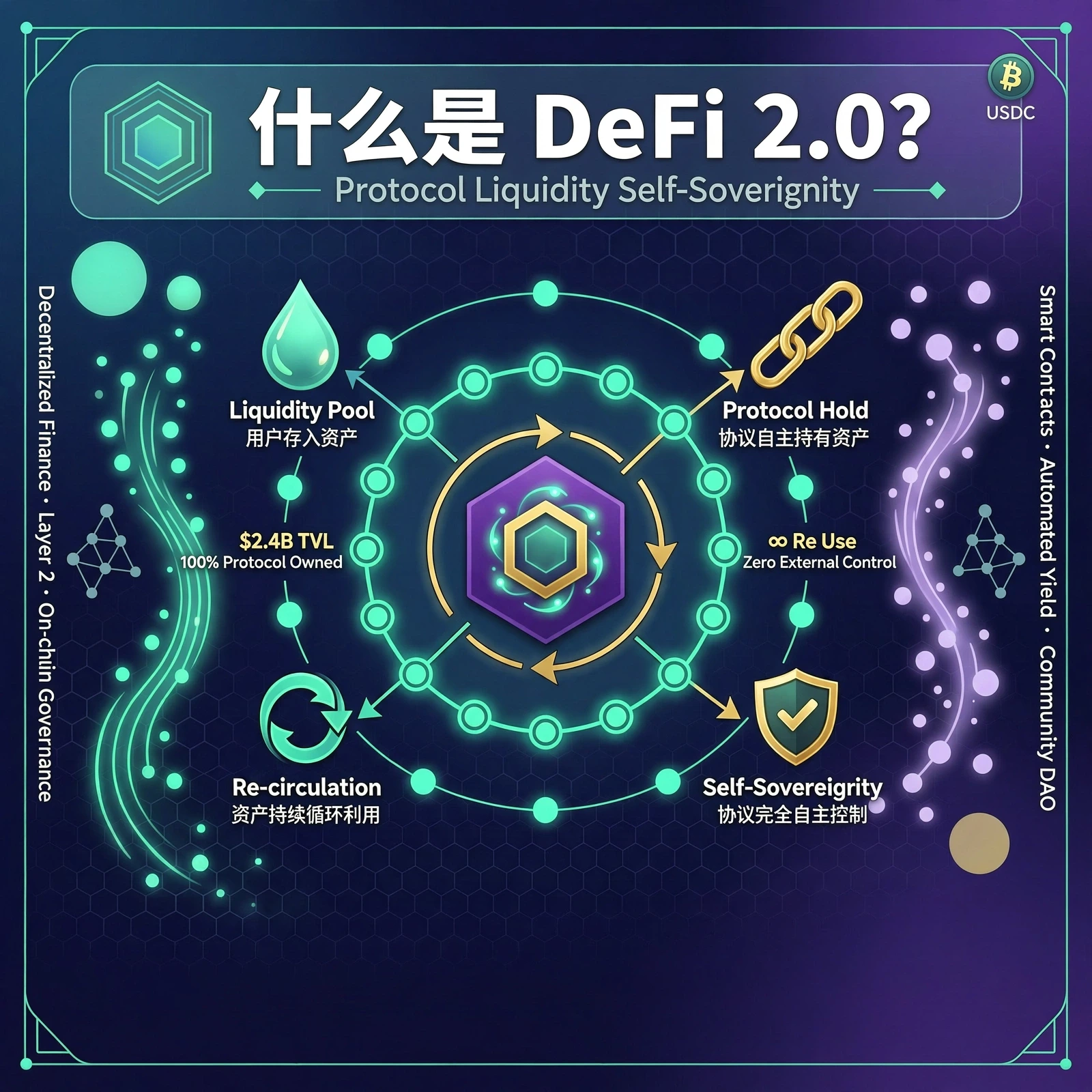
DeFi 2.0 usually refers to a group of mechanism innovations built on top of early DeFi that try to solve problems of liquidity, incentives, capital efficiency and protocol sustainability. One of its most representative shifts is moving from "relying on users to provide liquidity" to "the protocol owning and managing liquidity itself" — that is, Protocol Owned Liquidity (POL).
One point needs to be clear first: DeFi 2.0 is not a strict technical standard, nor is it a formal upgrade of DeFi 1.0. It is more of an industry concept that took shape around 2021, used to describe a set of protocols and models that redesigned early DeFi mechanisms.
Why did DeFi 2.0 appear?
To understand DeFi 2.0, you first have to understand the problems DeFi 1.0 faced.
An important growth method in early DeFi was liquidity mining. Protocols rewarded users with their own tokens to attract them to deposit assets into DEX liquidity pools, lending markets or other protocols.
This could launch a new project quickly, but it came with an obvious problem:
The liquidity a protocol obtains often does not truly belong to the protocol.
For example, a new project issues Token A and creates an A/ETH liquidity pool. To attract users to provide liquidity, the project pays LP rewards in Token A every day.
If another project offers a higher yield, LPs may well withdraw their funds and move to the new pool.
So a typical pattern forms:
High yield incentives → users provide liquidity → rewards decline → users withdraw → protocol liquidity falls.
This kind of liquidity is sometimes called "hired liquidity" or "rented liquidity." It can help a protocol gain TVL quickly, but it does not necessarily stay with the protocol over the long term.
Many DeFi 2.0 experiments started from exactly this point.
What is Protocol Owned Liquidity (POL)?
The core idea of POL is not complicated:
Instead of permanently spending tokens to reward users for providing liquidity, the protocol holds the liquidity assets itself.
Traditional liquidity mining can be understood as:
The protocol "rents" liquidity from users.
POL is closer to:
The protocol buys, controls and manages liquidity itself.
For example, a protocol needs an A/ETH trading pool. With traditional liquidity mining, it may need to keep issuing A Token to attract outside LPs.
With POL, the protocol can build or acquire an A/ETH liquidity position using assets from its treasury, and control that position over the long term.
This way, even if outside users stop providing liquidity, the protocol still keeps the portion of liquidity it controls.
This is also an important reason why the Olympus ecosystem pushed the POL concept early on. Its official documentation still defines POL as liquidity directly owned and controlled by the protocol, rather than liquidity that depends on external providers.
How does Olympus turn "user liquidity" into "protocol liquidity"?
Olympus is one of the most typical cases for understanding POL.
One important design in its early mechanism was Bonding. "Bonding" here should not be read as a bond in the traditional finance sense; it is in fact a mechanism that sells native tokens to users at a discount.
Here is a simple, abstract example:
Suppose a user holds an A/ETH LP Token.
The LP Token represents the user's share of assets in a liquidity pool.
The protocol can offer the user an exchange:
The user hands over LP Tokens → the protocol gives a certain amount of native tokens.
If the trade completes, those LP Tokens come under the protocol's control.
As a result, the protocol no longer depends on the user continuing to hold that LP position; it controls the asset that represents the liquidity itself.
The end result is:
Users provide liquidity → they receive LP Tokens → they hand the LP Tokens to the protocol → they receive protocol tokens → the protocol gains control of the liquidity.
This is the core logic of POL.
Olympus's official materials currently describe its POL as OHM liquidity directly controlled by the protocol, with market liquidity maintained through DEX liquidity and other mechanisms.
How is POL different from traditional liquidity mining?
The most fundamental difference is who controls the liquidity, and whether the protocol has to keep paying incentives to retain it.
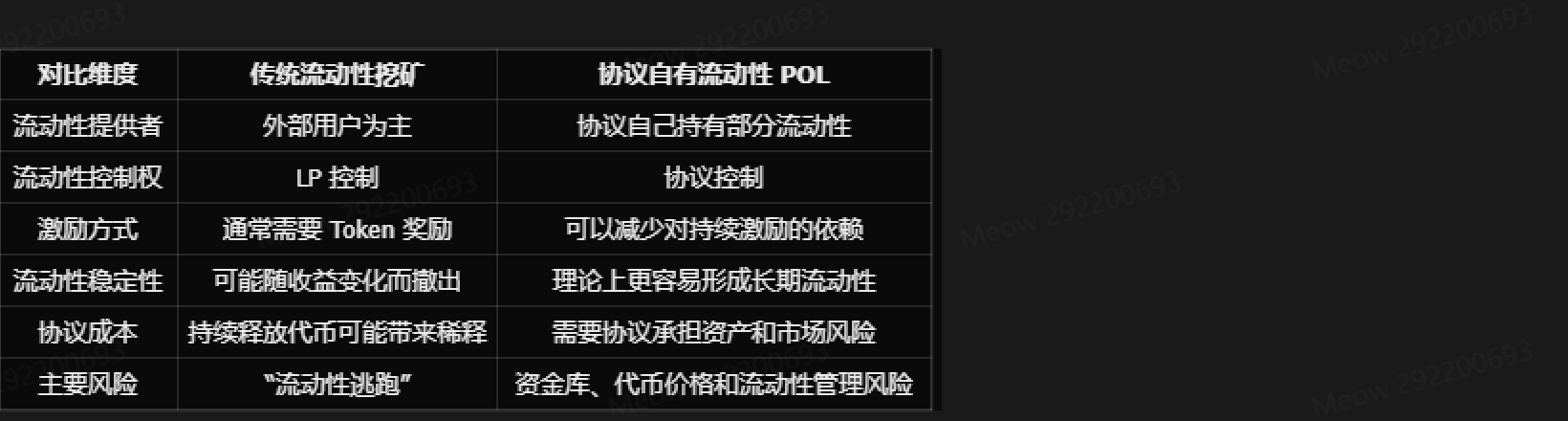
There is one point that is very easily misunderstood:
POL does not mean liquidity will never decline.
A protocol owning liquidity does not mean those assets carry no price risk, nor that the protocol can maintain stable depth in any market environment.
What it mainly addresses is the problem of "liquidity ownership and dependence on incentives," not the elimination of all market risk.
Why can a protocol owning its own liquidity be more effective?
The most direct advantage of POL is that the protocol does not have to depend entirely on external LPs.
If liquidity mainly comes from outside users, the protocol may need to keep paying token rewards to keep that capital in place. Once rewards fall, some of the capital may leave.
Protocol owned liquidity means:
The liquidity a protocol obtains can become part of its own balance sheet.
This brings several potential advantages.
1. Lower dependence on short-term incentives
The protocol does not have to rely entirely on large token rewards to attract LPs.
This helps reduce the pressure of the cycle "higher rewards → more capital → more token emissions."
2. Liquidity can become a long-term protocol asset
If the protocol holds the LP position, then trading fees and other income it generates may belong to the protocol rather than going entirely to external LPs.
Of course, the actual returns and risks depend on the liquidity pool design, asset price movements, and how the protocol manages the position.
3. Liquidity management becomes more controllable
The protocol can decide, based on its own goals, where liquidity is deployed, how much depth to provide, and when to adjust the position.
This is also an important difference between POL and simple liquidity mining.
DeFi 2.0 is not only about POL
Although "protocol owned liquidity" is one of the most common keywords of DeFi 2.0, equating DeFi 2.0 with POL alone actually narrows the concept.
DeFi 2.0 more broadly involves:
redesigning liquidity incentive mechanisms;
protocol treasury management;
improving capital efficiency;
automated yield strategies;
liquidity aggregation and reallocation;
optimizing the incentive relationship between protocols and users;
more complex on-chain financial composability.
For example, Tokemak once tried to coordinate the direction of assets and liquidity through a dedicated liquidity mechanism, so that liquidity could be allocated across markets according to the choices of governance participants. Attempts like this show that DeFi 2.0 has no single standard answer; it is a series of experiments around "how to manage liquidity and capital more effectively."
So rather than reading DeFi 2.0 as "the second generation of DeFi products," it is better to read it as:
DeFi began to move from simply chasing TVL growth toward asking where liquidity comes from, who owns it, what it costs, and whether it can last.
Is protocol owned liquidity really safer than user liquidity?
You cannot judge it that simply.
POL addresses the question of liquidity ownership; it does not mean smart contract, token price, governance and treasury management risks are solved.
For example, even a protocol that owns a large amount of its own liquidity may face:
A sharp fall in token price → treasury asset value declines → POL value declines → market depth falls → volatility widens further.
In addition, if a protocol's native token makes up too large a share of treasury assets, then "the protocol owns a lot of liquidity" does not necessarily mean the treasury has enough external asset backing.
So when looking at POL, you cannot look only at "how much liquidity the protocol owns." You also need to look further at:
What assets make up the liquidity?
What is the share of the native token?
What real reserve assets does the protocol treasury hold?
Is the liquidity concentrated in a single trading pool?
Who holds control over the treasury and the LP positions?
Can these assets be changed by governance at any time?
Does the protocol have a response mechanism when the market moves violently?
How does "the protocol owning liquidity" relate to TVL?
POL and TVL often appear together, but they are not the same concept.
TVL measures the value of assets locked or deposited in a protocol; POL focuses on how much of that liquidity is owned and controlled by the protocol itself.
A protocol can therefore have a very high TVL while depending almost entirely on external LPs.
Conversely, a protocol's TVL may not be especially high, yet a considerable portion of its liquidity may belong to the protocol itself.
This is why, when analyzing a DeFi protocol, you cannot judge its strength from a single TVL number.
If you want to understand how TVL should be read, see What Is TVL? A Key Metric for Measuring DeFi Protocol Value, which focuses on distinguishing between TVL, asset price changes and real capital inflows.
How do you judge whether a DeFi 2.0 project deserves further research?
Do not assume a project is more advanced or safer simply because it carries labels such as "DeFi 2.0," "protocol owned liquidity" or "high capital efficiency."
You can judge it with the four questions below.
First, whose liquidity is it?
This is the most basic question for a POL project.
If a project claims that "the protocol owns the liquidity," you need to confirm who actually controls those LP Tokens or liquidity positions, rather than looking only at the numbers on the marketing page.
Second, what is the liquidity made of?
If a protocol owns a large LP position made up of its own token and other assets, then you need to watch how its own token price affects the treasury.
What really deserves attention is the asset structure, not just the size of the liquidity.
Third, where do the returns come from?
If a project advertises a very high APY, you need to ask where the yield comes from:
Is it actual trading fees? Lending interest? Revenue from external protocols? Or continuous emissions of the project token?
If the yield mainly comes from continuously minted native tokens, then the nominal yield does not directly represent real economic returns.
Fourth, what happens in the worst case?
This is the question most easily overlooked when judging a DeFi 2.0 project.
You need to consider:
After a token crash, falling liquidity, a shrinking treasury, a smart contract exploit or a governance change, can the protocol still keep operating at a basic level?
If a project can only function in an environment of rising markets, high yields and large inflows of new capital, then its long-term sustainability needs careful assessment.
What did DeFi 2.0 actually change?
From DeFi 1.0 to DeFi 2.0, one important change is a change in how people think.
Early DeFi focused more on:
"How do we attract more capital into the protocol?"
DeFi 2.0 began to think further:
"Why would this capital stay? Can the protocol own liquidity itself? Can incentive costs come down? Can capital efficiency improve?"
POL is a typical expression of this line of thinking.
But this does not mean DeFi 2.0 has solved all of DeFi's problems. On the contrary, once a protocol owns liquidity, it also takes on more responsibility for asset management, market volatility and governance.
DeFi 2.0 is therefore better understood as a round of mechanism design experiments, rather than a version that is inherently superior to DeFi 1.0.
FAQ: Common questions about DeFi 2.0
What does DeFi 2.0 mean?
DeFi 2.0 is an industry umbrella term for a group of new DeFi mechanisms that mainly try to solve the problems early DeFi had with liquidity, incentives, capital efficiency and sustainability. Protocol Owned Liquidity (POL) is one of its most representative mechanisms.
What is Protocol Owned Liquidity (POL)?
POL stands for Protocol Owned Liquidity, meaning the protocol itself owns and controls liquidity instead of relying entirely on external users to provide it.
How is POL different from liquidity mining?
Liquidity mining usually attracts external LPs with token rewards; POL lets the protocol directly own part of the liquidity, which reduces its dependence on continuous external incentives.
Why is Olympus often seen as a representative of DeFi 2.0?
Olympus explored protocol owned liquidity early on through mechanisms such as Bonding and made POL one of its core mechanisms, which is why it is one of the most frequently mentioned cases in discussions of DeFi 2.0. Olympus officially still lists POL as an important part of the protocol.
Is DeFi 2.0 safer than DeFi 1.0?
Not in that sense. DeFi 2.0 mainly innovates in liquidity and economic mechanisms; it does not automatically remove smart contract, market, governance, liquidity and systemic risks.
Summary
The core of DeFi 2.0 is not simply "upgrading DeFi one generation," but trying to solve a very real problem in early DeFi: liquidity can be obtained quickly through large incentives, but that liquidity does not necessarily truly belong to the protocol, and it may not stay for the long term.
The idea behind Protocol Owned Liquidity (POL) is to move a protocol from "renting liquidity" to "owning and managing liquidity."
Olympus's practice brought the concept wide attention, but POL also brings asset management, token price and governance risk back to the protocol itself. So when judging a DeFi 2.0 project, you should not look only at TVL, APY or a single indicator such as "the protocol owns liquidity." You should go further and analyze where the assets come from, who owns the liquidity, where the yield comes from, how permissions are structured, and whether the protocol can survive extreme market conditions.
Risk warning: DeFi and the related tokens, liquidity pools and protocol mechanisms carry relatively high risk. Protocol owned liquidity does not mean asset prices are stable, funds are safe or yields are sustainable; smart contract exploits, market volatility, insufficient liquidity, governance changes and risk transmission between protocols can all cause losses. Before participating in any such protocol, make sure you fully understand the mechanisms and risks, and make decisions prudently based on your own risk tolerance.
DeFi began to move from simply chasing TVL growth toward asking where liquidity comes from, who owns it, what it costs, and whether it can last.
Inirerekumendang pagbabasa
Tingnan ang higit pa