BTC/USDT Trading for Beginners: How to Read a Bitcoin Trading Pair
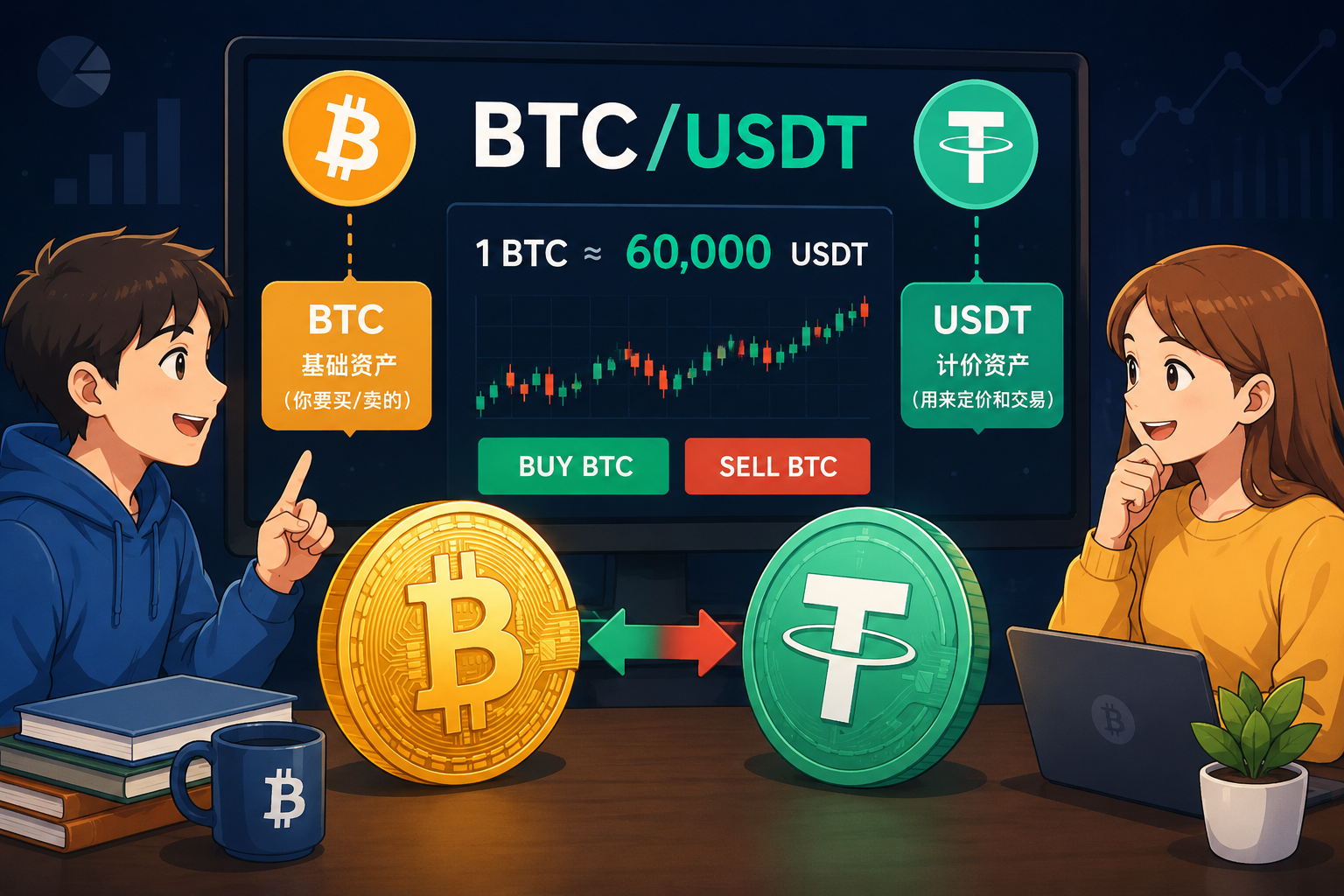
BTC/USDT simply means buying or selling BTC with USDT: BTC is the base asset on the left side of the pair, while USDT is the quote asset on the right. If BTC/USDT = 60,000, it means 1 BTC is quoted at 60,000 USDT. Once you understand this relationship, you can interpret trade direction, price, amount, the order book, and the actual trade value. Hotcoin spot trading supports pairs such as BTC/USDT, allowing users to select a pair and buy or sell on the spot trading page.
What Exactly Does BTC/USDT Mean?
BTC/USDT is a trading pair made up of two assets:
BTC / USDT
BTC: Base Asset, the asset you are buying or selling.
USDT: Quote Asset, the asset used to express the price of BTC and settle the trade.
So, when you see:
BTC/USDT = 60,000
It does not mean that both BTC and USDT are priced at 60,000. It means:
1 BTC = 60,000 USDT
The price of a trading pair answers one basic question:
How much of the asset on the right is required to buy one unit of the asset on the left?
The same rule applies to other pairs such as ETH/USDT, SOL/USDT, and ETH/BTC.
How Do Buying and Selling Work in BTC/USDT?
The most important part of understanding BTC/USDT is knowing which assets are exchanged when you buy or sell.
Assume:
BTC/USDT = 60,000
If you select Buy BTC, the exchange is essentially:
Pay USDT → Receive BTC
For example, if you use 6,000 USDT to buy BTC and ignore fees and price changes, you would receive approximately:
6,000 ÷ 60,000 = 0.1 BTC
Conversely, if you select Sell BTC, the exchange is:
Pay BTC → Receive USDT
For example, selling 0.1 BTC at an assumed price of 60,000 USDT per BTC would return approximately 6,000 USDT.
When you see BTC/USDT, remember this simple rule:
Buying BTC means exchanging USDT for BTC; selling BTC means exchanging BTC for USDT.
Hotcoin's spot trading guide follows the same logic: users can buy BTC with USDT or sell BTC back into USDT.
How Should You Read the BTC/USDT Price?
The BTC/USDT quote normally changes in real time with the market.
For example:
BTC/USDT = 60,000
This means that 1 BTC is currently quoted at about 60,000 USDT.
If the price rises to:
BTC/USDT = 65,000
More USDT is required to buy 1 BTC.
If the price falls to:
BTC/USDT = 55,000
Less USDT is required to buy 1 BTC.
However, there is one very important detail:
The price displayed on the page may not be the price at which your order is ultimately filled.
Your actual fill can be affected by the order type, order book depth, bid-ask spread, and market volatility. You should not assume that the displayed BTC/USDT quote is necessarily the final price available for your entire order.
Why Aren't BTC/USDT and USDT/BTC the Same Thing?
This is a common source of confusion for beginners.
Assume:
BTC/USDT = 60,000
It means:
1 BTC = 60,000 USDT
If the quote direction is reversed, the theoretical relationship becomes:
USDT/BTC = 1 ÷ 60,000
In other words, reversing the quote changes what the number represents.
An exchange does not automatically create an identical market simply by reversing the order of two assets. The pairs a platform offers depend on its market configuration, liquidity, and other factors. The available pairs also determine which assets users can exchange directly.
Therefore, when viewing a trading page, do not look only at the two asset names—first confirm which asset is on the left and which is on the right.
What Is the Difference Between BTC/USDT, BTC/USDC, and BTC/USD?
All of these pairs can express the price of BTC, but they use different quote assets on the right-hand side.
For beginners, BTC/USDT is often the easiest to understand:
BTC is the asset you trade, while USDT is the asset used for pricing and settlement.
USDT is a stablecoin and is not the same as the U.S. dollars held in a bank account. Although USDT is generally designed to track the value of the U.S. dollar, they are different types of assets.
After Understanding BTC/USDT, Learn to Read the Order Book
Knowing how much USDT one BTC is worth is only the beginning.
On a BTC/USDT trading page, you will usually also see an order book.
The order book lists buy and sell orders currently waiting to be filled, helping you see how much buying or selling interest exists around different price levels.
In simple terms:
Sell side → Traders willing to sell BTC
Buy side → Traders willing to buy BTC
Buyers and sellers continually submit orders, and matching orders become completed trades.
The BTC/USDT price is therefore not an arbitrary number; it is formed through the continuous matching of buy and sell orders in the market.
However, do not assume the market must rise or fall based on a quick glance at order book quantities. Orders can be canceled, modified, or filled rapidly, so the order book reflects only the orders visible at a particular moment.
Hotcoin's spot trading page also provides an order book, trade history, and order management tools so users can review the market and their own order status.
What Is the Difference Between Price, Amount, and Total on BTC/USDT?
These three concepts are easy to confuse when placing your first trade.
Assume:
BTC price = 60,000 USDT
You plan to buy:
0.1 BTC
The approximate order value is:
60,000 × 0.1 = 6,000 USDT
In other words:
Price: 60,000 USDT → The price of 1 BTC
Amount: 0.1 BTC → How much BTC you want to buy
Total: 6,000 USDT → The value of the order
Trading fees must also be considered, so the final asset deduction may differ slightly from a simple price-times-amount calculation.
A useful way to check your order is:
Price × BTC amount ≈ USDT trade value
If these figures do not align, do not rush to submit the order. First confirm the selected pair, order direction, and units.
What Do Best Bid and Best Ask Mean in BTC/USDT?
The order book normally shows buy and sell orders at multiple price levels.
Two important values are:
Best Bid: The highest current buy price in the market.
Best Ask: The lowest current sell price in the market.
For example:
Best Ask = 60,010 USDT
Best Bid = 59,990 USDT
The difference between the two is the bid-ask spread.
If you use a market order to buy BTC, it usually starts filling against the sell orders currently available. A larger order may continue filling against sell orders at progressively higher prices.
Therefore:
A market order does not fill at a theoretical middle price; it executes against the market orders available for matching at that time.
This is why your actual fill price can differ from the quote you just saw when the market moves quickly or liquidity is limited.
What Is the Difference Between BTC/USDT Spot and Futures Trading?
Seeing BTC/USDT does not necessarily mean you are trading spot.
BTC/USDT spot and BTC/USDT futures may reference a similar underlying asset and use a similar quote, but their trading mechanisms are different.
The core of spot trading is:
Exchanging one asset for another.
For example:
USDT → BTC
After the trade is completed, you receive BTC as a spot asset.
Futures trading is different. It involves derivatives based on the price of BTC and may include margin, leverage, long and short positions, and liquidation.
Therefore, if your goal is simply to buy and hold BTC, first confirm that you have selected:
Spot
Instead of:
Futures / Perpetual
Hotcoin's official spot guide defines spot trading as an exchange between digital assets and explains that this mode does not involve contracts or leverage.
How Do You Place Your First Trade After Understanding BTC/USDT?
Once you understand the trading pair, the actual process becomes much clearer.
On Hotcoin's spot trading page, you can select BTC/USDT, review the current price, order book, and trade information, and then choose whether to buy or sell with the appropriate order type. Hotcoin's official instructions show that the spot page supports trading-pair selection as well as limit and market orders.
A basic BTC/USDT purchase can be summarized as:
Select BTC/USDT → Confirm Spot → Review price and order book → Select Buy → Choose an order type → Enter price/amount → Check total and fees → Submit the order → Review fills.
The easiest mistake is not clicking Buy itself, but failing to confirm the trading pair, order type, or amount unit.
For example, you may intend to spend only 100 USDT on BTC but accidentally interpret the amount field as a USDT value instead of a BTC amount. That could result in a very different order size. Always check the Price, Amount, and Total fields before submitting.
Which Order Type Should You Use for BTC/USDT?
The most common order types in BTC/USDT spot trading are market orders and limit orders.
A market order is generally more direct when you want a faster fill. A limit order may be appropriate when you want more control over your buying price.
Neither order type is universally better.
Your choice should depend on your objective.
If you are still unsure how the two order types work, read Bitcoin Limit Order vs. Market Order: Which Should You Use to Buy BTC?.
Remember: a limit order is not guaranteed to fill, and a market order is not guaranteed to fill exactly at the last price you saw.
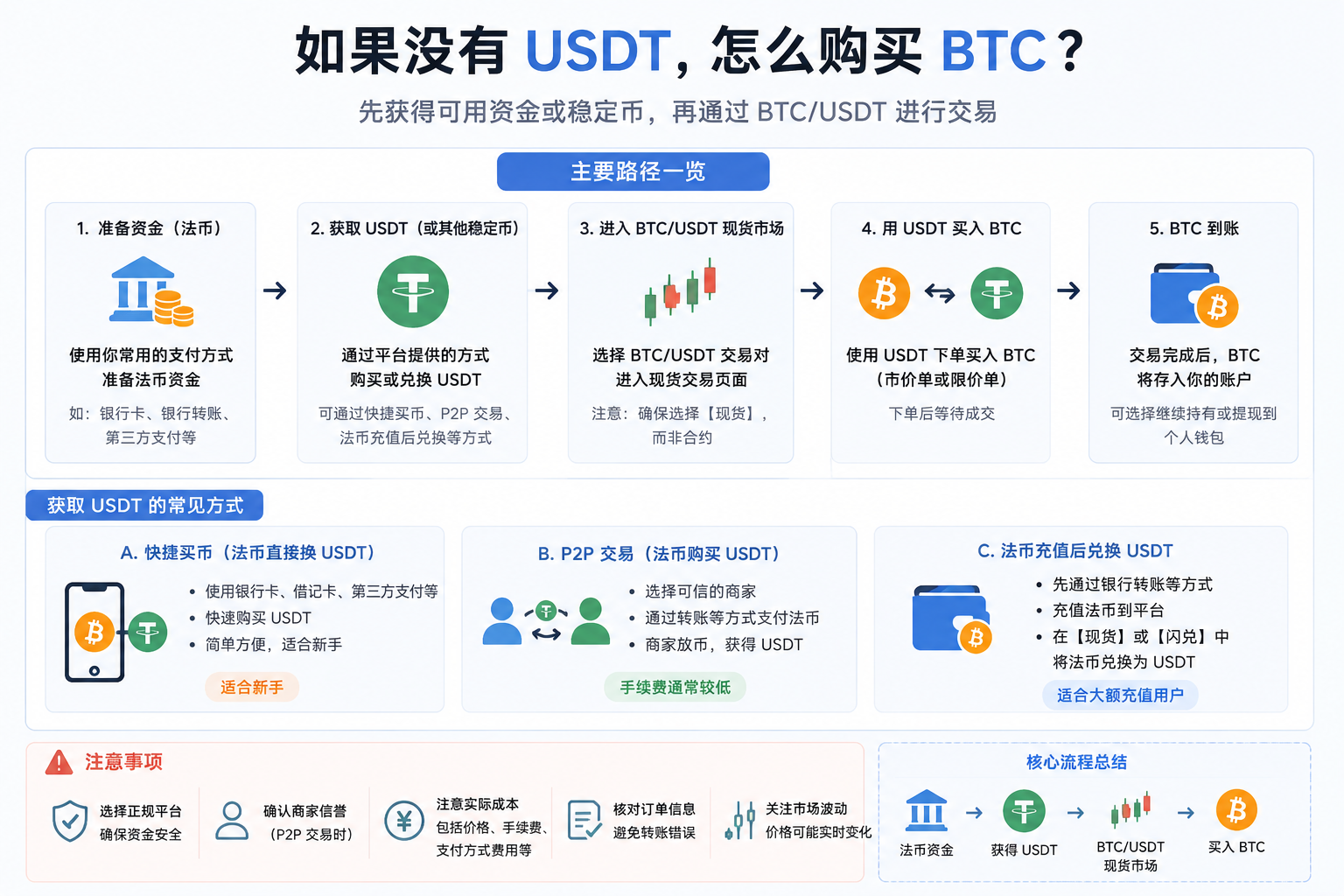
How Can You Buy BTC If You Do Not Have USDT?
If you do not have USDT, you generally cannot treat the BTC/USDT market as a direct fiat purchase channel.
You first need to obtain a quote asset supported by the trading platform, such as USDT, and then enter the BTC/USDT spot market.
Depending on availability, some users may obtain USDT through methods such as P2P trading before trading BTC/USDT.
To learn more, see Bitcoin P2P Trading Guide: Buy BTC Without Platform Trading Fees.
One important distinction is:
“No platform trading fee for P2P” does not mean the entire purchase process is necessarily free.
Actual costs may still arise from quote differences, payment methods, exchange rates, and other trading conditions, so compare the final amount you will pay.
The Essential BTC/USDT Reference for Beginners
If you can match all the concepts in this reference, you can understand most BTC/USDT spot trading pages.
FAQ
What Does BTC/USDT Mean?
BTC/USDT is a trading pair composed of Bitcoin and USDT. BTC is the base asset and USDT is the quote asset. For example, BTC/USDT = 60,000 means that 1 BTC is quoted at 60,000 USDT.
What Does Buying BTC/USDT Mean?
Buying BTC/USDT essentially means using a quote asset such as USDT to purchase BTC. Selling is the reverse: exchanging BTC for USDT.
Is BTC/USDT Spot or Futures?
The label BTC/USDT alone does not identify the product type because both spot and futures products may use similar underlying assets and quotes. Check whether the trading page is labeled Spot or Futures/Perpetual.
Which Is the Base Asset in BTC/USDT?
BTC is the base asset, and USDT is the quote asset. The trading-pair price indicates how much USDT is required to buy 1 BTC.
Why Is the BTC Price I See Different From My Final Fill Price?
The displayed price may be only the latest traded price or a price at one level of the order book. Actual fills are affected by the order type, order book depth, bid-ask spread, and market volatility. This is especially important for market orders and larger orders.
Your First BTC/USDT Trade
After understanding BTC/USDT, the next step toward your first spot trade is learning the order-entry interface, order types, and fill process.
Continue reading:
Hotcoin Guide to Buying BTC for the First Time
Risk Warning: Crypto assets are highly volatile, and trading BTC may result in a loss of principal. This article explains BTC/USDT trading pairs and spot trading fundamentals for educational purposes only and does not constitute investment advice. Before trading, confirm service availability in your region and refer to the platform's current trading rules, fees, and order information.
Inirerekumendang pagbabasa
Tingnan ang higit pa