
Zero-Knowledge Proofs: The Ultimate Solution for Privacy and Scaling
A zero-knowledge proof is a cryptographic method that lets a prover convince a verifier that a statement or computation is valid without revealing the underlying secret.
It can prove that “I am over 18” without disclosing a birth date, show that an account has enough funds without exposing its balance, or demonstrate that thousands of off-chain transactions were executed correctly without making Ethereum recompute them. Privacy and scaling have therefore become two of the most important applications of ZK technology.
ZK does not automatically hide everything, however, nor is it a cost-free ultimate answer. A ZK Rollup may publish transaction data and use a validity proof only to guarantee correct computation. A privacy protocol must instead treat sensitive data as a secret witness while carefully addressing metadata, keys, trusted setups, data availability, and contract vulnerabilities.
For a broader view of how zero-knowledge proofs relate to AI, cross-chain systems, oracles, and modular blockchains, read The Web3 Frontier in 2025.
What Is a Zero-Knowledge Proof?
A zero-knowledge proof involves a prover and a verifier. The prover knows a secret or has completed a computation and wants the verifier to accept a statement as true. The verifier checks the proof against public rules without learning all the private inputs used to create it.
The statement might be “I know the original text behind this hash,” “this account can cover the payment,” “this person belongs to an eligible set,” or “this transaction batch correctly transformed an old state into a new one.” The secret input is commonly called the witness.
A proving system converts a program or set of rules into mathematical constraints. The prover supplies a witness satisfying those constraints and generates a compact proof, which the verifier checks with a verification key or public parameters. Successful verification means only that the statement satisfies the defined rules; it does not guarantee that the rules capture the intended business outcome.
What Properties Must a Zero-Knowledge Proof Have?
2.1 What Is Completeness?
Completeness means that when a statement is true, a proof generated by an honest prover with the correct witness should be accepted by an honest verifier. A system that regularly rejects legitimate users cannot support a reliable product even if its cryptography is secure.
2.2 What Is Soundness?
Soundness means that when a statement is false, a dishonest prover has only a negligible chance of constructing a proof that passes verification. An attacker must not be able to invent a balance, falsely satisfy an age requirement, or make an invalid transaction batch acceptable to L1.
2.3 What Is Zero Knowledge?
Zero knowledge means that the verifier should learn nothing about the witness beyond the validity of the statement. Formal definitions commonly use a simulator to show that the information produced during verification could be generated without knowing the secret, so the proof reveals nothing extra.
All three properties matter. A system may prove that a computation is correct while leaving public inputs visible, or protect the witness while leaking addresses, timing, gas payments, or interaction patterns at the application layer. Privacy requires both cryptography and careful product design.
How Do Zero-Knowledge Proofs Work?
The first step is defining the program to prove. It might require the prover to know a password whose hash equals a public value, or show that every signature, nonce, balance, and state-root update in a transaction batch follows the rules.
The second step is arithmetization. The system converts the program into polynomials, a constraint system, or an execution trace over a finite field. Addition, multiplication, range checks, and hashes must all be expressed in a form the proving system understands, and complex programs can create enormous numbers of constraints.
The third step is witness generation. The prover runs the program, obtains private intermediate values and results, and arranges them as required by the circuit. An incorrect witness does not satisfy the constraints and, in theory, cannot produce a valid proof.
The fourth step is proving. The prover performs relatively heavy cryptographic computation to compress a large witness into a shorter proof. This phase may require substantial CPU, GPU, memory, or specialized hardware and is one of the main costs of a ZK system.
The fifth step is verification. The verifier uses only the public inputs, proof, and verification key to check a small number of cryptographic equations instead of rerunning the entire computation. This asymmetry—expensive proving and inexpensive verification—is what allows a blockchain to verify large amounts of off-chain computation.
How Do Interactive and Non-Interactive Proofs Differ?
Early zero-knowledge protocols required several rounds of interaction. The prover first made a commitment, the verifier issued a random challenge, and the prover returned a response. After enough repetitions, the probability that a cheater could pass by guessing became negligible.
Blockchains are better suited to non-interactive proofs. A prover generates a publicly verifiable proof once, and any node can check it independently without an online conversation with the original prover. The Fiat-Shamir transform commonly uses a hash function to convert the random challenge from an interactive protocol into a deterministic challenge.
Non-interactive proofs require public parameters or transparent randomness. Some SNARKs use a trusted setup to generate a common reference string, while other systems use universal setups, updatable setups, or setup-free designs. The choice affects proof size, speed, transparency, and upgrade costs.
What Is the Difference Between zk-SNARKs and zk-STARKs?
5.1 What Are the Characteristics of zk-SNARKs?
SNARK stands for Succinct Non-Interactive Argument of Knowledge. SNARKs generally produce very small proofs, enable fast on-chain verification, and incur relatively low gas costs, making them suitable for private payments, identity, and Rollups. Groth16, PLONK, and Halo2 are distinct proving systems and do not share every property implied by the broader label.
Some SNARKs require a trusted setup. If the secret parameters produced by the ceremony are not completely destroyed, an attacker holding the “toxic waste” may be able to forge proofs. Multiparty computation ceremonies reduce this risk by letting many participants contribute randomness; the system remains protected if at least one participant honestly destroys their secret.
Systems such as Halo2 support recursion and designs without circuit-specific trusted setups. Regardless of the approach, a project should disclose the source of its parameters, circuit versions, cryptographic curves, audits, and upgrade permissions rather than merely advertising that it “uses SNARKs.”
5.2 What Are the Characteristics of zk-STARKs?
STARK stands for Scalable Transparent Argument of Knowledge. It uses publicly verifiable randomness, usually avoids a traditional trusted setup, and relies on cryptographic assumptions such as hash functions, which are often considered more favorable for post-quantum research.
STARK proving scales well for large computations, but its uncompressed proofs are usually larger than SNARK proofs and can cost more to verify on-chain. Recursion and compression can aggregate multiple STARK proofs and lower the final settlement cost.
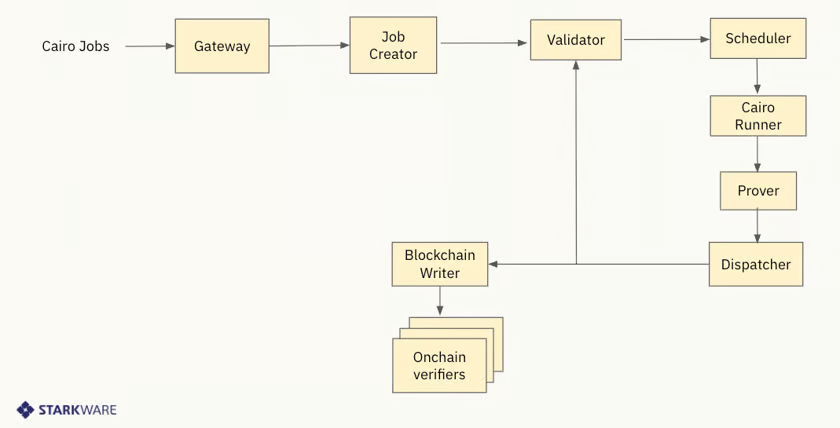
Starknet uses a STARK-based proving system, while Cairo is an execution environment designed for provable computation. SHARP can aggregate proofs from multiple programs and compress them recursively, allowing different applications to share proving and Ethereum verification costs.
How Do Zero-Knowledge Proofs Protect Privacy?
Privacy applications treat balances, transaction amounts, identity attributes, or set membership as secret witnesses and reveal only the minimum statement needed for verification. The verifier learns that the user qualifies without seeing all the underlying data.
Zcash shielded transactions use zk-SNARKs to prove compliance with monetary rules—for example, that inputs are valid, no funds are spent twice, and outputs conserve value—while hiding the sender, recipient, amount, and memo. The chain can reject invalid transfers without publicly revealing every financial detail.
In identity systems, users may prove that they are above an age threshold, come from an allowed region, hold a valid credential, or are a unique member of a set without uploading a passport. A nullifier can prevent one credential from claiming an award or voting twice without exposing a universal identifier across applications.
Zero knowledge does not automatically hide network-layer information. IP addresses, wallet funding sources, transaction timing, gas payments, and interactions with transparent addresses can still be correlated. If the anonymity set is small or users frequently move between public and private modes, outside observers may infer their identities.
How Do ZK Rollups Scale Ethereum?
A ZK Rollup executes and stores many transactions on L2, then submits a summary of the batch’s state changes, necessary data, and a validity proof to Ethereum. After L1 verifies the proof, it accepts the new state without re-executing every transaction in the batch.
Batching spreads fixed proving and settlement costs across many users and reduces L1 computation and storage pressure. Once the proof is verified, the state does not need a full Optimistic Rollup challenge period to establish computational correctness, so withdrawable state can theoretically become final sooner.
A ZK Rollup is not secured by the proof alone. Its L1 contract must verify proofs correctly, and the Rollup must provide enough data for users to reconstruct state and exit if the operator stops. Sequencers, provers, upgrade administrators, and bridge contracts can also become centralized or operational failure points.
ZKsync Era uses validity proofs for batch execution, Starknet uses STARK proofs and Cairo, and other zkEVM systems seek compatibility with Ethereum bytecode and development tools. They differ in virtual-machine design, proving systems, data availability, and compatibility.
For a full comparison of ZK Rollups, Optimistic Rollups, Validium, and sidechains, read What Is Layer 2? A Complete Guide to Ethereum Scaling.
What Is a zkEVM?
A zkEVM is a system that can generate validity proofs for the EVM or an EVM-like execution environment. It allows Solidity contracts and Ethereum tools to move to a ZK Rollup while translating transaction execution into mathematical constraints that a proving circuit can verify.
The EVM was not originally designed for ZK. Some opcodes, Keccak hashing, dynamic memory, and state access are expensive to prove. Projects must trade off Ethereum equivalence, developer compatibility, and proving efficiency, so different zkEVMs support bytecode and tools to different degrees.
It is also important to distinguish a zkEVM Rollup from an L1 zkEVM. The former executes on L2 and sends proofs to Ethereum. The latter aims to let Ethereum validators verify L1 block execution through ZK proofs, reducing repeated computation across all nodes and making verification more efficient and accessible.
How Do ZK Rollup, Validium, and Volition Differ?
A ZK Rollup publishes transaction data, or the data required to recover state, on L1. This is relatively expensive, but users can rely on Ethereum data to reconstruct state. Even if the operator stops, users have a stronger basis for exiting independently.
Validium also uses validity proofs to guarantee correct state transitions, but stores data off-chain through a data-availability committee or another network. This can lower fees and increase throughput while introducing data-withholding risk. A correct proof does not guarantee that users can obtain the data needed to recover state.
Volition lets a user or application choose between Rollup and Validium data modes. High-value assets may use L1 data availability, while low-value, high-frequency transactions may use off-chain data. This flexibility requires wallets and interfaces to disclose clearly which security mode protects each asset.
Data availability and execution validity are separate questions. A ZK proof can establish that “the state transition was computed correctly,” but it cannot reconstruct transaction data that was never published. Both must be evaluated when reviewing a scaling project.
What Else Can Zero-Knowledge Proofs Be Used For?
Decentralized identity can use ZK proofs for qualifications, credential possession, and set membership with minimal disclosure. Users need not give every application a complete identity document; the verifier receives only the conclusion required by the service. For context, read Decentralized Identity: Take Control of Your Digital Identity.
Proof-of-reserves systems can demonstrate that assets or liabilities satisfy certain constraints without revealing every account. They still do not automatically establish asset ownership, complete liabilities, or the legal relationship of custody, so audits, signatures, and other evidence remain necessary.
Compliance systems can prove that a transaction meets list, limit, or jurisdictional rules without revealing all customer data. Private machine learning may prove that a model ran as committed or that a result came from a particular model, although proving large models remains expensive and often requires specialized zkVMs, recursion, and hardware acceleration.
Cross-chain protocols can use ZK light clients to prove another chain’s consensus and state with less reliance on a fixed multisig. Games can prove fair computation, DAOs can enable anonymous voting while preventing duplicate votes, and supply chains can prove that conditions were met while protecting commercial secrets.
What Are the Limitations and Risks of Zero-Knowledge Proofs?
11.1 High Proving Costs
Complex programs require many constraints, and a prover may consume substantial compute, memory, and time. If proving services concentrate among a few high-performance operators, the result can be availability, censorship, and infrastructure-centralization risks.
11.2 Circuit Bugs Are Hard to Find
A circuit proves only the rules encoded in it. If a developer omits a constraint, an attacker may provide a witness that violates the intended business logic while satisfying the circuit. The verifier then correctly accepts a proof for a wrongly defined problem.
11.3 Trusted Setups Can Fail
A proving system with a specific trusted setup depends on the ceremony secrets being destroyed. If parameter generation is compromised, an attacker may forge proofs without being easily detected. Projects should disclose the ceremony, participants, parameter hashes, and update process.
11.4 Cryptographic Implementations Carry Risk
An implementation error in elliptic curves, hashes, finite fields, randomness, compilers, or verifier contracts can undermine security. New proving systems require long-term research, formal verification, audits, and practical operational testing.
11.5 Metadata Can Defeat Privacy
Even when the witness stays private, public inputs, nullifiers, deposit and withdrawal amounts, network addresses, and timing patterns may link activity to a user. Privacy applications need sufficiently large anonymity sets and safe defaults.
11.6 Administrators and Upgrades Remain Risks
Rollup contracts, bridges, provers, sequencers, and verification keys may be controlled by administrators. A ZK proof prevents an invalid state under the current rules, but it does not automatically prevent a malicious upgrade. Timelocks, multisigs, and escape hatches still matter.
11.7 A Valid Proof Does Not Make the Inputs True
Zero-knowledge proofs excel at showing that an input satisfies a rule, but they cannot determine whether off-chain input is true. If an institution issues a claim about age, qualifications, assets, or a real-world event, the system must still trust that issuer to verify facts correctly and protect its keys. An incorrect credential can produce a cryptographically valid proof once it enters the circuit.
Identity and compliance applications should therefore check credential provenance, revocation, expiry, issuer key rotation, and oracle security. ZK can reduce the data disclosed to a verifier, but it cannot remove source-data risk.
11.8 A Small Privacy Set Weakens Anonymity
Privacy is not an isolated property of one transaction. If a shielded pool has few users, or someone deposits and immediately withdraws the same amount, observers may correlate activity through amount, time, gas, network address, and behavior. A proof that does not reveal the witness may still leave a recognizable pattern.
Users should not confuse “the plaintext cannot be read directly” with “the activity cannot be traced.” Protocols should evaluate anonymity-set size, amount standardization, delays, relayers, network-layer privacy, and default wallet flows while clearly disclosing public fields.
11.9 Benchmarks Must Reflect Real Workloads
Projects often advertise proofs per second, proof size, or verification gas, but results from different circuit complexities, hardware, batch sizes, and security parameters are not directly comparable. The speed of a simple hash circuit does not represent the cost of a complete zkEVM executing complex smart contracts.
Performance reviews should consider proof latency, peak memory, hardware configuration, batch waiting time, on-chain data fees, verification fees, and final confirmation time. Laboratory benchmarks, testnet results, and sustained mainnet loads must also be distinguished rather than relying on one scalability metric.
How Should You Evaluate a ZK Project?
First, determine what it proves. A project should disclose its statement, public inputs, secret witness, and security boundary. Saying only that it “uses ZK” is not enough to evaluate its privacy or validity guarantees.
Second, identify the proving system. Check whether it uses SNARKs, STARKs, PLONK, Halo2, or another framework; whether it needs a trusted setup; and how proof size, generation cost, verification cost, and recursion work.
Third, examine whether the circuit and code are open source, audited, and tested. A secure proving-system library does not make a business circuit secure, and the Rollup state machine, bridge, upgrade contracts, and wallet also require independent review.
Fourth, inspect data availability. Determine whether transaction data is published to Ethereum, blobs, an independent DA network, or a committee, and how users can reconstruct state and exit if the operator stops.
Fifth, review system centralization. Understand who controls the sequencer, prover, parameter generation, upgrade administration, emergency pauses, and bridge. A roadmap promising future decentralization is not evidence of decentralization today.
Sixth, define the user privacy boundary. Identify which fields are hidden and which remain public, whether the wallet protects privacy by default, whether nullifiers can be linked across applications, and whether IP addresses or fiat on-ramps expose identity.
Hotcoin’s Six-Dimension ZKP Framework
The ZKP checklist offers six dimensions for evaluating zero-knowledge projects. It is neither an investment rating nor a cryptographic security certification.
13.1 Z: Zero Knowledge—What Is Hidden?
Identify the secret witness, public inputs, and metadata that may leak. A validity proof does not necessarily provide transaction privacy; every privacy claim should map to specific fields and a defined threat model.
13.2 K: Knowledge—What Knowledge Is Proved?
Define the statement and constraints: does the proof establish a balance, identity, program execution, state transition, or chain consensus? A proof is responsible only for encoded rules, not facts outside them.
13.3 P: Prover—Who Generates the Proof?
Review proving hardware, costs, prover count, censorship resistance, and failure recovery. A network may stop if its only prover goes offline even when that prover cannot submit an invalid state.
13.4 C: Circuit—Can the Circuit Be Trusted?
Check whether circuits, compilers, proving libraries, parameters, and verifier contracts are open source, audited, and formally verified. Missing business constraints are among the most dangerous implementation errors.
13.5 D: Data—Is the Data Available?
Confirm where data is published and how state recovery and forced exits work. A validity proof guarantees correct computation; data availability determines whether users can independently continue using the state.
13.6 G: Governance—Who Can Upgrade the System?
Review multisigs, timelocks, pause powers, bridges, sequencers, and verification keys. An administrator who can replace a verifier immediately may bypass the trust users place in the current proving system.
Frequently Asked Questions
14.1 Do Zero-Knowledge Proofs Reveal No Information at All?
They protect only information designed as a secret witness. Public inputs, transaction timing, address links, IP addresses, and deposit or withdrawal paths may still leak. Actual privacy depends on both the protocol and how it is used.
14.2 Are All Transactions on a ZK Rollup Private?
No. Most ZK Rollups use validity proofs for scaling while transaction data and account activity may remain public. Privacy also requires shielded state, dedicated circuits, and appropriate wallet design.
14.3 Which Is More Secure, zk-SNARK or zk-STARK?
There is no universal answer. SNARK proofs are small and inexpensive to verify, although some systems require a trusted setup. STARKs are generally transparent and scale well for large computations, but their proofs are larger. Security also depends on implementation, parameters, and audits.
14.4 Can Someone Recover the Secret by Breaking the Proof?
Normal verification does not recover the witness. Privacy may still fail if cryptographic assumptions, implementations, key management, or application metadata fail, so “zero knowledge” should not be treated as permanent and absolute anonymity.
14.5 Why Are ZK Rollup Fees Lower Than Mainnet Fees?
They execute many transactions off-chain and spread proof and batch-data costs across many users. Fees still depend on proving, data publication, L1 gas, the sequencer, and bridging, so a ZK Rollup is not guaranteed to be cheaper at all times.
14.6 What Is a Trusted Setup?
A trusted setup is a ceremony that generates public parameters for proving and verification. If an attacker obtains retained secrets, some systems may permit forged proofs. Multiparty ceremonies and transparent proving systems can reduce this risk.
14.7 Must Users Understand Cryptography to Use a ZK Project?
Ordinary users do not need to master the formulas, but they should understand what the project proves, whether it provides privacy, where the data lives, who controls upgrades, and what risks its bridge and wallet introduce.
Conclusion: ZK Is a Powerful Tool, Not a Universal Endpoint
Zero-knowledge proofs replace “trust the operator” with “verify the mathematical proof.” They can prove eligibility and transaction validity without revealing secrets, and let Ethereum confirm large amounts of off-chain computation with one verification.
SNARKs, STARKs, recursive proofs, zkEVMs, and zkVMs continue to improve proving efficiency and programmability. Zcash demonstrates private payments, Starknet and ZKsync demonstrate validity Rollups, and identity protocols demonstrate selective disclosure and Sybil resistance.
ZK guarantees only a statement that has been correctly encoded and verified. Circuit bugs, trusted setups, prover centralization, unavailable data, administrator upgrades, and metadata leaks do not disappear because a project adds the “ZK” label.
Viewed through the Web3 Technology Stack: From Base Blockchains to Applications, zero-knowledge proofs span cryptography, execution, scaling, identity, and applications. A sound evaluation examines the proving system, data, operations, and user experience separately.
Return to The Web3 Frontier in 2025 to place ZK in the same framework as AI, cross-chain protocols, oracles, privacy computing, and modular blockchains.
To connect to Web3 applications with a standalone wallet, consider Hotcoin Web3 Wallet. For mobile market data and trading tools, visit the Hotcoin App. Browse more educational content at Hotcoin.
Risk warning: This article is for education and information only and does not constitute investment, trading, cryptographic, smart-contract development, legal, or tax advice. ZK projects may face circuit and verifier bugs, trusted-setup failures, proving-key leaks, prover and sequencer centralization, unavailable data, bridge risks, contract upgrades, privacy-metadata exposure, and regulatory risks. Before participating, verify current official documentation, audits, parameters, data modes, administrator permissions, and exit mechanisms, and use only funds you can afford to lose.
Inirerekumendang pagbabasa
Tingnan ang higit pa

Service@hotcoin.com
Product@hotcoin.com
Business@hotcoin.com
Casecn@hotcoin.com