
What Is Tokenomics?
Tokenomics is the set of rules governing how a token is issued, allocated, used, and governed. It explains how supply changes, who holds the token, and why participants may want to hold or use it.
Tokenomics alone cannot predict price. Prices are also affected by market liquidity, actual demand, broader market conditions, and changes to implementation rules. An analysis should track the supply that may enter circulation in the future, the token's real demand, and the incentives of different participants.
What Does Tokenomics Include?
A complete tokenomics model typically covers supply, initial allocation, release schedules, token utility, participant incentives, and governance rights. These elements must be considered together. Looking only at a supply cap or burn mechanism can easily produce a misleading conclusion.
| Component | What to understand | Common points to examine |
|---|---|---|
| Supply | Total supply, maximum supply, circulating supply, issuance, and burn rules | Whether supply is fixed and who can change issuance parameters |
| Allocation | Shares assigned to the team, investors, community, foundation, and ecosystem treasury | Whether ownership is concentrated and whether relevant addresses can be verified |
| Release | TGE unlocks, cliffs, linear vesting, or milestone-based releases | Which tokens become transferable at the same time |
| Utility | Paying fees, staking, governance, accessing services, or use as collateral | Whether the use creates real demand and whether another asset can replace the token |
| Incentives | Rewards for validation, liquidity, development, and users | Whether rewards come from new issuance or sustainable revenue |
| Governance | Proposals, delegation, voting, execution, and emergency powers | Whether voting power is concentrated and whether approved votes can be executed directly |
If you are not yet familiar with the differences among payment coins, platform tokens, stablecoins, and meme coins, start with A Complete Guide to Cryptocurrency Categories. A token category describes its broad purpose, while tokenomics explains how its supply and incentives operate.
How Should Token Supply Be Understood?
The supply structure determines how many tokens can currently trade and how supply may change in the future. Token standards such as ERC-20 expose totalSupply, but the on-chain total supply is not the same as circulating supply. It also cannot replace an examination of locked addresses, treasuries, and issuance permissions.
- Maximum supply is the theoretical limit permitted by the protocol. Some tokens have no fixed cap, with issuance determined by protocol parameters or governance.
- Total supply generally means the number of tokens created minus tokens that have clearly been burned. Data providers may treat locked or inaccessible tokens differently.
- Circulating supply focuses on tokens that can be freely transferred in the market. Whether team vesting, foundation treasuries, and cross-chain custody addresses are included depends on the provider's methodology.
- Net issuance reflects both new issuance and burns. A burn mechanism does not necessarily reduce supply; total supply declines only when the amount burned exceeds new issuance over the same period.
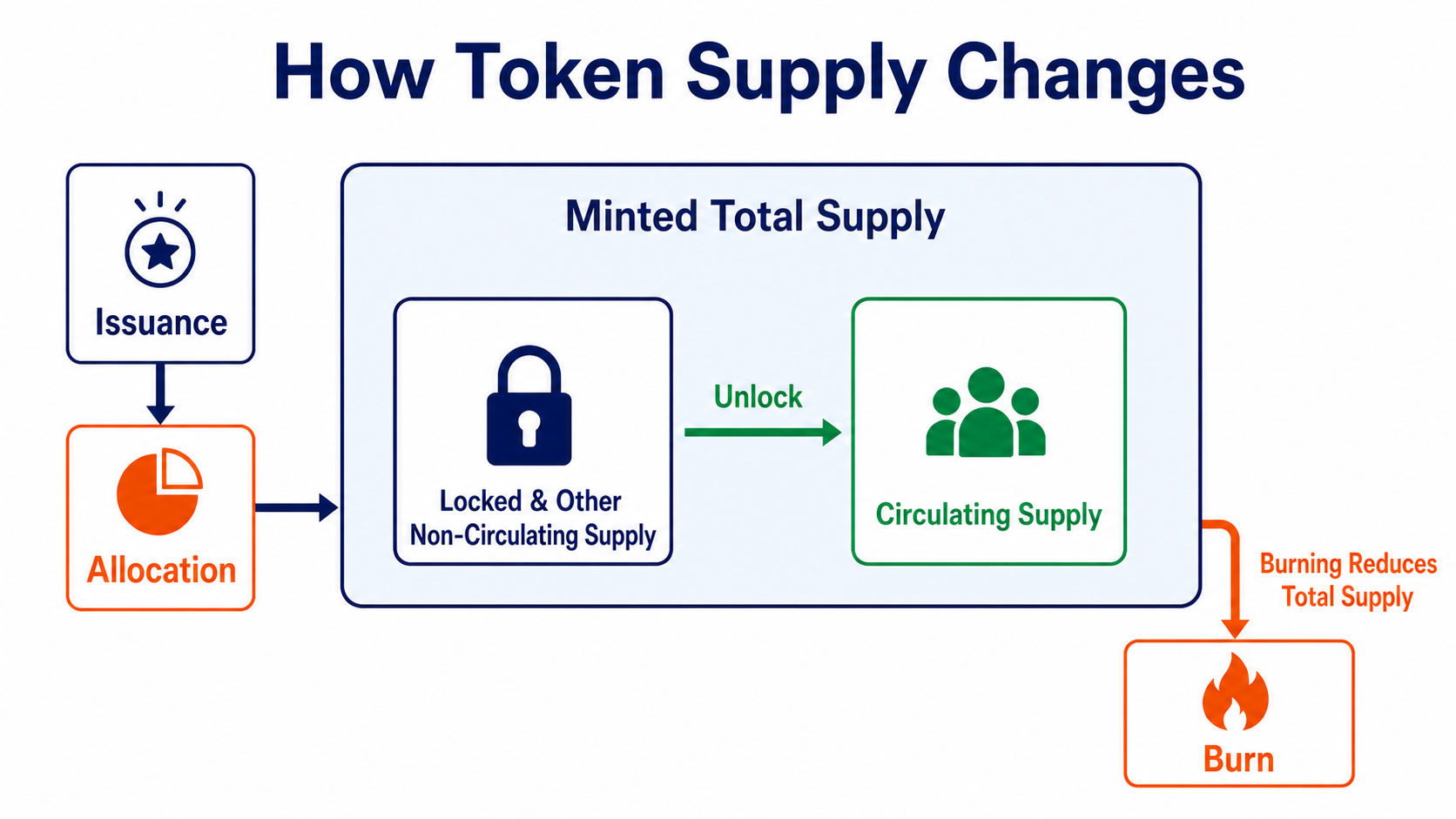
Supply changes also require distinguishing inflation from dilution for individual holders. A holder who receives newly issued tokens through staking may see their nominal balance rise, but their share of total supply can still fall if their rewards are lower than the network-wide supply growth rate.
What Does the Initial Allocation Reveal?
The initial allocation identifies who controls tokens at launch or under a predetermined plan. Team, early investors, community incentives, and ecosystem treasury are only category labels. The key facts to verify are control, differences in acquisition cost, and when the tokens become transferable.
Use the following sequence when evaluating an allocation structure:
- Identify the entities included in each category and determine whether one controller has spread holdings across multiple wallets or labels.
- Compare the whitepaper, foundation disclosures, and on-chain addresses to ensure that allocated, committed, and circulating tokens have not been conflated.
- Check whether treasury transfers require an individual signature, a multisignature wallet, or governance approval, and whether an administrator can change issuance or vesting rules unilaterally.
- Compare the acquisition terms and release dates for each group instead of looking only at percentages in a pie chart.
An even allocation does not necessarily mean decentralized governance. Multiple addresses may belong to the same entity, and tokens held by many wallets may all be delegated to one representative. Conversely, a foundation holding a large allocation does not mean those tokens are immediately sellable; vesting and budget restrictions still need to be checked.
How Do Token Unlocks and Release Schedules Work?
A release schedule determines when allocated tokens can be claimed or transferred. Common structures begin with a lockup period followed by a one-time unlock or linear release. Other plans distribute tokens based on project milestones, governance decisions, or participant activity.
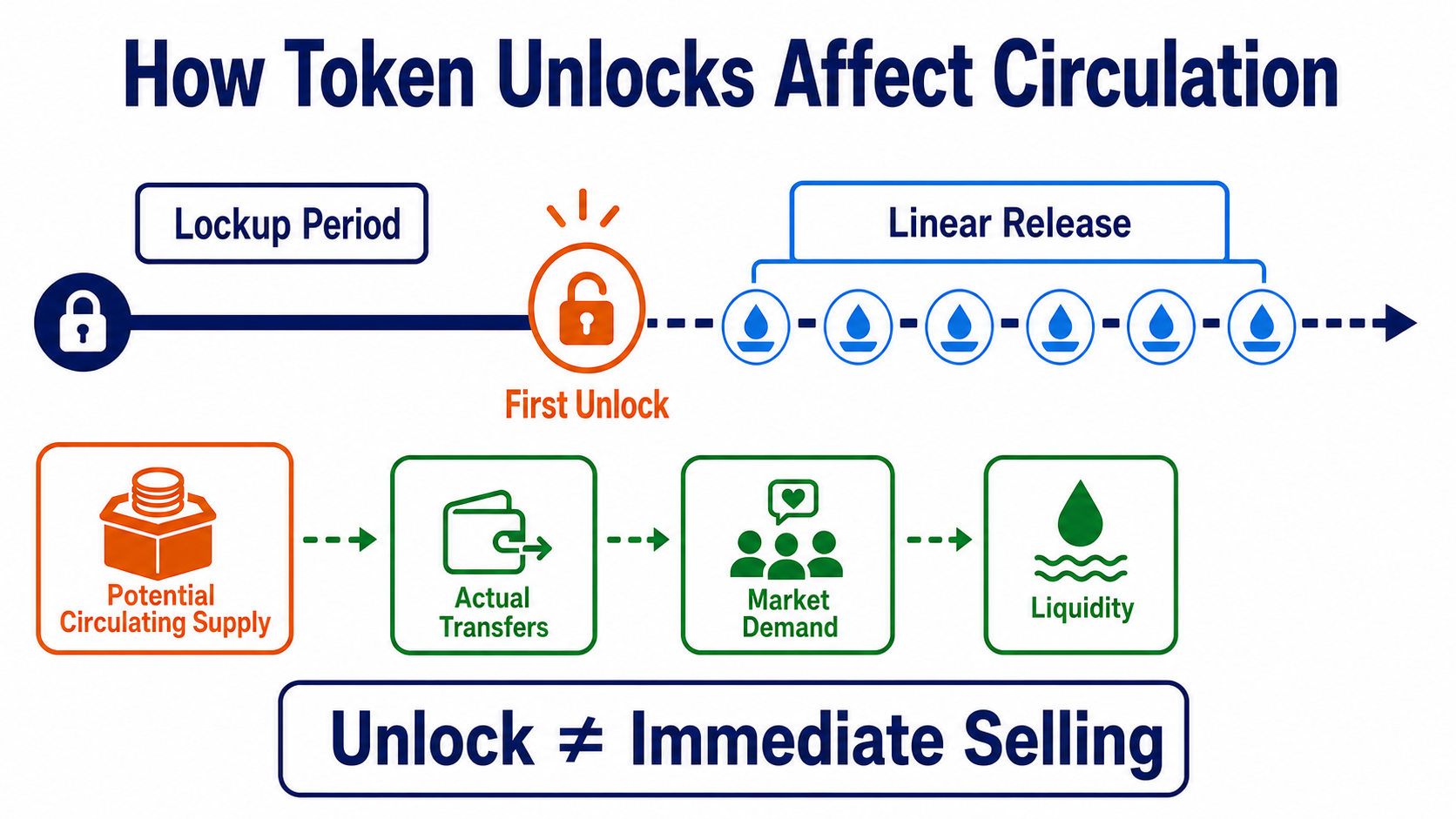
An unlock increases the potential circulating supply, but it does not mean holders will sell immediately, nor does it always increase total supply. If tokens were minted earlier and locked in a contract, an unlock changes their transfer conditions. If the protocol mints tokens only when they are distributed, an unlock may increase both total and circulating supply.
Do not evaluate an unlock by looking at a single date alone. Also confirm:
- The unlocked amount as a percentage of current circulating supply, not merely maximum supply.
- Who receives the tokens and whether they are transferred automatically, must be claimed, or remain subject to other conditions.
- Whether market depth can absorb the additional circulating tokens and whether recipients have a history of transfers or delegation.
- Whether staking withdrawals, reward distributions, treasury grants, or other supply changes occur at the same time.
Therefore, the claim that a large unlock must cause a price decline is not reliable. Unlocks increase the amount that could be sold, but the price outcome still depends on actual transfers, demand, and market liquidity.
How Does Token Utility Create Demand?
Token utility is the reason holders must or want to use a token. Common uses include paying network fees, providing collateral through staking, accessing protocol features, participating in governance, and settling transactions within an application. Listing a use in a whitepaper is only the starting point. You must also confirm that it is live, that the token is required, and what happens to the token after it is used.
A simple path can be used to examine utility:
User action → whether the token is required → token is held, locked, or paid → how the recipient handles the token
For example, staking temporarily reduces the amount that can be freely transferred, but supply also grows if rewards come from continuing issuance. Distributing token rewards to users may generate early activity, yet the attraction may disappear when rewards decline. New demand and new issuance should be placed on the same timeline rather than evaluated separately.
Are the Incentives Sustainable?
Incentive mechanisms use tokens to coordinate validators, developers, liquidity providers, governance participants, and users. Effective incentives should encourage the behavior the protocol needs while making the costs of cheating, extracting short-term rewards, or exiting sufficiently clear.
Analyze incentives by tracing where tokens come from and where they go:
| Question | How to assess it |
|---|---|
| Where do rewards come from? | Distinguish new issuance, protocol fees, treasury grants, and other revenue |
| Who bears the cost? | Check dilution for non-staking holders, user fees, or declining treasury balances |
| What happens when rewards end? | Determine whether usage demand remains and whether participants were attracted only by subsidies |
| Is exit restricted? | Review unstaking periods, penalty rules, liquidity, and claim conditions |
A nominal yield alone does not prove that a model is sustainable. If rewards primarily come from new issuance, compare the rewards received by an individual with total supply growth and changes in token price rather than looking only at the number of tokens earned.
What Can a Governance Token Decide?
Governance utility depends on the matters holders can actually control. Votes may cover protocol upgrades, treasury grants, issuance parameters, or representative elections, but they may also be merely advisory. Some systems let holders delegate voting power, so the distribution of token ownership may differ from the distribution of effective voting power.
When evaluating governance, follow the complete path from proposal to execution: who can submit a proposal, what threshold is required to begin voting, whether a quorum applies, whether an approved vote is executed automatically by an on-chain contract or manually by multisignature signers, and whether any party holds emergency powers to pause the contract.
Governance rights also do not automatically constitute company equity, rights to protocol revenue, or redemption rights over assets. The rights attached to a token should be determined from protocol rules, legal documents, and executable contracts.
How Can You Analyze a Project's Tokenomics Systematically?
Instead of applying a universal allocation ratio for “good tokenomics,” it is more useful to verify documents, on-chain state, and future events layer by layer.
- Read the project documentation and record the supply cap, issuance formula, allocation categories, release rules, token uses, and governance rights.
- Inspect the token contract to confirm minting, burning, pausing, upgrading, and administrator permissions, and identify who can call the relevant functions.
- Review holder addresses, vesting contracts, treasuries, and cross-chain custody addresses so that custodial balances are not mistaken for ordinary ownership concentration.
- Build a supply calendar that places team unlocks, investor releases, staking rewards, and treasury distributions on one timeline.
- Verify actual demand by confirming that fee payments, staking, governance, or feature access are operational rather than merely listed on a roadmap.
- Examine governance execution records and compare written rules, on-chain votes, and multisignature actions.
Market capitalization and FDV can help compare the current circulating value with the nominal value at full dilution, but they do not automatically account for the speed of unlocks or token utility. See Market Cap, Circulating Supply, and Fully Diluted Valuation Explained for the calculations. To place these metrics within a broader asset-analysis framework, return to the Beginner's Guide to Crypto Assets.
Frequently Asked Questions
Are tokenomics and cryptoeconomics the same concept?
They overlap, but their scopes differ. Tokenomics typically focuses on the supply, allocation, uses, and governance of a particular token. Cryptoeconomics also examines consensus security, strategic behavior, and how cryptographic systems coordinate participants.
Does a token with more decimals have a larger supply?
No. decimals only specifies how wallets and interfaces display the smallest unit; it does not create more tokens. Supply figures should first be converted using the precision specified by the contract rather than comparing raw integers returned on-chain.
Does moving a token across chains double its total supply?
Not necessarily. A common bridge design locks tokens on the source chain and mints a corresponding representation on the destination chain. Economic supply statistics must recognize this relationship to avoid double counting. Bridges use different minting, burning, and custody methods, so the asset's origin must be verified before calculating supply.
Does delegating a governance vote transfer ownership of the token?
Usually not. Governance delegation generally transfers only voting power to a representative while the original address continues to hold the tokens. However, the delegation method and revocation terms depend on the specific governance contract, so rules cannot be assumed to be the same across all protocols.
Inirerekumendang pagbabasa
Tingnan ang higit pa


Service@hotcoin.com
Product@hotcoin.com
Business@hotcoin.com
Casecn@hotcoin.com