
What Is Arbitrage Trading? Common Types of Arbitrage Explained
Arbitrage trading involves buying and selling the same or related assets simultaneously, or nearly simultaneously, to capture price discrepancies across markets, trading pairs, or contracts. Any real result must account for trading fees, slippage, funding charges, and transfer costs. Seeing a price gap does not mean it can be turned into profit.
What Is the Core Principle of Arbitrage Trading?
The CFTC defines arbitrage as buying and selling the same or equivalent contracts or instruments simultaneously in two or more markets to take advantage of discrepancies in their price relationships. In the strict sense, arbitrage focuses on establishing offsetting positions rather than predicting whether an asset will rise or fall later.
For example, when the same asset has different executable prices on two platforms, a trader may buy in the lower-priced market and sell at the same time in the higher-priced market. The trade produces a realizable arbitrage result only if the difference between the two transactions remains positive after all costs. Price discrepancies in crypto markets are often short-lived, so the ability to execute both orders together is critical.
Buying now and selling later after the price rises is not arbitrage in the strict sense. It does not establish an offsetting position, and its outcome depends on the asset’s future direction, making it closer to ordinary trading or speculation. Calling every buy-low, sell-high trade arbitrage obscures the difference between their risk structures.
Why Do Prices Differ Across Markets?
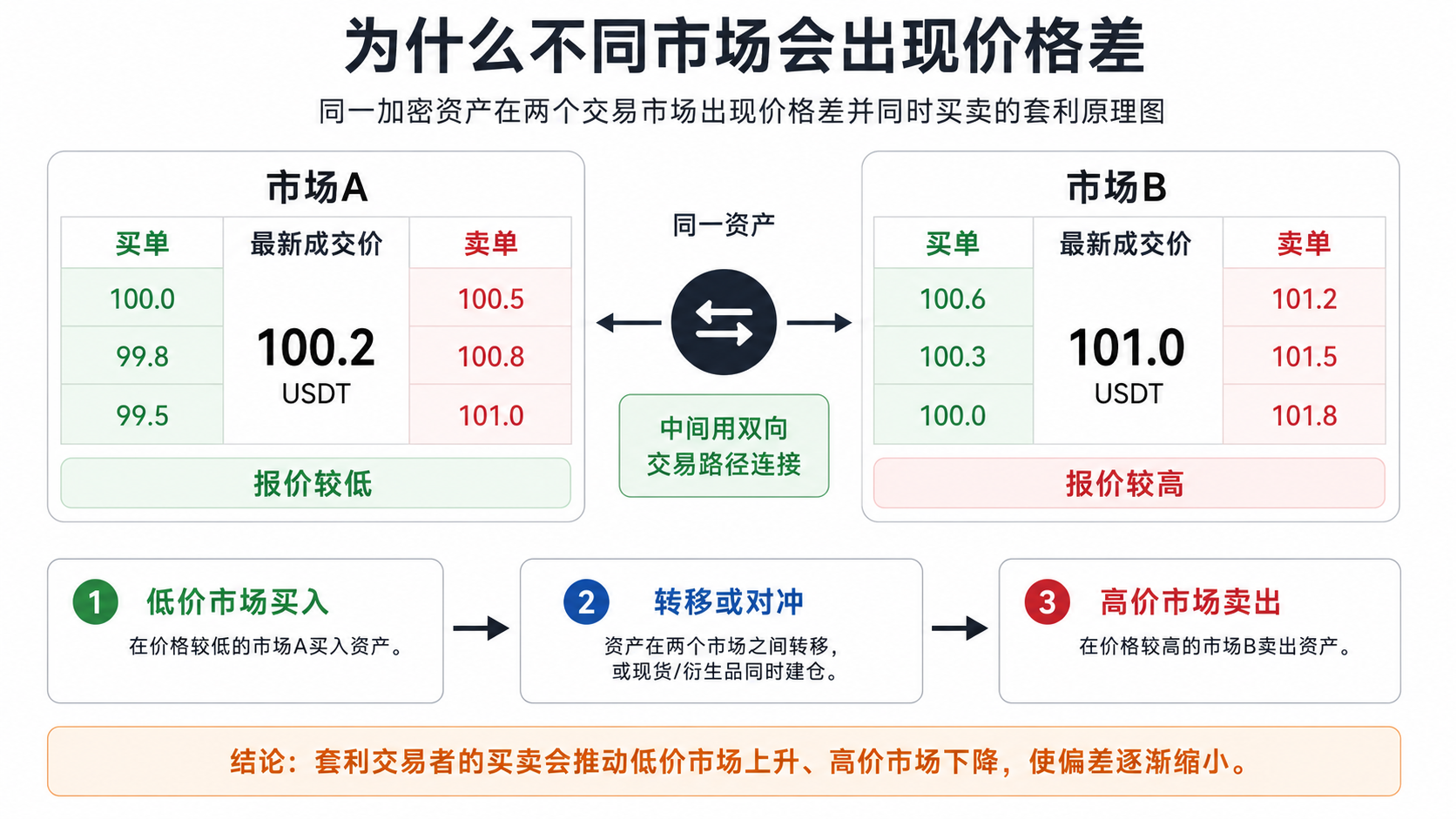
Each centralized exchange has its own order book, users, and liquidity, so demand for the same asset is not perfectly synchronized across platforms. Prices may temporarily diverge when the market moves quickly, market depth differs, regional demand varies, or capital transfers are constrained.
Price relationships can also become inconsistent within a single platform. For example, the implied conversion rate among three trading pairs may temporarily diverge from a direct trading price. Spot and derivatives prices may also differ because of positioning demand, funding costs, and market expectations.
Arbitrage buying tends to push prices up in the lower-priced market, while arbitrage selling tends to push them down in the higher-priced market, gradually narrowing the gap. Visible discrepancies therefore attract intense competition from automated strategies, and an opportunity may disappear before every leg is executed.
What Are the Common Types of Arbitrage?
Common crypto arbitrage strategies include cross-exchange arbitrage, triangular arbitrage, cash-and-carry arbitrage, and funding-rate arbitrage. Each seeks to reduce reliance on a simple directional market call, but their execution processes, capital requirements, and sources of risk differ.
Cross-Exchange Arbitrage
Cross-exchange arbitrage means buying the same asset on the lower-priced platform while selling it on the higher-priced platform. It is the easiest form to understand, but practical execution usually requires traders to pre-position quote and base assets on both platforms.
If a trader first buys on the cheaper platform and then waits for an on-chain transfer before selling on the more expensive platform, the price gap may vanish during the transfer. Pre-positioning assets on both sides reduces transfer delays but increases capital tied up on platforms and counterparty exposure. Kraken also warns that funds kept on centralized exchanges may be exposed to the platform’s operational, security, and solvency risks.
Triangular Arbitrage
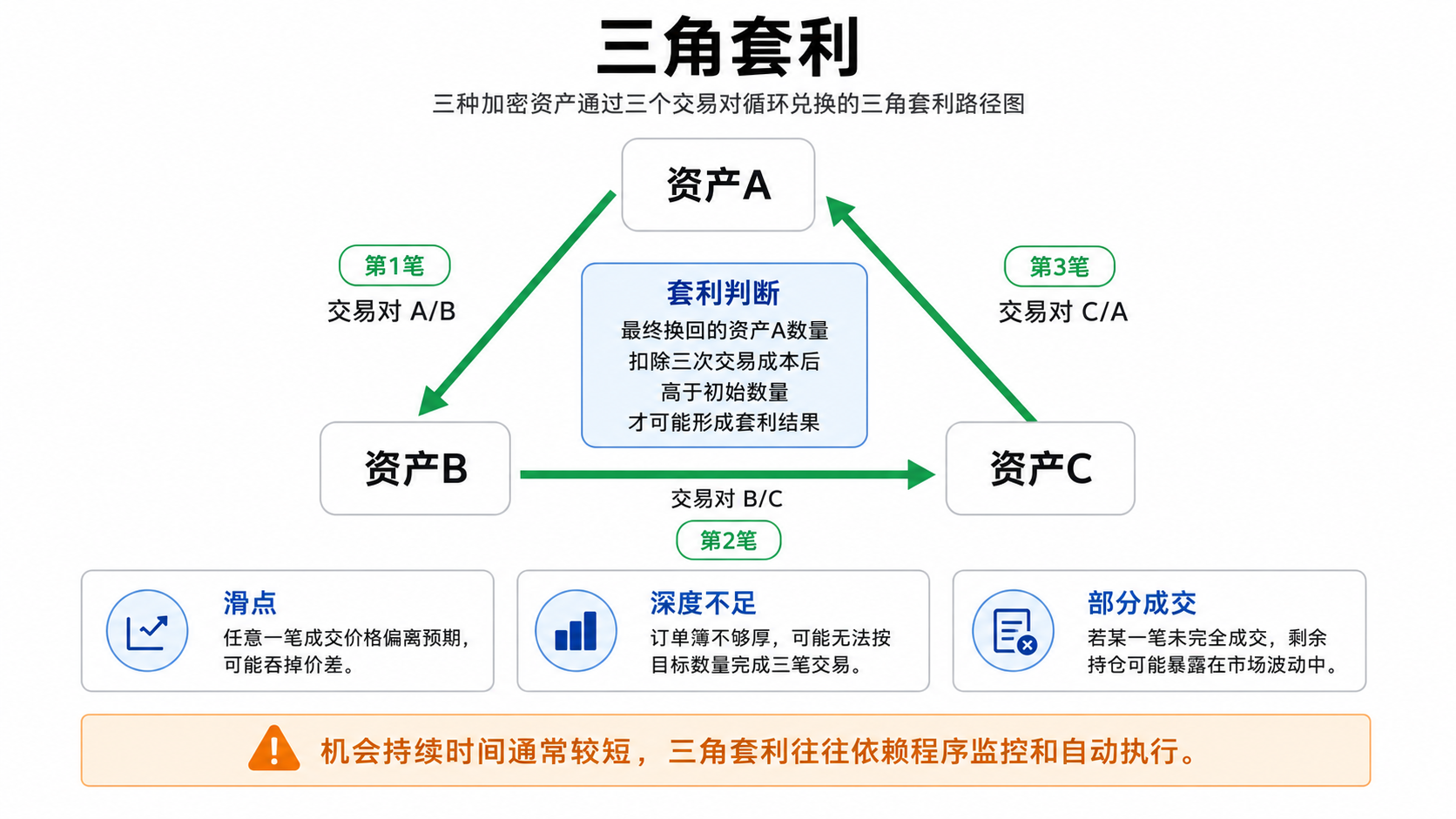
Triangular arbitrage uses inconsistencies among the exchange rates of three trading pairs on the same platform. Funds may be converted from asset A to asset B, then to asset C, and finally back to asset A. An arbitrage result is possible only when the final quantity exceeds the starting quantity after the costs of all three trades are deducted.
Triangular arbitrage does not require transfers across platforms, but all three trades must be completed in sequence. Slippage, insufficient depth, or a partial fill on any leg can leave the remaining position exposed to market direction. Because these opportunities are usually brief, the strategy often relies on programmatic monitoring and automated execution.
Cash-and-Carry Arbitrage
Cash-and-carry arbitrage uses the price difference between a spot asset and a futures contract with an expiration date. When the futures price is above the spot price and the spread can cover all holding costs, one common structure is to buy spot and sell the corresponding futures contract, then wait for the contract price to converge with the reference spot price around expiration and settlement.
The spot quantity, contract notional value, and expiration date must be matched correctly. When futures are traded on margin, the trader must continue meeting margin requirements. The basis can widen further before it eventually converges, exposing the account to margin calls or premature liquidation. CME crypto futures are cash settled and incorporate an implied financing cost related to the holding period.
Funding-Rate Arbitrage
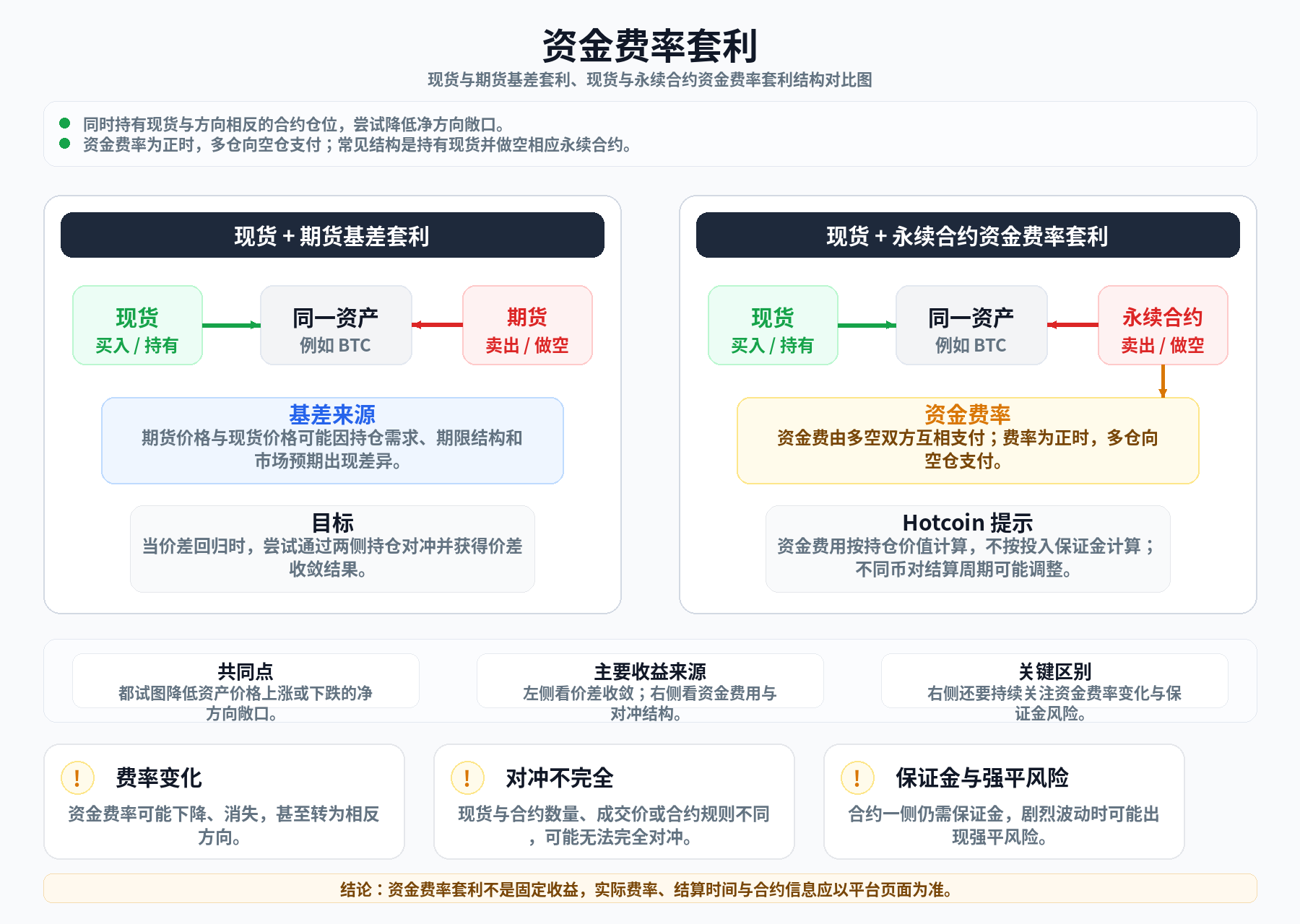
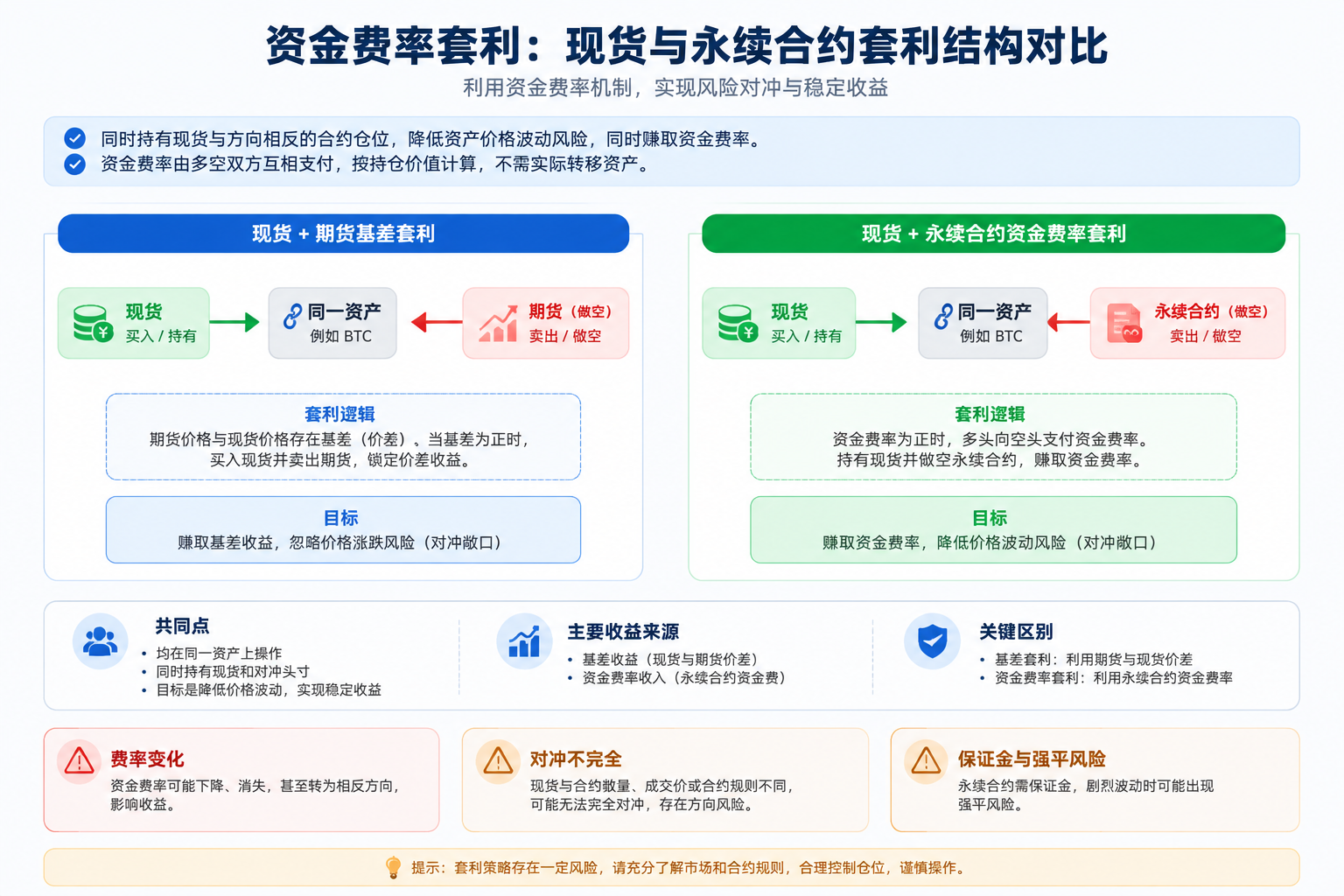
Funding-rate arbitrage typically combines a spot position with an opposing perpetual-contract position. The aim is to reduce net directional exposure to price increases or decreases while receiving funding payments. When the funding rate is positive, for example, longs pay shorts, so a trader may hold the spot asset and short the corresponding perpetual contract.
This structure does not provide fixed income. The funding rate may fall or reverse, and differences in quantity, execution price, or contract rules may prevent the spot and derivatives positions from fully offsetting one another. The contract leg still requires margin, and sharp volatility can create liquidation risk.
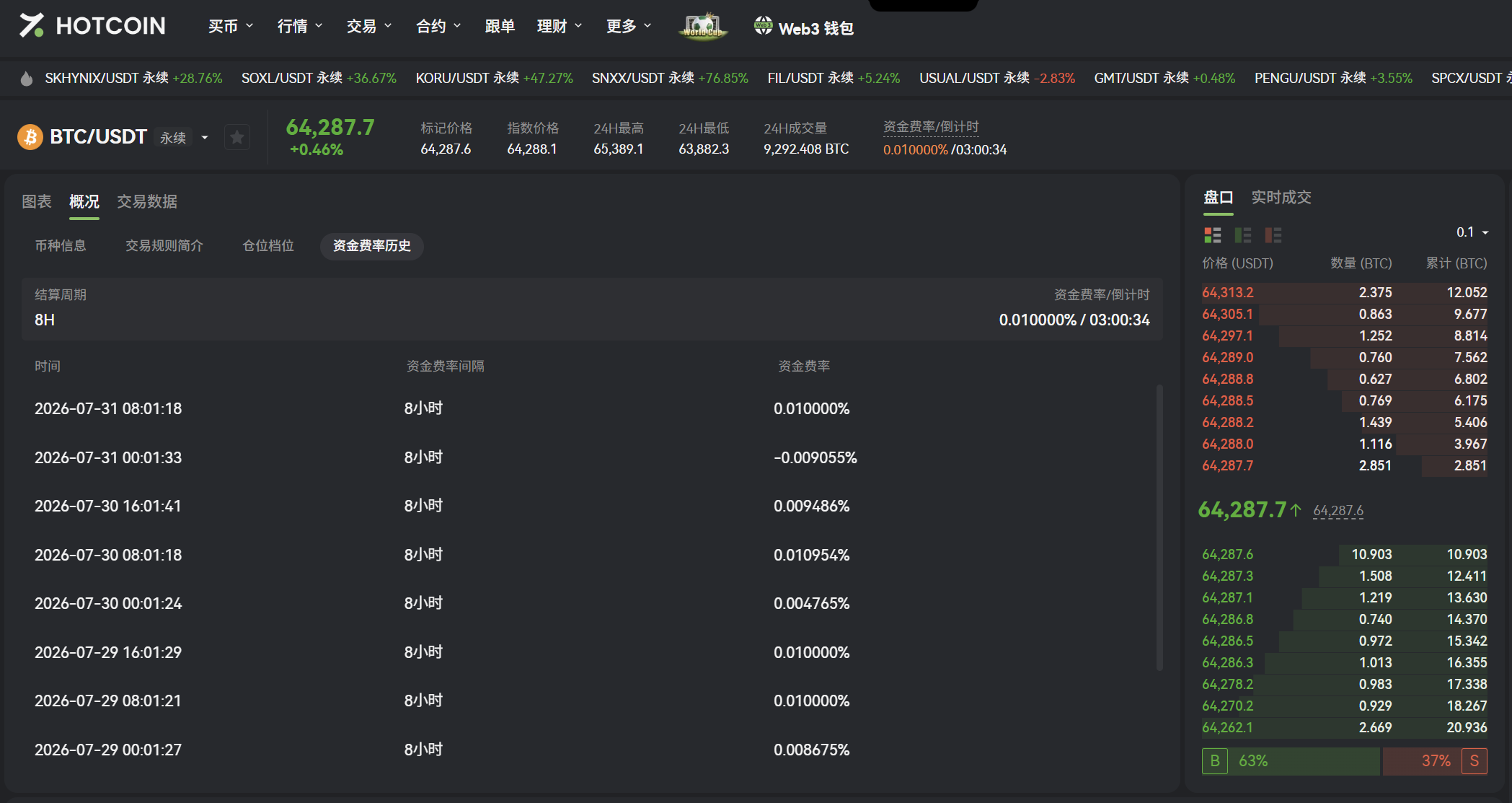
Hotcoin perpetual-contract funding payments are exchanged between long and short position holders and are calculated from position value rather than the margin committed. Settlement intervals can be adjusted for different trading pairs, so the actual rate and timing should always be checked on the contract information page.
Statistical Arbitrage
Statistical arbitrage builds models from the historical prices, spreads, or correlations of related assets. Opposing positions are opened when the relationship diverges significantly, in anticipation of a reversion.
Although it is often grouped with arbitrage strategies, statistical arbitrage is not risk-free arbitrage. Historical relationships can change permanently, and a model may stop working after the market structure changes. Whenever returns depend on the assumption that a past relationship will reassert itself in the future, the strategy carries material model and directional risk.
How Do You Calculate the Real Arbitrage Margin?
An arbitrage calculation must use executable bid and ask prices together with order-book depth, rather than merely comparing the latest trade shown by two platforms. A last-traded price describes a transaction that has already occurred; it does not mean the required quantity can still be traded at that price.
On a per-unit basis, the net arbitrage margin can be expressed as:
Net arbitrage result = sale proceeds − purchase cost − trading fees − transfer fees − slippage − funding or borrowing costs
Cross-exchange trades may also include withdrawal fees and on-chain network fees. Derivatives arbitrage requires funding charges, margin costs, and the contract’s settlement rules to be included as well.
As of July 2026, Hotcoin’s standard spot trading fee for regular users is 0.2% per fill. For VIP 0 contract trading, the maker fee is 0.02% and the taker fee is 0.06%. Actual rates vary by account tier and execution method, so users should check the My Fee Rates page.
This means that a price difference shown on screen cannot be treated as profit when evaluating arbitrage on Hotcoin. Traders must first determine whether each order is likely to execute as maker or taker, then include the other platform’s fees, slippage, and all other costs.
Why Can Arbitrage Trading Still Lose Money?
Arbitrage is often described as a low-directional-risk strategy, but that does not make it risk-free. The CFTC warns that digital-asset markets can involve extreme volatility, inadequate platform safeguards, cybersecurity threats, and market manipulation. Leverage can amplify losses further.
Key risks include:
-
Execution risk: One order fills while the offsetting order does not, turning a hedged trade into a one-sided position.
-
Liquidity risk: The order size exceeds available market depth, so the average execution price is materially worse than the displayed quote.
-
Spread disappearance: The market reprices while orders are placed or assets are transferred, rapidly reducing the gross spread.
-
Incorrect cost calculation: Multiple fees in a triangular trade, withdrawal charges, network fees, or funding payments are omitted.
-
Platform risk: Withdrawal suspensions, account restrictions, system outages, or solvency issues prevent funds on either side from being moved.
-
On-chain risk: Network congestion, block-confirmation times, or smart-contract problems delay or prevent assets from arriving.
-
Margin risk: An adverse move before convergence brings a futures or perpetual position close to liquidation.
-
Rule differences: Index construction, contract notional value, settlement currency, and funding rules may differ between platforms.
Research also shows that arbitrage profitability depends heavily on how transaction costs, exchange-rate volatility, and execution time are handled. Even when an opportunity can be identified, insufficient execution capability may still produce a negative result.
Pre-Trade Arbitrage Checklist
Before starting, work through the following checks:
-
Confirm that the assets or contracts are identical or equivalent.
Check the network, contract notional value, settlement currency, expiration date, and index source. -
Use executable bid and ask quotes.
Use the actual ask on the lower-priced side and the actual bid on the higher-priced side, then inspect order-book depth for the required size. -
List every cost.
Include trading fees on both sides, withdrawal charges, network fees, slippage, funding charges, borrowing costs, and any applicable tax costs. -
Confirm that funds are already available on both sides.
Do not wait until a brief discrepancy appears before funding an account, completing verification, or waiting for withdrawal permissions. -
Set a minimum net spread.
Treat a discrepancy as a candidate only when it remains above the threshold after costs and an execution-error allowance. -
Define abort conditions.
Stop the remaining steps if one side cannot fill, market depth changes, funding changes, or withdrawals become abnormal. -
Evaluate the worst-case outcome.
Decide in advance how to respond to a one-sided fill, a platform withdrawal failure, or a contract position nearing liquidation.
This process separates finding a discrepancy from finding an executable arbitrage trade and helps prevent traders from placing orders solely because two prices on screen differ.
Common Mistakes
Treating the last-traded price as an executable price.
Arbitrage requires current bid and ask quotes, along with the average execution price for the full target quantity.
Transferring first and waiting to sell later.
The discrepancy may disappear during on-chain confirmation. Pre-positioning funds across platforms can improve execution speed, but it increases capital requirements and platform exposure.
Assuming that a hedge is perfectly neutral.
Quantity mismatches, contract notional values, funding charges, and basis movements can all leave residual exposure.
Ignoring withdrawal and account restrictions.
A paper profit is useful only if the funds can be moved and settled normally.
Believing claims of risk-free arbitrage.
The CFTC explicitly warns that no digital-asset trading strategy can guarantee profits. Promises of fixed or risk-free high returns may be warning signs of fraud.
Frequently Asked Questions
Is arbitrage trading risk-free?
No. Risk-free arbitrage in a theoretical model requires simultaneous execution, certain costs, and perfectly equivalent assets. Real markets typically involve slippage, delays, platform risk, and margin risk.
Does cross-exchange arbitrage require a transfer every time?
Not necessarily. Some traders pre-position different assets on two platforms, complete the buy and sell simultaneously, and rebalance afterward. This approach ties up more capital and increases counterparty exposure to the platforms.
Can triangular arbitrage be done manually?
In theory, yes, but it requires three consecutive trades, and the opportunity may disappear quickly. Manual execution is more exposed to price changes and fill delays.
If the funding rate is positive, does shorting a perpetual always earn a return?
No. The position must satisfy the platform’s rules at settlement, and the funding rate can change. Without a matching spot position, a short also loses when the asset price rises.
Are market making and arbitrage the same strategy?
No. Market makers generally quote both bids and asks to capture the spread while carrying inventory risk. Arbitrage strategies primarily target an existing discrepancy in the price relationship among markets or instruments.
Practical Guidance
An arbitrage assessment should begin with executable prices and net costs, not the spread shown on screen. If either side cannot be executed at the same time, what began as arbitrage can become a directional trade.
Risk Warning
Digital-asset arbitrage involves price volatility, trading fees, slippage, network delays, platform security, and derivatives margin risk. Automated tools can also cause losses because of software, connectivity, or data errors. This article is provided solely for user education and general information and does not constitute investment advice.
Inirerekumendang pagbabasa
Tingnan ang higit pa

service hotcoin.com
producthotcoin.com
businesshotcoin.com
casecnhotcoin.com