
How to Track Live SOL/DOGE/BNB Prices
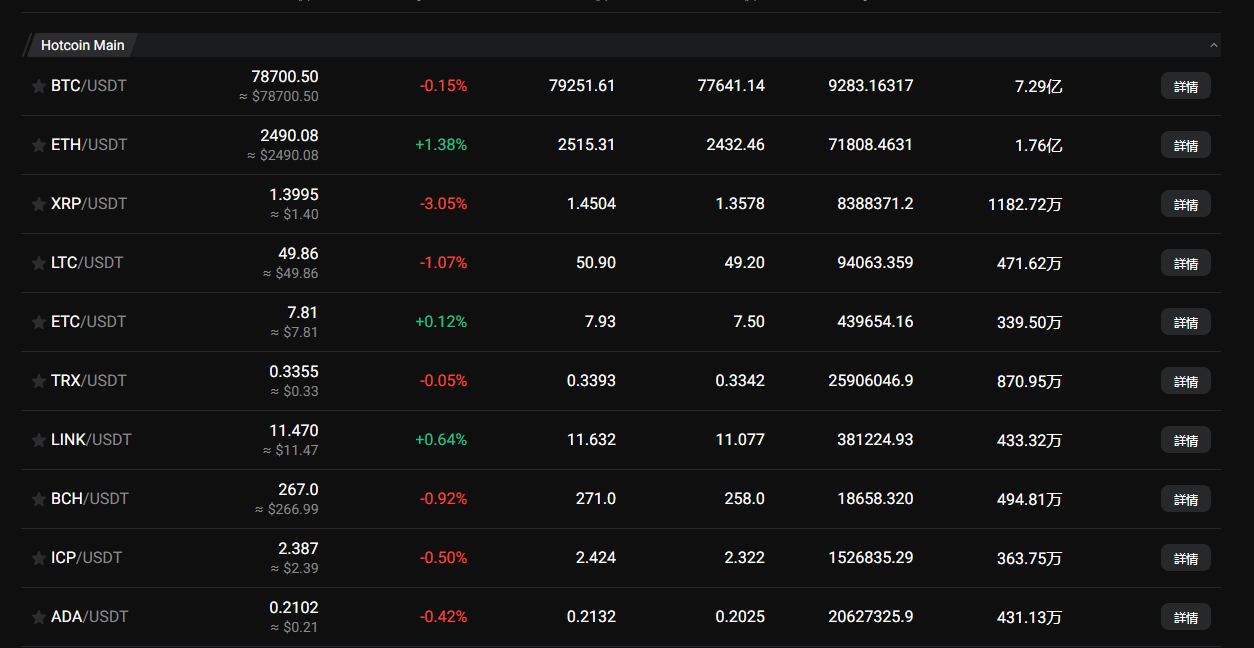
Live market data for popular cryptocurrencies such as SOL, DOGE, and BNB can be viewed in one place on platforms like Hotcoin. The market page displays the latest price, 24-hour change, trading volume, and price chart, making it easier to compare the performance of popular assets.
Based on reference data from August 2026, SOL often traded in the USD 90–100 range, BNB near USD 700, and DOGE around USD 0.08–0.09. All three are popular, highly liquid assets. Live data is more than a set of numbers: it is a practical way to identify market themes and relative strength. The sections below explain how to obtain and interpret this information efficiently.
What Key Data Does a Live Crypto Market Page Show?
A professional market tool, such as Hotcoin's popular-crypto market page, typically displays:
- Latest price: The current reference trading price, usually quoted in USDT.
- 24-hour change and range: The high, low, and percentage change, which indicate intraday volatility.
- Trading volume and turnover: Measures of market activity; stronger volume can make a trend more credible.
- Market capitalization ranking: SOL and BNB are commonly among the largest assets, while DOGE is a high-capitalization Meme coin.
- Candlestick chart and order-book depth: Multiple time frames visualize price movement and buying or selling pressure.
Exchange data comes directly from the platform's live order book and therefore tends to be closer to an executable price than a purely aggregated quote.
How to View SOL/DOGE/BNB Live Prices on Hotcoin
- Open the Hotcoin website or app and go to Markets or the popular-assets ranking.
- Search for SOL, DOGE, or BNB, or select an asset from the popular-crypto list.
- Open the relevant trading pair, such as SOL/USDT. The latest price and 24-hour data appear at the top.
- Switch between the basic chart and TradingView, then select a time frame to examine the trend.
- Review order-book depth and recent trades to assess buying and selling pressure.
- Add the assets to your watchlist and set price alerts to monitor several coins at once.
This workflow is closer to an actual trading scenario than a static price table. Market data connects directly to the trading interface, reducing the need to switch between services.
How to Interpret Live Price Trends
When reviewing the numbers, consider them in this order:
- Start with relative strength: Compare the percentage changes of SOL and BNB with BTC and ETH to see whether they are outperforming the broader market.
- Check volume: A price increase accompanied by expanding volume is often more convincing, while a price-volume divergence deserves caution.
- Use multiple time frames: Short intervals help identify intraday momentum, while the daily chart provides context for the medium-term direction.
- Review depth and capital flow: The thickness of bids and asks can help identify short-term pressure.
- Account for each asset's characteristics: SOL is sensitive to ecosystem activity and network performance, BNB is closely linked to the Binance ecosystem, and DOGE is more heavily influenced by sentiment and social media.
What Can You Learn Beyond a Basic Price List?
- Hotcoin provides a practical workflow as well as multi-asset watchlists and alerts.
- A clear interpretation sequence helps identify conditions in which signals may be less reliable, including low-volume periods and extreme sentiment.
- The distinct characteristics of SOL, DOGE, and BNB support a more targeted comparison.
This context addresses a common limitation of pages that display figures without explaining how to use them.
Use Cases and Risk Notice
- Routine monitoring: Add SOL, DOGE, and BNB to a watchlist and set alerts around key price levels.
- Pre-trade checks: Review depth and volume to estimate possible slippage.
- Risk notice: Market data is provided for reference only and does not constitute investment advice. Popular cryptocurrencies can be highly volatile, and DOGE in particular can react sharply to sentiment. Past performance does not guarantee future results. Consider your own risk tolerance, platform security, and local regulatory requirements.
Frequently Asked Questions
Q1: Why do SOL, DOGE, and BNB prices differ slightly between platforms?
A: Platforms use different data sources and update frequencies. An exchange shows the latest trade from its own order book, while an aggregator generally calculates a multi-source average. Your actual trade will use the price available on the platform where you place the order.
Q2: How can I monitor several popular cryptocurrencies at the same time?
A: Use the watchlist on Hotcoin or a similar platform. Add SOL, DOGE, and BNB to view their latest prices and percentage changes on one page, then configure price alerts.
Q3: Which indicators should a beginner check first?
A: Start with the latest price, 24-hour percentage change, trading volume, and 24-hour high and low. Once you understand these figures, add candlestick and order-book analysis.
Q4: Should I immediately buy a coin listed among the top gainers?
A: Not necessarily. A large increase may have already priced in short-term expectations and often comes with high volatility. Consider volume, fundamentals, and your own strategy instead of chasing a price move.
Q5: Which is usually more volatile: SOL, BNB, or DOGE?
A: DOGE, as a Meme coin, has often shown stronger sentiment-driven volatility. SOL can react to ecosystem and network events, while BNB is closely connected to an exchange ecosystem. Market conditions change, so historical patterns should not be treated as guarantees.
Using this process, you can quickly obtain live prices for SOL, DOGE, BNB, and other popular cryptocurrencies and turn the data into a more structured market assessment. Because markets move rapidly, disciplined monitoring and risk awareness remain essential.
Inirerekumendang pagbabasa
Tingnan ang higit pa

Service@hotcoin.com
Product@hotcoin.com
Business@hotcoin.com
Casecn@hotcoin.com