
Polkadot: A Pioneer in Cross-Chain Interoperability
Polkadot is a multichain protocol that coordinates multiple parachains through a relay chain. Parachains execute their own application logic, the relay chain validates their state transitions and provides shared security, and XCM describes messages across consensus systems.
It is better understood as Layer 0 or multichain infrastructure than as a general-purpose smart contract chain where every application is deployed on the same network. Each parachain can have its own runtime, fee model, and governance logic.
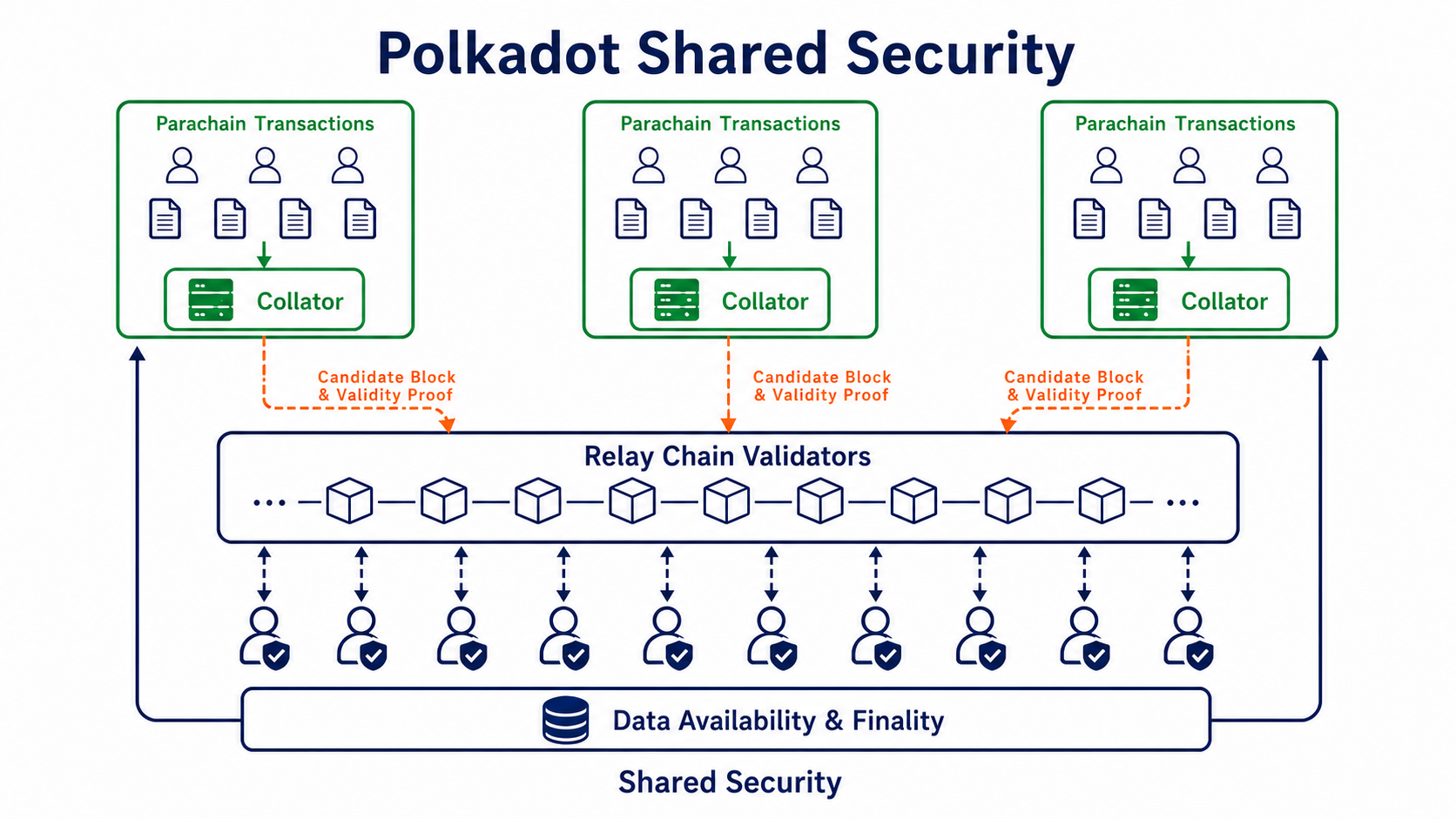
How Do the Relay Chain and Parachains Divide Responsibilities?
Parachains maintain their own accounts, transactions, and state transition functions. Collators collect transactions and produce candidate parachain blocks with proofs of validity, then submit them for review by relay-chain validators assigned to that parachain.
The relay chain does not execute every parachain's entire business logic. Instead, it verifies that state transitions comply with the parachain's registered Wasm runtime and handles data availability, disputes, and finality.
| Role | Primary responsibility |
|---|---|
| Relay-chain validator | Checks parachain candidate blocks and participates in shared consensus |
| Collator | Maintains parachain state and produces candidate blocks |
| Nominator | Uses DOT to support validator selection |
| Parachain runtime | Defines the chain's transaction and state rules |
| Relay chain | Provides validation, availability, finality, and coordination |
Producing a block does not allow a collator to determine parachain history on its own. A malicious candidate must still pass relay-chain validation and the dispute process.
What Problem Does Shared Security Solve?
An independent application chain usually has to attract its own validators and staked assets. Polkadot randomly assigns relay-chain validators to different parachains, allowing connected chains to share the validation resources backed by staked DOT.
Shared security can reduce the difficulty of bootstrapping a validator set for a new chain. However, a parachain can still suffer from smart contract vulnerabilities, governance mistakes, oracle issues, or collator availability failures. The relay chain guarantees that registered state transition rules are executed correctly; it does not guarantee that the application rules themselves are sound.
Relay-chain resources are allocated through Coretime. The older parachain slot auction model has gradually been replaced by the more flexible Coretime mechanism, so fixed-lease procedures described in older tutorials may no longer apply.
Is XCM a Bridge?
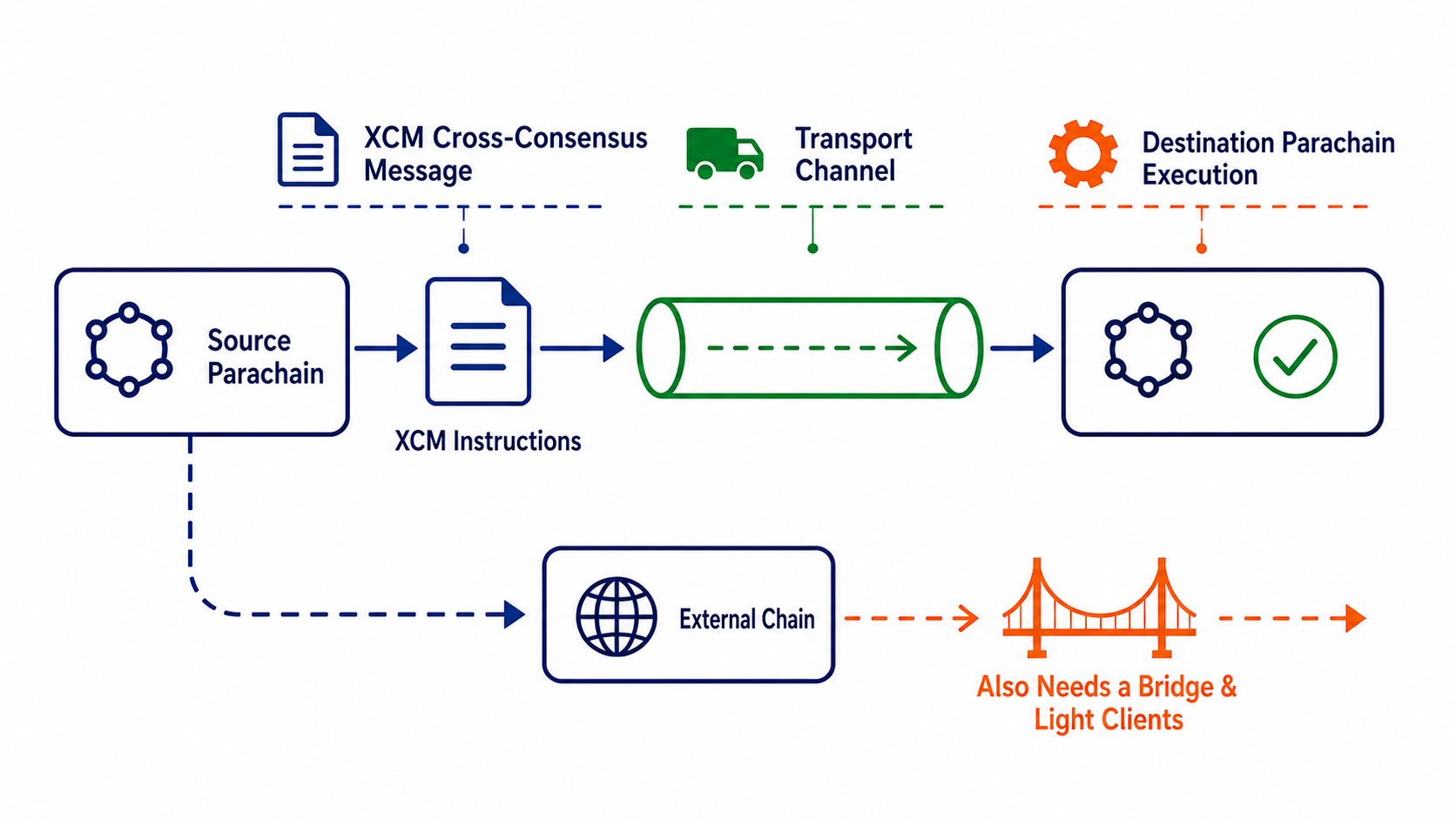
XCM is a cross-consensus messaging format that describes how assets move, which instructions the destination chain should execute, and which fees should be used. It is neither a single network transport channel nor a bridge to an external blockchain.
The Polkadot ecosystem delivers XCM through different transport mechanisms. Connecting external consensus systems such as Bitcoin or Ethereum also requires bridges, light clients, and other components.
| Scenario | Main source of security |
|---|---|
| Messages between parachains in the same Polkadot shared-security domain | Relay-chain consensus, messaging channels, and destination-chain execution |
| Communication between Polkadot and an external chain | Finality on both sides, bridge light clients, and the messaging protocol |
| Application-layer asset mapping | Token contracts, custody, or lock-and-mint rules |
When evaluating a cross-chain feature, determine whether it uses XCM, a system bridge, or a third-party bridge because their failure modes differ.
Why Is the Polkadot SDK Suitable for Custom Chains?
The Polkadot SDK provides components including Substrate, FRAME, Cumulus, and XCM. Developers can combine modules and write their own Wasm runtime instead of forcing all business logic into a fixed virtual machine.
This flexibility suits application chains that need custom fee, governance, identity, or asset rules. The tradeoff is that runtime development, upgrades, and cross-chain configuration are more complex than deploying an ordinary EVM contract, and teams must maintain node and chain-level infrastructure.
For a comparison with another sovereign application-chain approach, read about the Cosmos ecosystem. For a broader perspective, see the 2025 overview of major public-chain ecosystems.
Frequently Asked Questions
Is DOT the universal gas token for every parachain?
No. DOT is used for Polkadot staking, governance, resources, and related purposes. Parachains may use their own native assets and fee rules.
Are parachains the same as Ethereum Layer 2 networks?
No. A parachain has its own state transition function and borrows shared security from the relay chain. A Layer 2 network usually settles state commitments or proofs on a Layer 1 blockchain.
Must collators stake DOT to produce blocks?
Each parachain determines its own collator eligibility rules, which are separate from the NPoS staking requirements for relay-chain validators. A parachain may define its own incentives and selection criteria.
Is an XCM message guaranteed to execute successfully after it is sent?
No. Insufficient destination-chain fees, incompatible versions, or incorrect asset locations or instructions can cause execution to fail. Applications need query and recovery mechanisms.
Inirerekumendang pagbabasa
Tingnan ang higit pa

service hotcoin.com
producthotcoin.com
businesshotcoin.com
casecnhotcoin.com