
Other Consensus Mechanisms: PoH, PoA, and PBFT
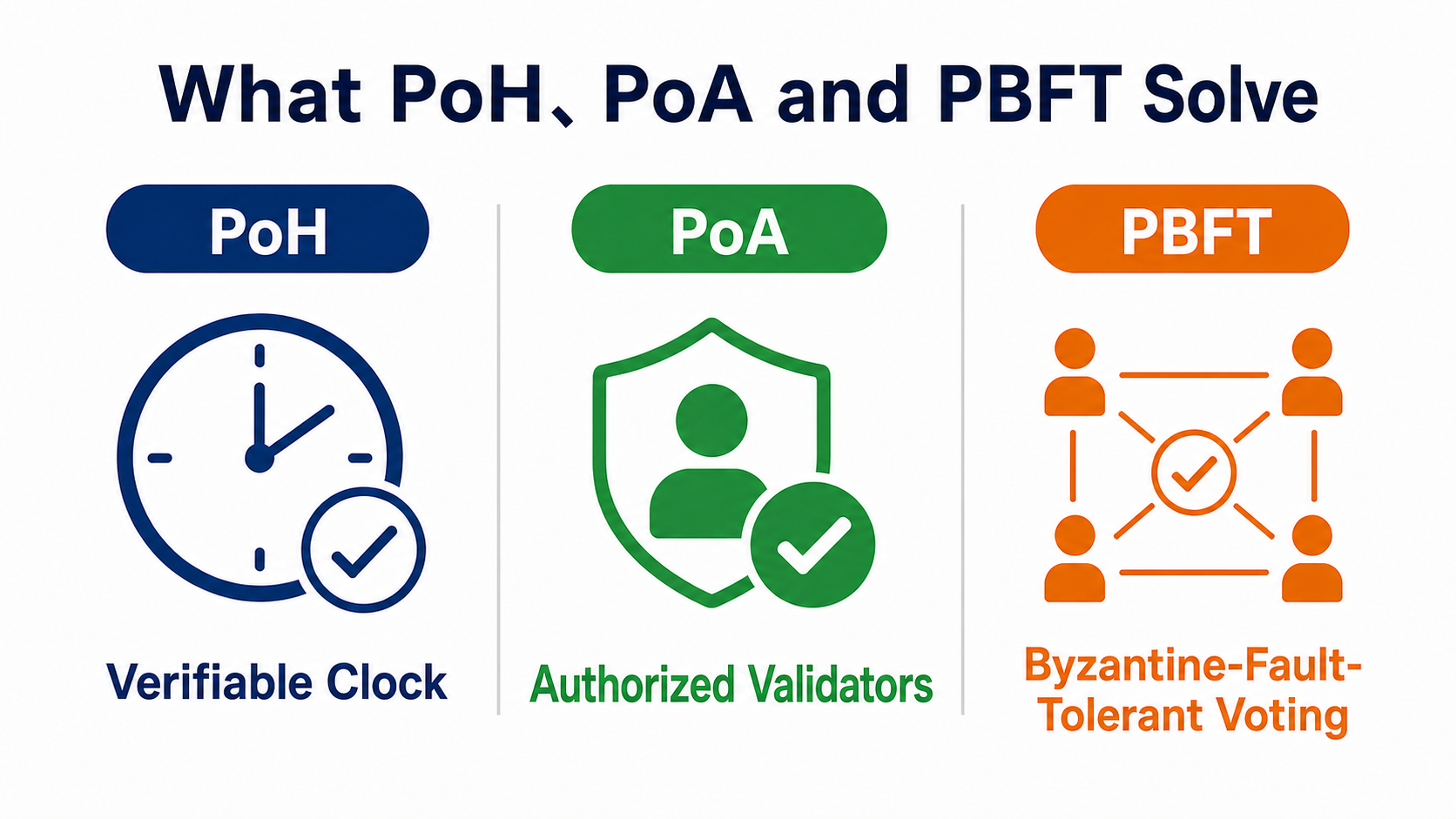
PoH provides a verifiable sequence of events, PoA relies on the identities of authorized validators, and PBFT enables known replicas to tolerate malicious faults through multiple rounds of messaging. Each mechanism solves a different problem.
Grouping them together in a single list of “consensus mechanisms” can be misleading. PoH generally works in combination with PoS and BFT-style protocols, PoA focuses on who is authorized to propose blocks, and PBFT defines how replicas vote and finalize a shared state.
What Is PoH?
Proof of History (PoH) uses a continuous hash sequence to create a verifiable record of elapsed time and event order. The sequence must be generated sequentially, while other nodes can verify separate segments in parallel.
PoH can reduce the need for nodes to repeatedly exchange messages to order events, but it cannot independently determine which validator may produce a block or resolve conflicting votes on its own. Solana uses PoH as a clock ahead of consensus, alongside components such as PoS and Tower BFT.
It is therefore more accurate to describe PoH as “part of a high-performance consensus system.” When comparing networks, you must also examine leader selection, validator voting, fork handling, and finality instead of looking only at the PoH label.
What Is PoA?
Proof of Authority (PoA) assigns block production rights to a group of validators authorized through identity checks or governance. Participants are typically public or otherwise accountable, and misconduct can affect their eligibility, reputation, or real-world responsibilities.
PoA requires neither an open computational race nor necessarily a large token stake, so it can offer fast confirmation and low resource usage. This makes it suitable for consortium chains, enterprise networks, or public chains with clearly defined governance boundaries.
Its main trade-off is permissioning. The degree of effective centralization depends on who can become an authority node, who can revoke that status, and who controls emergency keys. Known identities also do not automatically prevent collusion.
How Does PBFT Tolerate Malicious Nodes?
Practical Byzantine Fault Tolerance (PBFT) is designed for a known group of replicas. A primary node proposes an order for requests, and the other replicas proceed through messaging phases such as pre-prepare, prepare, and commit. Once a quorum is reached, they execute the same result.
Under the required network and cryptographic assumptions, classic PBFT generally needs at least 3f+1 replicas to tolerate f Byzantine faults. This means four replicas can tolerate one arbitrarily malicious replica, while seven can tolerate two.
PBFT can provide explicit finality without waiting for subsequent blocks to accumulate more work. However, the cost of multi-round, all-to-all communication grows rapidly as the number of participants increases. Practical systems therefore often use committees, aggregate signatures, or newer BFT protocols to reduce overhead.
How Do the Three Mechanisms Compare?
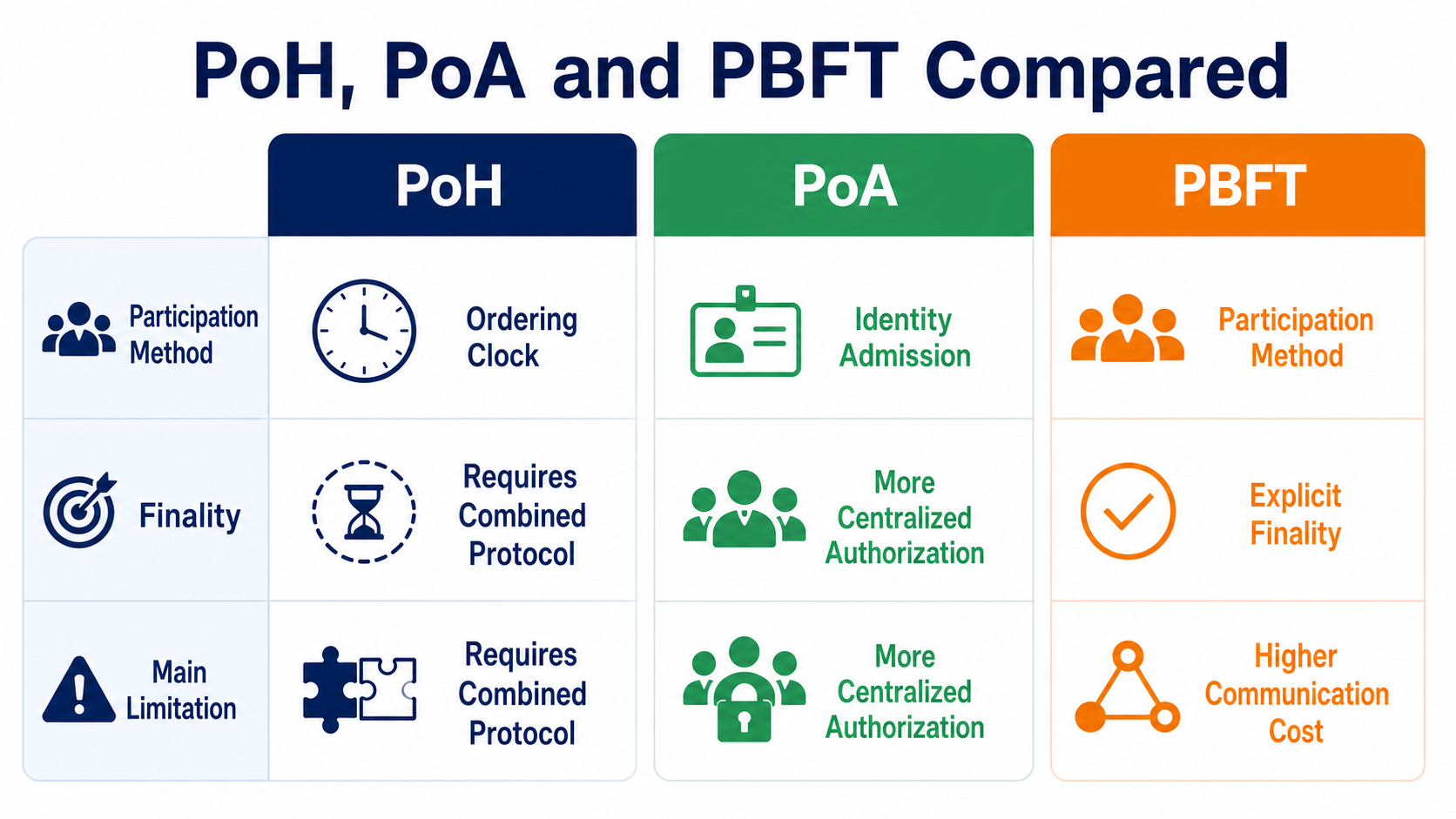
| Category | PoH | PoA | PBFT |
|---|---|---|---|
| Main problem addressed | Proves elapsed time and event order | Identifies authorized block producers | Enables known replicas to agree despite malicious faults |
| Complete standalone consensus? | Usually not | Still requires accompanying fork-choice or finality rules | Can serve as the core replication and finality protocol |
| Participant identity | Can be used in open networks | Usually known or authorized | Usually a known replica set |
| Finality | Determined by the combined protocol | Determined by accompanying voting or chain rules | Can become explicitly final after reaching a quorum |
| Main limitation | Easily mistaken for a standalone consensus protocol | Admission and revocation authority may be centralized | Communication overhead rises substantially with more nodes |
Real-world networks often use composite architectures. For example, PoS can determine validator weight, a BFT protocol can provide voting-based finality, and PoH can supply an ordering clock. Even when networks use the same mechanism names, different combinations can produce different security conclusions.
DPoS likewise reduces communication costs by using a smaller representative set. See Delegated Proof of Stake for details. To understand how these components relate to PoW and PoS, return to the Consensus Mechanism Guide.
Frequently Asked Questions
Can a Permissionless Public Blockchain Use PBFT?
It can use a BFT-style protocol, but it typically first forms a limited committee through staking, elections, or random sampling. If identities can join without limit, an attacker could create numerous fake replicas and undermine the assumptions behind quorum voting.
Must PoA Validators Reveal Their Real Names Publicly?
Not necessarily to every user, but a governing organization generally needs to identify, authorize, or hold them accountable. The extent of identity disclosure depends on the network’s governance and compliance requirements.
Does PBFT Require Mining?
It does not require Proof-of-Work-style mining. Replicas establish request order through signed messages and quorum thresholds. The primary costs are network communication, verification, and node operations.
Can a Blockchain’s Safety Be Judged by Its Consensus Mechanism Name Alone?
No. You must also examine the participant set, key management, client implementations, network assumptions, upgrade authority, and actual distribution of power. Protocols with the same name may have very different security boundaries after parameter changes and implementation modifications.
Inirerekumendang pagbabasa
Tingnan ang higit pa


service hotcoin.com
producthotcoin.com
businesshotcoin.com
casecnhotcoin.com