
What Are the Risks of Grid Trading? One-Way Markets, Fees, and Capital Lockup
The main risks of grid trading are a persistent one-way market, fees consuming per-grid profit, and capital remaining tied up in positions, open orders, or margin. Spot grids generally do not have the liquidation mechanism used in futures contracts. Futures grids also involve leverage, funding fees, and liquidation, making them significantly riskier.
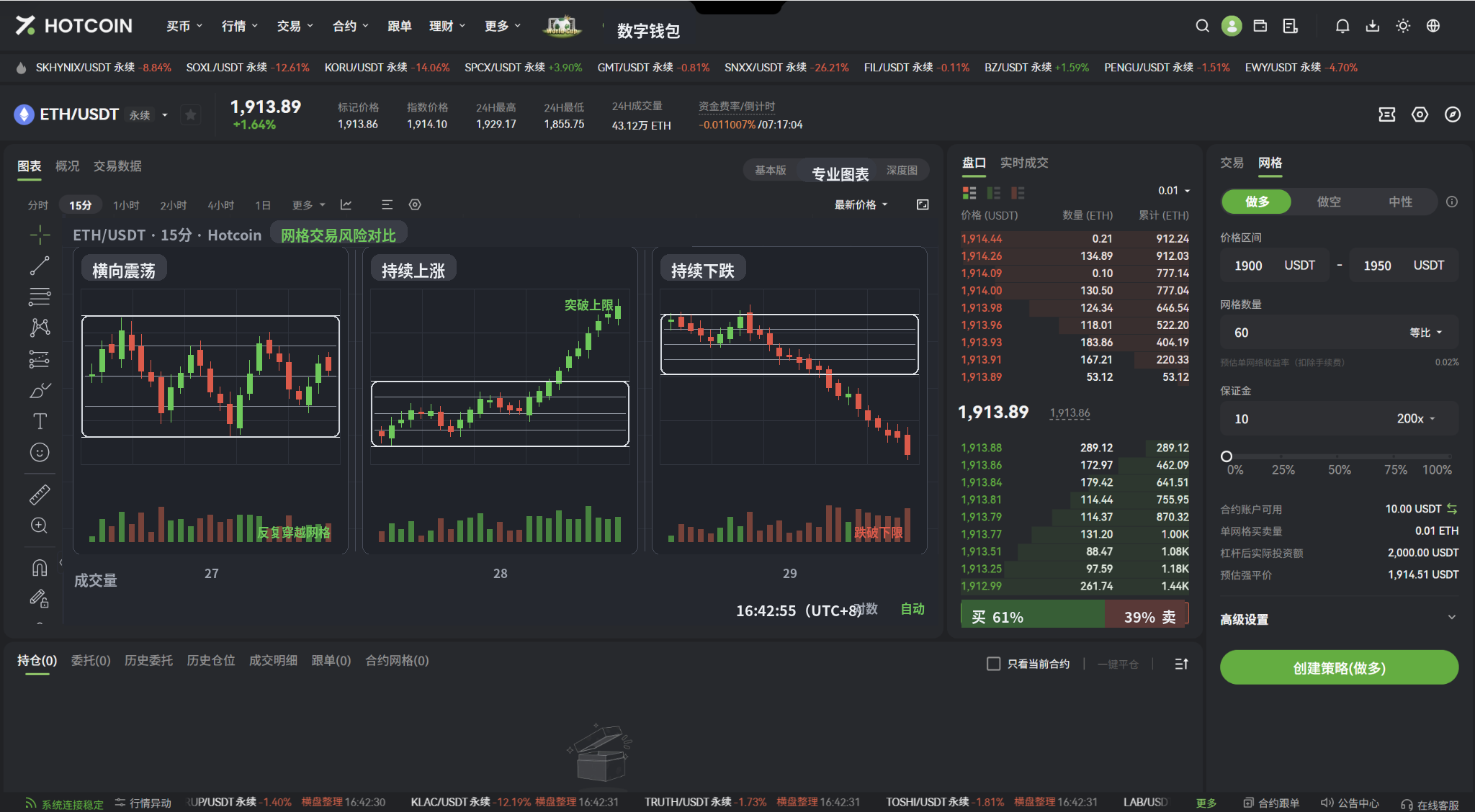
Why One-Way Markets Are a Major Risk for Grid Trading
A grid strategy depends on the price repeatedly moving within a preset range. When a range-bound market turns into a sustained rise or fall, orders gradually fill in the same direction. A strategy intended to capture recurring price differences may then become a directional position.
In a spot grid, the system may progressively buy the base asset at different levels as the price continues to fall. Completed grid cycles can produce realized profit, but assets that have not yet been sold incur unrealized losses as the market declines. The total value of the portfolio may still decrease.
When the price keeps rising, a spot grid usually sells the base asset gradually at different levels. If the price breaks above the upper boundary and continues higher, the strategy may already have reduced its holdings and can underperform simply holding the asset. This is an opportunity cost and may not appear as a direct trading loss.
The risk is more direct with a futures grid. Hotcoin futures grids support several strategy directions and use margin and leverage. If the market continues moving against the position, unrealized losses rise, the margin ratio may fall, and liquidation may occur in extreme circumstances. Once the price leaves the preset range, the Hotcoin grid stops opening new positions, but existing positions and orders inside the range do not automatically disappear.
In a one-way market, consider each of the following:
-
Price falls below the range: Long or neutral strategies may accumulate more long exposure and sustain increasing unrealized losses.
-
Price rises above the range: A spot strategy may progressively sell the asset, while a short or neutral futures strategy may face risk from exposure in the opposite direction.
-
Price remains outside the range: Grid cycles become less frequent while capital stays tied up in existing positions or orders.
-
Volatility suddenly expands: The price may cross several grid levels quickly, causing executions and risk exposure to change faster than expected.
Why Fees Can Erode Grid Returns
A complete grid cycle normally involves two executions, so it is not enough to consider the fee for only one side. Denser grids have smaller price differences between levels. Although orders may execute more often, cumulative fees can more easily consume a large share of gross profit.
For example, Hotcoin's current VIP 0 futures rates for regular users are 0.02% for Maker orders and 0.06% for Taker orders. Actual rates depend on the user's VIP tier and execution method, so users should refer to the rates displayed in their account.
Suppose a grid completes one opening trade and one closing trade. If both execute at the Maker rate, fees alone amount to approximately 0.04%. If both execute as Taker orders, the total is approximately 0.12%. These figures do not include slippage or funding fees.
Grid orders do not necessarily all execute at the Maker rate. Whether an order is classified as Maker or Taker depends on whether it immediately matches an existing order when it enters the order book. Before creating a strategy, users should not assume that every order will receive the lower fee rate.
Hotcoin uses the current parameters and fee rate to calculate the estimated per-grid return after fees. A strategy cannot be created when that return is no greater than zero. This prevents parameters that clearly cannot cover fees, but it does not guarantee a positive total PnL. Unrealized losses, funding fees, and the price leaving the range can still affect the outcome.
Futures grids must also account for funding fees. Funding for perpetual contracts is calculated from the value of the position, not only from the initial margin invested by the user. The longer a strategy runs and the larger its position value becomes, the more important it is to review the effect of funding fees separately.
Where Capital Becomes Tied Up
After a grid strategy starts, the invested funds are allocated among current positions, pending orders, margin, and fee reserves. They therefore cannot be used simultaneously for other trades or withdrawals. Capital lockup is not itself a loss, but it reduces the available account balance and the flexibility to adjust the strategy.
When Hotcoin calculates the buy or sell quantity for each futures grid, it uses only 80% of the initial margin to determine the maximum number of orders. The remainder must be reserved for risk and fees. As the number of grids increases, the quantity allocated to each level usually decreases, while the minimum order quantity and minimum margin requirements must still be met.
If the price remains on one side of the range for an extended period, distant orders may remain unfilled while existing positions continue to use margin. The strategy may appear to be running normally, but the rate of capital turnover has already slowed.
Changing the price range can also increase the amount of capital required. Hotcoin reprocesses open orders and existing positions using the new parameters. If the current assets are below the minimum investment required by those parameters, the user must add margin. Adding or withdrawing margin also changes the position's risk level and estimated liquidation price.
The margin mode changes the scope of capital at risk as well. In cross-margin mode, positions in the futures account share available margin, so a loss in one position may affect others. In isolated-margin mode, margin is calculated separately for each position, and liquidation of one position generally does not directly use the funds allocated to other positions.
Why Total PnL Can Be Negative When Grid Profit Is Positive
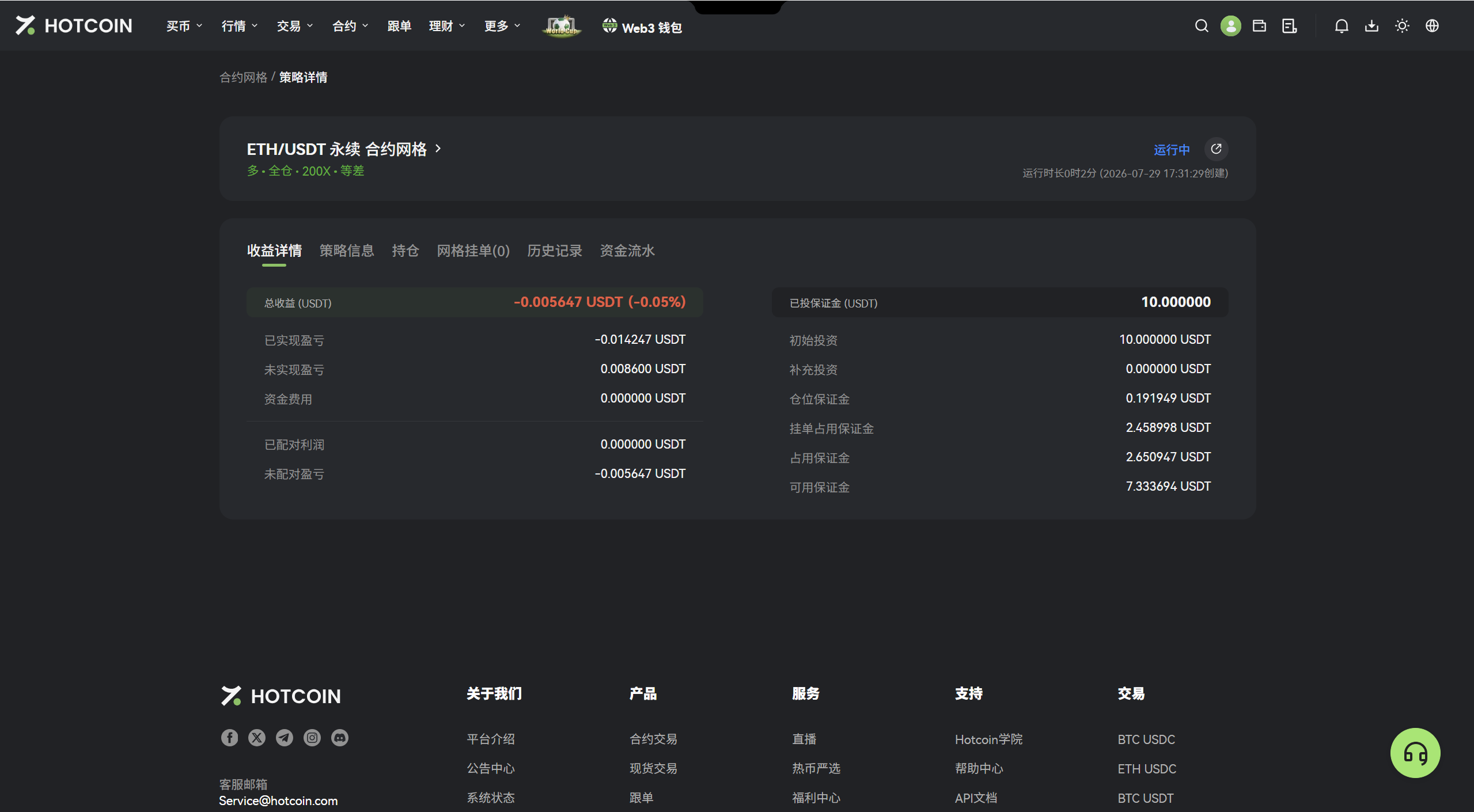
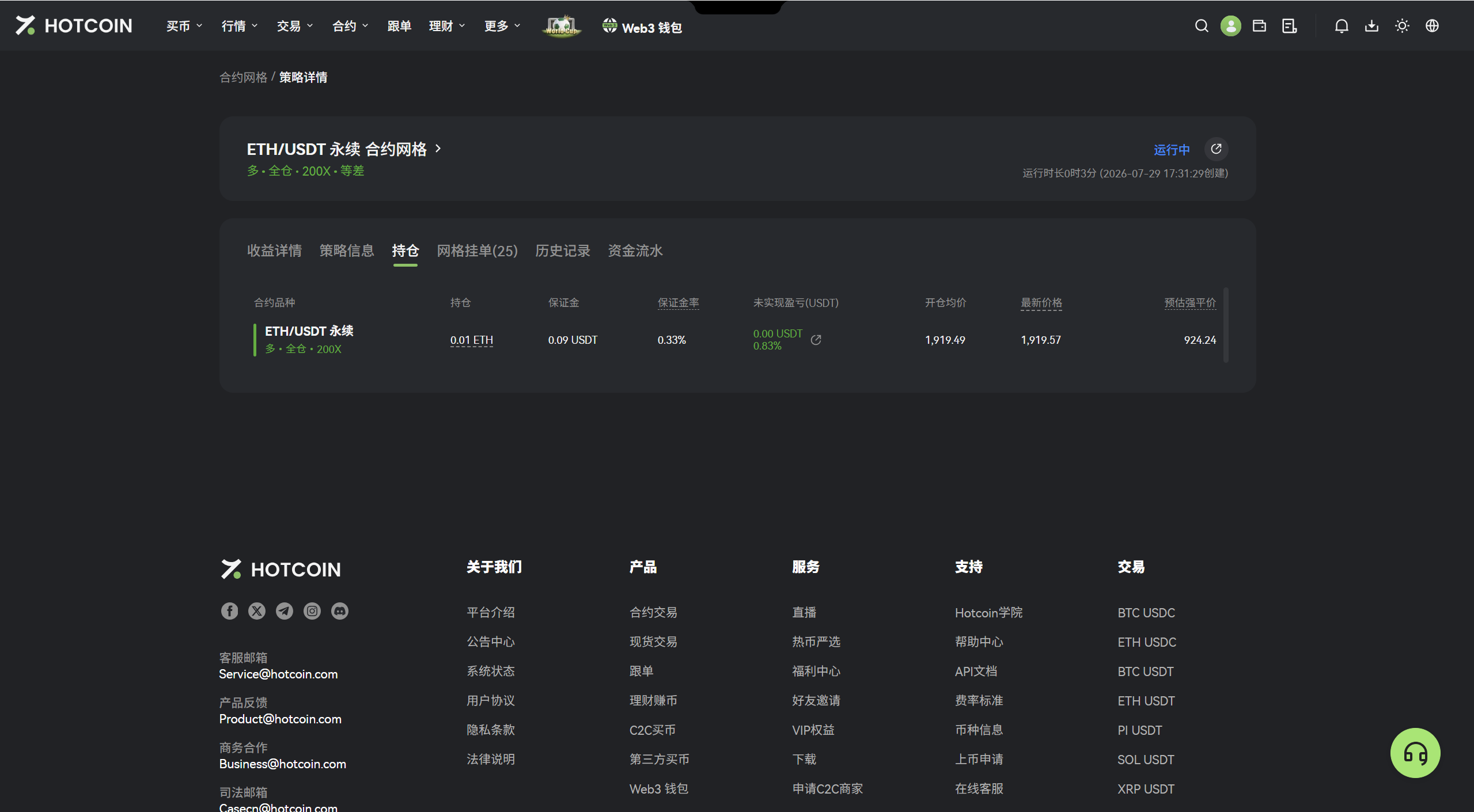
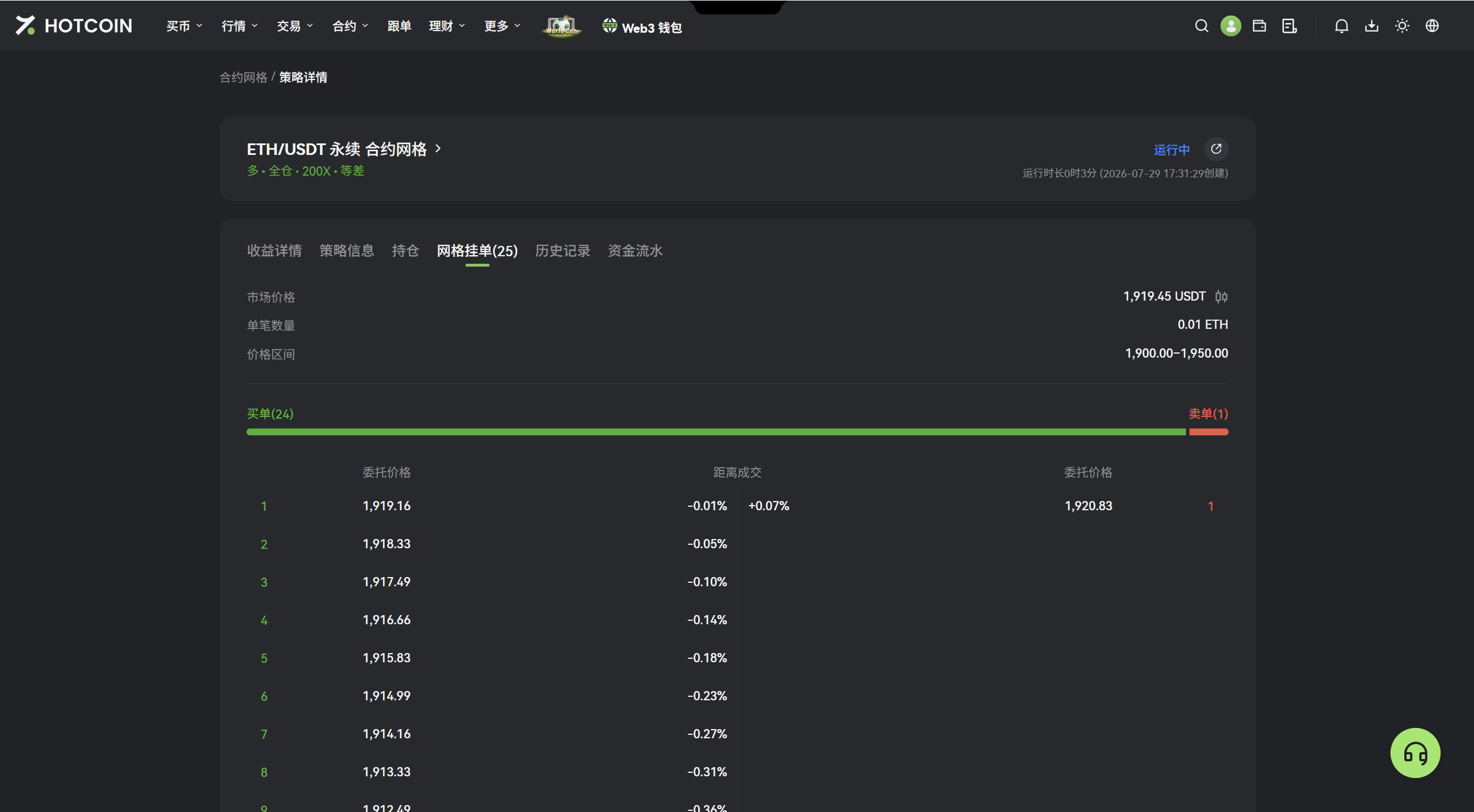
Grid profit usually counts only completed buy-and-sell cycles. Total PnL must also include unrealized PnL on the current position, trading fees, funding fees, and other realized gains or losses. When the price continues falling, a strategy can complete small profitable grid trades while accumulating a larger unrealized loss on its position.
Platform definitions also distinguish clearly between grid profit and total PnL. Grid profit represents the cumulative result of completed order combinations, while total PnL also includes unrealized PnL caused by changes in the base asset's price and the associated costs. Positive grid profit is not sufficient evidence that the strategy as a whole is currently profitable.
At a minimum, these components should be reviewed together when evaluating a grid strategy.
For example, a strategy may have completed several trades with small price differences and show positive grid profit. However, if the current long position has a larger unrealized loss because the price has fallen, total PnL may still be negative. There is no need to invent specific amounts—the key is to understand that the two metrics include different components.
How to Check Risk Before Starting a Grid
Before creating a grid, confirm the strategy type, the conditions that invalidate the range, and the maximum risk you can bear. Then review fees and capital usage. Automation can only follow the parameters; it cannot decide for the user whether the market has changed from range-bound to one-way movement.
Use the following checklist:
-
Confirm whether it is a spot or futures grid: A spot grid mainly carries the risks of falling asset prices and capital lockup. A futures grid also requires checks on leverage, margin, funding fees, and the liquidation price.
-
Check whether the price range is reasonable: The upper and lower limits should be based on an explainable market structure, rather than arbitrary fixed percentages around the current price.
-
Write down the range invalidation conditions: Define the price level or structural change at which the strategy should be stopped or reassessed.
-
Review the per-grid return after fees: Use the estimated net return displayed by the platform instead of calculating only the gross price difference manually.
-
Check the current price location: Near the lower boundary, pay closer attention to further declines and growing exposure. Near the upper boundary, consider the risk of the price moving above the range.
-
Confirm how long the capital can remain committed: A grid may take a long time to complete all orders. Funds needed in the short term should not be committed to a long-running strategy.
-
Set take-profit and stop-loss triggers: Hotcoin supports trigger prices. Once a condition is met, the strategy ends and the current position is handled according to the applicable rules.
-
Check the margin mode: Cross margin can affect the entire futures account balance, while isolated margin makes it easier to limit the scope of risk for one position.
After the strategy starts, regularly check whether the market still matches the original assumptions. Price ranges, volatility, and liquidity all change over time. Parameters that were reasonable when the strategy was created may not remain suitable.
Common Mistakes
Treating automated execution as automatic profit. A grid bot only follows its preset range and order rules. It does not determine on its own whether the range has become invalid.
Looking only at profit from completed grids. Grid profit does not include every unrealized gain or loss and cost. Evaluate the strategy primarily through total PnL and account equity.
Assuming denser grids are always better. Adding more grids narrows the price difference per level while increasing the number of executions and cumulative fees. More frequent trading does not guarantee a higher net return.
Increasing leverage to compensate for insufficient capital. Leverage can increase the notional position, but it also amplifies unrealized losses and reduces the distance to liquidation.
Repeatedly widening the boundaries after the price leaves the range. Changing the range alters the original strategy logic and may require additional margin. Reassess the strategy instead of repeatedly expanding the range merely to keep it running.
Assuming that stopping new positions means the risk has ended. When the price leaves the grid range, the system may stop opening new positions, but existing positions continue to gain or lose value as the price changes.
Frequently Asked Questions
Can a spot grid be liquidated? A standard spot grid does not use perpetual-contract margin and generally has no futures liquidation mechanism. However, a sustained fall in the asset price can still cause substantial unrealized losses and capital lockup.
Will Hotcoin automatically close positions when the price leaves the grid range? No. Hotcoin stops opening new positions outside the range, but existing positions still require management. The system handles them according to the relevant rules only when a configured take-profit or stop-loss trigger is reached, or when the user manually terminates the strategy.
Can adding margin eliminate liquidation risk? Adding margin can reduce effective leverage, change the position's risk level, and move the liquidation price farther from the current price. It cannot eliminate the risk of the market continuing to move against the position.
Which margin mode puts a wider pool of funds at risk, cross or isolated? With cross margin, positions in the futures account share available margin, so a loss in one position may affect others. With isolated margin, risk is generally limited to the margin allocated to the individual position.
Usage Note
When evaluating a grid strategy, review one-way market conditions, fees, capital lockup, unrealized PnL, and liquidation risk together. Automation can improve execution efficiency, but it cannot replace parameter reviews and risk management.
Risk Warning
Futures grid trading involves leverage, margin, trading fees, funding fees, and liquidation risk. Under extreme market conditions or insufficient liquidity, actual executions and position handling may differ from expectations. This article is for user education and informational purposes only and does not constitute investment advice.
Inirerekumendang pagbabasa
Tingnan ang higit pa


Service@hotcoin.com
Product@hotcoin.com
Business@hotcoin.com
Casecn@hotcoin.com