
Grass Airdrop Update: How to Earn Passive Points with Bandwidth Sharing
Earn passive Grass points by sharing unused bandwidth through the Grass Network node—no heavy hardware required.
The Grass airdrop rewards users for contributing unused internet bandwidth to the Grass Network, a DePIN project that powers AI data scraping and training. Install the official app or extension, keep your device online, and accumulate Grass Points based on uptime and bandwidth contribution for potential $GRASS token distributions.
What Is the Grass Network and How Does Its Airdrop Work?
The Grass Network operates as a decentralized physical infrastructure network (DePIN) where participants share idle bandwidth to support AI labs and data needs. Users earn Grass Points through two main metrics: uptime (keeping the node connected) and network usage (actual bandwidth routed). These points determine eligibility and allocation in airdrops, such as Stage 1 (already distributed) and ongoing Season 2 rewards.
This model creates passive crypto earnings without mining hardware or high electricity costs typical of traditional crypto farming.

How to Start Earning Grass Points with Bandwidth Sharing in 2026
Download and Install the Grass Node
Visit the official Grass website (grass.io), download the desktop app, browser extension (Lite Node), or mobile version. Create an account and connect your wallet. The setup takes under five minutes and runs silently in the background.
Activate Bandwidth Sharing
Enable the node to share unused internet bandwidth. The system automatically detects idle capacity and contributes it without impacting normal browsing, streaming, or downloads in most cases.
Monitor Your Grass Points Dashboard
Log into your account to track daily/epoch points. Consistent uptime maximizes accumulation toward airdrop snapshots.
Grass Desktop Node vs Browser Extension: Which Delivers More Points?
The desktop node generally provides higher and more stable points because it supports full network participation and better uptime. The browser extension (Lite Node) works well for beginners or lighter usage but may yield fewer points during high-demand periods. Many users run both on separate devices for optimal results. Mobile apps offer additional 3x bonuses in select campaigns.
Relevant article: What is a Blockchain Node?
Grass Airdrop Season 2 Rewards and Snapshot Dates Explained
Season 2 emphasizes long-term contributions with enhanced rewards, including up to 170 million $GRASS tokens allocated based on points from bandwidth sharing. Snapshots occur periodically—check the official dashboard for exact epoch end dates. Higher points from sustained activity and referrals improve your allocation. Stage 1 distributed 100 million tokens to over 2.8 million users.
Best Ways to Farm Grass Airdrop Without High CPU Usage
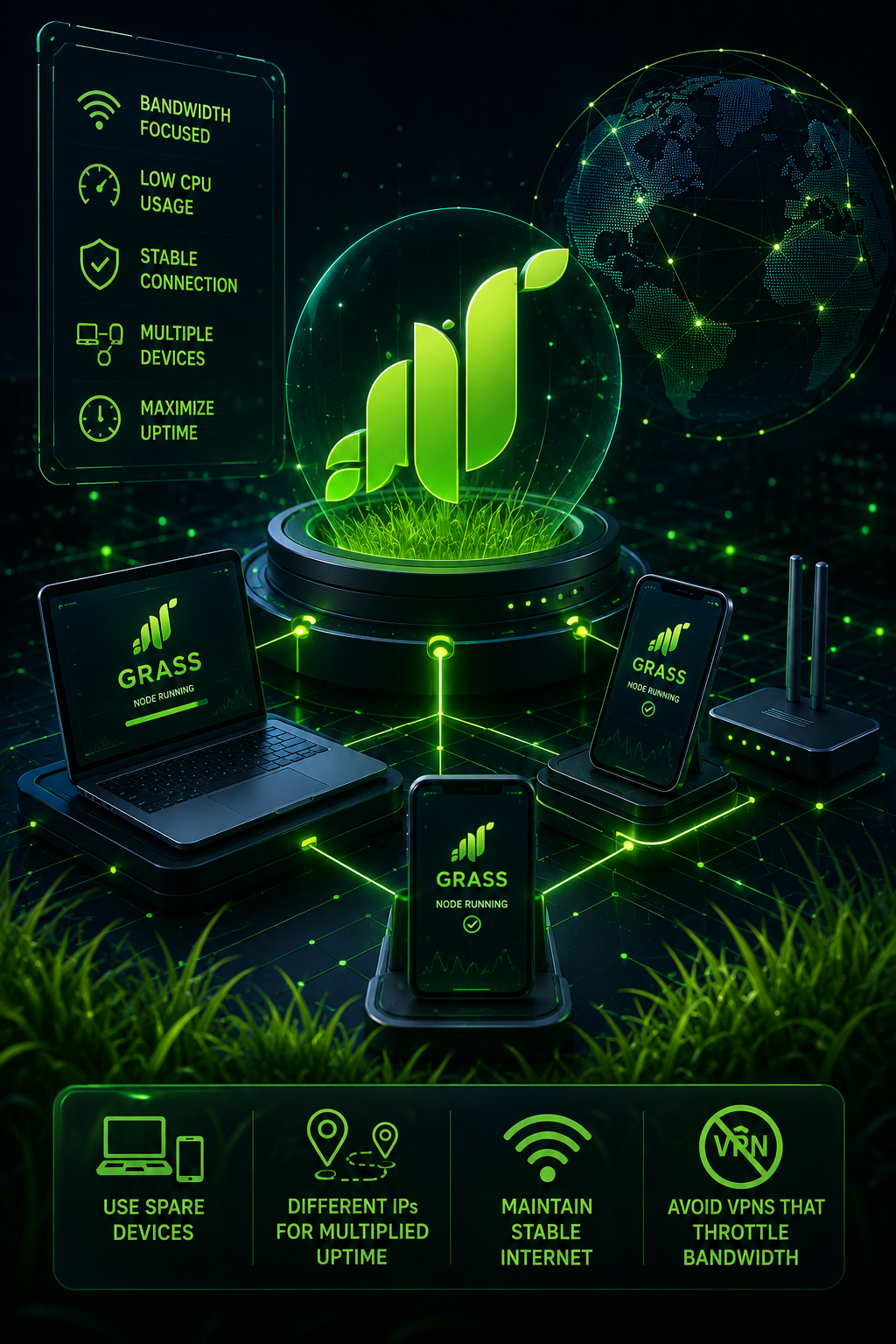
Grass is bandwidth-focused, not compute-intensive. Run the node on a spare laptop, old phone, or always-on device. Avoid overloading a single connection—use multiple devices on different IPs for multiplied uptime. Maintain stable internet and avoid VPNs that throttle bandwidth.
Grass Airdrop Referral Program and Bonus Points
Invite friends via your referral link to earn bonus points (e.g., 2,500 per successful referral plus a percentage of their earnings). This compounds passive income over time and helps grow the network.
Is the Grass Airdrop Legit and How Much Can You Earn?
Grass is a legitimate DePIN project with millions of users and transparent token distributions. Earnings vary: light users might accumulate thousands of points monthly, while optimized multi-device setups report significantly higher yields. Actual $GRASS value depends on market conditions and total supply distribution. Always use official sources.
Share Unused Internet Bandwidth for Crypto Rewards: Safety and Best Practices
Device and Network Safety
Use only the official Grass app/extension. The process uses minimal resources and does not access personal data. Monitor your internet speed—most users notice no slowdown with typical home connections (100 Mbps+ recommended).
Optimization Tips
-
Run 24/7 for maximum uptime points.
-
Use wired connections where possible.
-
Combine with other low-impact DePIN projects carefully.
-
Verify claims only through grassfoundation.io or official channels.
Potential Drawbacks
Rare IP bans or minor speed fluctuations can occur in dense networks. Test on secondary devices first.
Grass DePIN Project Bandwidth Sharing Tutorial 2026
-
Sign Up — Register at grass.io.
-
Install Node — Choose desktop for best results.
-
Connect — Link wallet and enable sharing.
-
Track Progress — Use the in-app dashboard.
-
Scale — Add devices and referrals.
Grass Airdrop vs Other DePIN Projects for Passive Income
Grass stands out for its low barrier (no GPU/CPU needed) compared to storage or compute-focused DePINs. It directly supports AI data needs, positioning it uniquely in the growing decentralized infrastructure sector.
Relevant Article: Quick Overview of DePIN Project Mechanism
When Is the Next Grass Token Airdrop and Eligibility Requirements?
Eligibility centers on accumulated Grass Points before snapshots. Check official announcements for Season 2 timelines. Minimum thresholds (e.g., 500+ points in prior epochs) applied in past distributions. Maintain activity to stay qualified.
Best Practices for Grass Bandwidth Sharing Without Slowing Down Your Internet
Prioritize stable, high-speed connections. Limit concurrent heavy downloads during peak hours. Use Quality of Service (QoS) settings on your router if needed. Most participants experience negligible impact.
The Role of Grass in Decentralized AI Data
Grass contributes to a more open AI ecosystem by crowdsourcing bandwidth for web scraping and training data. Unlike centralized providers, it democratizes access while rewarding individuals. This aligns with broader Web3 trends toward user-owned infrastructure. As AI demand grows, bandwidth-sharing networks like Grass could become foundational.
Key Entities in the Grass Ecosystem
-
Grass Network (DePIN protocol)
-
Grass Points (reward metric)
-
$GRASS Token (native asset on Solana)
-
Grass Foundation
-
Desktop Node / Lite Node / Mobile App
-
Epoch Snapshots
-
Referral System
-
AI Data Layer
-
Bandwidth Contributors
-
Token Holders
-
Season 1 & Season 2 Airdrops
-
Uptime & Network Usage Metrics
-
Solana Blockchain Integration
-
Decentralized Infrastructure
-
Passive Income Participants
FAQ
How does the Grass airdrop work with bandwidth sharing for passive points?
Users run a node that shares idle bandwidth, earning points based on uptime and contribution volume for airdrop eligibility.
What is the latest Grass Network airdrop update and how to start earning?
Season 2 focuses on long-term rewards. Download the official app, install the node, and maintain uptime to start accumulating points immediately.
Can I earn crypto by sharing unused internet bandwidth with Grass?
Yes. The network rewards participants with points convertible to $GRASS tokens through airdrops.
Step by step guide to farming Grass points in 2026
Sign up, install node, enable sharing, monitor dashboard, add devices/referrals, and maintain consistent uptime.
Is running the Grass node safe and how many points do I need for the airdrop?
Official nodes are safe with no reported major issues. Specific point thresholds vary per snapshot—aim for high consistent accumulation.
Grass airdrop vs other DePIN projects for passive income
Grass requires minimal resources compared to compute-heavy alternatives, making it ideal for true passive participation.
How to maximize Grass rewards with multiple devices and referrals
Run nodes on different IPs/devices and share referral links for bonus points.
When is the next Grass token airdrop and eligibility requirements?
Monitor official channels for Season 2 snapshots. Eligibility is points-based with emphasis on sustained activity.
Best practices for Grass bandwidth sharing without slowing down my internet
Use stable connections, avoid peak-hour overloads, and start with a secondary device.
Real earnings from Grass airdrop by sharing bandwidth explained
Varies by contribution; consistent users in prior seasons received allocations tied to their points and network impact.
The Grass airdrop exemplifies how DePIN projects turn everyday resources like unused bandwidth into passive crypto opportunities. By focusing on uptime, smart device scaling, and official tools, participants can position themselves for meaningful rewards in 2026 and beyond. Stay updated via official sources, experiment responsibly on secondary setups, and contribute to the decentralized AI infrastructure while earning. This approach balances low effort with real network value creation.
References
Grass Foundation. "Grass Airdrop One." Grass Docs. Accessed July 23, 2026. https://grass-foundation.gitbook.io/grass-docs.
Stanford University AI Lab. "Decentralized Data Infrastructure for Machine Learning." Stanford.edu, 2025. (Contextual reference on bandwidth needs for AI training).
Internet Society. "The Role of DePIN in Sustainable Digital Infrastructure." ISOC.org, 2026.
Inirerekumendang pagbabasa
Tingnan ang higit pa
Crypto Regulations in 2026: A Complete Guide to Crypto Compliance, Laws, and Global Frameworks
Basic Concepts
Quick Overview of Ethena's Delta Neutral Strategy Profit Mechanism
Basic Concepts
What is the Bitcoin White Paper?
Basic Concepts

Mga contact sa serbisyo
Service@hotcoin.com
Feedback ng produkto
Product@hotcoin.com
Kooperasyon sa negosyo
Business@hotcoin.com
Legal na mga contact
Casecn@hotcoin.com
Tungkol sa atin
produkto
maglingkod
suporta
©2017-2026