
Crypto Assets 101: From Token Classification to Valuation
Crypto assets are digital representations of value or rights that are recorded and transferred on blockchains. A sound introduction begins by identifying the type of asset, then examining its supply, utility, value capture, and liquidity instead of looking only at price.
The same asset may serve payment, gas, staking, and governance functions at once, so classification is not a contest in labeling. Its purpose is to reveal which mechanisms an asset depends on, what holders actually receive, and which metrics can reasonably be compared.
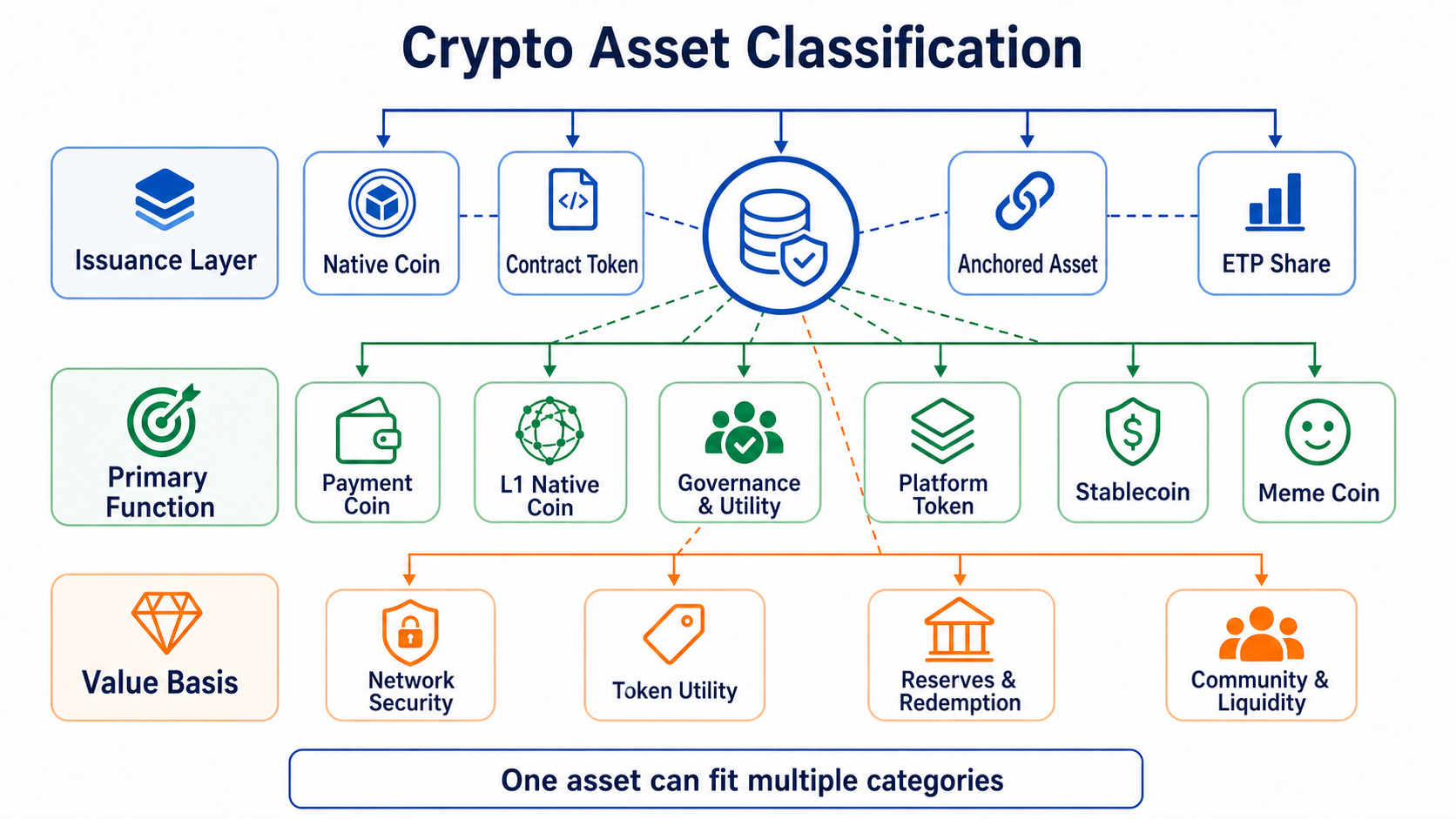
What Is the Difference Between a Crypto Asset, Cryptocurrency, and Token?
Crypto asset is the broadest term. It includes assets native to a blockchain as well as tokens issued through smart contracts, stablecoins, and on-chain claims. In everyday usage, “cryptocurrency” often refers broadly to tradable fungible crypto assets, but regulators and data providers do not use a completely uniform classification system.
| Concept | How It Is Created | Common Uses | What to Verify |
|---|---|---|---|
| Native coin | Issued directly by a blockchain protocol | Network fees, staking, block rewards, or value transfer | Mainnet, consensus rules, and issuance policy |
| Smart-contract token | Issued by a smart contract on an existing blockchain | Governance, application access, points, collateral, or asset claims | Chain, contract address, administrator privileges, and issuance rules |
| Pegged or tokenized asset | Represents off-chain reserves, an asset on another chain, or another claim | Settlement, cross-chain use, or on-chain trading | Issuer, custody structure, redemption terms, and bridging mechanism |
| Exchange-traded product share | Issued by a traditional financial product rather than the underlying native protocol | Price exposure through a securities account | Fund documents, fees, custody, and tracking method |
Coins and tokens differ technically, but the distinction says nothing by itself about value. A native coin may have no fixed cap, while a smart-contract token may have a hard, non-inflationary limit. Each protocol still needs to be checked individually.
What Are the Main Types of Cryptocurrency?
By primary economic function, common categories include payment coins, platform tokens, stablecoins, and meme coins. Functions can overlap: a platform’s native coin may pay gas and participate in staking, while a meme coin may later add application features. See A Complete Guide to Cryptocurrency Categories for the full classification.
| Category | Primary Basis of Value | Questions to Check |
|---|---|---|
| Payment coin or monetary asset | Transfers, settlement, scarcity, and network security | Can issuance rules change, who maintains the network, and how readily do transactions become final? |
| Public-chain native coin | Gas, staking, network resources, and ecosystem activity | Does usage growth create genuine token demand, and how do issuance and burning interact? |
| Governance or utility token | Voting rights, application access, fee functions, or incentives | Can the stated rights actually be exercised, and does the protocol require the token? |
| Platform token | Fees and benefits within an exchange, blockchain, or service ecosystem | Who may alter benefits, are buybacks and burns transparent, and how is the platform related to the token? |
| Stablecoin | A peg supported by reserves, overcollateralization, or a stabilization mechanism | Who may redeem, where are reserves held, and how would the peg recover? |
| Meme coin | Community consensus, cultural reach, and market liquidity | Is ownership concentrated, are contract privileges controlled, and is there enough liquidity to exit? |
Understanding the Meme Coin Phenomenon separately explains the community and issuance differences among DOGE, SHIB, and PEPE. Platform Token Value Analysis compares the uses and control boundaries of BNB, KCS, GT, and HT.
Where Does a Token’s Value Come From?
A token’s utility can enter a valuation only when it creates sustained demand, reduces effective supply, or grants enforceable rights. “Ecosystem utility” written in a white paper does not mean that anyone already uses it, nor does it guarantee that demand will flow through to the token.
Demand for a public chain’s native coin may come from gas, staking, and blockspace. An application token may be used for fees, collateral, voting, or service access. Platform tokens are often tied to fee benefits, on-chain gas, or platform rules. For stablecoins, the central questions are not growth narratives but whether reserves, redemption, and the price peg function as intended.
When assessing value capture, ask three questions: must users hold or spend the token, is protocol revenue explicitly connected to token holders, and can governance or administrators unilaterally change that relationship? User counts or trading volume alone do not imply that a token will capture value in the same proportion.
What Should You Examine in Tokenomics?
Tokenomics describes how a token is issued, allocated, circulated, and used. It connects protocol design with market supply and is a structural review that must be completed before valuation.
Key points to verify include:
- Supply rules should distinguish circulating supply, total supply already created, maximum supply, and future issuance. The absence of a maximum supply does not automatically mean unrestricted inflation; the annual issuance rules must also be reviewed.
- Initial allocation should state the shares assigned to the team, investors, foundation, community incentives, and public sale, as well as who holds the unreleased allocation.
- The unlock schedule should identify exact dates, quantities, and recipients. Linear vesting, cliff unlocks, and ongoing block rewards affect circulating supply differently.
- Token utility should be verifiable in the protocol. Governance, gas, collateral, and fee discounts create different kinds of demand and should not be combined into a single “utility” metric.
- Identify who controls issuance, burning, and parameter changes. Contract administrators, multisigs, on-chain governance, and hard-coded protocol rules provide different degrees of mutability.
How Should You Read Market Cap, FDV, and Token Price?
Token price is merely the last traded price of one unit. It cannot determine whether an asset is “cheap” or “expensive.” Market capitalization and fully diluted valuation combine price with supply, but both remain estimates rather than the amount of capital that actually entered a project.
Circulating market cap = current price × circulating supply
Fully diluted valuation (FDV) = current price × fully diluted supply
Data providers may calculate FDV using total supply or maximum supply. When there is no fixed cap, future issuance is controlled by governance, or supply data cannot be verified, FDV may be unavailable or may simply reflect the provider’s assumptions. Read Market Cap, Circulating Supply, and FDV for details on methodologies and common misconceptions.
The gap between market cap and FDV can indicate the scale of supply that is not yet circulating, but it cannot predict the price effect of future unlocks on its own. Unlock timing, recipient cost bases, market depth, and new demand must also be considered. Multiplying the last traded price by the entire supply does not mean that every token could be sold at that price.
How Can You Evaluate a Crypto Asset Systematically?
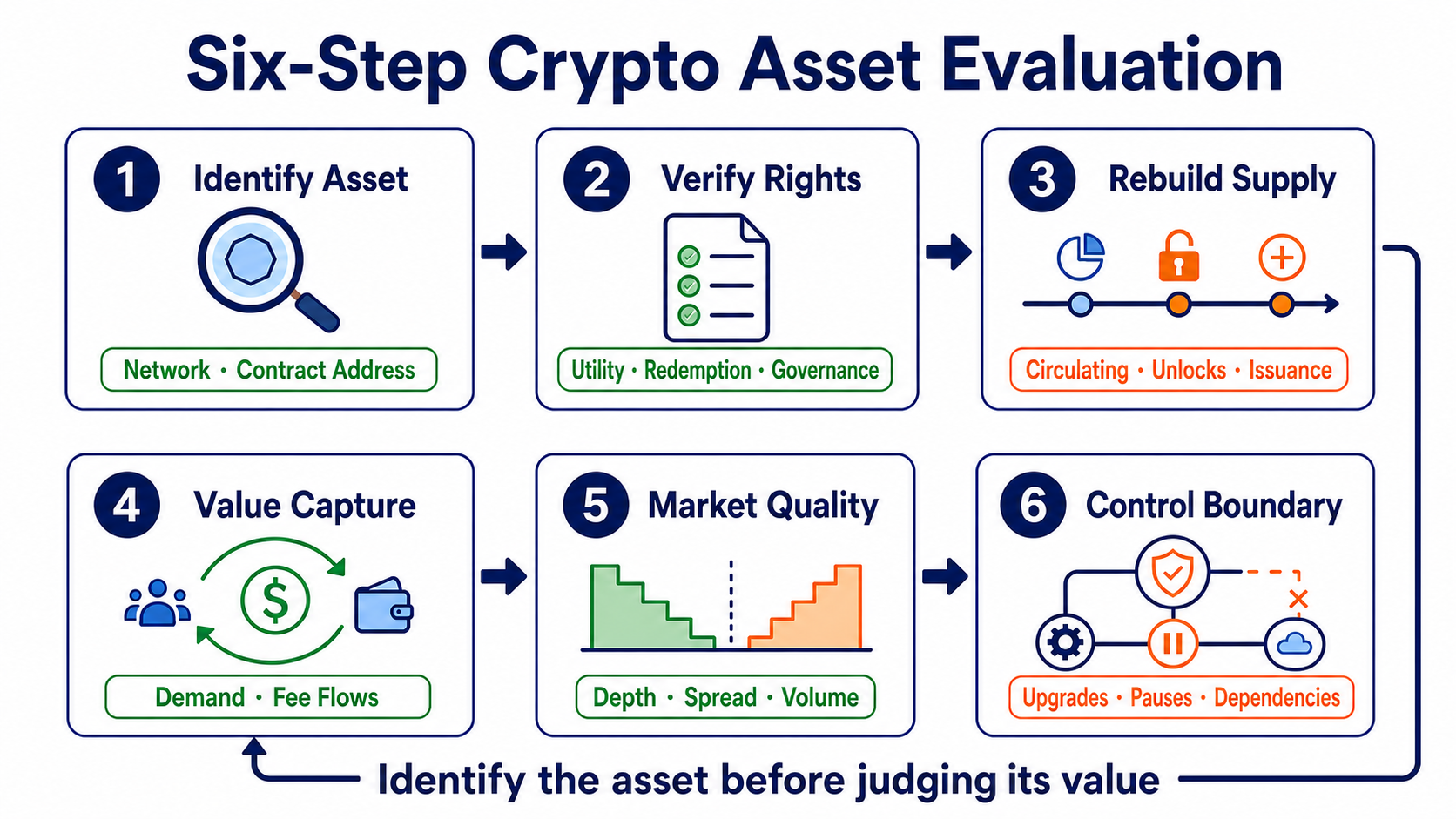
A reusable evaluation process should establish the asset’s identity before discussing valuation. The following six steps help organize research and reduce the temptation to force fundamentally different assets into the same ranking.
Step 1: Confirm the Asset’s Identity
Record the network, token standard, contract address, and native asset symbol. Tokens with the same name may exist on several chains, and bridged and native versions may depend on different issuers or custody arrangements.
Step 2: Determine What Holders Receive
Express each right as a verifiable action, such as paying gas, redeeming reserve assets, voting, or receiving a service discount. If a right exists only on a promotional page, keep looking for supporting contracts, protocol rules, or legal documents.
Step 3: Reconstruct Changes in Supply
Cross-check circulating supply, total supply, maximum supply, unlocks, and burns using on-chain contracts, project documentation, and data providers. The important question is not one number on a particular day, but which future events may change tradable supply.
Step 4: Examine Demand and Value Capture
Distinguish between people using a product and people needing its token. Application revenue may go entirely to a service provider or may flow to the protocol treasury, validators, or a burn mechanism. Only an explicit transmission path belongs in the analysis.
Step 5: Examine Market Quality
Trading volume should be considered alongside order-book depth, the distribution of trading venues, and available pairs. A small amount of trading when circulating supply is low can raise the displayed price and make market capitalization appear large without proving that equivalent exit liquidity exists.
Step 6: Map Control and Failure Boundaries
List every party capable of minting, freezing, pausing, upgrading, or changing the oracle. Then examine bridges, custodians, reserve banks, and governance multisigs. Technical decentralization and operational authority are separate questions and should be answered separately.
Why Should Stablecoins Be Evaluated Separately?
A stablecoin aims to maintain a stable value relative to a reference asset, so an increase in market capitalization does not mean holders earned an equivalent investment return. The assessment should focus on reserve assets, liability coverage, redemption eligibility, attestation frequency, custodians, and whether on-chain issuance reconciles with those records.
The Differences Among USDT, USDC, and DAI are substantial at the issuer and collateral-mechanism level; similar prices near one US dollar do not make them the same risk. Lessons from the UST Collapse further shows how mechanisms that rely on market incentives and a related token to absorb redemption pressure face failure modes different from reserve-backed stablecoins.
How Do Spot ETFs Differ From Holding Crypto Directly?
What are commonly called BTC or ETH spot ETFs are shares traded on securities markets that provide price exposure to the underlying crypto assets. Investors hold product shares, not BTC or ETH that can be transferred on a public blockchain, and they do not automatically receive on-chain signing, staking, or application-interaction capabilities.
In 2024, the U.S. Securities and Exchange Commission approved related exchange rule changes, allowing a group of spot Bitcoin and spot Ether ETPs to list. Approval of those rules was not an endorsement of the underlying assets’ value. Products also differ in management fees, trading hours, tracking error, custody, and creation and redemption arrangements.
Read A Complete Guide to Spot Bitcoin ETFs for the product structure, and see ETH ETF vs. BTC ETF for differences in the two underlying assets and product mechanisms.
Crypto Asset Research Checklist
| Item | Evidence to Keep | Common Misreading |
|---|---|---|
| Asset identity | Official network, contract address, and token standard | Identifying an asset only by its name or icon |
| Supply | Protocol rules, on-chain data, and unlock schedule | Treating maximum supply as current circulating supply |
| Rights and utility | Contracts, governance documents, and product terms | Treating governance rights as equity or dividend rights |
| Value capture | Fee flows, burn rules, and sources of staking rewards | Inferring token value directly from product trading volume |
| Liquidity | Depth, spreads, and trading across multiple markets | Using market cap as a substitute for executable liquidity |
| Control | Administrators, multisigs, upgrade powers, and pause powers | Assuming on-chain issuance means there is no centralized control |
| External dependencies | Custody, reserves, oracles, and bridges | Reviewing only the token contract while ignoring supporting systems |
Frequently Asked Questions
Does Token Burning Always Reduce Circulating Supply?
Not necessarily. Burning reduces the amount that is destroyed, but issuance, unlocks, or reward emissions during the same period may offset it. Compare the net change in supply over time and verify the burn address and transactions on-chain.
Does All Staking Yield Come From Protocol Revenue?
No. Staking yield may come from newly issued tokens, transaction fees, MEV, protocol subsidies, or a combination of sources. If rewards are funded mainly through issuance, an increase in the nominal number of tokens does not mean the holder’s share of total supply also increased.
Why Do Websites Report Different Circulating Supplies?
Providers may treat team wallets, foundation inventory, cross-chain locked balances, and non-tradable tokens differently. Review each provider’s methodology, then cross-check on-chain balances, unlock announcements, and project disclosures rather than simply selecting the larger number.
Is a Wrapped Token Guaranteed to Trade at the Same Price as the Native Coin?
No. A wrapped token generally corresponds to a native asset through custody, locking, or cross-chain messaging, and price parity depends on redeemability and market liquidity. If minting or redemption is suspended, a bridge fails, or custodial assets are insufficient, the two may trade at different prices.
Inirerekumendang pagbabasa
Tingnan ang higit pa



Service@hotcoin.com
Product@hotcoin.com
Business@hotcoin.com
Casecn@hotcoin.com