
BitMart, BitMEX & AscendEX Closures: Three Exchanges Down in Seven Days
BitMart, BitMEX, and AscendEX have all begun orderly wind-downs of their trading platforms in July 2026, marking three centralized exchange exits within roughly one month and intensifying industry consolidation pressures.
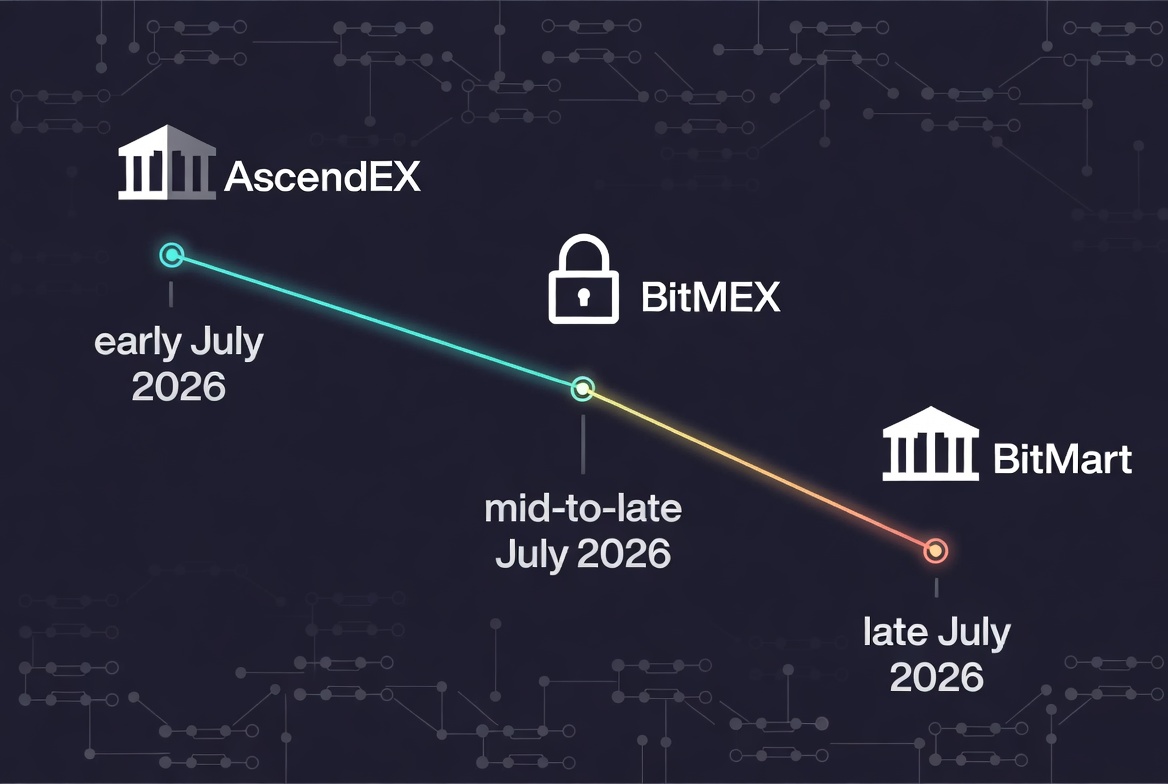
AscendEX stopped operations effective July 1 (announced July 6), citing the full implementation of the EU’s Markets in Crypto-Assets (MiCA) rules for which it lacked authorization, a failed strategic financing deal, and broader market and operational pressures. BitMEX announced on July 23 that it will permanently close on September 23 after an 11-year run, following a strategic review by its operator HDR Global Trading Limited. BitMart followed on July 26, beginning a phased wind-down with all trading services ending August 26 and platform operations ceasing January 31, 2027, after evaluating operating conditions, the market environment, and strategic direction.
Users of these platforms face clear timelines for closing positions and withdrawing assets, while the cluster of exits highlights ongoing challenges for mid-tier centralized exchanges amid regulatory tightening, thinner liquidity, and reduced retail activity in a prolonged bear market.
What Happened: The Three Closures in Sequence
AscendEX (formerly BitMax) was the first of the three. On July 6 it informed users that the platform had ceased operations as of July 1. The exchange explicitly linked the decision to MiCA’s full enforcement date, the absence of required authorization, a strategic transaction that was expected to supply liquidity but whose counterparty “did not perform,” and additional financial and operational pressures. Automated withdrawals were paused; remaining requests moved to manual review covering KYC/AML, sanctions, fraud checks, and balance reconciliation. The company stated it was “not in a position to give assurances about timing or amounts.” On-chain observations around the period showed reduced balances in major assets held by marked addresses, adding to user uncertainty.
BitMEX, the derivatives venue co-founded in 2014 that popularized the 100x-leverage perpetual swap, announced its exit on July 23. HDR Global Trading Limited’s board cited a strategic review of the business and the wider crypto industry. New account registrations stopped immediately. Trading continues under normal conditions until August 26 at 04:00 UTC, after which risk limits restrict users to reduce-only activity. Remaining open positions will be force-closed in an orderly process ahead of the final September 23, 04:00 UTC shutdown. Users who leave assets after closure face a monthly maintenance fee of the greater of $50 equivalent or 1% per annum. BitMEX emphasized that customer assets remain under user control during the transition and noted its historical record of zero customer funds lost to hacks.
BitMart’s announcement arrived three days later, on July 26. The exchange stated it would commence an orderly wind-down after evaluating operating conditions, market environment, and future strategic direction. Key milestones include: suspension of new registrations, deposits, and new orders beginning July 26 at 01:30 UTC (futures moved to reduce-only); full cessation of spot, futures, and other trading services on August 26 at 01:00 UTC (with remaining futures positions potentially settled by the platform under applicable mark or index prices); and official termination of platform operations on January 31, 2027 at 15:59 UTC. Withdrawals remain available, and the exchange strongly advises users to complete KYC where needed, close positions, and submit withdrawal requests early—ideally before the August 26 trading cutoff. BitMart Earn, staking, lending, Launchpad, copy trading, grid trading, and API services are being discontinued in phases. The platform’s BMX token fell approximately 58–60% in the 24 hours following the announcement. Global CEO Nenter (Nathan) Chow publicly stated he had been informed of his employment termination on July 24, was no longer involved in management or decision-making, was not consulted on the wind-down, and learned of it when it became public.
These are not abrupt insolvencies in the style of some past failures. BitMEX and BitMart both framed their exits as strategic responses to market conditions rather than immediate financial collapse, while AscendEX’s communication centered more explicitly on regulatory and liquidity shortfalls.
Why These Exits Matter Now
Centralized exchanges have faced mounting pressure from several directions. Regulatory regimes such as MiCA raise compliance costs and exclude platforms that cannot obtain authorization. Trading volumes and retail participation have contracted in the extended bear market, reducing fee revenue for venues that rely on high-leverage products and continuous new-user acquisition. Analysts, including Moonrock Capital’s Simon Dedic, have described the pattern as the exhaustion of an “extraction model” that depended on a steady supply of new participants; when that supply dries up, weaker platforms become unsustainable. Some market observers have interpreted successive exchange closures as a potential bottoming signal for Bitcoin and the broader market, arguing that the removal of over-leveraged or under-capitalized venues constitutes a healthy clearing process.
BitMEX’s trajectory is particularly illustrative. Once dominant in perpetual futures, its market share eroded as competitors scaled and decentralized alternatives gained traction. Reports indicated the firm had explored a sale process earlier; the ultimate decision was closure after strategic review. BitMart, operating for roughly nine years and having previously absorbed a significant 2021 hot-wallet incident, similarly cited operating and strategic factors without detailing specific insolvency. The combination of regulatory friction, failed capital raises or sales, and prolonged low-activity conditions has left mid-tier platforms with fewer paths to viability.
Practical Implications for Affected Users
Users of all three platforms should treat the published timelines as hard constraints rather than flexible guidelines. For AscendEX, the priority is submitting or following up on manual withdrawal requests and documenting balances, KYC status, and any correspondence, given the explicit lack of assurances on timing or full recovery. For BitMEX, the window to close positions and withdraw before the August 26 reduce-only phase and the September 23 final close is the critical period; remaining balances after closure incur fees. For BitMart, the August 26 trading halt and recommended withdrawal submission window before that date are the most immediate deadlines, with login access expected to persist for a period after January 31, 2027 for record review and residual withdrawals.
In all cases, users should avoid sending further deposits once suspension notices take effect, complete any outstanding identity verification, export transaction histories, and move assets to self-custody or alternative venues that meet their risk and compliance requirements. Delays, additional documentation requests, or partial processing remain possible, especially where compliance screening or volume spikes occur.
Related Source: Real-time Crypto Prices and Charts
Broader Industry Context and Remaining Risks
The cluster of exits does not imply that every mid-sized exchange faces imminent closure. Larger, better-capitalized platforms with clearer regulatory pathways continue to operate. However, the pattern underscores persistent custody and counterparty risks inherent to centralized venues: users remain dependent on the platform’s solvency, operational continuity, and willingness or ability to process withdrawals under stress. Historical precedents show that even platforms with long operating histories can exit when market structure, regulation, or internal strategy shift.
Decentralized perpetual venues and non-custodial tools have absorbed some activity displaced from these closures, but they introduce their own smart-contract, liquidity, and interface risks. The net effect of the July exits is a further concentration of residual centralized liquidity among a smaller set of surviving platforms and a sharper distinction between venues that can sustain compliance and capital costs and those that cannot.
Frequently Asked Questions
Will users of these three exchanges recover 100% of their balances?
AscendEX has stated it cannot provide assurances on timing or amounts under its manual-review process. BitMEX and BitMart have indicated withdrawals remain available during their respective wind-down periods and have not announced shortfalls, but processing times, additional KYC or source-of-funds checks, and potential force-settlement of open positions can still affect the final outcome and timing. Individual results depend on account status, asset type, and the platform’s operational capacity.
Do these closures signal the end of centralized crypto exchanges?
No. They reflect selective pressure on platforms that lost competitive position, failed to secure regulatory authorization or financing, or could not adapt to lower volume environments. Surviving exchanges with stronger balance sheets, clearer licensing, and diversified revenue continue to operate. The exits reduce the total number of venues but do not eliminate the centralized model.
How does MiCA specifically factor into these events?
AscendEX directly cited the full application of MiCA and its lack of authorization as a primary driver. The regulation imposes authorization, governance, capital, and conduct requirements on crypto-asset service providers operating in the EU. Platforms unable or unwilling to meet those standards face restricted market access, which can accelerate strategic exits when combined with other financial pressures. BitMEX and BitMart announcements focused more on broader market and strategic factors.
The simultaneous wind-downs of AscendEX, BitMEX, and BitMart within a short window illustrate the ongoing maturation and attrition of the centralized exchange sector. Users holding assets on any of the three should act promptly according to the published schedules, while the wider market absorbs the reduction in venues as part of a longer-term clearing process driven by regulation, capital discipline, and demand.
Reference:
Bashir, Kamina. “Why BitMart and BitMEX Shutdowns Have Analysts Calling a Bottom.” BeInCrypto, July 27, 2026. https://beincrypto.com/bitmart-bitmex-shutdowns-analysts-bottom/.
“BitMart Begins Shutdown Process as Crypto Exchange Sets Final Trading Deadline.” Bitcoin.com News, July 26, 2026. https://news.bitcoin.com/bitmart-begins-shutdown-process-as-crypto-exchange-sets-final-trading-deadline/.
“Crypto Exchange BitMart to Shut Down After Nine Years, BMX Token Crashes 58%.” CoinDesk, via Cryptonews.net, July 26, 2026. https://cryptonews.net/news/market/33203767/.
Inirerekumendang pagbabasa
Tingnan ang higit pa
Quick Guide to the Highly-Controlled Tokens
Basic Concepts

FDV vs Market Cap: Why Fully Diluted Valuation Matters
Basic Concepts

What is an EIP?
Basic Concepts
Customer Support
service@hotcoinex.io
Feedback ng produkto
Product@hotcoin.com
Kooperasyon sa negosyo
Business@hotcoin.com
Pagpapatupad ng Batas
Casecn@hotcoin.com
Tungkol sa laro
Produkto
maglingkod
suporta
©2017-2026