
The Trillion-Dollar Stock Token Market Is Accelerating, and the Breakthrough Point of the Next Bull Market May Have Emerged Hotcoin Research | February 2-6, 2026
Introduction
Since 2025, US stock tokens have experienced exponential growth, and major trading platforms have opened dedicated sections to list Ondo, xStocks, and other tokenized US equities. Recently, on-chain trading volumes for US stocks and precious-metal tokens have continued to reach new highs, and stock tokens are gradually shifting from niche blockchain innovations toward mainstream investment entry points. The tokenization of major technology companies such as Tesla, Nvidia, Apple, and Circle is driving a surge in cross-border investment among global investors.
This article systematically analyzes the current landscape and future outlook of stock tokens from multiple perspectives, including their advantages and issuance mechanisms, market performance and data trends, representative issuers, risk-return opportunities, and long-term development prospects. By comparing the specific models and structural differences of major publishers (such as Ondo, xStocks, Securitize, and Robinhood), the article explores how stock tokens are reshaping participation logic and infrastructure within the securities market. With the ongoing inflow of capital into on-chain securitized assets, stock tokens are increasingly serving as a bridge between traditional finance and Web3, and their momentum may represent an important starting point for the next bull cycle.
I. Advantages and Mechanisms of Stock Tokens
The core concept behind stock tokens is to map real or expected equity assets onto the blockchain and enable free circulation through standardized token formats.
The Advantages of Stock Tokens
As a product of the integration between traditional financial assets and blockchain technology, stock tokens offer multiple potential advantages:
-
Global Accessibility: Through encrypted wallets and open networks, users worldwide can access tokenized US stocks and ETFs without traditional brokerage accounts, significantly lowering the barrier to cross-border investment
-
Fractional Ownership: Investors can purchase small denominations, enabling more flexible portfolio allocation and making participation more accessible for retail and emerging-market investors
-
24/7 Trading: Unlike traditional stock markets with limited trading hours, tokenized equities can be traded around the clock, improving market efficiency and liquidity management
-
Faster Settlement: On-chain transactions typically support real-time settlement (T+0), reducing clearing risks and intermediary costs
-
Programmability: Smart contracts can automate dividend distribution, governance weighting, and transfer restrictions, unlocking new possibilities for financial product design
-
DeFi Integration: Tokenized stocks can be used as collateral, participate in portfolio strategies, and expand the functionality of on-chain financial ecosystems
These advantages are attracting both traditional financial institutions and crypto-native participants, accelerating the evolution of stock tokens from experimental tools into foundational infrastructure.
Stock Token Issuance Mechanisms
The core design principle of stock tokens is to represent real or expected equity ownership on-chain while enabling standardized and tradable digital formats. Current mainstream issuance models generally fall into three categories:
-
Real Stock Mapping Model
This model involves regulated entities holding real stocks or ETFs and issuing equivalent tokens. Examples include xStocks, Ondo, and WisdomTree. These tokens typically adopt off-chain custody structures with full compliance pathways and maintain a one-to-one correspondence between tokens and underlying shares. Some also support USDC net-value redemption or account-based rotation mechanisms.
-
Shareholder Rights: In most cases, holders receive economic rights such as price exposure and dividends, but do not possess voting or governance rights unless a compliant on-chain registration mechanism is implemented
-
Custody Structure: Assets are generally held by independent third-party brokers or trust institutions to ensure segregation and solvency protection
-
Compliance: Issuance typically follows securities regulations such as Reg D, Reg A+, or MiCA, and is supervised by recognized financial authorities, making it the most compliant and institutionally accepted model
-
SPV Mapping Model
Under this structure, projects establish Special Purpose Vehicles to hold private equity stakes and issue tokens representing expected economic exposure. Examples include PreStocks’ exposure to companies such as OpenAI and SpaceX. Investors usually do not receive direct legal ownership or voting rights, and redemption is often unavailable.
-
Shareholder Rights: Limited to potential economic returns upon exit events such as IPOs or acquisitions
-
Custody Structure: Assets are managed internally by project-controlled SPVs, often lacking independent third-party custody, and reducing transparency
-
Compliance: Frequently falls into regulatory gray areas and may face jurisdictional restrictions or higher legal risks
-
Synthetic Model
This model does not involve real-asset backing and instead tracks stock prices via oracle feeds. A notable historical example is the discontinued Mirror Protocol. These tokens reflect price fluctuations only, without dividends or governance rights, and are often regarded as unregistered derivatives.
-
Shareholder Rights: No equity ownership or cash-flow entitlement; investors bear purely price-tracking risk
-
Custody Structure: No off-chain custody required, fully dependent on smart-contract mechanisms
-
Compliance: Often classified similarly to CFDs or synthetic futures and may be restricted or prohibited in multiple jurisdictions
Overall, real-asset-backed stock tokens currently demonstrate the strongest regulatory adaptability and market sustainability, and are becoming the dominant issuance paradigm.
II. Current Situation and Performance of Stock Tokens
Since 2025, as macroeconomic conditions have improved and technological maturity has increased, the stock-token market has entered a rapid expansion phase. Numerous institutions and exchanges have launched high-profile initiatives. Kraken partnered with Switzerland-based Backed Finance to introduce xStocks in May 2025, offering dozens of tokenized US stocks and ETFs, including S&P 500 constituents. Robinhood launched 24/7 tokenized stock trading in June 2025 on the Ethereum-based Arbitrum Layer-2 network and announced plans to develop its own blockchain infrastructure for native custody and settlement. Ondo released multiple large-cap technology stock tokens through Ondo Global Markets across Solana, Ethereum, and BNB Chain. Meanwhile, institutions such as JPMorgan and BlackRock have experimented with on-chain fund and ETF products, including JPM’s money-market initiatives and BlackRock’s BUIDL fund.
As of early February 2026, the total market capitalization of on-chain stock tokens is approximately $930 million, representing a multi-fold increase from roughly $32 million at the beginning of 2025—an increase of nearly 25 times within a single year.
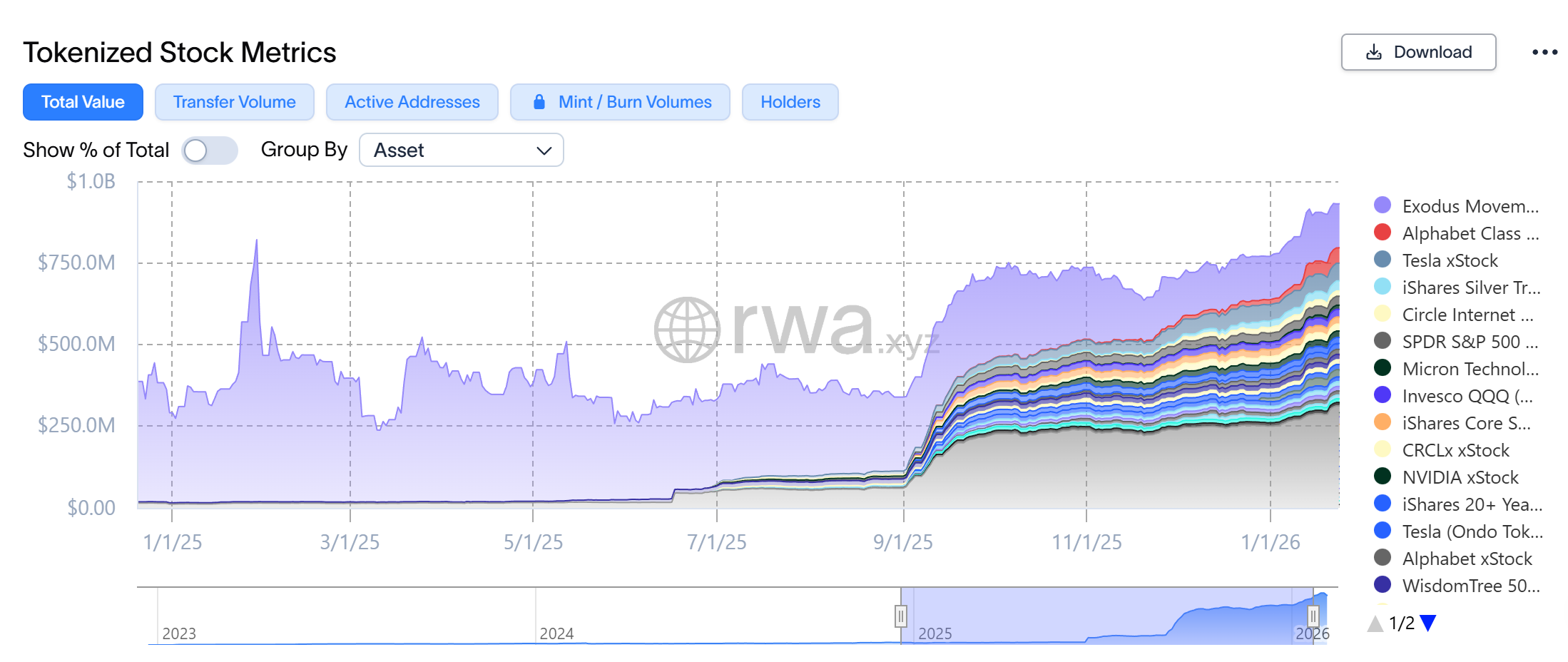
Source: https://app.rwa.xyz/stocks
Beyond market capitalization, on-chain trading activity has also risen significantly. The monthly on-chain transfer volume is approximately $2.4 billion, and the number of token-holding addresses is close to 298,000. In terms of exchange distribution, these tokens are widely available on platforms such as Binance, Kraken, Bybit, Hotcoin, Bitget, Gate, and Jupiter DEX, forming a hybrid centralized-plus-decentralized trading ecosystem.
According to CoinMarketCap’s tokenized-stock sector data, overall capital attention and trading activity remain strong. Technology giants such as Apple, Tesla, Nvidia, and Meta dominate trading volume, with stable growth in both TVL and liquidity. Average 30-day trading volumes are generally in the million-dollar range. Price deviations between tokenized stocks and their underlying equities typically fluctuate within 1%–2%, reflecting both discount and premium dynamics.
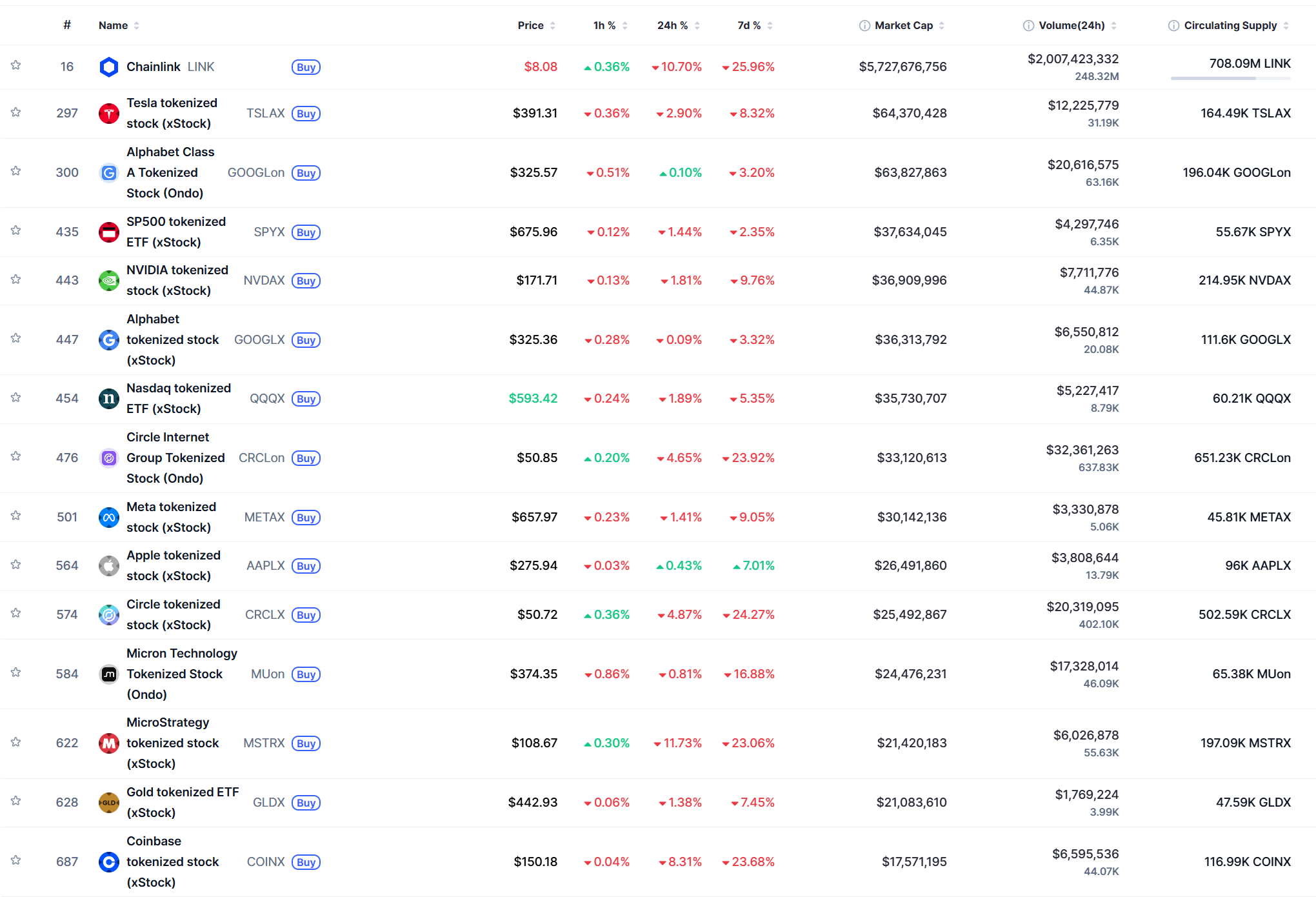
Source: https://coinmarketcap.com/view/tokenized-stock/
III. Representative Publishers of Stock Tokens
From a market-share perspective, as of early February 2026, Ondo Finance holds a significant lead, with an estimated 59.5% share and approximately $559 million in on-chain asset value. xStocks ranks second with roughly $209 million, representing 22.4% of the market, and offers around 74 US stock and ETF tokens, making it one of the most retail-accessible channels. Securitize ranks third, with an approximately 10% market share and a valuation of nearly $94 million, driven largely by a few major equity-token projects such as Exodus. Following these are WisdomTree (2.5%), Superstate Opening Bell (1.8%), and Robinhood-related tokens (around 1.2%).
The data indicate a highly concentrated market structure, with the top two platforms accounting for more than 80% of the total share. This concentration suggests that licensed and regulated institutions are currently more trusted by capital markets, whereas newer entrants continue to strive to expand their scale and credibility.
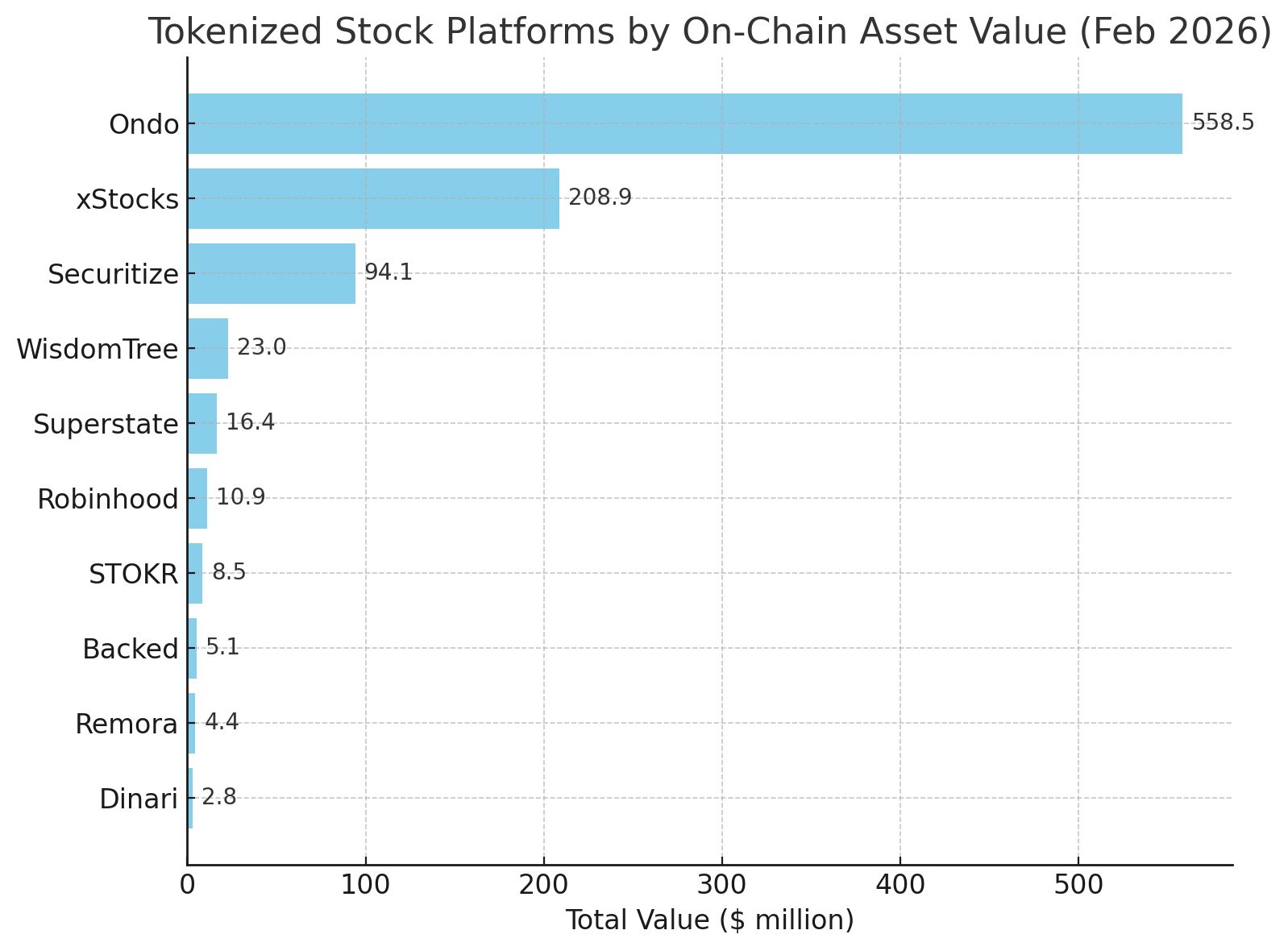
Source: https://app.rwa.xyz/stocks
-
Ondo Finance
Ondo Finance is a decentralized finance (DeFi) startup founded in 2021, focused on bringing traditional fixed-income assets on-chain. In 2023, Ondo launched three tokenized fund products: OUSG (short-term US Treasury fund), OSTB (investment-grade corporate bond fund), and OHYG (high-yield bond fund), corresponding to ETFs managed by BlackRock and PIMCO. These tokens are primarily targeted at accredited investors through KYC procedures, are issued on chains such as Ethereum, and can be purchased or redeemed daily using USDC. Ondo works with cooperative custodians (such as Prime Trust) to hold the underlying ETF shares.
In 2025, Ondo expanded into stock tokens and introduced a series of large-cap technology equity tokens (including Alphabet, Microsoft, Apple, and Tesla) through its subsidiary Ondo Global Markets, covering Solana, Ethereum, and BNB Chain. As of early 2026, the total value of stock and security tokens managed by Ondo is approximately $559 million, ranking first in the industry. The Ondo model is characterized by high compliance and real-asset backing: each token is supported by a complete legal structure and underlying assets, with relatively high investment thresholds but strong institutional participation. From a regulatory perspective, Ondo primarily relies on the Reg D private placement exemption, which is available only to qualified purchasers. Currently, Ondo tokens are primarily traded through its proprietary portal and secondary-market DeFi protocols, which maintain high liquidity and activity.
-
xStocks
xStocks is a stock and ETF token trading service launched by Kraken in 2025. The service is technically supported by Backed Finance, a Swiss firm acquired by Kraken. xStocks adopts a 1:1 full-reserve model, in which underlying stocks or ETFs are held by regulated custodians and corresponding SPL tokens are issued on the Solana blockchain. On Kraken, these tokens are represented by the original stock ticker followed by an “x” (e.g., AAPLx, TSLAx), covering more than 70 assets, including major US equities and S&P 500 ETFs.
xStocks allows non-US users to purchase tokens starting at $1 and supports 24/5 trading. For dividend processing, it adopts an automatic reinvestment mechanism: when the underlying stock pays dividends, the token balance increases proportionally rather than distributing cash. Legally, token holders are not recognized as direct shareholders of the company, and the tokens function more like exchange-traded notes. Kraken ensures compliance by operating through a Jersey-registered entity and restricting services in jurisdictions such as the US, Canada, and the UK. Since launch, xStocks’ asset scale and trading volume have grown rapidly. As of early 2026, its on-chain asset value is approximately $209 million, ranking second with roughly 22% market share. Kraken has also announced plans to expand xStocks to Ethereum to improve composability, demonstrating how major exchanges are actively embracing tokenization through brand credibility and operational infrastructure.
-
Securitize
Founded in 2017, Securitize is a leading US digital-securities issuance platform specializing in blockchain-based securities registration and trading solutions for enterprises. Securitize holds licenses from the US SEC and FINRA (including transfer-agent and broker qualifications) and consistently follows compliant issuance routes. One representative case is its assistance to Exodus Wallet in completing a Reg A+ equity token issuance in 2021, which registered approximately $75 million in company shares on the Algorand blockchain.
Investors subscribe via Securitize’s investment portal, and Securitize serves as the official transfer agent, managing shareholder records. Currently, the Exodus token EXOD trades on ATS platforms, with on-chain data showing a market value of approximately $94 million. Beyond Exodus, Securitize has also issued tokens for multiple private enterprises and funds, including KKR-related products and global equity portfolio funds. Its model emphasizes full compliance combined with private-market access, helping non-listed companies raise capital or provide employee-equity liquidity through tokenized formats, with investors typically being qualified or institutional participants.
-
WisdomTree
WisdomTree is a well-known U.S. asset management firm recognized for its ETF products. In recent years, the company has expanded into on-chain finance through platforms such as WisdomTree Prime and WisdomTree Connect, offering a range of tokenized funds covering money-market instruments, equity portfolios, and bond allocations. To date, WisdomTree has launched 13 SEC-registered tokenized funds.
Investors can purchase these fund tokens through WisdomTree’s mobile application, with a process similar to buying ETFs, except ownership records are stored on the blockchain. WisdomTree tokens are currently issued across multiple chains, including Ethereum and Solana. Holding asset-management and brokerage licenses in both Europe and the United States, WisdomTree represents a traditional asset-management giant’s structured entry into tokenization. By connecting conventional fund products with blockchain infrastructure, it offers users near-continuous trading and holding accessibility.
-
Superstate Opening Bell
Superstate, founded in 2023 by Compound founder Robert Leshner, aims to place listed company equities directly on-chain. Its Opening Bell platform, launched in May 2025, is a regulated on-chain securities issuance system that enables publicly listed, SEC-registered companies to convert shares into blockchain-native formats. A distinguishing feature of this model is its close cooperation with issuing companies, which enables on-chain tokens to become part of the authorized share capital rather than third-party certificates.
Superstate operates as a registered transfer agent and FINRA member, capable of updating shareholder registries on-chain with the company's authorization. Currently, the Opening Bell platform has launched three stock tokens, including Forward and Galaxy, with a combined market value of approximately $16.4 million. Although still small in scale, the model is highly compliant: token holders enjoy full shareholder equity and can participate in corporate actions directly on-chain, making it one of the closest bridges between traditional equity ownership and blockchain infrastructure.
-
Robinhood
Robinhood is a well-known zero-commission stock-trading platform in the United States. In 2025, it introduced tokenized stock-trading services for European users via Robinhood Wallet and its crypto entity. These stock tokens operate on the Arbitrum Nova blockchain and support 24/5 trading, covering more than 2,000 assets, including US-listed stocks, ETFs, and certain equity-exposure instruments.
Robinhood does not directly issue stock tokens; instead, it integrates multiple token issuers and relies on its proprietary blockchain infrastructure for matching and custody. The service is primarily available to European users, and US investors cannot directly access it. From a regulatory standpoint, Robinhood’s tokenized stock services are not currently approved by the US SEC and are instead managed through Robinhood Europe and Robinhood Crypto entities under European crypto-asset regulations. On-chain data indicate that the total value locked in Robinhood token products is approximately $10.9 million, with a rapidly expanding retail user base. These tokens generally do not grant voting or direct shareholder rights but track underlying stock prices, providing convenient retail market access.
-
PreStocks
PreStocks is a platform that tokenizes private-company equity stakes in the pre-IPO stage. It holds limited secondary-market shares of well-known private firms such as OpenAI, SpaceX, Anthropic, and Neuralink through Special Purpose Vehicles and issues corresponding tokens on the Solana blockchain. PreStocks explicitly states that it has no official partnerships with the underlying companies and that its tokens function solely as economic exposure certificates without voting rights, shareholder rights, or dividend entitlements.
After purchasing tokens, users may receive profit distributions associated with SPV exit events, such as IPOs or acquisitions. PreStocks does not hold a U.S. securities broker license and is not registered with the SEC; its services are primarily open to non-U.S. users. In parallel, Coinbase has publicly indicated that it is seeking SEC approval to launch tokenized stock trading through its broker-dealer subsidiary, while Dinari has already obtained a tokenized stock brokerage license and introduced dShares products, with plans to build a dedicated Layer-1 chain. These emerging participants continue to diversify and expand the stock-token ecosystem.
IV. Risks and Opportunities of Stock Tokens
At present, stock tokens exist in a landscape where risks and opportunities coexist. Only by effectively managing risks can their full potential be realized, and this innovation progresses toward maturity.
Main Risks
-
Compliance and Policy Risks Regulatory uncertainty remains the primary risk, as stock tokens sit at the intersection of traditional securities and crypto assets. Different jurisdictions classify stock tokens as securities, derivatives, or illegal issuances. When regulations tighten, related services may be suspended, as previously seen with Binance and FTX stock-token products. Even compliant tokens must continuously adapt to evolving securities laws across regions, creating barriers to cross-border expansion. For example, the United States has not formally approved public stock-token trading for retail investors, whereas the European Union’s MiCA framework is still being interpreted. Policy shifts could result in restricted platform access or token delistings.
-
Legal Rights and Investor Protection Many stock tokens do not confer on holders true shareholder status, particularly in synthetic or gray-area structures, leaving investors without clear legal claims in disputes or issuer defaults. Bankruptcy scenarios further complicate matters: if a custodian or holding institution fails, asset recovery pathways remain uncertain and largely untested in courts. In addition, the absence of voting rights prevents token holders from participating in corporate governance decisions, which may negatively impact investor interests during events such as mergers, restructurings, or privatizations.
-
Liquidity and Premium/Discount Risk Although overall market capitalization has grown, stock-token liquidity often remains lower than that of traditional equity markets. Some tokens exhibit limited daily volume and wide bid-ask spreads, making them vulnerable to premiums or discounts relative to underlying assets. When redemption mechanisms are inefficient, price deviations may widen further. For instance, private-company equity tokens may trade well below the company’s latest financing valuation, resulting in floating losses for holders. In thin markets, large sell orders can also trigger sharp price declines and liquidity drains.
-
Technical and Security Risks Stock tokens operate on blockchains via smart contracts, exposing them to vulnerabilities such as contract exploits, oracle manipulation, and hacking incidents. A compromised contract could result in unauthorized token transfers or asset mismatches. Oracle reliability is especially critical for synthetic tokens; inaccurate feeds can cause severe price divergence and liquidation cascades. Network-level instability also affects trading continuity. Historical blockchain outages have demonstrated the risk of interrupted access. While most major tokens undergo audits and are deployed on mature chains, technical risk cannot be fully eliminated and requires continuous security investment.
-
Credit and Counterparty Risk Purchasing a stock token often entails exposure to the issuer's or custodian's creditworthiness. Compliant structures typically employ independent trustees, but gray-area models may leave users functioning merely as unsecured creditors. Misappropriation of funds or operational failure can lead to investor losses. Even with custodial arrangements, legal and structural complexities—such as opaque SPV governance can reduce transparency and oversight. These counterparty risks must be mitigated through auditing, disclosure standards, and legal safeguards; otherwise, trust events could significantly damage market confidence.
Potential Opportunities
-
Cross-Border Investment and Financial Inclusion Stock tokens can reconstruct global investment channels by reducing geographic and institutional barriers. Traditionally, investors faced obstacles such as account-opening restrictions, foreign-exchange controls, and limited market access. Tokenization enables participation through internet connectivity and encrypted wallets, offering emerging-market investors new entry points into global capital markets. Over time, this may significantly reduce the cost and threshold of international securities investment while improving the efficiency of global wealth allocation.
-
Enhanced Market Efficiency and Liquidity Continuous trading and near-instant settlement can enhance information responsiveness and reduce counterparty risk relative to traditional T+2 cycles. Clearing pressure decreases, and portfolio adjustments become more flexible. Fractional ownership also broadens participation, attracting smaller investors and increasing overall liquidity. Institutional adoption, such as the acceptance of tokenized securities as collateral could further accelerate asset turnover and operational efficiency.
-
Innovative Financial Products and Services Stock tokens can integrate with DeFi infrastructure to create new financial instruments and service models. Examples include using equity tokens as collateral for stablecoin lending, providing liquidity on decentralized exchanges, and employing structured derivative strategies. Future developments may include on-chain index funds, automated portfolio management, and programmable dividend distribution. Tokenized equities may also be used for payment, settlement, and supply-chain finance, reducing intermediary costs and expanding the scope of financial innovation.
-
Opportunities for Traditional Financial Institutions For securities firms and exchanges, stock tokens represent both disruption and opportunity. Leading institutions are already investing in digital-asset divisions, custody services, and tokenized-asset platforms. As regulations clarify, traditional players can leverage brand trust, compliance infrastructure, and client networks to capture market share. Partnerships with token issuers for custody, liquidity provision, and market-making are becoming increasingly common. For multinational financial groups, tokenization opens new business lines and strengthens global connectivity.
-
Catalyzing Capital-Market Reform The rise of stock tokens pressures traditional markets to modernize settlement cycles, reduce fees, and extend trading hours. Exchanges are exploring T+0 settlement and all-day trading mechanisms, while legal frameworks are gradually recognizing electronic equity registration and smart-contract execution rights. Digitized securities could enable real-time regulatory oversight and greater transparency, thereby contributing to long-term market stability and risk management.
V. Outlook on the Future Trend of Stock Tokens
-
Large-Scale Market Potential Industry projections suggest that a meaningful share of global securities could be tokenized within the next decade. As one of the largest asset classes, equities alone represent a trillion-dollar potential for tokenization. In cross-border investment and private equity markets, tokenization can unlock dormant liquidity and broaden participation, thereby supporting the emergence of a globally unified, continuously operating capital-market framework.
-
Acceleration of Traditional Exchange Transformation Stock tokens are reshaping the business models of conventional securities firms and exchanges. Institutions may simultaneously launch digital-asset segments and optimize legacy processes to reduce costs and retain customers. Emerging platforms have already demonstrated 24-hour trading capabilities, while established exchanges continue to research blockchain-based settlement. Over time, direct token-trading boards and blockchain-enabled listing processes may become viable under regulatory approval, potentially lowering IPO costs and enabling hybrid brokerage models that serve both traditional and tokenized assets.
-
Gradual Improvement of Regulatory Frameworks Regulators worldwide are increasingly monitoring and formalizing rules for tokenized securities. Future frameworks are expected to provide clearer compliance pathways, licensing structures, and investor-protection standards. Jurisdictions such as the United States, the European Union, Hong Kong, and Singapore are likely to refine digital securities regulations, thereby reducing uncertainty, attracting institutional participation, and fostering sustainable market growth.
-
Strengthening the Mapping of Shareholder Rights A key development trajectory is the closer alignment between token ownership and real shareholder rights. Models that integrate on-chain shareholder registries, voting systems, and programmable dividends demonstrate the feasibility of bridging digital tokens with corporate governance. As adoption increases, the gap between tokenized and traditional shares may narrow, enabling outcomes of “same shares, same rights, same benefits.”
-
Synergistic Development with Other Real-World Assets Tokenization is expanding beyond equities to bonds, funds, commodities, and real estate. A comprehensive on-chain asset ecosystem may emerge, where diversified portfolios combine multiple token types within unified wallets and DeFi protocols. Such integration could enhance capital mobility, enable collateralized borrowing against tokenized government bonds, and support automated portfolio rebalancing through smart contracts — ultimately improving global resource-allocation efficiency.
Conclusion
Stock tokens represent a frontier of financial innovation at a pivotal stage of development. They have the potential to transform how investors access and participate in equity markets by increasing openness, efficiency, and global reach. While the sector still exhibits characteristics of rapid and uneven growth, such as valuation volatility and variable project quality, the entry of large institutions and clearer regulation are expected to drive standardization and maturity.
Future progress will likely include unified disclosure standards, stronger self-regulatory organizations, professional market-making infrastructure, and insurance mechanisms for digital assets. As service quality and investor protections approach those of traditional securities markets, broader institutional participation may create a positive feedback loop of liquidity and trust. Looking ahead, stock tokens could become as commonplace in the next decade as electronic trading platforms became in the previous one, marking a significant evolution in global capital markets.
About Us
Hotcoin Research, the core research and investment arm of Hotcoin Exchange, is dedicated to turning professional crypto analysis into actionable strategies. Our three-pillar framework—trend analysis, value discovery, and real-time tracking—combines deep research, multi-angle project evaluation, and continuous market monitoring.
Through our Weekly Insights and In-depth Research Reports, we analyze market dynamics and highlight emerging opportunities. With Hotcoin Selects—our exclusive dual-screening process powered by both AI and human expertise, we help identify high-potential assets while minimizing trial-and-error costs.
We also engage with the community through weekly livestreams, decoding market hot topics, and forecasting key trends. Our goal is to empower investors of all levels to navigate cycles with confidence and capture long-term value on Web3.
Risk Disclaimer
The cryptocurrency market is highly volatile, and all investments carry inherent risks. We strongly encourage investors to remain informed, assess risks thoroughly, and adhere to strict risk management practices to protect their assets.
Connect with Us
X: x.com/HotcoinAcademy
Email: labs@hotcoin.com
Inirerekumendang pagbabasa
Tingnan ang higit pa
Hotcoin Research|Mt.Gox Starts BTC Repayment: How Much Selling Pressure? Analysis of the Event and Market Impact
In-depth Research
Hotcoin Research: Unleashing the Power of Digital Gold: BTC Staking Track Explodes
In-depth Research

Hotcoin Research | Guide to Investing in Meme Coins: A Safety Manual for Survival
In-depth Research
