
What is Blockchain Message Signing?
Blockchain message signing refers to the process in which a user in a blockchain environment uses a private key to cryptographically sign a message or data to prove its authenticity, integrity, and the identity of the sender. Message signing ensures that information within the blockchain system is not tampered with during transmission, and only the specific sender can generate the signature, thereby providing non-repudiation of the data.
1. Definition
Blockchain message signing refers to the process in which a user utilizes their private key to digitally sign a message (such as a transaction, contract call, etc.) using cryptographic technology. The signed message can be verified by other users, ensuring that the information is reliably sourced and has not been modified.
2. Process
The process of message signing generally includes the following steps:
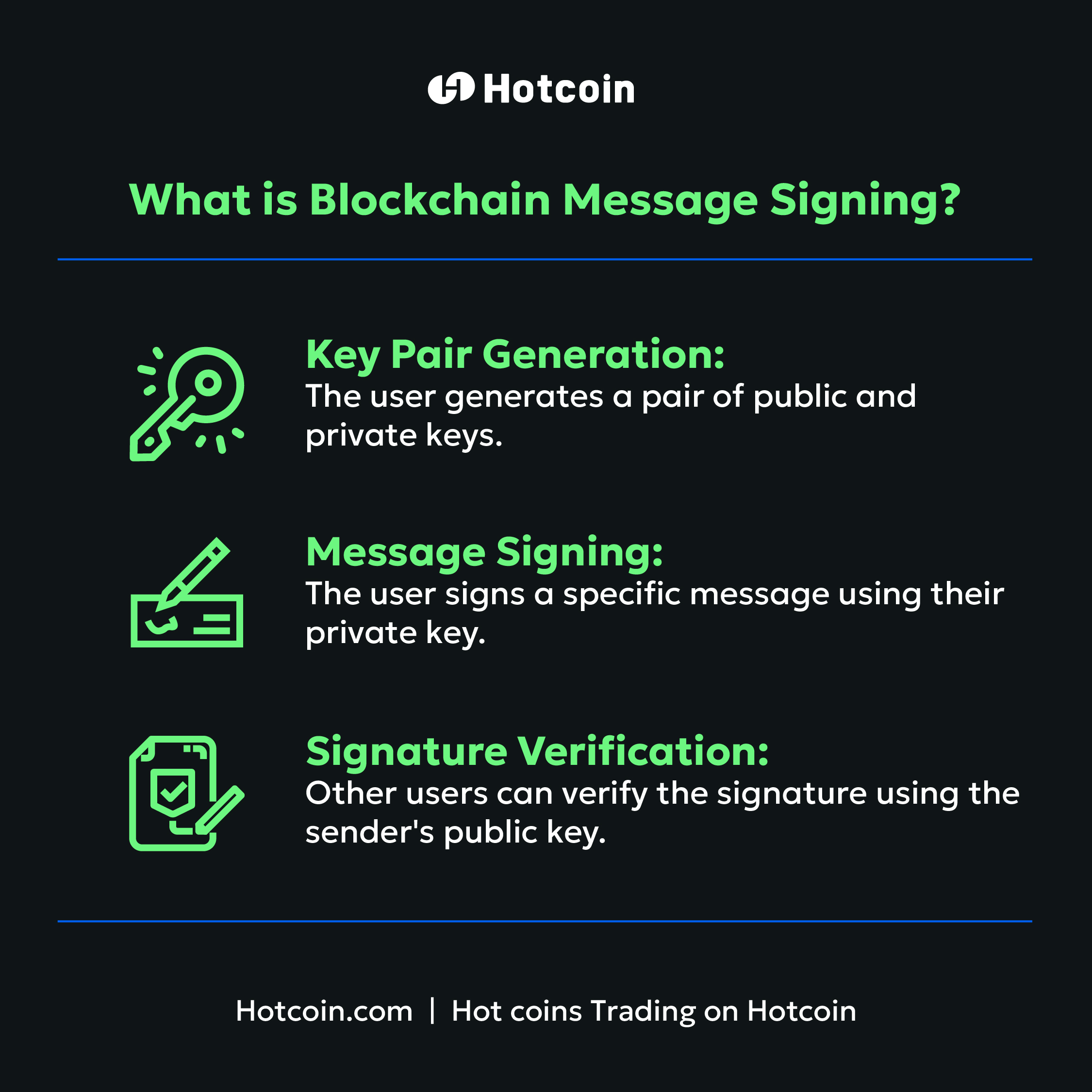
Key Pair Generation: The user generates a pair of public and private keys. The public key is used for public verification, while the private key is used to sign messages.
Message Signing: The user signs a specific message using their private key. This usually involves first generating a hash of the message using a hash function and then encrypting the hash value to create the signature.
Signature Verification: Other users can verify the signature using the sender's public key to confirm that the signature corresponds to the message and that the message has not been tampered with.
3. Applications
Transaction Signing: On the blockchain, every transaction needs to be signed by the sender using their private key to ensure the transaction is legitimate and initiated by the correct party.
Smart Contract Invocation: When invoking a smart contract, users must sign the contract call message to prove that the invocation is initiated by the correct user.
Identity Authentication: Blockchain signatures can be used in decentralized identity systems, allowing users to sign messages with their private key to prove their identity without relying on centralized third parties.
Data Integrity Verification: Blockchain message signing ensures that data remains untampered during transmission and storage, widely applied in supply chain, medical records, and other sectors.
Blockchain message signing uses cryptographic technology to ensure the security, integrity, and non-repudiation of data, which is particularly crucial in decentralized environments.
Inirerekumendang pagbabasa
Tingnan ang higit pa

Service@hotcoin.com
Product@hotcoin.com
Business@hotcoin.com
Casecn@hotcoin.com