
TradFi vs DeFi: Where Traditional Finance Meets Crypto
For years, TradFi and DeFi have looked like two separate worlds. TradFi relies on banks, exchanges, brokerages, and clearinghouses, while DeFi is built on blockchains and smart contracts, enabling trading, lending, swaps, and asset management with less reliance on traditional intermediaries.
Since the start of 2026, however, that once-clear boundary has begun to blur. Traditional assets such as stocks, gold, government bonds, and ETFs are increasingly entering digital trading systems, while traditional financial institutions are also beginning to apply blockchain technology to asset issuance, settlement, custody, and other areas.
TradFi vs DeFi: What Sets Them Apart
TradFi is built around regulation, institutional trust, and established financial infrastructure. DeFi emphasizes openness, transparency, automation, and global accessibility.
| Category | TradFi | DeFi |
| Core infrastructure | Banks, brokerages, exchanges | Blockchains, smart contracts |
| Main assets | Stocks, bonds, gold, forex, ETFs, etc. | Crypto assets, stablecoins, tokenized RWAs, etc. |
| Intermediaries | Greater reliance on intermediaries | Smart contracts can reduce reliance on intermediaries |
| Trading hours | Usually subject to market trading hours | Most DeFi protocols can operate 24/7 |
| Transparency | Relies on institutional disclosure | On-chain data is public and verifiable |
| Key strengths | Regulatory compliance, maturity, large asset base | Openness, automation, global accessibility |
But the differences matter less than where the two now overlap.
The Signal to Watch: Real-World Assets Are Moving On-Chain
Real-world assets (RWAs) are becoming an important bridge between TradFi and DeFi.
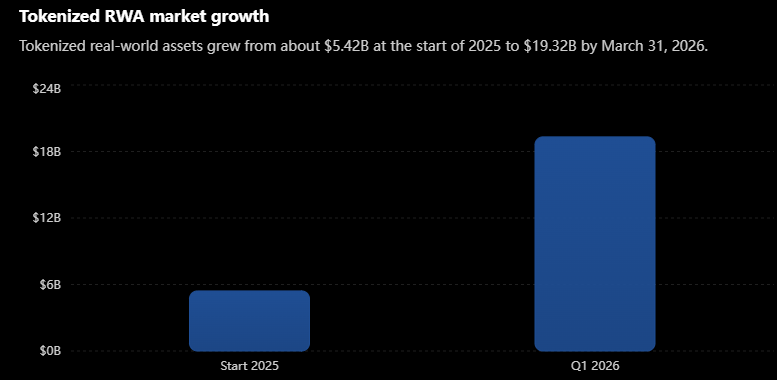
According to CoinGecko’s 2026 RWA report, tokenized RWAs reached approximately $19.3 billion in market capitalization by the end of Q1 2026, up around 257% from the beginning of 2025. Tokenized U.S. Treasuries remained the largest asset category, while tokenized commodities, stocks, and ETFs also continued to grow.
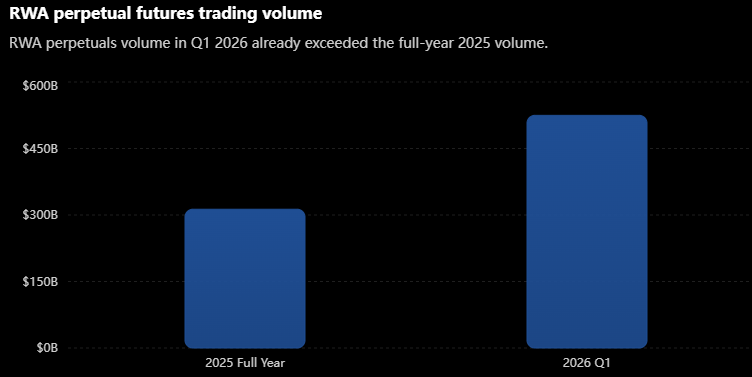
Trading volume tells an even sharper story. In Q1 2026, RWA perpetual futures trading volume reached approximately $524.8 billion, already well above the roughly $313.0 billion recorded for the whole of 2025.
In other words, the market is moving beyond simply bringing traditional assets on-chain and toward using digital infrastructure to trade them.
At the same time, traditional financial institutions are actively exploring asset tokenization. BlackRock, JPMorgan, UBS, and other institutions have participated in tokenized funds, bonds, repo transactions, settlement, and related use cases.
Hotcoin Launches TradFi: From Crypto to Global Multi-Asset Trading
Against this backdrop, Hotcoin has launched Hotcoin TradFi, expanding its multi-asset trading offering.
Hotcoin TradFi currently offers two product categories: TradFi Spot and TradFi Futures. TradFi Spot covers U.S. and South Korean stocks, precious metals, commodities, ETFs, and indices, while TradFi Futures covers U.S., Hong Kong, Japanese, and South Korean stocks, as well as precious metals, commodities, ETFs, indices, and forex.
For users already familiar with crypto trading, Hotcoin TradFi broadens the range of accessible assets beyond crypto and into traditional financial markets, making it possible to explore opportunities across U.S. stocks, gold, indices, ETFs, forex, and other markets within a familiar platform environment.
TradFi + Crypto: The New Shape of Trading Platforms
As traditional assets become increasingly digitized, TradFi and crypto are becoming more integrated at the product level. For trading platforms, the competitive focus is shifting from simply adding more crypto trading pairs to offering a broader range of assets and a more complete cross-market trading experience.
Crypto offers around-the-clock access, global reach, and a digital-native market environment, while TradFi connects users to established financial markets such as stocks, commodities, indices, and forex. As the two become more closely connected, trading platforms are evolving as well, with broader asset coverage and more diverse trading offerings.
This reflects a broader shift among digital asset platforms toward becoming multi-asset trading hubs.
TradFi vs DeFi: The Future Isn’t a Choice Between the Two
If DeFi is exploring how finance can become more open, transparent, and automated, then the digitalization of TradFi is helping bring established financial assets into a more efficient and broadly accessible digital trading environment.
The rapid growth of RWAs reflects this shift. The connection between traditional assets and blockchain infrastructure is deepening, while TradFi, DeFi, and crypto are increasingly overlapping across a wider range of use cases.
For traders, this means access to a broader range of asset classes. At the market level, the integration of traditional and on-chain finance is also expanding beyond assets into areas such as trading, settlement, and infrastructure.
Looking ahead, the boundaries between TradFi, crypto, RWAs, and DeFi may become even less distinct. Traditional financial assets may become available through more digital trading channels, while blockchain and digital asset platforms may play a greater role in connecting different financial markets.
TradFi vs DeFi, then, may no longer be a question of which one will replace the other. What matters more is that TradFi is accelerating its digital transformation, DeFi is connecting with more real-world assets, and both are moving toward a more open, diverse, and interconnected financial landscape.
Risk Warning: Hotcoin TradFi product prices are linked to the prices of assets in traditional financial markets and may be affected by factors including macroeconomic conditions, interest rate policies, corporate events, liquidity, and trading hours. TradFi Futures are leveraged products. Leverage can magnify both gains and losses and carries a risk of liquidation. Hotcoin TradFi products do not represent direct ownership of the corresponding stocks or other underlying assets. Specific product characteristics are subject to the relevant trading page and product rules.
Inirerekumendang pagbabasa
Tingnan ang higit pa
Why Isn't T+1 Enough for Financial Markets? What Does Blockchain Want to Change from Clearing to Settlement?
TradFi

Hotcoin TradFi Futures vs Crypto Perpetual Futures
TradFi
What Is TradFi? Why Do Crypto Users Need It?
TradFi