
What Is the Difference Between Triangular Arbitrage and Cross-Platform Arbitrage?
Triangular arbitrage normally cycles through three trading pairs on the same platform to profit from exchange-rate discrepancies. Cross-platform arbitrage buys and sells the same asset on different platforms to capture an executable price difference. The former depends more heavily on completing three orders in sequence, while the latter depends on capital being available on both sides, deposit and withdrawal status, and coordinated execution across platforms.
Both strategies must be completed before the price discrepancy disappears, and neither can be evaluated using only the latest displayed price. Fees, bid-ask spreads, order book depth, and execution delays can turn an apparently profitable opportunity into a loss.
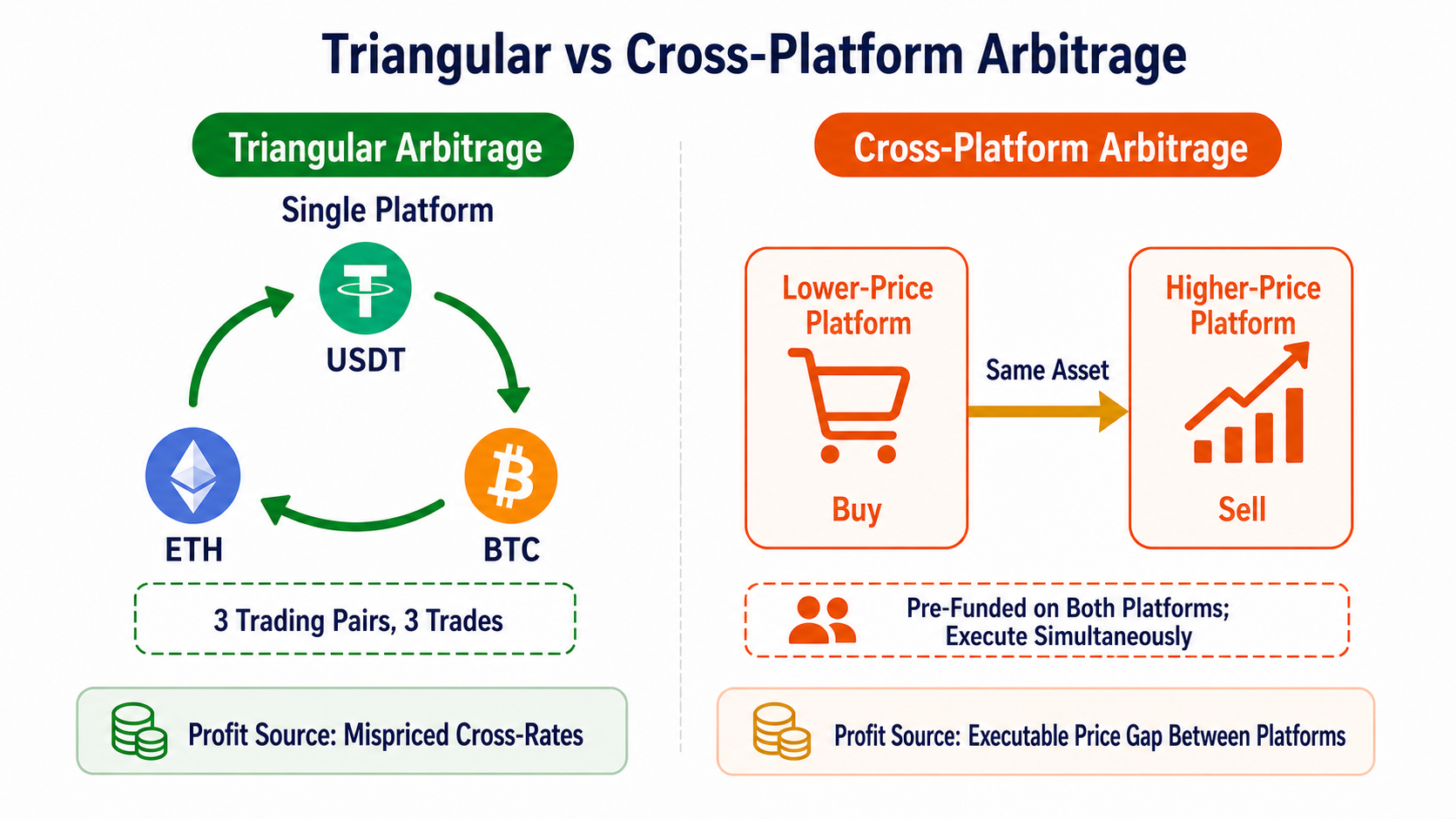
What Are the Core Differences Between Triangular and Cross-Platform Arbitrage?
Triangular arbitrage compares the relative exchange rates among three trading pairs on the same platform. A trader converts asset A into asset B, then into asset C, and finally back into asset A. The route produces a positive net return only if the trader ends with more asset A than at the start and the increase covers all three transaction costs.
Cross-platform arbitrage compares the executable price of the same asset on two platforms. A trader buys on the platform with the lower quote and sells simultaneously or shortly afterward on the platform with the higher quote. It normally involves only one target asset, but requires managing two accounts, two order books, and capital transfers between platforms.
| Comparison | Triangular Arbitrage | Cross-Platform Arbitrage |
|---|---|---|
| Source of price discrepancy | Inconsistent relative exchange rates among three trading pairs | Different quotes for the same asset across platforms |
| Typical venue | One centralized platform or one on-chain protocol | Two or more trading platforms |
| Basic trading path | A→B→C→A | Buy on the lower-priced platform and sell on the higher-priced platform |
| Basic number of trades | Usually three | Usually two, followed by possible asset transfers |
| Capital allocation | Capital concentrated in one place | Capital often distributed across multiple platforms |
| Reliance on transfers | On-chain transfers are usually unnecessary within a centralized platform | May rely on transfers, or trades can be executed simultaneously with pre-funded accounts |
| Main execution challenge | Completing three orders quickly and sequentially | Coordinating execution, deposits, withdrawals, and capital rebalancing across both sides |
| Main additional risks | Interrupted routes, partial fills, and quantity precision errors | Settlement delays, suspended deposits or withdrawals, platform risk, and quote-asset differences |
How Does Triangular Arbitrage Form a Trading Cycle?
A common route is USDT→BTC→ETH→USDT. It uses the BTC/USDT, ETH/BTC, and ETH/USDT trading pairs. The first trade buys BTC with USDT, the second buys ETH with BTC, and the third sells ETH for USDT.
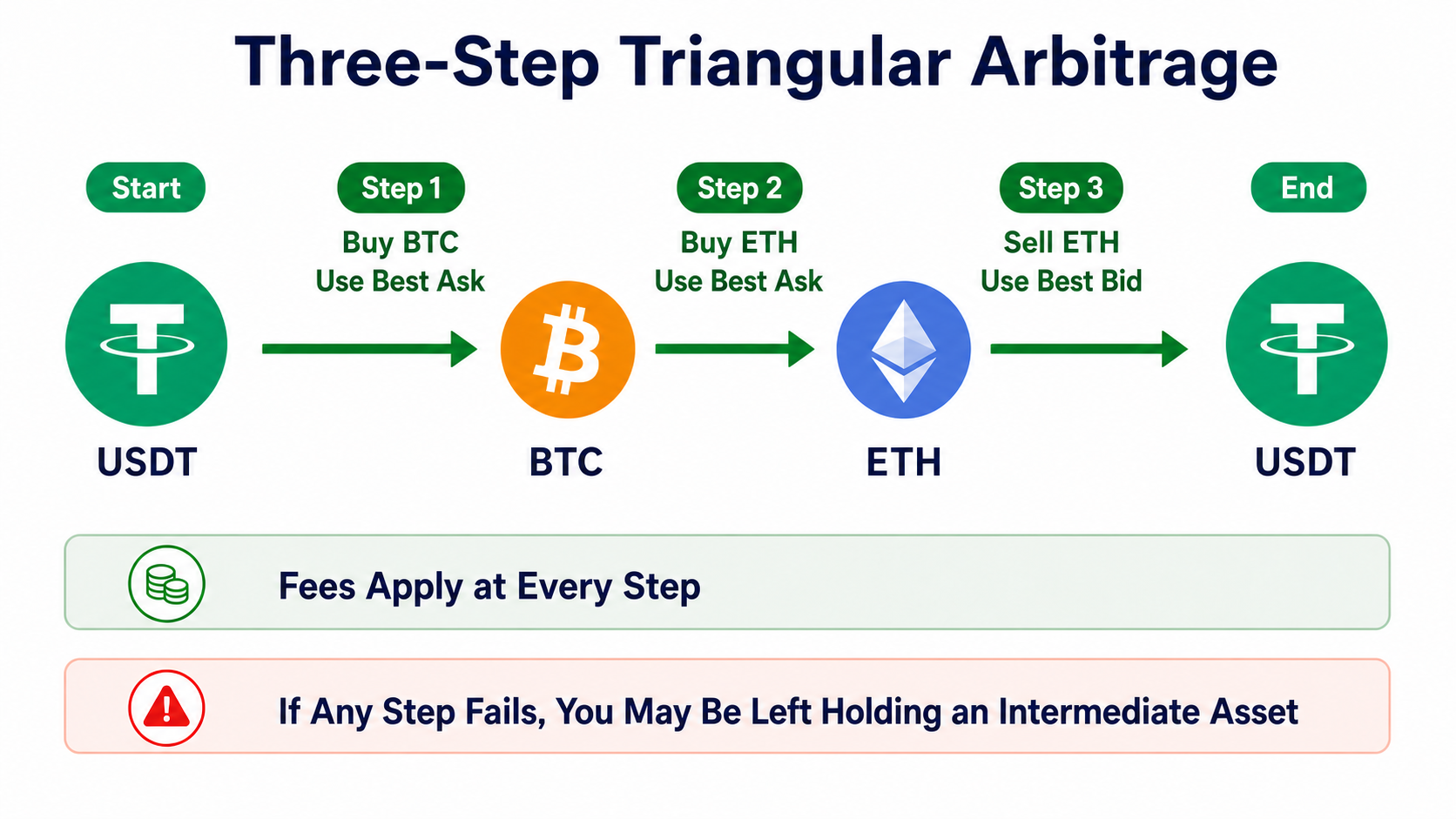
You cannot determine whether the route works by multiplying the three displayed prices directly. A purchase must use the ask price, a sale must use the bid price, and the direction of each trading pair determines whether to multiply or divide. For this route, if each fee is deducted from the asset received at that step, the result can be estimated with the following framework:
Ending USDT = Starting USDT ÷ BTC/USDT best ask ÷ ETH/BTC best ask × ETH/USDT best bid × (1 − Fee Rate 1) × (1 − Fee Rate 2) × (1 − Fee Rate 3)
Net cycle profit = Ending USDT − Starting USDT
The best ask and best bid represent only the first level of the order book. If an order is larger than the available quantity at that level, the remaining portion will execute at less favorable prices. A practical calculation should use the volume-weighted average execution price for the target quantity and account for minimum order size, price precision, quantity precision, and the asset used to pay fees.
The risks of triangular arbitrage are concentrated between the three orders. After the first order fills, the second may fill only partially, and balance precision may prevent the third order from using the entire remaining amount. The cycle then fails to complete as planned, leaving the account exposed to BTC, ETH, or another intermediate asset.
On a centralized platform, the three trades usually occur sequentially. An on-chain protocol may bundle multiple swaps into one atomic transaction that reverts entirely if its conditions are not met, but network fees, slippage settings, transaction ordering, and smart contract risk still apply. The two environments should not be evaluated using the same execution assumptions.
How Does Cross-Platform Arbitrage Buy Low and Sell High?
Cross-platform arbitrage usually monitors the asks on platform A and the bids on platform B at the same time. An opportunity may exist only when the actual purchase cost on platform A is lower than the actual sale proceeds on platform B.
A trader can first buy on the lower-priced platform, transfer the asset to the higher-priced platform, and then sell it. This approach requires less initial capital, but the trader must wait for block confirmations and the receiving platform to credit the deposit. The price difference may narrow before the asset arrives, and the destination platform may suspend deposits.
Another approach is to pre-fund both platforms. The lower-priced platform holds the quote asset, while the higher-priced platform holds the asset to be sold. When a price discrepancy appears, orders are submitted on both sides at the same time. This avoids waiting for a transfer before selling, but capital is spread across multiple platforms, and balances must be restored to their target proportions after execution.
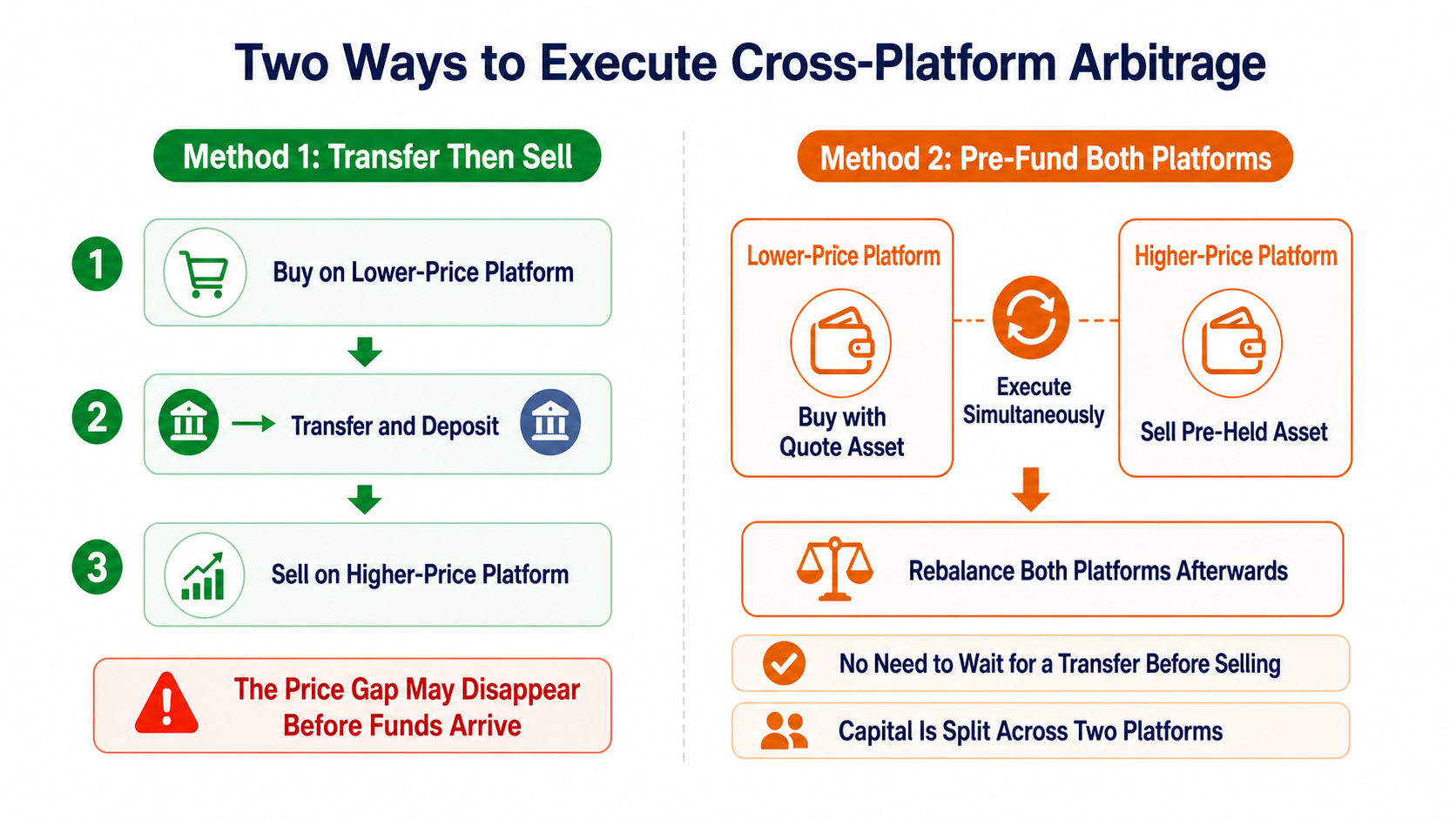
Cross-platform arbitrage can be estimated with the following framework:
Executable gross price difference = Average bid for the target quantity on the higher-priced platform − Average ask for the target quantity on the lower-priced platform
Estimated net profit = Executable gross price difference × Trade quantity − Buying fee − Selling fee − Withdrawal and network fees − Capital rebalancing cost − Quote-asset conversion cost
If both platforms are already pre-funded, withdrawal and network fees may not occur during the current round of trades, but they should not be ignored. The assets will eventually need to be rebalanced, and this cost should be allocated to the strategy's results.
Why Is the Displayed Price Difference Not the Tradable Profit?
The latest traded price only shows where the previous transaction occurred. It does not guarantee that the next order can execute at the same price. An immediate purchase normally consumes asks, while an immediate sale consumes bids. Arbitrage calculations must use prices and quantities that can actually be executed in both directions.
Order book depth also limits strategy size. Platform B may display a higher price, but if the high-priced bids can absorb only a small quantity, the remaining asset will sell into lower price levels. Buying on the lower-priced platform may likewise push the average purchase cost upward across successive levels.
Fees must be calculated using the account's actual rates. Maker and taker rates may differ, and trading-volume tiers, fee discounts, and the asset used to pay fees can change the final amount received. Triangular arbitrage executes three consecutive trades, so underestimating the cost of any one leg affects the final result of the entire cycle.
Cross-platform comparisons also require a consistent unit of account. BTC/USDT and BTC/USD may both appear to be denominated in dollar value, but USDT and US dollars are not the same asset. Treating different quote assets as equivalent can cause a conversion discrepancy to be mistaken for a BTC price difference between platforms.
What Capital and Tools Do the Two Strategies Require?
Triangular arbitrage can keep capital on one platform, but it must read three order books simultaneously and calculate the route according to each pair's direction. Opportunities are often short-lived, making it difficult to complete three trades manually under the same quotes. A program must read the actual quantity received after every fill instead of continuing to calculate from the theoretical pre-order result.
Cross-platform arbitrage requires maintaining multiple accounts at the same time. Under a pre-funded model, the lower-priced platform must hold the quote asset, while the higher-priced platform must hold the asset to be sold. If either side has an insufficient balance, the two trades cannot be completed simultaneously even when a price discrepancy appears.
At a minimum, monitoring tools should identify the following:
- Triangular arbitrage requires the best bid, best ask, depth, minimum order size, precision, and actual fees for all three trading pairs. Route calculations must also choose multiplication or division according to the trade direction.
- Cross-platform arbitrage requires comparisons of both order books, account balances, trading permissions, deposit and withdrawal status, supported networks, crediting requirements, and capital rebalancing costs.
- Both strategies should record order submission times, filled quantities, average execution prices, and failure reasons. Recording only the theoretical price difference shown by a scanner is not enough to review actual performance.
What Are the Main Risks of Triangular and Cross-Platform Arbitrage?
Triangular Arbitrage Can Leave Intermediate-Asset Exposure
It is difficult to guarantee that all three trades will execute as expected. Price changes, API latency, rejected orders, or quantity rounding can stop the cycle at the second step. The remaining asset then fluctuates with the market and is no longer a pure exchange-rate arbitrage position.
A limit order constrains the worst execution price but may not fill. A market order is faster but may consume multiple order book levels and increase slippage. The choice of order type should reflect how long the route is likely to remain available and the depth of each trading pair.
Cross-Platform Arbitrage Can Stall During Capital Transfers
Deposit confirmations, withdrawal reviews, network congestion, and wallet maintenance can all extend settlement time. A price difference between platforms sometimes exists precisely because capital cannot move easily on one side. A larger discrepancy does not automatically mean a better opportunity; it may instead indicate deposit or withdrawal restrictions or insufficient liquidity.
Pre-funding reduces execution delays but increases capital fragmentation and counterparty risk. If one platform cannot accept orders or process withdrawals, a trade completed on the other platform becomes a one-sided position.
Both Strategies Are Limited by Costs and Speed
Price discrepancies usually narrow as other traders place orders. Triangular arbitrage bears three trading fees and slippage on three legs. Cross-platform arbitrage bears two trading costs and may also incur transfer, network, and rebalancing fees. The strategy is profitable on an accounting basis only when the actual increase in assets after execution covers every cost.
What Should You Check Before Trading a Price Discrepancy?
| Check | Triangular Arbitrage | Cross-Platform Arbitrage |
|---|---|---|
| Quotes | Best bids, best asks, and route direction for three trading pairs | Asks on the lower-priced platform and bids on the higher-priced platform |
| Depth | Whether every leg can handle the same capital size | Whether both platforms can fill the target quantity at the same time |
| Costs | Three trading fees and the assets used to pay them | Two trading fees, withdrawal fees, network fees, and rebalancing costs |
| Account | Intermediate-asset precision, minimum quantities, and order permissions | Balances, verification status, trading permissions, and deposit and withdrawal permissions on both sides |
| Execution | Cancellation or exit procedures if one leg fails | Procedures for when one side fills and the other fails |
| Settlement | Whether the route ends in the starting asset | How to restore asset balances on both sides for the next round |
Recalculate the complete route using the intended trade quantity before deciding whether to submit an order. A trial with the minimum quantity can verify pair direction, fee deductions, and API responses, but the slippage of a small trade does not directly represent the slippage of a larger order.
Frequently Asked Questions
Must Triangular Arbitrage Start With USDT?
No. The starting point can be any asset in the route. The requirement is to return to the same starting asset after three conversions. Different starting points and directions use different bid and ask prices, so one triangle may support several calculation paths.
Why Is It Called Triangular Arbitrage Rather Than Three-Coin Arbitrage?
The name comes from the closed loop formed by three connected markets. The route usually involves three assets and three trading pairs, but one of the assets may be a stablecoin or a fiat-denominated asset. The key feature is completing an A→B→C→A cycle.
Is a Spot-Perpetual Price Difference for the Same Asset a Form of Cross-Platform Arbitrage?
Usually not. A price difference between spot and perpetual or delivery futures is better classified as cash-and-carry arbitrage, basis trading, or funding-rate arbitrage. Even if the two positions are held on different platforms, the return structure must still be analyzed under the rules of the spot and derivatives instruments.
Can Cross-Platform Arbitrage Work if the Two Platforms Do Not Support the Same Deposit and Withdrawal Network?
Pre-funded accounts can still submit trades on both sides, but restoring the original asset distribution afterward will be difficult. The trader may need to convert into an asset or network supported by both platforms, transfer it, and then convert back. The additional trades, fees, and price movements must all be included in the rebalancing cost.
Must an Arbitrage Program Enable API Withdrawal Permissions?
Triangular arbitrage occurs entirely within one platform and normally does not require withdrawal permissions. Cross-platform order execution and capital rebalancing can also be handled separately. Limiting a trading API key to the permissions required for reading data and placing orders, while using a separate process and whitelist for withdrawals, can reduce the impact of a compromised key.
Lectura recomendada
Ver más



Service@hotcoin.com
Product@hotcoin.com
Business@hotcoin.com
Casecn@hotcoin.com