
Top GameFi Projects to Watch in 2025
Which GameFi Projects Were Most Worth Watching in 2025?
The most notable GameFi projects of 2025 include MapleStory N, Off The Grid, Pixels, Axie Infinity, Parallel, Lumiterra, World of Dypians, Seraph: In the Darkness, and Cambria. Together, they represent several major directions: established game IP moving onchain, AAA shooters, social farming, the rebuilding of an early blockchain-game ecosystem, competitive card games, open worlds, metaverses, and Risk-to-Earn.
This list is not a token-performance ranking and does not imply that any project will generate returns. Hotcoin Learn selected these projects primarily on the basis of products that launched or entered open testing in 2025, real gameplay, the purpose of onchain assets, development progress, and industry significance. The information was updated in 2026, but the assessment focuses on each project's performance in 2025 rather than using later price movements to reinterpret its value at the time.
How Should GameFi Projects Be Evaluated?
The first step in assessing a GameFi title is not checking its token price. It is verifying whether players can actually enter the game, complete its core loop, and enjoy it without depending on rewards. Only then should you examine whether NFTs, tokens, and onchain accounts solve genuine problems involving ownership, trading, identity, or community coordination instead of being forced into the product.
Product maturity: Is there a downloadable, playable game, or only a trailer, white paper, and NFT presale?
Gameplay retention: Would players continue fighting, collecting, building, or socializing without high token rewards?
Need for onchain features: Do NFTs and tokens have clear uses, and can ordinary players understand the onchain interactions?
Economic sustainability: Are rewards supported by real sinks and revenue, and can asset supply adjust to demand?
Team delivery: Do releases, tests, roadmaps, and security responses continue over time, and do promises become shipped content?
Onboarding experience: Can users start for free, sign in socially, or use a custodial wallet, reducing seed-phrase and gas-fee barriers?
Security and compliance: Are smart-contract, bridge, marketplace, wallet, and regional restrictions explained adequately?
How Did the GameFi Market Change in 2025?
In 2025, GameFi shifted from “issue a token to generate growth” toward “prove the game is playable first.” DappRadar reported that blockchain games averaged roughly 5.8 million daily unique active wallets in the first quarter of 2025, falling to about 4.66 million in the third quarter. Blockchain gaming still represented a substantial share of onchain activity, but player growth and funding cooled significantly. The market increasingly filtered out projects without working products or durable revenue.
A unique active wallet, or UAW, only shows that a wallet interacted with a DApp smart contract; it is not the same as a unique human player. Check-ins, reward claims, multi-account campaigns, and bots can all inflate the number. Projects also place different amounts of gameplay onchain, so wallet counts alone cannot establish game quality. Sources: DappRadar's Q1 2025 report and Q3 2025 report
MapleStory N: An Established Game IP Moves Onchain
MapleStory N was one of the most emblematic new GameFi projects of 2025. It combines Nexon's long-running MapleStory IP and side-scrolling MMORPG gameplay with an onchain item economy. Unlike new projects that must build an audience entirely within crypto, MapleStory N benefits from mature content, existing player awareness, and the operating experience of a major game company.
Nexon officially launched MapleStory N on May 15, 2025, positioning it as the first blockchain-based MMORPG in MapleStory Universe. Players can earn resources and items in the game, while some assets are verified and circulated through onchain systems. Source: Nexon's official launch announcement
4.1 Why Is It Worth Watching?
Established IP: MapleStory already has long-developed content, classes, equipment, and social systems, so it does not need to educate players from scratch.
A major publisher's experiment: Nexon's involvement shows that traditional game companies are directly testing player ownership and open economies.
A complete MMORPG loop: Fighting monsters, leveling up, obtaining equipment, and trading have their own gameplay demand; rewards are not the only objective.
4.2 What Needs to Be Monitored?
MapleStory N must balance scarce items, bot farming, the experience of ordinary players, and its onchain market. Traditional MMORPGs already struggle with resource inflation and automation, and open trading can make economic imbalances show up in asset prices more quickly. Researchers should also watch whether the onchain version attracts conventional MapleStory players rather than only crypto users.

Off The Grid: How an AAA Shooter Hides Web3 Friction
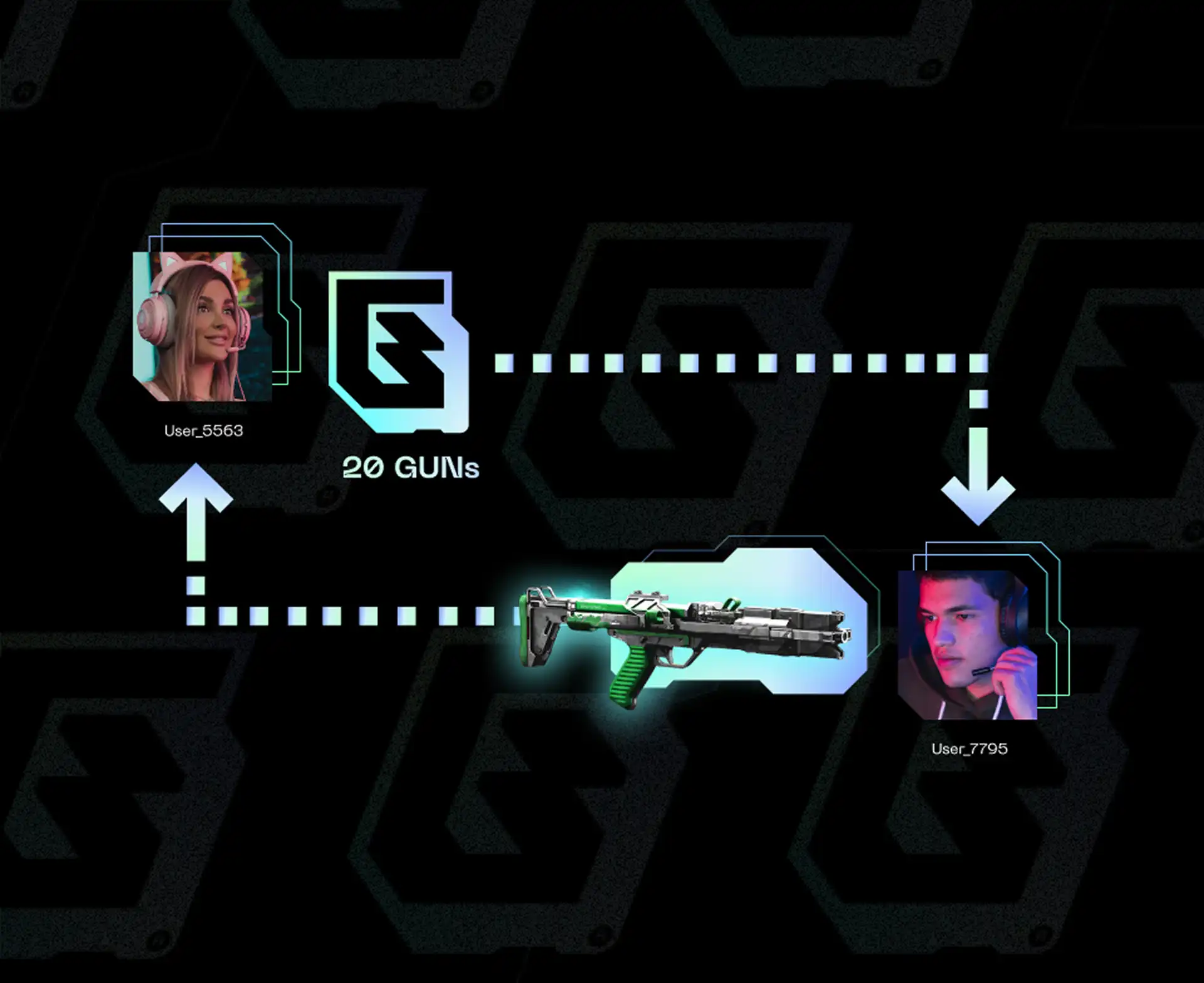
Off The Grid is a cyberpunk Extraction Royale shooter developed by Gunzilla Games and available on PC, PlayStation 5, and Xbox Series X/S. Its underlying GUNZ platform lets players convert eligible in-game items into tradable NFTs, but users can begin through a conventional free-to-play experience without buying tokens or NFTs before entering the game.
In 2025, the GUN token launched, GUNZ advanced its mainnet migration, and Off The Grid's onchain item and marketplace structure received further real-world testing. GUNZ describes itself as an AAA gaming platform that lets players choose whether to turn game items into tradable NFTs. Source: the official GUNZ website
5.1 Why Is It Worth Watching?
Gameplay first: Its central selling points are shooting, extracting gear, and modifying characters, not claiming a token every day.
Optional onchain use: Players can experience the game before deciding whether to use wallets, marketplaces, and NFT features.
Cross-platform release: Availability on consoles and PC gives GameFi a chance to reach conventional core gamers.
5.2 What Needs to Be Monitored?
Off The Grid still needs to prove that onchain items improve the player experience rather than create pay-to-win advantages or complex tax issues. Mainnet migration, regional compliance, anti-cheat systems, marketplace fees, and item supply will all affect the economy. AAA development is expensive; if active users and spending cannot cover long-term operations, onchain trading volume alone will not solve the business-model problem.
Pixels: A Lightweight Onchain Economy for Social Farming
Pixels is a social farming game in the Ronin ecosystem. Players can grow crops, craft, complete quests, manage land, and interact with others. Instead of pursuing AAA graphics, it lowers the barrier to entry with browser access, pixel art, short tasks, and social collaboration. This represents a branch of GameFi that more closely resembles a casual gaming platform.
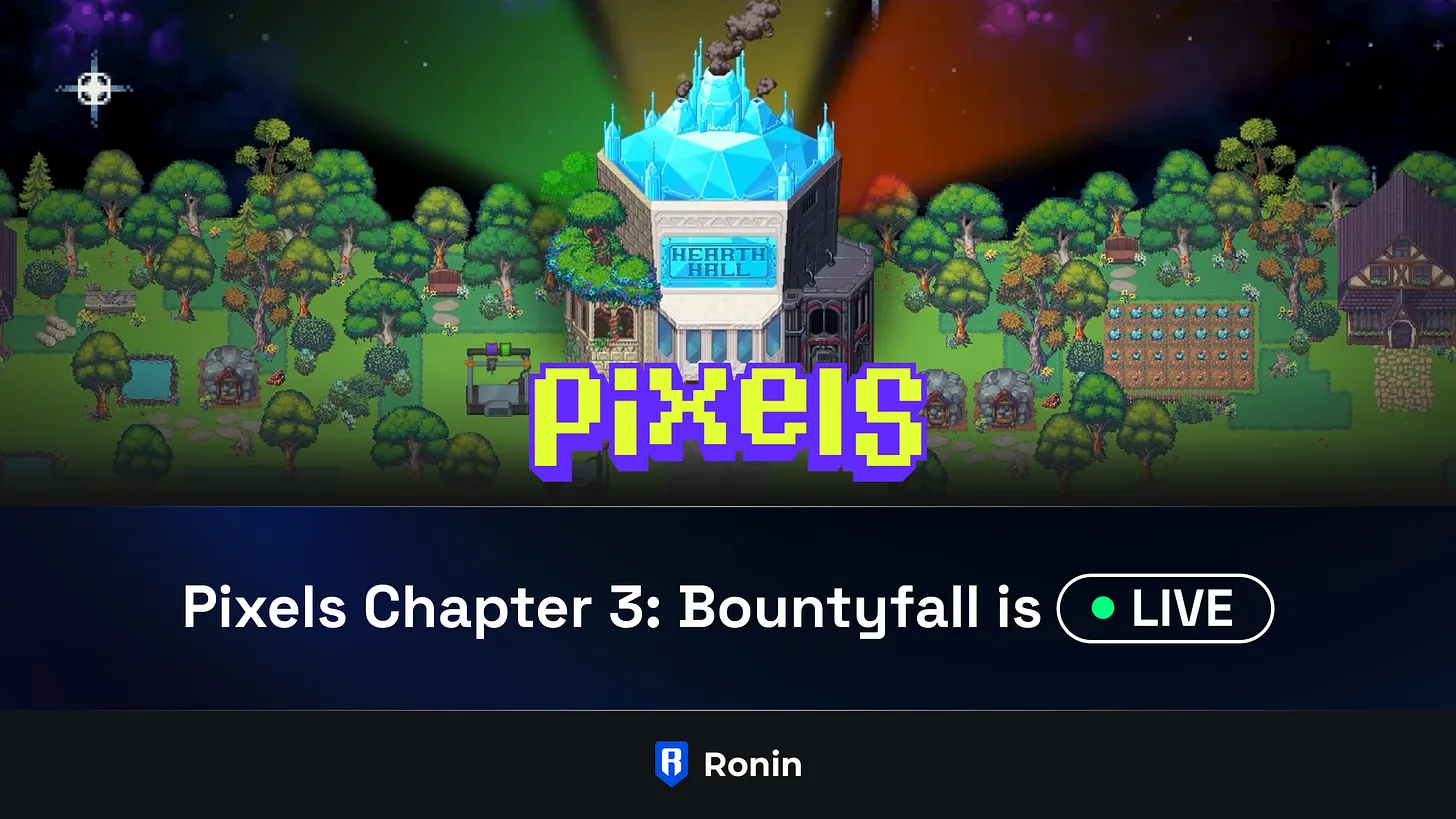
In October 2025, Pixels launched Chapter 3: Bountyfall, introducing Unions, Yieldstones, and faction competition so that everyday collaboration could affect seasonal results. The update showed the team's attempt to embed rewards in community competition instead of relying only on repetitive solo farming. Source: Ronin's official Pixels Chapter 3 announcement
Pixels matters because it demonstrates that GameFi does not require complex combat or expensive NFTs. Farming and social relationships can also create retention. However, PIXEL rewards, production advantages tied to land NFTs, scripted accounts, and resource inflation still require continuous balancing. If user growth is driven mainly by reward campaigns, retention after those campaigns ends is the more important metric.
Axie Infinity: From a P2E Case Study to a Long-Term Gaming Ecosystem
Axie Infinity's importance in 2025 was not its ability to recreate the high yields of 2021. It was a chance to observe how an established GameFi ecosystem rebuilds content and player relationships. Origins, Classic, Axie progression systems, and ecosystem games continued to receive updates. The team also announced the Axie MMO Atia's Legacy in 2025 and held its first test in September.
Official Axie material describes Atia's Legacy as an MMO set in the world of Lunacia for mobile and PC. After the first 2025 playtest, the team said that some invited testers spent substantial time in the game. Such team-reported figures still need to be evaluated against future public tests, retention, and the finished release. Sources: Axie Infinity's announcement of Atia's Legacy and its playtest feedback
Axie is worth watching because it has lived through a complete cycle of rapid growth, inflation, security incidents, and economic adjustment. For a deeper look at the relationship among SLP, AXS, Axie NFTs, and Ronin, read Axie Infinity: The Rise and Fall of a Blockchain Gaming Pioneer.
Parallel: Competitive Card Play Meets Digital Collectibles
Parallel is a free-to-play science-fiction digital card game. Players select a faction, construct a deck from 40 cards and a Paragon leader, and compete in one-on-one strategy matches. Card games already revolve around collecting, rarity, deck building, and trading, so NFTs can align with existing gameplay rather than introduce assets with no practical role.
Parallel's official material says new players can receive starter decks and card packs through Quickplay. The game also offers a Battle Pass, packs, and crafting. Free access lets users decide whether the gameplay suits them before engaging with digital assets and PRIME-related features. Sources: Parallel's official game page and game manual
Parallel's main challenges are card balance, player scale, and digital-card liquidity. NFT ownership can strengthen collecting and trading, but onchain features cannot replace the basic competitive experience if matchmaking is slow, deck disparities grow too large, or demand for cards declines.
Lumiterra: Open-World Survival, Crafting, and Multiplayer Cooperation
Lumiterra is a multiplayer open-world survival and crafting game. Players fight, farm, produce resources, and explore with other players or collected creatures. By placing farming, combat, resource loops, and MMO cooperation in one world, it illustrates how 2025 blockchain games moved beyond simple click-and-claim tasks toward more complex gameplay loops.
DappRadar identified Lumiterra as one of the faster-growing Web3 games in its third-quarter 2025 report and recorded a large number of game-related active wallets. Those figures may include onchain interactions from testing, check-ins, and reward campaigns, so they should not be interpreted as an equal number of human players. Sources: the official Lumiterra website and DappRadar's Q3 2025 report
Lumiterra still needs to prove that its open-world content, combat depth, and social relationships can generate long-term retention. Resource-based games must also control automated scripts, asset duplication, production efficiency, and reward inflation. Otherwise, excessive output quickly weakens the satisfaction players get from collecting and crafting.
World of Dypians: A Traffic Experiment in Metaverses and Multichain Campaigns
World of Dypians is an open-world fantasy game and metaverse platform in which players can explore, fight, complete quests, join events, and use certain NFTs or onchain functions. Its availability through the Epic Games Store makes it easier for conventional players to find a verified installer. Source: the World of Dypians page on the Epic Games Store
The project repeatedly appeared near the top of blockchain-game wallet activity rankings in 2025. DappRadar's third-quarter report recorded a very high number of wallets interacting with it, while also noting that onchain actions differ by game and may be limited to login, claiming, or NFT trading. The most valuable question World of Dypians raises is whether campaign traffic can become sustained gameplay retention.
Players should evaluate the actual game, onchain campaigns, social tasks, and reward accounts separately. A large wallet count can demonstrate distribution capacity, but it cannot on its own prove willingness to pay, gameplay depth, or economic sustainability.
Seraph: In the Darkness: An Onchain Equipment Experiment for a Dark ARPG
Seraph: In the Darkness is a dark action role-playing game centered on combat, skill builds, equipment drops, seasonal challenges, and PvP. ARPGs naturally depend on equipment rarity and repeated loot runs, so onchain gear can connect organically with demand for collecting and trading. This makes Seraph a representative GameFi experiment.
Seraph continued to release content through seasons in 2025. When evaluating the project, players should distinguish ordinary in-game items, assets that can be moved onchain, and reward tokens. They should also verify which progress resets when a season ends and which assets remain. Source: the official Seraph website
Seraph's primary risks involve seasonal economics, equipment supply, and bot farming. If valuable gear depends entirely on rare drops, ordinary players may struggle to enter. If rewards are overproduced, equipment and tokens lose scarcity. The key question is whether combat and build variety are strong enough to support repeated play.
Cambria: A High-Risk Risk-to-Earn Experiment
Cambria: Gold Rush is an MMO built around onchain risk. Players enter PvPvE zones to collect resources and loot, then try to extract safely. Failure can mean losing part of their stake or loot. Unlike P2E designs that distribute free rewards, Risk-to-Earn places risk, competition, and economic strategy directly in the core loop.
Cambria advanced multiple Gold Rush seasons in 2025, and its official documentation describes the mode as a Risk-to-Earn MMO with onchain stakes. Source: the official Cambria Gold Rush documentation This structure may produce stronger competitive tension and sources of revenue, but it also resembles high-risk financial activity. New users should not regard it as a stable way to make money.
Cambria is notable because it attempts to derive rewards from risks that players willingly assume and from in-game competition rather than unlimited token issuance. Researchers still need to monitor matchmaking fairness, advantages held by large asset owners, cheating, regional restrictions, custody of funds, and loss disclosures.
Which GameFi Projects Suit Different Types of Players?
Whether a project deserves attention depends on a player's goals rather than a universal ranking. Players who enjoy MMORPGs and long-term character growth can examine MapleStory N, Axie Infinity, and Lumiterra. Those who prefer skill-based competition can consider Off The Grid, Parallel, and Seraph. For casual social play, Pixels has a relatively approachable entry point.
Traditional MMO players: Experience MapleStory N's quests, equipment, and economic loop first, then decide whether onchain functions add value.
Shooter players: Treat Off The Grid as a free shooter first. Do not buy assets in advance based on expected earnings.
Card-game players: Learn Parallel's rules with a free deck and decide whether you enjoy deck building and competition before studying its collectibles.
Casual players: Pixels offers farming and social tasks as a starting point, but players should distinguish enjoyment from token rewards.
Blockchain-game researchers: Axie, World of Dypians, and Lumiterra provide useful cases for studying the gap between wallet data, campaign traffic, and genuine retention.
High-risk players: Cambria is appropriate only for users who understand asset losses, smart contracts, and liquidity risk.
What Is Hotcoin's Six-Dimension GameFi Evaluation Framework?
Hotcoin Learn separates a GameFi project into six dimensions: playability, retention, onchain necessity, a closed economic loop, infrastructure, and team delivery. This framework does not predict token prices. It helps users judge whether a project applies blockchain to a real gaming problem and whether it can continue attracting players after rewards decline.
Playability: Does the game have a complete core loop, and can its controls, strategy, and content support continued play?
Retention: Do social relationships, competition, collecting, and updates bring players back, rather than only airdrop claims?
Onchain necessity: Do NFTs, tokens, and wallets provide meaningful ownership, trading, identity, or community-coordination benefits?
Closed economic loop: Does asset creation correspond to consumption, and are rewards supported by real revenue and player demand?
Infrastructure: Are the network, marketplace, bridges, and wallets secure, stable, and suitable for frequent gameplay?
Team delivery: Can the project keep shipping releases, respond publicly to security problems, and correct unbalanced economic parameters?
If a project performs well only in the “onchain assets” category but lacks gameplay and retention, it looks more like a financial product wrapped in a game. If its gameplay is mature but onchain necessity is weak, researchers should ask whether blockchain is merely a marketing label. Projects with the best chance of long-term success should allow the game and its onchain functions to reinforce each other.
Which Data Matters When Evaluating GameFi Projects?
GameFi data must be used in combination. Daily active wallets, transaction counts, and NFT volume can reflect onchain activity, but none can independently establish the number of human players, time spent playing, or quality of spending. Researchers should examine the game client, blockchain explorers, marketplace transactions, official releases, and community feedback together, while distinguishing team disclosures from independent data.
Actually playable status: Is a download available, is testing access limited, and can the servers maintain stable connections?
Daily and monthly active players: Prefer gaming-platform data; onchain UAW should only supplement it.
Next-day and monthly retention: Whether users continue playing after a campaign is more meaningful than short-term registrations.
Average playtime: This can help distinguish genuine gameplay from low-effort check-ins and reward claims.
Share of paying users: Does revenue come from a broad player base or a small number of large NFT holders?
Quality of asset trading: Examine actual sales, bid-ask spreads, holder concentration, and wash trading.
Token production-to-consumption ratio: Compare daily rewards and unlocks with crafting, upgrades, and burn demand.
Release frequency: Determine whether updates add substantive gameplay rather than only new reward campaigns.
How Did GameFi Economic Models Change in 2025?
More projects in 2025 deemphasized promises that users could reliably earn money by playing. They shifted toward free-to-play access, seasonal rewards, optional NFTs, player crafting, and competitive prizes. MapleStory N emphasizes an item economy, Off The Grid makes onchain conversion optional, Pixels uses social seasons, and Cambria turns risk into part of the gameplay. These models still have financial elements, but they do not simply copy early P2E.
For more context, read GameFi's Core Models: Play-to-Earn and Play-and-Earn. Sustainable GameFi should not ask only “how much can players receive?” It must also answer who pays for rewards, why anyone spends, how users exit assets, and whether game revenue can fund long-term development.
How Can Beginners Experience These GameFi Projects Safely?
Beginners should download games through official websites, the Epic Games Store, gaming platforms, or verified app stores, then create a dedicated wallet for game interactions. When free access is available, they should not buy an expensive NFT before starting. Every bridge, deposit, or marketplace transaction should begin with a small test after confirming the network, contract address, and requested permissions.
Choose one game: Select a project based on gameplay preferences instead of joining many reward campaigns at once.
Verify official entry points: Navigate from the project's official website to downloads, marketplaces, and help centers. Avoid search ads and links sent by direct message.
Play for free first: Complete the tutorial and core loop to confirm that the game itself deserves your time.
Create a separate wallet: Keep only the small amount intended for gameplay in the game wallet, separate from long-term holdings.
Understand asset use: Determine whether NFTs, tokens, and in-game points can be transferred, as well as withdrawal requirements and fees.
Test with small amounts: Use an amount you can afford to lose for the first deposit, bridge, purchase, and withdrawal.
Revoke permissions regularly: Remove unnecessary token or NFT permissions from marketplaces and DApps you no longer use.
What Are the Main Risks of Participating in GameFi?
GameFi combines the risks of game shutdowns, asset depreciation, token inflation, smart contracts, wallets, and regulation. A recognized IP, real players, or a large team does not guarantee that a token or NFT will preserve value. Trying a free game and purchasing an onchain asset are two separate decisions. Enjoying a game should not automatically lead a user to assume its assets are good investments.
Project shutdown: If servers, marketplaces, or development stop, an NFT may remain onchain while losing most of its practical use.
Reward inflation: When token and item production exceeds player consumption, prices and in-game returns can keep falling.
Insufficient liquidity: An NFT's listed price is not its sale price, and an expensive asset may be difficult to sell quickly.
Rule changes: Teams may alter character statistics, rewards, crafting costs, withdrawals, and what can be traded.
Cheating and bots: Automated accounts increase resource supply and damage competitive fairness and earnings for real players.
Wallet attacks: Fake marketplaces, malicious signatures, exposed private keys, and bridge incidents can all cause losses.
Regional restrictions: Local rules may limit tokens, prizes, NFT trading, and Risk-to-Earn modes.
Frequently Asked Questions About 2025 GameFi Projects
19.1 Is This List a Ranking of GameFi Projects?
No. It is a watchlist organized around product progress, representative gameplay, and onchain design, not a return chart, token-performance table, or investment rating. The projects target different players and sit at different development stages, so they cannot be ranked uniformly by wallet count, funding, or token market capitalization.
19.2 Which GameFi Project Is Best for Beginners?
Start with projects that are free to enter, provide a clear official access point, and do not require an NFT purchase. Pixels, Parallel, and Off The Grid allow users to begin with gameplay, although regional availability, device requirements, and account processes can change. Beginners should complete the free experience before deciding whether to use onchain features.
19.3 Is the Game With the Most Active Wallets Always the Best?
No. One user can control several wallets, and task campaigns can generate large numbers of check-in and claim transactions. Different games put different actions onchain, so transaction frequency is not directly comparable. Wallet data must be considered alongside real player counts, playtime, retention, spending, and content updates.
19.4 Do You Have to Buy an NFT to Play GameFi?
Not necessarily. More projects now provide free characters, starter decks, or conventional account login so users can try the game first. NFTs generally affect collecting, trading, production efficiency, or particular features. Users should verify an asset's practical role and exit liquidity rather than treat NFT ownership as a default prerequisite.
19.5 Are GameFi Tokens Worth Investing In?
A game can operate sustainably without its token necessarily appreciating. Token prices are also affected by unlocks, reward emissions, market liquidity, team policies, and broader market conditions. This article discusses projects and game design only; it is not investment advice regarding tokens or NFTs.
19.6 Why Are Some Popular Projects Missing?
The list prioritizes projects with verifiable product progress in 2025 that represent different development paths. It is not intended to include every popular blockchain game. A project does not qualify solely because of social attention if it has only a trailer, relies mainly on airdrop tasks, has an unclear product status, or lacks verifiable core gameplay. Users should still consult the latest official announcements as project conditions change.
How Can You Manage Game Assets With a Web3 Wallet?
When managing GameFi tokens, NFTs, and game items, first confirm the asset's network, official contract, and marketplace entry point. Verify the domain and signature contents before connecting to a game, and never disclose a seed phrase, private key, or recovery password. Long-term assets, routine game interactions, and high-risk tests are best isolated in separate wallets.
You can use Hotcoin Web3 Wallet to manage multichain assets and DApp permissions, or download the Hotcoin App to explore related Web3 services.
Conclusion
The most important GameFi change in 2025 was not the rise of a particular gaming token. More teams began putting the game back at the center of the product. MapleStory N demonstrated an established IP moving onchain, Off The Grid explored AAA gaming with optional NFTs, Pixels tested casual social play, Parallel emphasized competitive collecting, Lumiterra and World of Dypians explored open worlds, and Axie represented the rebuilding of an established ecosystem.
These projects have not solved all of GameFi's problems. Real retention, reward inflation, bots, asset liquidity, and security risks remain. Users should research projects in this order: first decide whether the game is worth playing, then whether onchain features are necessary, and finally whether the asset risk is tolerable.
For a systematic introduction to blockchain games, NFT items, and player economies, return to GameFi Blockchain Games: The New Play-and-Earn Economy.
Visit the Hotcoin website for more educational content about GameFi, NFTs, and Web3.
Risk warning: This article is for education and information only and does not constitute investment, legal, or tax advice. GameFi tokens and NFTs can be highly volatile and carry risks including project shutdowns, insufficient liquidity, rule changes, smart-contract vulnerabilities, wallet attacks, bridge failures, and regional compliance restrictions. Conduct independent research and participate cautiously.
Lectura recomendada
Ver más

Service@hotcoin.com
Product@hotcoin.com
Business@hotcoin.com
Casecn@hotcoin.com