
What Is Futures Trading? Perpetual vs Delivery Futures
Futures trading is a form of derivatives trading in which traders seek to profit from price movements without directly owning the underlying asset. Crypto futures fall into two main categories based on whether they expire: perpetual futures have no expiration date and can be held indefinitely, while delivery futures have a fixed settlement date and are automatically closed and settled at expiry. Understanding this distinction is the first step toward choosing the contract that fits your trading strategy.
What Is Futures Trading?
A futures contract is essentially a standardized agreement: the parties agree to trade a specified amount of cryptocurrency at a specified price at a future point in time. Traders do not need to own the asset itself. They only need to take a view on price direction—going long when they expect prices to rise and short when they expect prices to fall.
Unlike spot trading, where payment and asset delivery occur directly, the defining feature of futures trading is leverage. A relatively small amount of margin can control a position several or even dozens of times larger than the trader's capital, magnifying both potential gains and losses.
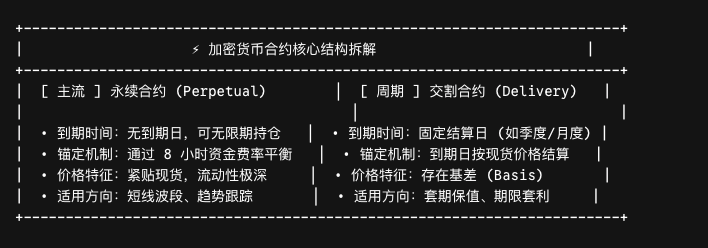
Futures contracts are mainly divided into the following two types:
Perpetual vs Delivery Futures: Key Differences
Perpetual Futures: Contracts Without an Expiration Date
Perpetual futures are currently the most heavily traded type of crypto futures and account for more than 90% of Bitcoin futures trading volume. Their defining feature is the absence of an expiration date. As long as the account has sufficient margin, a position can theoretically remain open indefinitely.
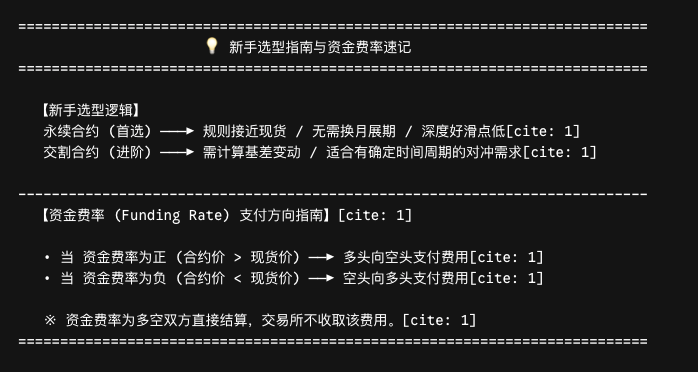
To keep perpetual futures prices close to the spot market, exchanges use a funding-rate mechanism. Funding is not a fee collected by the platform; it is a periodic payment exchanged between long and short traders:
When the futures price is above the spot price and sentiment is bullish, longs pay funding to shorts.
When the futures price is below the spot price and sentiment is bearish, shorts pay funding to longs.
Funding is commonly settled every eight hours, meaning that long-term positions may incur an ongoing holding cost or generate funding income.
Perpetual futures are suited to short-term trading, trend following, and strategies that enter and exit the market frequently. Because traders do not need to manage an expiration date, these contracts are flexible and are generally easier for beginners to understand.
Delivery Futures: Contracts With a Fixed Expiration Date
Delivery futures have a fixed expiration and settlement date. When the contract expires, every open position is automatically closed at the system's settlement price, regardless of whether it is profitable or unprofitable.
Major exchanges commonly offer weekly, biweekly, quarterly, and biquarterly delivery futures. For example, a quarterly contract may use the code BTCUSDT-25SEP26, indicating settlement on September 25, 2026.
Because delivery futures settle automatically at expiry, they do not depend on funding payments to keep prices anchored. However, the futures price may differ from the spot price. This difference is known as the basis, and the basis generally becomes larger as the delivery date moves farther into the future.
Delivery futures are suited to event-driven trades, such as positioning before a major announcement, hedging an existing position, and strategies with a clearly defined time horizon.
Comparison Overview
How Should Beginners Choose?
For investors encountering futures trading for the first time, perpetual futures are usually the more suitable choice for several reasons:
Simpler rules: there is no need to monitor settlement dates or roll contracts forward.
Deeper liquidity: higher trading volume generally means tighter bid-ask spreads and lower slippage risk.
Greater flexibility: positions can be opened or closed at any time without an expiry constraint.
Delivery futures involve concepts such as basis and contract rollover, creating a steeper learning curve for beginners.
Frequently Asked Questions (FAQ)
Q1: Which is more suitable for beginners, perpetual or delivery futures?
Perpetual futures. They have no expiration date, and their operating rules are closer to spot trading. Traders do not need to monitor settlement dates or contract rollovers. Delivery futures involve concepts such as basis and rollover, which makes them harder to learn.
Q2: What is the funding rate, and who pays whom?
Funding is a periodic payment between long and short traders that helps keep the perpetual futures price close to the spot market. When the funding rate is positive, longs pay shorts; when it is negative, shorts pay longs. The platform does not collect this payment—it is settled directly between traders.
Q3: Are delivery futures positions automatically closed at expiry?
Yes. On the settlement date, delivery futures positions are automatically closed at the system's settlement price, without requiring manual action. To maintain exposure after expiry, a trader must close the current contract and open a position in the next contract before settlement.
Related tutorials:
Lectura recomendada
Ver más

Service@hotcoin.com
Product@hotcoin.com
Business@hotcoin.com
Casecn@hotcoin.com