
Understanding Meme Coins: The Cultural Codes of DOGE, SHIB, and PEPE
Meme coins are cryptocurrencies that combine internet memes, community identity, and tradable assets. DOGE, SHIB, and PEPE represent three distinct paths: a native blockchain asset, an ecosystem token, and a culture-centered token.
All three attract attention through recognizable symbols that are easy to remix, but their on-chain structures differ. Community enthusiasm can accelerate their spread, yet it does not prove that a token is scarce, sufficiently liquid, or evenly distributed among holders.
Why Can Meme Coins Spread So Quickly?
Meme coins borrow an existing language of internet culture and let participants continuously reinterpret it through images, short phrases, usernames, and social interaction. The barrier to entry is low: people can join the conversation without understanding a complex protocol, while token ownership connects cultural participation with market outcomes.
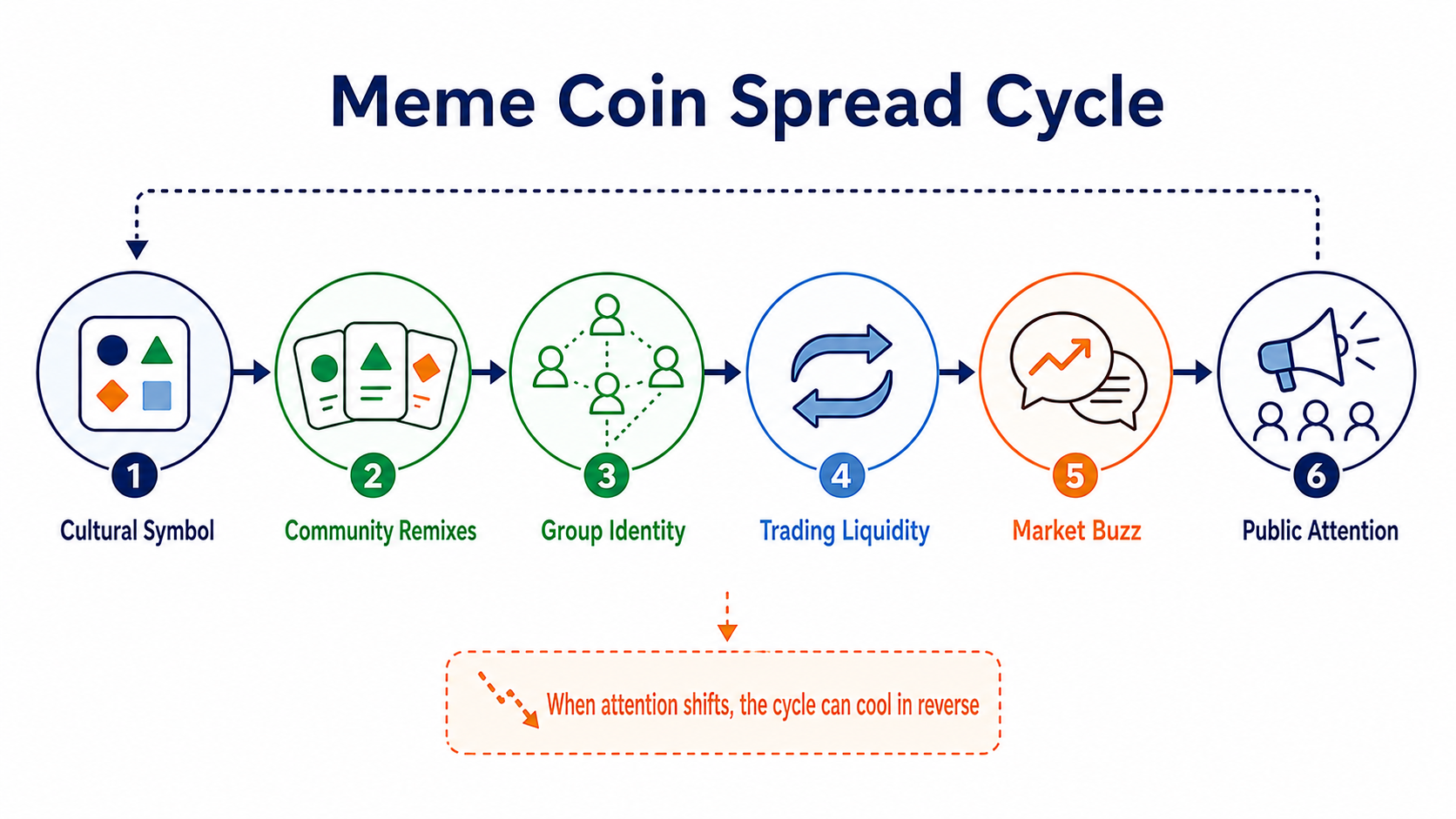
A typical spread cycle includes the following stages:
- The symbol is recognized quickly: Images such as Shiba Inu dogs and frogs already had audiences before the tokens appeared, so new projects do not need to explain their visual meaning from scratch.
- The community keeps creating remixes: Users circulate image templates, slogans, and jokes themselves, allowing discussion to extend beyond the reach of official accounts.
- Holding becomes an expression of identity: Some participants include token names in avatars, usernames, or community vocabulary, turning buying and selling into part of their group affiliation.
- Market data creates more content: Trading volume, price moves, and listing news generate new talking points, while greater exposure may attract more trading.
This cycle can also run in reverse. When attention shifts, liquidity declines, or large holders sell, community content may no longer absorb the selling pressure. Evaluating a meme coin requires more than counting posts and reposts; its issuance rules, ownership structure, and genuine use cases also matter.
DOGE: From an Internet Joke to an Independent Payment Network
Dogecoin was created by Billy Markus and Jackson Palmer and launched on December 6, 2013. Inspired by the Doge Shiba Inu meme, it was initially used for tipping in communities such as Reddit. Charity fundraisers also helped shape an accessible and friendly community culture.
DOGE is not a token deployed on another blockchain; it is the native asset of the Dogecoin network. The network uses proof of work, with miners producing blocks and maintaining the ledger. Beginning at block height 600,000, each block has issued a fixed 10,000 DOGE. Consequently, DOGE has no fixed maximum supply, and roughly 5 billion new coins are added each year.
A fixed annual addition is not the same as endlessly accelerating issuance. DOGE's absolute issuance rate remains stable under the protocol, although its total supply continues to grow. Its primary uses still center on transfers, payments, and community tipping, combining cultural reach and an independent network in the same asset.
SHIB: Expanding the Meme Narrative into a Multi-Token Ecosystem
SHIB launched in 2020 as an ERC-20 token on Ethereum, created by a pseudonymous figure known as Ryoshi. Although the project also uses Shiba Inu culture, its technical model differs from DOGE: SHIB does not secure Ethereum consensus. Transfers and smart contract execution depend on Ethereum, and users pay network fees in ETH.
SHIB began with a supply of 1 quadrillion tokens, after which a large number were sent to burn addresses. This enormous supply makes the price of a single token appear low, but unit price cannot be evaluated without considering circulating supply and market capitalization.
SHIB's reach no longer depends on a single token. Its ecosystem later added the ShibaSwap decentralized exchange, the Shibarium Ethereum Layer 2 network, and other assets such as BONE and LEASH. Two ideas must remain separate: ecosystem products can create more ways to participate, but product adoption does not guarantee that value will flow back to SHIB. Investors should check which token pays fees, who receives revenue, and which addresses hold governance power in each product.
PEPE: Using a Familiar Symbol to Shorten the Path to Recognition
PEPE launched in April 2023 as an ERC-20 token associated with Pepe the Frog, a cultural symbol that had already circulated widely online. It does not have its own blockchain; on-chain transfers depend on Ethereum and require ETH for Gas.
PEPE's initial total supply was 420.69 trillion tokens. At launch, about 93.1% entered a liquidity pool, with the project burning the corresponding liquidity provider tokens and renouncing contract ownership. The remaining roughly 6.9% was held in a multisignature wallet for exchange listings, bridges, and liquidity.
Fair-launch claims and culture-first distribution therefore became central to PEPE's narrative, but people still control the relevant addresses. In 2023, former team members transferred about 16 trillion PEPE from the multisignature wallet. The incident demonstrated that renouncing ownership of a smart contract restricts changes to its parameters but does not prevent existing token-holding addresses from transferring their balances.
Unlike SHIB, PEPE has not built its main narrative around a range of products. Consensus forms primarily around the symbol, community content, and market liquidity, while complex on-chain functionality is not presented as the project's core proposition. That makes PEPE easy to understand, but also more dependent on remaining part of the public conversation.
What Fundamentally Distinguishes DOGE, SHIB, and PEPE?
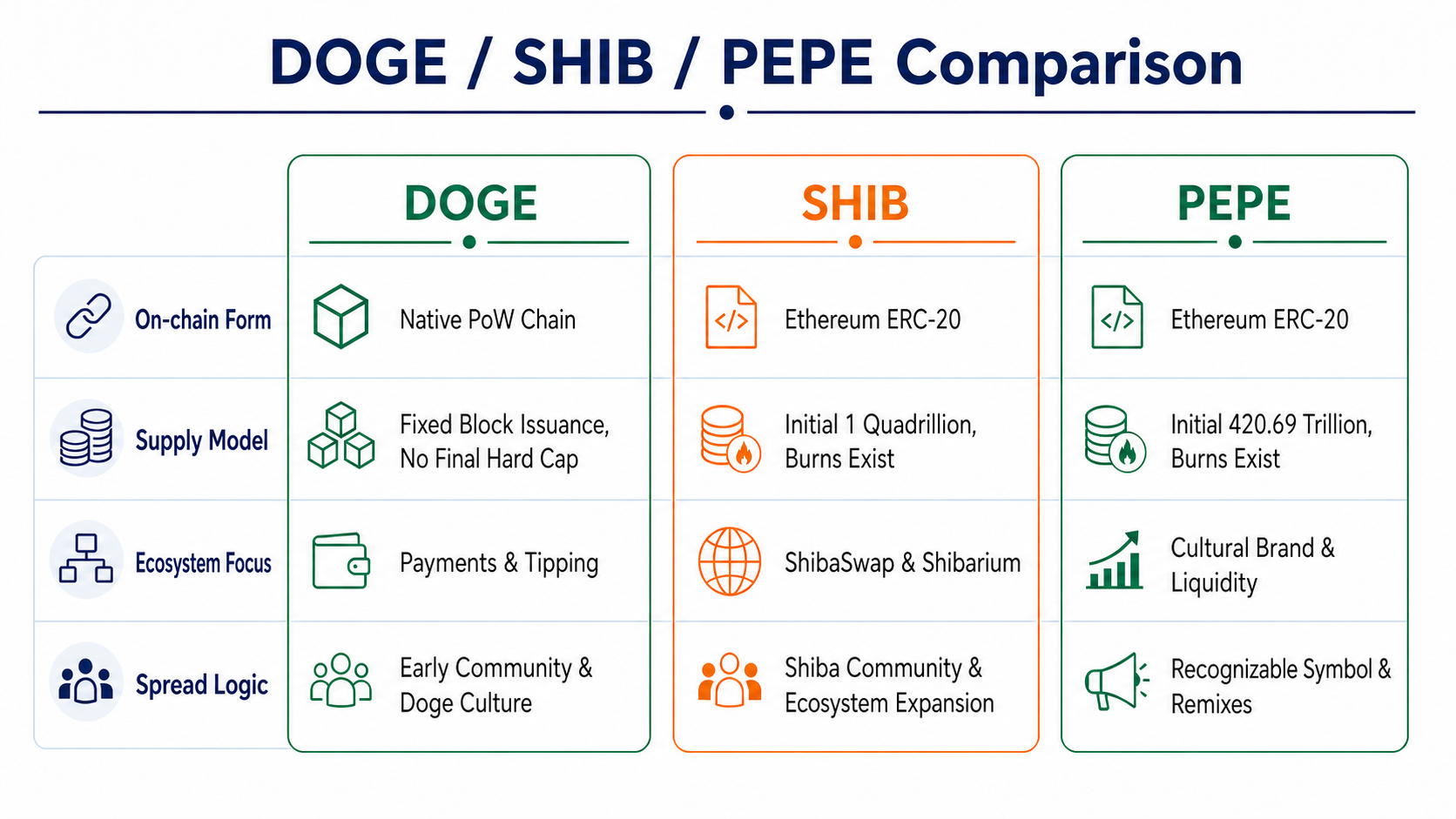
| Comparison | DOGE | SHIB | PEPE |
|---|---|---|---|
| Launch year | 2013 | 2020 | 2023 |
| On-chain form | Native coin of Dogecoin | Ethereum ERC-20 token | Ethereum ERC-20 token |
| Supply model | Fixed new issuance per block with no final hard cap | Initial supply of 1 quadrillion with token burns | Initial supply of 420.69 trillion, a fixed cap, and token burns |
| Ecosystem focus | Transfers, payments, tipping, and an independent node network | ShibaSwap, Shibarium, and a multi-token system | Cultural branding, community distribution, and market liquidity |
| Foundation for growth | Doge humor and early internet communities | Shiba Inu identity, community organization, and ecosystem expansion | The recognizable Pepe image and its remix potential |
| Main factors to monitor | Whether network use can keep pace with continuing issuance | Whether ecosystem activity creates genuine demand for SHIB | Lasting attention, ownership concentration, and multisignature wallet activity |
All three reduce the cost of communication through memes, but they differ in how their tokens connect with networks, products, and communities. For a broader taxonomy, read A Complete Guide to Cryptocurrency Categories. To continue with valuation and supply analysis, see A Beginner's Guide to Crypto Assets.
How Can You Analyze a Meme Coin's Culture and On-Chain Conditions?
Record the strength of its cultural reach separately from its asset structure. The following framework can help when cross-checking project materials, community posts, and blockchain explorers.
| Area to check | Question to answer | Common misconception |
|---|---|---|
| Cultural origin | Does the symbol already have an audience, and can the community keep producing new content? | Treating a single trending moment as evidence of a stable community |
| Supply mechanism | Can supply increase, and are there burns, unlocks, or team reserves? | Assuming a low unit price means a low valuation |
| Control permissions | Can the contract be paused, mint tokens, blacklist addresses, or change fees? | Interpreting “renounced ownership” as an absence of large holders |
| Holder distribution | After excluding exchanges, liquidity pools, and burn addresses, are balances concentrated? | Drawing conclusions directly from the top ten addresses on an explorer |
| Liquidity | Where is market depth located, and how much slippage would a large trade cause? | Looking only at trading volume instead of executable depth |
| Ecosystem links | Which assets actually pay application fees, govern the system, and fund rewards? | Assigning every ecosystem development to the value of one token |
Meme-driven distribution can explain where attention comes from, but it cannot independently establish a reasonable price. Market capitalization, fully diluted valuation, holder concentration, and executable liquidity still require separate analysis, and no single metric can predict the next social trend.
Frequently Asked Questions
Does a Larger Number of Holding Addresses Mean a Stronger Meme Coin Community?
Not necessarily. One person can control multiple addresses, an exchange wallet can represent many users, and airdrops can create numerous low-balance addresses. Active addresses, balance distribution, genuine interaction, and activity over time should be considered together.
Does a Token Burn Guarantee That the Price Will Rise?
No. A burn reduces supply under a particular definition, but price also depends on demand, liquidity, and the selling behavior of other holders. If the burned amount is small relative to circulating supply, its effect may also be limited.
Many Meme Coins Share the Same Name. How Can I Verify the Intended Asset?
Do not rely on the name, ticker, or icon alone. Cross-check the network, contract address, and decimal precision using official project materials and a reputable blockchain explorer, then confirm that the trading platform uses the same contract.
Does Holding a Meme Coin Grant Copyright to Its Associated Image or Character?
Usually not. Token ownership, smart contract rights, and copyright in a cultural image are separate matters. Unless a project provides explicit and valid licensing terms, holding the token does not automatically grant copyright or commercial-use rights to the character.
Lectura recomendada
Ver más
service hotcoin.com
producthotcoin.com
businesshotcoin.com
casecnhotcoin.com