
Hotcoin Research | From Play to Earn to Tap to Earn: Insights from Notcoin's Meteoric Rise and the Evolution of Blockchain Gaming Models
The explosive popularity of Notcoin has highlighted the vast potential of the Tap to Earn model. With simple tapping operations yielding in-game rewards, this easy and enjoyable way to earn has quickly gained traction, drawing significant user attention. As its market capitalization soars and trading volumes spike, the Tap to Earn model has emerged as a new favorite in blockchain gaming. How did the blockchain gaming model evolve from Play to Earn to X to Earn? What drives the success of Tap to Earn? Is this shift heralding a new trend in the blockchain gaming market? This article will explore the evolution from Play to Earn to Tap to Earn and analyze the implications of this transition.
I. What is Blockchain Gaming?
Blockchain gaming, also known as GameFi (Game Finance), involves integrating blockchain technology into games. By using smart contracts and decentralized technology, blockchain gaming puts game assets, rules, logic, and transactions on-chain, creating a decentralized, trustworthy, verifiable, and tradable gaming model. GameFi merges DeFi and NFTs, gamifying DeFi rules and turning game items and derivatives into NFTs, thus imbuing all in-game assets, items, and characters with uniqueness and collectibility.
GameFi represents not only the fusion of blockchain technology and the gaming industry but also a revolution in traditional gaming revenue models. By leveraging decentralization, transparency, and security, GameFi enhances the entertainment value of games and provides players with true digital ownership, allowing them to earn real economic benefits from virtual assets like tokens, items, and NFTs. This model disrupts the convention where game assets belong solely to the game developers, enabling players to achieve wealth through gaming.
II. How Does Blockchain Gaming Work?
Each GameFi project has its unique model and in-game economy, but most in-game assets are NFTs that can be traded directly on NFT marketplaces. These assets often provide players with benefits, allowing them to earn more rewards. For example, many assets can generate additional income by completing tasks, staking, or lending.
Specifically, GameFi operates through the following aspects:
In-Game Rewards: Players earn cryptocurrencies, virtual land, avatars, weapons, clothing, and other in-game assets through gameplay. These diverse rewards add to the game's fun and challenge.
Asset Trading: Most in-game assets are NFTs that can be traded directly on NFT marketplaces, allowing players to enjoy the game and earn actual profits through virtual asset transactions. In some projects, in-game assets need to be converted into NFTs before they can be sold or traded.
Tasks and Battles: Players can earn rewards by completing tasks, battling other players, or building monetized structures on their land. These activities enhance interaction and competition, allowing players to earn more through effort.
Staking and Lending: In some games, players can stake or lend their in-game assets to other players, earning passive income without actively playing. This increases the liquidity and earning potential of game assets.
Decentralized Governance: Some GameFi projects incorporate DAO (Decentralized Autonomous Organization) mechanisms, allowing players to participate in the game's development and decision-making through voting and governance, increasing their sense of involvement and belonging.
III. From Play to Earn to X to Earn
The Play to Earn model, exemplified by Axie Infinity, laid the foundation for blockchain gaming by enabling players to earn through gameplay. As projects like StepN popularized the Move to Earn model, the concept of X to Earn gradually evolved into a broad narrative space. These models share the common feature of rewarding players for participating in various activities, fostering the idea that "everything can be monetized."
Play to Earn (P2E)
Players earn cryptocurrency or NFT rewards by playing games, which can be sold on the market for real profits. For example, in Axie Infinity, players earn rewards through gameplay, which can be sold for actual returns. Early blockchain games mainly focused on attracting players through simple game mechanics. However, this model exposed issues such as lack of gameplay depth and unstable token economies. Over time, P2E games began incorporating more complex economic systems and diverse gameplay to increase appeal and sustainability. For instance, The Sandbox and Decentraland introduced virtual real estate and content creation mechanisms, allowing players to earn tokens through gaming and profit from creating and trading virtual assets.
Move to Earn (M2E)
Players earn in-game rewards by engaging in physical activities like walking or running. StepN, for example, rewards users with GST tokens for real-world movement tracked by the app and introduces an NFT shoe system where players can buy, upgrade, and trade NFT shoes. Essentially, M2E games are P2E games with the gameplay focusing on physical activity.
Watch to Earn (W2E)
Users earn rewards by watching various types of content, such as videos, ads, movie trailers, and promotional clips. Platforms like Cheelee pay users to watch content, leveraging the attention economy for profits.
Tap to Earn (T2E)
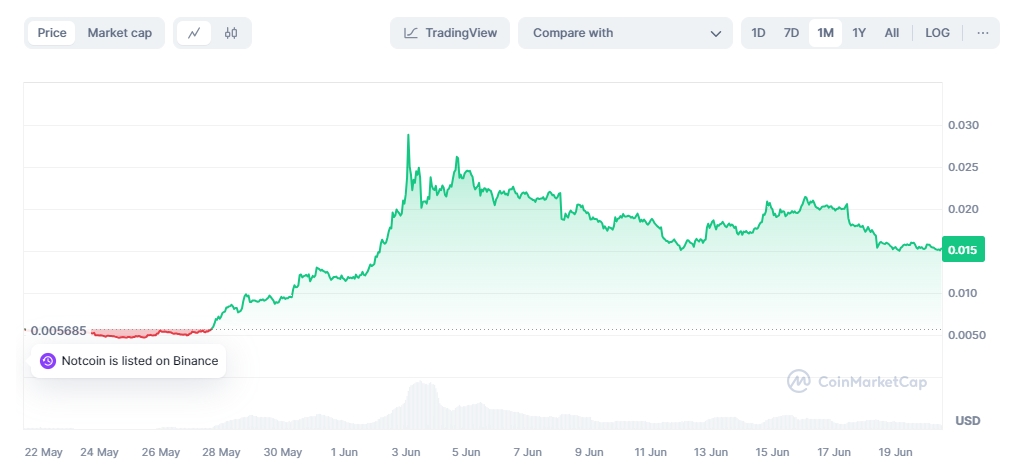
Players earn rewards through simple tapping operations. Notcoin, for example, allows users to earn tokens through tapping and includes social sharing and invitation reward mechanisms to enhance user engagement and virality. The T2E model quickly gained popularity due to its simplicity and ease of use, catering to light entertainment and quick feedback, making it ideal for short, casual play sessions. According to CMC data, as of June 20, Notcoin's market capitalization exceeded $1.6 billion, ranking 53rd, with a 24-hour trading volume of over $500 million, ranking 14th, making it one of the hottest blockchain games currently.
Other Notable Tap to Earn Games
Hamster Kombat: Players earn coins by tapping their screens, with coins expected to convert into tokens. The game's Twitter followers surged to 8.55 million, and its Telegram group reached 200,000 members within three months, showcasing T2E's powerful virality and appeal.
Catizen: Through a Telegram bot, players can merge two low-level cats into a higher-level one, attracting more guests to earn money by "petting cats." This simple and direct light gaming model has high virality.
Building on the Play to Earn economic model, various X to Earn models have emerged, encompassing all Web3 activities that generate revenue, such as Learn to Earn, Drive to Earn, Write to Earn, Sing to Earn, Sleep to Earn, and Eat to Earn. These models combine daily activities with blockchain economies to expand the application scope of X to Earn, exploring innovative and diverse forms.
IV. Why Has the Tap to Earn Model Exploded?
Notcoin's rise popularized the Tap to Earn model, an extension of the X to Earn model, which succeeded due to several factors:
Simple and Accessible Game Mechanics The core of Tap to Earn lies in its extremely simple operation. Players earn rewards by tapping the screen, without needing complex operations or strategies. This ease of use allows users to quickly gain feedback and rewards, significantly enhancing user engagement and stickiness.
Efficient User Growth and Spread Mechanism Notcoin's social sharing and invitation reward mechanisms greatly boosted user growth. Users earn extra rewards by sharing game links or inviting friends, increasing the game's exposure and enhancing user interaction and engagement. Active sharing and promotion by users enabled the game to attract a large number of new users rapidly, achieving exponential growth.
Instant Incentive Mechanism and Economic Returns The Tap to Earn model offers immediate economic returns, with players earning token rewards for each tap. This instant gratification significantly boosts user enthusiasm, enhancing satisfaction, retention, and activity levels.
Vast Potential User Base Due to its simple mechanics and minimal time investment, the Tap to Earn model appeals to a wide user base, including those unfamiliar with blockchain technology and complex game mechanics. Compared to other complex blockchain game models, Tap to Earn requires fewer resources and technical knowledge, making it accessible to most smartphone users and expanding its user base.
Innovation and Differentiation The Tap to Earn model stands out with its novelty and efficiency. While other blockchain game models explore complex game mechanics, Tap to Earn attracts attention with its minimal design and efficient reward mechanisms, filling a market gap for low-threshold, light entertainment blockchain games and meeting the needs of diverse user groups.
This indicates that mini-games and game bots can pave the way for broader Web3 applications. Unlike fully on-chain games or AAA games requiring extensive development cycles, these platforms prioritize agility and rapid deployment. This approach may more effectively attract and retain a large user base compared to pursuing complex yet less accessible gaming experiences.
V. Current Issues in Blockchain Gaming Models
While Tap to Earn has quickly risen due to its simplicity, it also highlights several issues in current blockchain gaming models:
Lack of Gameplay Depth Many blockchain games, especially early Play to Earn models, focused too much on economic returns and neglected gameplay quality, resulting in poorly made and unengaging games. Initial enthusiasm wanes as users lose interest due to a lack of depth and challenge. While popular initially for token rewards, these games struggle with long-term user retention.
Unstable Economic Models Poorly designed economic models can cause significant token price volatility and even a "death spiral," affecting user profit expectations and confidence. For example, after Axie Infinity's token price plummeted over 90%, user growth continued, but market confidence was severely shaken.
Homogeneity Many blockchain games lack innovation and overly imitate successful projects, leading to a market flooded with similar games. For instance, numerous projects tried to replicate Axie Infinity's success without significant differences in game mechanics, graphics, or user experience, failing to attract long-term users.
Balancing Gameplay and Economic Returns Ensuring engaging gameplay while achieving economic returns is a challenge for blockchain game developers. Overemphasizing economic returns can undermine gameplay, affecting user experience and retention.
User Acquisition and Retention Challenges While blockchain games can attract users through aggressive marketing and high rewards initially, long-term retention remains difficult. Users may lose interest after completing initial tasks and earning rewards due to a lack of novelty and challenges. Many projects rely on heavy spending and rewards for early user acquisition but struggle with sustainable engagement.
VI. Future Trends in Blockchain Gaming Models
Diversified X to Earn Models X to Earn models will continue to expand, encompassing more innovative formats beyond Play to Earn, Move to Earn, and Tap to Earn. These new models will enrich blockchain gaming applications, attracting users with various interests and needs. Additionally, traditional Web2 enterprises will leverage their resources and advantages, combining X to Earn models to drive product iterations and user growth, fostering the integration of Web2 and Web3.
Integration of New Technologies As blockchain technology advances, blockchain games will integrate more emerging technologies like virtual reality (VR), augmented reality (AR), and artificial intelligence (AI), offering more immersive and intelligent gaming experiences. Future blockchain games may use VR to create virtual worlds and AI for intelligent NPC interactions, enhancing immersion and interactivity.
Innovation and Differentiation Blockchain gaming projects need to continuously innovate in gameplay and economic models and use differentiation strategies to stand out. Introducing new game mechanics, increasing social interaction features, and developing unique economic systems can enhance game appeal and user stickiness. Designing different gaming experiences and reward mechanisms for various user groups can meet diverse user needs.
User Experience Optimization Improving user experience through enhanced game graphics, smoother operations, and increased content. Continuously refining core gameplay and user interfaces can boost user satisfaction and retention. Blockchain gaming projects can gather user feedback and suggestions through community building and research, making timely adjustments and improvements to game content.
Community Building and Governance Building and maintaining active game communities can enhance user stickiness and engagement. Hosting online and offline events, creating social platforms, and providing spaces for user interaction can foster player interaction and communication. Introducing DAO and voting mechanisms allows players to participate in game development and decision-making, increasing user enthusiasm and loyalty.
Sustainable Development Blockchain gaming projects need to focus on sustainable development by designing reasonable economic models and ecosystems to ensure long-term stability. Continuous innovation, user feedback, and community building will help optimize games and economic systems, achieving positive cycles and sustainable growth.
In conclusion, the success of the Tap to Earn model not only demonstrates the potential of blockchain gaming but also highlights several issues in current blockchain gaming model development. By enhancing gameplay, optimizing economic models, strengthening user acquisition and retention strategies, addressing regulatory risks, and improving security and privacy protection, blockchain gaming projects can better meet challenges and achieve sustainable development. With the integration of new technologies, the expansion of diverse X to Earn models, ecosystem building, and participation from traditional enterprises, we can expect more possibilities in the blockchain gaming model's future.
About Us
Hotcoin Research, as the core investment research department of Hotcoin, is dedicated to providing comprehensive and professional analysis of the crypto market. Our goal is to offer clear market insights and practical operational guidance for investors at all levels. Our professional content includes "Play to Earn Web3" tutorial series, in-depth analysis of crypto market trends, detailed analysis of potential projects, and real-time market observations. Whether you are a newcomer exploring the crypto world or a seasoned investor seeking deep insights, Hotcoin is your reliable partner for understanding and seizing market opportunities.
Risk Disclaimer
The crypto market is highly volatile, and investment involves risks. We strongly advise investors to fully understand these risks and operate within a strict risk management framework to ensure the safety of their funds.
Website:https://www.hotcoin.com/
X:x.com/HotcoinAcademy
Mail:labs@hotcoin.com
Medium:medium.com/@hotcoinglobalofficial
Lectura recomendada
Ver más



Service@hotcoin.com
Product@hotcoin.com
Business@hotcoin.com
Casecn@hotcoin.com