
Exchange Token Value Analysis: BNB/KCS/GT/HT Compared
BNB, KCS, and GT still have utility on trading platforms or public blockchains, while HT's platform benefits have migrated to HTX. The four assets cannot be ranked simply by fee discounts, burn volume, or historical price.
An exchange token derives value from the connection between usable functions and demand for the token. Analysis should separate trading-platform benefits, public-chain utility, supply changes, and control over the rules. For an overview of where exchange tokens fit among crypto assets, return to the Beginner's Guide to Crypto Assets.
Where Does an Exchange Token's Value Come From?
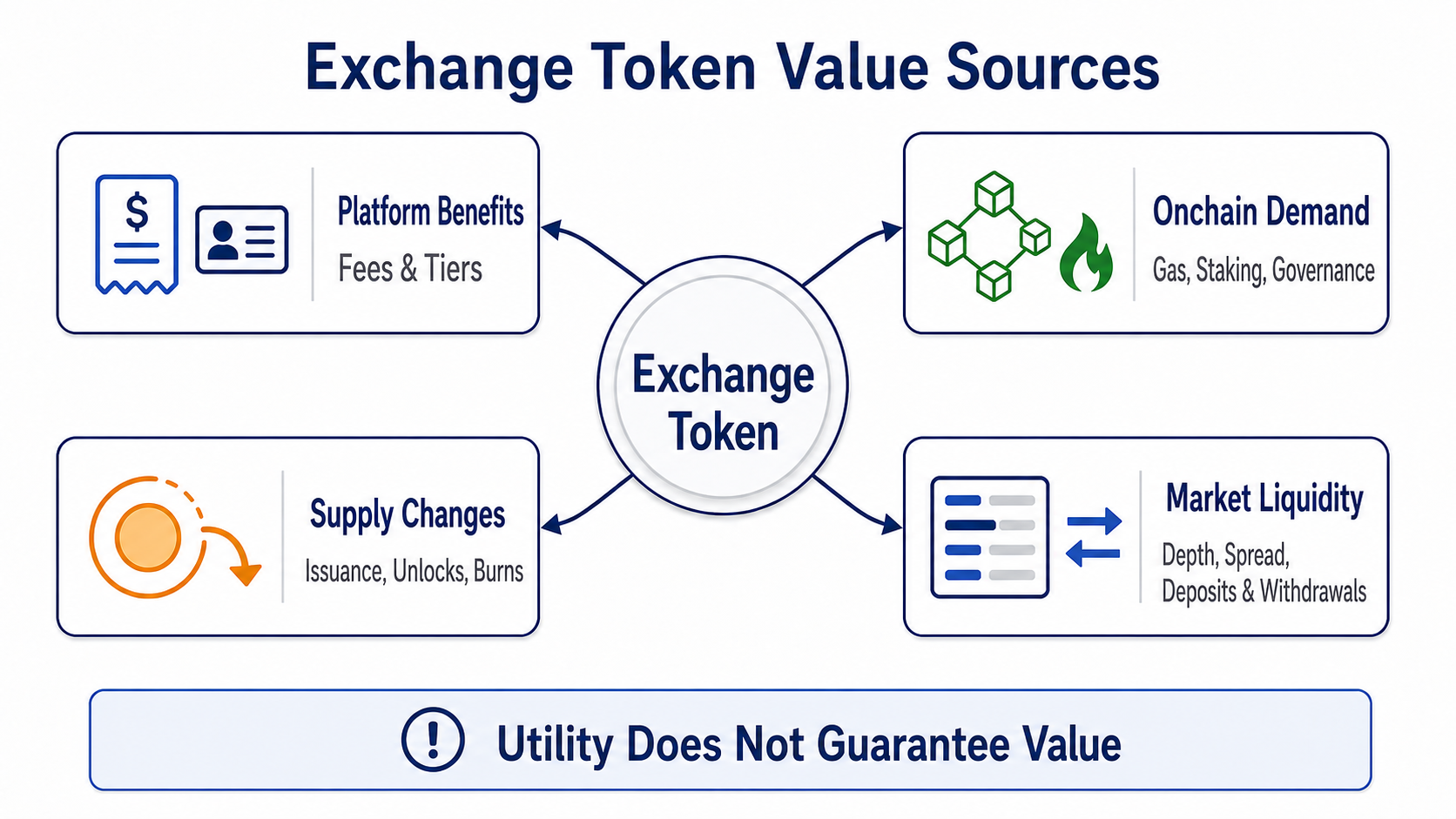
Exchange tokens often combine centralized-platform benefits with on-chain utility in one asset. Trading-fee deductions and membership tiers are enforced by a platform's account system, while gas, staking, and on-chain governance are enforced by blockchain protocols. These two sources of demand persist under different conditions and should not be merged into a single category.
The common sources of value can be divided into four groups:
| Source | How the token is used | Evidence to verify |
|---|---|---|
| Platform benefits | Deduct fees, determine tiers, or qualify for specific programs | Current fee pages, program rules, eligible regions, and account requirements |
| On-chain resources | Pay gas, stake, delegate, or participate in governance | Mainnet documentation, contracts, validator rules, and on-chain transactions |
| Supply management | Conduct periodic burns or reduce supply under a formula | Burn addresses, transaction hashes, concurrent issuance, and unlocks |
| Market liquidity | Enable trading and collateral use across multiple venues | Order-book depth, trading-pair distribution, and deposit and withdrawal networks |
A burn is only a supply-side event. If tokens are being unlocked or issued at the same time, or if demand for the token's utility is declining, one burn does not independently prove that value has increased. Fee discounts must also be assessed against actual trading volume: the fees saved may be smaller than the price volatility of the tokens held.
How Do BNB, KCS, GT, and HT Differ Today?
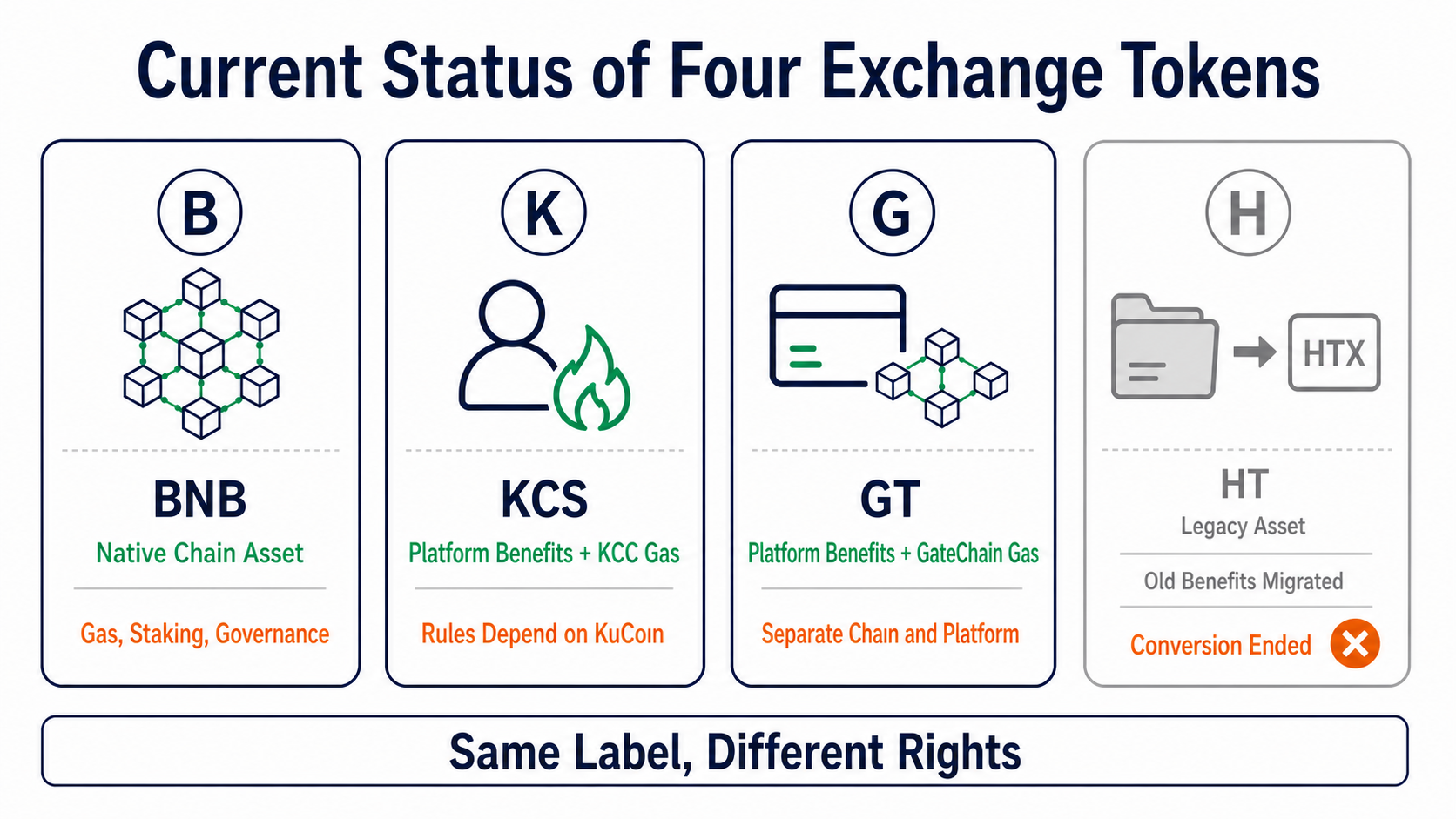
As of 2026, BNB, KCS, GT, and HT are no longer in the same position. BNB, KCS, and GT connect their respective trading platforms with on-chain ecosystems. HT is a legacy token whose former platform benefits have ended and migrated to the HTX DAO token, HTX.
| Asset | Current primary identity | Verifiable on-chain utility | Platform relationship | Status assessment |
|---|---|---|---|---|
| BNB | Native coin of BNB Chain and an ecosystem asset | Gas, staking, validation, and on-chain governance on BSC and related networks | Has historical and product ties to the Binance ecosystem, but its on-chain utility can be observed independently | Should not be valued solely as an exchange token |
| KCS | KuCoin platform token and KCC gas asset | KCC gas, on-chain staking, and ecosystem applications | Fee benefits, memberships, and program rules depend on KuCoin | Both platform demand and KCC activity must be checked |
| GT | Gate utility token and GateChain native asset | GateChain gas, staking, and network security | Fee payment, VIP status, and program eligibility are determined by Gate's rules | On-chain use and platform benefits must be verified separately |
| HT | Legacy Huobi Token asset | Current value cannot be inferred from former platform benefits | HTX has ended HT spot trading and migrated holder benefits | Should be studied as a legacy asset after migration, not as a current exchange token |
This table compares functional structures; it is not a ranking of price, return, or platform safety. Platform products can also change by account tier, region, and date, so users must still review the current rules.
Why Is BNB No Longer Just a Fee-Discount Token?
BNB's core demand has expanded to BNB Chain. Users pay gas on BNB Smart Chain, while validators and delegators stake BNB to participate in network security, and staking credentials can also be used in on-chain governance. BNB is used to settle fees or resources on networks such as opBNB and Greenfield, so its demand does not come solely from a centralized trading platform.
On the supply side, BNB uses quarterly Auto-Burns and real-time burning of a portion of gas fees. Auto-Burn follows a public formula, with a long-term goal of reducing total supply to 100 million tokens. Research should examine each on-chain burn and the remaining supply rather than treat the dollar value of a burn as money entering the market.
BNB analysis should focus on whether on-chain activity creates sustained demand for gas and staking, how concentrated validation and governance are, and whether events involving Binance-related platforms affect market liquidity. A broader public-chain role adds utility, but it also introduces more variables that must be verified separately.
How Do KCS Platform Benefits Connect to KCC Utility?
KCS can be used within KuCoin's account system to pay certain trading fees and can be linked to membership, staking, or platform programs. On KCC, KCS is the native gas asset. Platform benefits are determined by KuCoin's product rules, while on-chain utility depends on KCC users, applications, and transaction activity.
KCS follows a periodic buyback-and-burn arrangement. Its official objective is to reduce the original supply of 200 million tokens gradually to 100 million. To assess actual supply changes, monthly burns, circulating supply, and the portion that has not yet been released must be placed on the same timeline. Citing a single burn period omits supply definitions and the release schedule.
KCS fee benefits do not apply unconditionally to every trade. Whether an account has enabled KCS fee payments, where the assets are held, the trading product, and the fee tier can all affect the actual result. Dividend claims, discount rates, or participation thresholds in old articles should not be treated as current promises.
How Does GT's Platform Utility Differ From Its Role as a GateChain Native Asset?
Within Gate's account system, GT can be used for fee payments, VIP tiers, and specific programs. It also provides gas and staking functions on GateChain. Platform benefits depend on Gate's product terms, whereas GateChain transfers, validation, and staking can be observed through on-chain rules.
GT uses an ongoing burn mechanism, and official quarterly burn transactions are published. In addition to verifying the burn address, analysts must check the starting point used in the statistics. Some materials calculate the cumulative reduction from the original issuance of 1 billion tokens, while other announcements start from an adjusted supply of 300 million. Percentages using these two bases cannot be combined directly in one table.
GT's value cannot be assessed from Gate's trading volume alone. Analysts also need to determine how much demand comes from on-chain gas and staking and how much comes from platform tiers or programs. If most demand is created by account rules that can be changed at any time, rule changes are part of the valuation conditions.
Is HT Still HTX's Exchange Token?
No. HTX ended HT spot trading in January 2024, and HT's former fee, membership-tier, and other holding benefits subsequently migrated to the HTX DAO token, HTX. The platform's HT-to-HTX conversion service ended on January 20, 2025, so in 2026 HT cannot still be described as a token with current HTX platform benefits.
HT and HTX are not simply the same token under a new name. The conversion was a voluntary migration arrangement with separate conversion ratios, unlocks, and claim rules. Users who completed the conversion hold HTX. Any HT still visible off-chain or in other markets must be assessed as a legacy asset by checking its contract, liquidity, and available services; users cannot assume that the platform still offers conversion.
Therefore, placing HT alongside BNB, KCS, and GT in a ranking of current benefits creates a structural error. A more useful comparison retains HT as a migration case that shows why an old valuation framework can fail when an exchange token's rules, liquidity, and identity change.
How Should Exchange Token Value Be Compared?
When comparing exchange tokens, first determine whether each source of demand requires the token, then identify who controls the return or benefit. The following five-step framework is easier to verify than directly comparing prices, burn volumes, or exchange rankings.
Step 1: Separate Platform Benefits From On-Chain Utility
Record gas, staking, governance, fee payments, and program eligibility separately. If a function works only in a platform database, list the platform rules and regional restrictions as prerequisites. If it occurs on-chain, check the contracts and mainnet data.
Step 2: Calculate the Actual Use Value of Benefits
Fee benefits should be calculated from a user's real trading volume, fee tier, and token-holding cost. If the value of tokens held to receive a discount is much greater than the fees saved, the discount alone cannot explain demand for holding the token.
Step 3: Reconstruct Net Supply Changes
Use consistent definitions to organize starting supply, issuance, unlocks, buybacks, and burns. Total supply and circulating supply should be calculated separately:
Ending total supply = starting total supply + new issuance - verified burns
Ending circulating supply = starting circulating supply + issuance and unlocks entering circulation - burned circulating tokens
An unlock usually changes tokens from non-circulating to circulating and does not necessarily change total supply. A buyback reduces supply only if the tokens are subsequently burned.
Step 4: Identify Controllers and Paths for Rule Changes
List who can change fee discounts, program eligibility, burn policies, contract permissions, and mainnet parameters. On-chain governance, platform announcements, multisignature control, and company decisions provide different levels of transparency. A token advertised as having governance utility does not mean holders can decide every part of the platform's business.
Step 5: Check Exit and Replacement Paths
Verify major trading pairs, deposit and withdrawal networks, cross-chain versions, and the distribution of liquidity. HT's migration shows that a platform may stop trading an old token or transfer its benefits to a new one. Token replacements, contract migrations, and delisting dates can all change the original demand.
Which Metrics Cannot Directly Value an Exchange Token?
Platform trading volume, burn value, market capitalization, and holder count all provide information, but none can independently establish intrinsic value. Trading volume may be affected by statistical definitions and market-making activity. Burn value is often converted using the token price at the time and does not mean the platform distributed an equal amount of cash to holders. Market capitalization also does not mean all tokens can exit at the displayed price.
Exchange tokens are generally not shares in the companies operating trading platforms. Holding BNB, KCS, GT, or HTX does not automatically confer equity, debt, statutory dividend rights, or claims in liquidation. If a benefit is funded by platform revenue, confirm the rules, claim requirements, and whether those rules can change rather than applying a stock price-to-earnings ratio.
To compare the reserve disclosures, fees, products, and regional availability of trading platforms themselves, continue with the Comparison of Major Cryptocurrency Exchanges. Platform analysis and token analysis are related, but they are not the same task.
Frequently Asked Questions
Does a Burn Always Increase Each Holder's Ownership Share?
It depends on which tokens are burned and on simultaneous supply changes. If the burned tokens came from inventory that was not circulating, a holder's share of circulating supply may not change. If issuance or unlocks occur at the same time, the net change must also be recalculated.
Is BNB Still an ERC-20 Token?
BNB was initially issued on Ethereum and later migrated to become a native BNB Chain asset. When selecting a deposit or withdrawal network, follow the networks and address requirements currently supported by the platform rather than relying on early ERC-20 information.
Can KCS and GT Be Used in Self-Custody Wallets?
Yes, but users must confirm the specific network and token version. Whether assets in a self-custody address qualify for platform-account benefits depends on whether the platform recognizes on-chain holdings and on the current program rules; a wallet balance alone is not enough to infer eligibility.
Does an On-Chain Token Disappear Automatically After a Platform Ends Its Old Benefits?
No. The token contract and balances in user addresses may remain on-chain, while a trading platform's support for deposits, trading, withdrawals, or migration follows a separate set of rules. Seeing an on-chain balance does not mean the former platform benefits are still active.
Lectura recomendada
Ver más


Service@hotcoin.com
Product@hotcoin.com
Business@hotcoin.com
Casecn@hotcoin.com