
Bitcoin's New Ecosystem Narrative: Ordinals, BRC-20, and Runes
Ordinals, BRC-20, and Runes are three metaprotocols built on Bitcoin transactions and the UTXO model. They are used to track satoshis, create inscriptions, and issue fungible tokens.
Ordinals first gives every satoshi a trackable serial number and makes it possible to inscribe images, text, and other content onto a particular satoshi. BRC-20 then uses JSON inscriptions to represent deployment, minting, and transfer operations, with indexers calculating token balances. Runes takes an approach closer to the UTXO model by encoding issuance and transfer instructions in transactions.
None of these protocols turns Bitcoin into an Ethereum-style smart contract platform, nor are their tokens recognized natively by Bitcoin consensus rules. Bitcoin nodes mainly verify whether transactions, scripts, and UTXOs are valid. The asset meaning of Ordinals, BRC-20, and Runes is interpreted by compatible clients, indexers, wallets, and markets according to additional rules.
To place Bitcoin's new ecosystem narrative alongside AI, DePIN, modular blockchains, parallel EVMs, and zero-knowledge proofs, read The 2025 Web3 Frontier Landscape.
Why Did New Asset Narratives Emerge on Bitcoin?
Bitcoin was originally designed as peer-to-peer electronic cash. Its base ledger records the creation and spending of UTXOs, while its scripting system verifies spending conditions. For many years, Bitcoin applications focused primarily on payments, store-of-value use, multisignature arrangements, and timelocks.
SegWit separated signatures and other witness data from the traditional transaction structure and changed how block weight is calculated. Taproot introduced more flexible script commitments and witness paths. Ordinals developers used these existing rules to place content in Taproot witness data and track the satoshis carrying that content with an off-chain numbering theory.
This approach did not require a Bitcoin soft fork to add a token standard. Instead, it used already valid transaction formats to establish a metaprotocol. Anyone can write, read, and index data according to the rules, enabling on-chain collectibles, BRC-20, Runes, rare sats, domain names, and application tools.
Technical feasibility does not mean that every participant agrees with this use of Bitcoin. Supporters argue that users pay fees for block space, broadening Bitcoin's utility and miner revenue. Critics worry that non-payment data increases fees, storage requirements, and the burden of managing the UTXO set. Both views are part of Bitcoin's long-running governance debate.
What Should You Know Before Learning About Ordinals?
2.1 What Is a Satoshi?
A satoshi, or sat, is the smallest unit of Bitcoin: 1 BTC equals 100 million sats. Bitcoin consensus generally cares only about how many sats a UTXO contains and does not store a separate identity label for every sat.
Ordinal Theory assigns serial numbers to sats on top of the consensus rules. Numbers are created according to the order in which sats are mined, and deterministic rules then track how sats in transaction inputs flow into outputs. If different indexers follow the same rules, they can reach a consistent interpretation of a sat's historical position.
2.2 What Is a UTXO?
A UTXO is an unspent transaction output. The balance shown by a wallet is usually the sum of multiple UTXOs. When a user sends a transaction, the wallet selects one or more UTXOs as inputs and creates recipient and change outputs.
Ordinals assets reside in specific UTXOs. Input order, output order, and amounts can all affect where an inscribed sat goes. A wallet without Coin Control may treat a UTXO containing an inscription as ordinary BTC and spend it accidentally, causing the asset to be transferred away.
For more background, read What Is Bitcoin? A Guide to BTC's Principles and Value.
How Does Ordinals Number Every Satoshi?
Ordinal Theory assigns consecutive numbers according to the order in which sats are mined. New sats are created through block subsidies and enter the output of a miner's coinbase transaction. In ordinary transactions, sats from the inputs flow to outputs in a defined order, while the fee portion joins the fees claimable by the miner.
This is a deterministic indexing rule, not a new field added to Bitcoin Core's consensus database. An ordinary Bitcoin node cannot answer, “What is this sat's ordinal number?” A user needs an Ordinals indexer or a compatible service to query it.
Ordinals also classifies sat rarity using block cycles, difficulty adjustments, halvings, and positions within blocks. Rarity is a collectible category defined by Ordinal Theory. It does not give the corresponding sat additional rights under Bitcoin consensus or guarantee any market value.
What Is a Bitcoin Inscription?
Inscription is the process of associating content with a sat. The content can be an image, text, audio, code, or another file type. The Ordinals protocol places the content type and data in the witness of a Taproot script path. Indexers recognize a particular envelope format and bind the content to the inscribed sat.
Inscribing usually involves Commit and Reveal stages. The Commit transaction first creates a Taproot output containing a script commitment. The Reveal transaction spends that output and publishes the inscription content in its witness. The user pays miner fees for both transactions, the data size, and the prevailing fee rate.
Inscription content becomes part of Bitcoin's transaction history and is propagated and validated with blocks. However, “permanent storage” still depends on node software, pruning settings, indexing services, and future protocol policies. Lightweight wallets generally do not store or parse all inscription data themselves.
How Do Ordinals NFTs Differ From Traditional NFTs?
An Ethereum NFT is usually managed by a smart contract that records its token ID, owner, approvals, and metadata URI. Its image or metadata may be stored on IPFS, Arweave, or a centralized server, although fully on-chain storage is also possible.
An Ordinals inscription is associated directly with a sat, and ownership moves with the UTXO carrying that sat. There is no uniform smart contract that manages collection permissions, royalties, and approvals. Markets, wallets, and indexers must understand satpoints, output positions, and inscription order.
“Bitcoin NFT” is a convenient market label; it does not mean that Ordinals duplicates conventional NFT standards. Before buying, users should verify whether the content is fully on-chain, the collection's origin, parent-child relationships, inscription number, rare-sat attributes, and the market's verification method.
For more about collectibles, wallets, and marketplace operations, read Bitcoin NFTs: The Ordinals and BRC-20 Inscription Ecosystem.
What Is BRC-20?
BRC-20 is an experimental metaprotocol that uses Ordinals JSON inscriptions to represent fungible-token operations. Its name was inspired by ERC-20, but the two have completely different technical foundations. ERC-20 balances and transfer logic are executed by EVM smart contracts, while BRC-20 balances are calculated by indexers that read inscription history.
BRC-20 initially defined three operations: Deploy, Mint, and Transfer. A Deploy inscription sets a four-character ticker, maximum supply, and per-mint limit. A Mint inscription increases the holder's balance within those rules. A Transfer inscription converts a quantity from available balance into transferable balance, after which a later Bitcoin transaction sends it to the recipient.
Bitcoin nodes verify only whether the transactions containing these inscriptions comply with consensus. They do not check whether a ticker is duplicated, whether a mint exceeds its cap, or whether a sender has enough BRC-20 balance. Those judgments depend on indexers applying the BRC-20 rules.
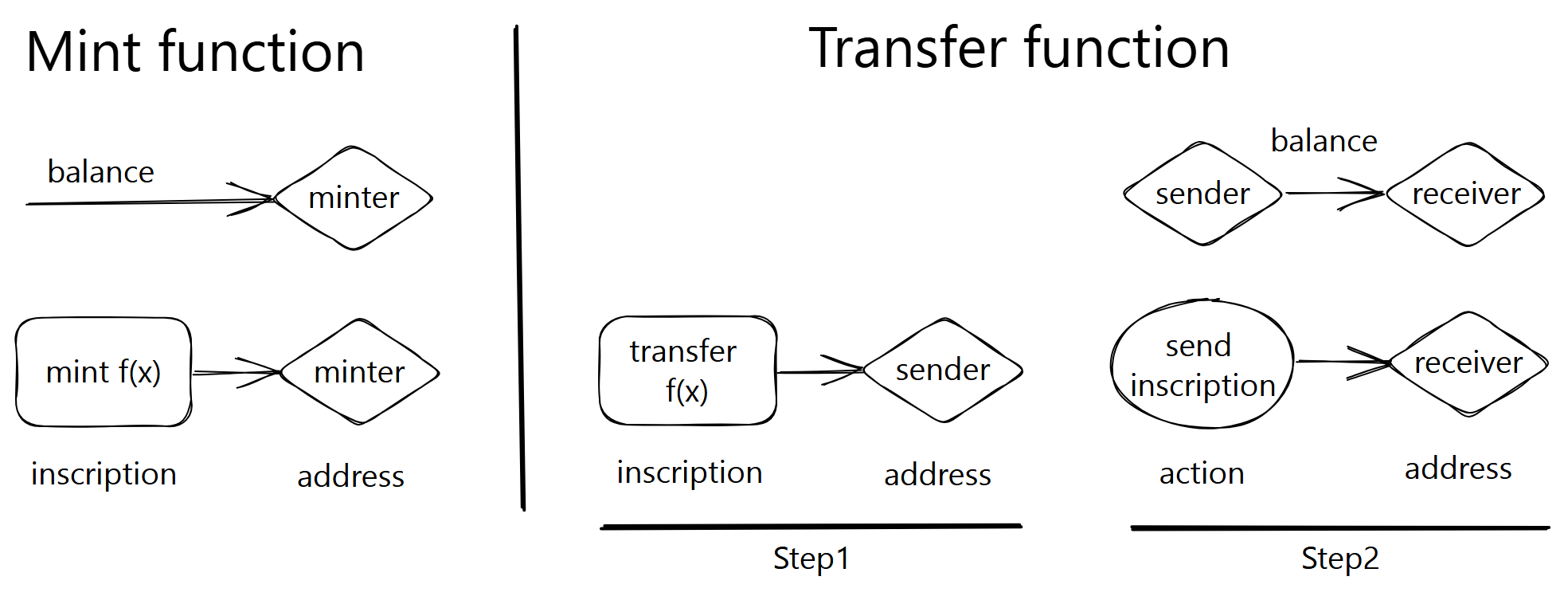
Why Does BRC-20 Depend on Indexers?
A BRC-20 balance is not a native field in a Bitcoin UTXO. An indexer must scan relevant inscriptions in sequence from the protocol's activation point, determine formatting validity, deployment precedence, mint limits, transfer inscriptions, and actual UTXO spends, and finally reconstruct the available balance of every address.
If two indexers use different versions, parsing boundaries, or error-handling rules, they may produce different results for the same operation. Mature services generally coordinate around rule updates, unusual inscriptions, and historical replays, but this is social and software coordination rather than an automatic ruling by Bitcoin consensus.
Users should verify that their wallet, marketplace, trading platform, and block explorer follow compatible indexing rules. A balance displayed on one platform is not guaranteed to be recognized immediately by another. Protocol upgrades and indexing outages can also affect deposits, withdrawals, and trading.
What Is the Runes Protocol?
Runes is a Bitcoin fungible-token metaprotocol proposed by the creator of Ordinals. It is also built on Bitcoin transactions, but instead of using JSON inscriptions to record balances, it uses Runestone messages in transactions to describe token creation, minting, and transfers.
A Runestone is generally placed in a provably unspendable OP_RETURN output and uses compact integer encoding for protocol instructions. The protocol identifies assets by Rune ID and assigns balances directly to transaction outputs, making token movement more closely aligned with Bitcoin's UTXO model.
Runes activated around Bitcoin block 840,000, at the same height as the 2024 halving. The activation point is part of the protocol rules, but market interest, token counts, and prices continue to change, so static rankings are not a sound basis for valuation.
How Are Runes Created, Minted, and Transferred?
9.1 Etching: Creating a Rune
Etching defines a new Rune. Its creator may set a name, symbol, divisibility, premine amount, and public minting terms. Those terms can limit the amount per mint, total number of mints, and the opening and closing blocks.
Name availability is governed by protocol reservations and a gradual unlocking schedule. Similar characters, spacers, and display styles can create confusion. Users should not identify an asset by its interface name alone; they should verify its Rune ID and etching transaction.
9.2 Mint: Issuing Under Defined Terms
If a Rune is open for minting, a transaction can reference its Rune ID and receive an amount under the terms set by the etching. Indexers check block height, mint count limits, and the minting terms. An operation outside those conditions does not create a valid balance.
Public mints may lead to intense fee competition. Even when a transaction confirms, the user should confirm that the protocol-level operation met all applicable rules. Bitcoin transaction confirmation does not necessarily mean that a Rune mint succeeded.
9.3 Edict: Assigning Balances to Outputs
An Edict instruction assigns Rune balances from the inputs to one or more outputs. Unallocated balances follow the Pointer or default-output rules. A wallet must construct BTC amounts, Rune allocations, and change at the same time. An incorrect output order may misdirect or destroy tokens.
A malformed Runestone may be interpreted as a Cenotaph. Under the protocol rules, some operations may be ignored or associated Rune balances burned, usually irreversibly. Extra care is essential when constructing transactions manually.
What Is the Difference Between BRC-20 and Runes?
First, they represent data differently. BRC-20 uses Ordinals JSON inscriptions, while Runes uses compact Runestone protocol messages. Runestones generally reduce redundant text, although the exact transaction size depends on the numbers of inputs, outputs, and operations.
Second, their balance models differ. BRC-20 indexers maintain account-like available and transferable balances. Runes assigns token balances to UTXO outputs, closer to the way assets move natively on Bitcoin.
Third, their transfer processes differ. BRC-20 usually requires a user to create a Transfer inscription and then spend the UTXO carrying that inscription. Runes can allocate incoming Rune balances through Edicts in one transaction.
Fourth, their protocol rules differ. Rules for tickers, supply, minting, fair launches, and malformed transactions are not interchangeable. A wallet that supports BRC-20 does not automatically support Runes, and its receiving-address and Coin Control requirements may differ.
Fifth, both rely on additional indexing. Bitcoin Core does not maintain BRC-20 or Rune balances, so users still depend on compatible clients, indexers, and wallets to interpret metaprotocol state.
Sixth, neither is a smart contract platform. They are designed for issuing and transferring fungible assets, while more complex DeFi logic usually requires additional protocols, off-chain matching, PSBTs, atomic swaps, sidechains, or Layer 2 systems.
The Shared Security Boundaries of Ordinals, BRC-20, and Runes
11.1 What Does Bitcoin Secure?
Bitcoin consensus secures valid transaction ordering, proof of work, and prevention of UTXO double-spends. Once an asset operation has enough block confirmations, its underlying transaction benefits from Bitcoin's confirmation security.
Bitcoin does not verify whether a collection is authentic, whether a BRC-20 balance is correct, or whether a Rune has market value. Nor does it guarantee that an indexer, wallet, market, or bridge is free of vulnerabilities. A valid base-layer transaction and a correct higher-layer asset interpretation are separate matters.
11.2 What Do Indexers Secure?
Indexers interpret ordinary transactions as inscription, BRC-20, or Rune state. They must correctly handle chain reorganizations, transaction ordering, malformed data, protocol versions, and historical replays. Indexing errors can produce inconsistent balance displays or force platforms to suspend services.
11.3 What Do Wallets Secure?
Wallets select UTXOs, construct outputs, estimate fee rates, and protect private keys. A compatible wallet should identify inscribed sats and token-bearing UTXOs so that it does not spend them as ordinary change. Users must still verify the address, asset type, and transaction preview.
What Has Bitcoin's New Ecosystem Narrative Introduced?
First, block space gained more uses. In addition to BTC transfers, users now compete for block space to create digital collectibles, issue tokens, and publish protocol messages, producing additional demand for miner fees.
Second, wallet and indexing infrastructure expanded rapidly. Markets need to recognize inscriptions, rare sats, BRC-20, and Runes while supporting PSBTs, Coin Control, UTXO batching, and fee management.
Third, Bitcoin-based asset issuance regained attention. Projects can use Bitcoin's transaction ordering and settlement history to create assets while exploring Lightning, sidechains, rollups, and cross-chain liquidity.
Fourth, the fair-launch narrative returned. Public minting is often described as an issuance model without private rounds, but creators can still set premines, time windows, and supply rules. Bots, fees, and infrastructure advantages can also affect the actual distribution.
Fifth, the miner fee market gained new sources of demand. As block subsidies decline through successive halvings, fees become more important. Whether this demand persists depends on real users, asset cycles, and competition among protocols.
What Are the Risks of Participating in Bitcoin Inscriptions and Tokens?
13.1 Assets Can Be Spent Accidentally
An incompatible wallet may treat an inscribed sat or Rune UTXO as an ordinary BTC input. Incorrect change, output ordering, or Coin Control can cause an irreversible loss of the asset.
13.2 Fake Tickers and Copies Are Hard to Identify
Identical or similar names do not mean that assets are the same. BRC-20 deployment precedence, Rune ID, the etching transaction, and marketplace verification are more reliable identifiers.
13.3 Indexing Rules May Diverge
Services may handle unusual inscriptions, protocol upgrades, or chain reorganizations differently, producing balance discrepancies. Before depositing, users should confirm the protocol version and minimum confirmation requirements supported by the platform.
13.4 Fees and UTXO Costs Can Be High
Commit, Reveal, Mint, Transfer, and UTXO-splitting operations all require Bitcoin transactions. During congestion, fees may exceed an asset's value, while low-fee transactions can remain unconfirmed for a long time.
13.5 Liquidity Can Be Thin and Prices Volatile
Many assets lack sustained trading and transparent valuation. Floor prices, asking prices, and brief bursts of trading do not represent the price at which a holder can reliably exit. Large trades may experience severe slippage.
13.6 Markets and Custodians Carry Risks
Marketplaces, custodial wallets, cross-chain bridges, and indexing APIs may suffer vulnerabilities, private-key leaks, outages, or discontinued support. Normal operation of the Bitcoin base layer does not guarantee uninterrupted higher-layer services.
13.7 Metadata and Copyright Are Not Automatically Trustworthy
Putting content on-chain does not prove that the creator owns its copyright or that a collection is officially licensed. Duplicate images, counterfeit collections, and malicious files may all exist.
13.8 Protocols and Tools Continue to Evolve
Wallets, indexers, and markets may update rules, deprecate interfaces, or change how assets are displayed. Participants should retain transaction records and cross-check information with multiple reliable explorers.
How Should You Evaluate a Bitcoin Ecosystem Asset?
First, identify the protocol type. Distinguish ordinary inscriptions, BRC-20, Runes, rare sats, and other metaprotocols instead of relying on a generic “Bitcoin ecosystem” label.
Second, verify its on-chain identity. Check the inscription ID, satpoint, deployment transaction, ticker, Rune ID, etching transaction, and block height rather than relying on screenshots or social-media names.
Third, review the supply rules. Understand maximum supply, minted amount, per-mint limits, premine, open window, team allocation, and any ability to modify the rules. For a broader framework, read What Is Tokenomics?.
Fourth, compare indexing results. Use multiple reputable explorers or indexing services to inspect balances, holders, and transaction history, and confirm that the platform uses compatible rules.
Fifth, examine UTXO safety. The wallet should support asset detection, Coin Control, PSBTs, and separate receiving addresses. Before sending, verify the inputs, outputs, change, and miner fee.
Sixth, assess real liquidity. Look at sustained volume, bid-ask spreads, market depth, and withdrawal support rather than a single high-priced trade or headline market capitalization.
14.1 Establish Separate Wallets and Addresses
Collectibles, BRC-20, Runes, and ordinary BTC are best managed separately. Dedicated addresses reduce the risk that automatic coin selection will spend an inscribed sat or token-bearing UTXO and make it easier to review each asset type's inputs, change, and transaction history.
After creating a wallet, verify the seed-phrase backup, address type, and protocol support. Importing a private key does not mean that a new wallet can interpret every asset correctly. Incompatible software may show the BTC while hiding an inscription or Rune in the same UTXO.
14.2 Verify With an Explorer Before Signing
After receiving an asset identifier, query it with an explorer compatible with the official protocol rather than following a social-media link. For Ordinals, verify the inscription ID and satpoint. For BRC-20, check the earliest valid deployment, supply, and indexed balance. For Runes, check the Rune ID, etching, premine, and mint terms.
Before signing, inspect every input and output in the PSBT or transaction preview. In addition to the recipient, confirm asset change outputs, BTC change, the miner fee, and OP_RETURN data. A wallet that displays only one total amount is unsuitable for handling complex UTXO assets.
14.3 Use Small Tests and Tiered Confirmations
When sending to a new wallet, market, or trading platform for the first time, start with the smallest recognizable amount. Wait until the platform has received its required confirmations and displays the correct asset before moving the remainder. A test does not eliminate risk, but it can reveal problems with the address, network, protocol version, or indexer compatibility.
High-value operations should wait for more confirmations according to chain-reorganization risk. Marketplace settlement, platform crediting, and successful protocol minting are separate states. A Bitcoin transaction merely entering the mempool does not mean that every stage is complete.
14.4 Keep Records That Support Independent Recovery
Save transaction IDs, inscription IDs, Rune IDs, deployment or etching transactions, purchase pages, and wallet versions. If an indexer stops operating, these on-chain identifiers can help locate the assets again through another compatible tool.
Screenshots are only supporting records and cannot replace on-chain data. If a restored wallet shows no balance, first check whether the indexer has synchronized, whether the address is correct, and whether the asset UTXO remains unspent. Do not immediately send the remaining BTC with an ordinary wallet.
Hotcoin's Six-Dimension SCRIBE Framework
The SCRIBE checklist offers a quick way to analyze Bitcoin ecosystem assets. It is designed to identify protocol and operational risks, not to provide an investment rating or guarantee of value.
15.1 S: Satoshi — Where Is the Asset Bound?
Determine whether the asset resides in a specific inscribed sat, a BRC-20 indexed balance, or a Rune UTXO. Each model requires different wallets, addresses, and transfer procedures.
15.2 C: Consensus — How Far Does Consensus Validation Extend?
Separate Bitcoin consensus from metaprotocol indexing rules. Base-layer confirmation prevents UTXO double-spends, but it does not verify tickers, collection origins, or market prices for the user.
15.3 R: Rules — Are the Issuance Rules Clear?
Review deployment, etching, minting, premine, supply, open blocks, and malformed-transaction handling. Complex or inconsistently interpreted rules increase indexing risk.
15.4 I: Infrastructure — Is the Infrastructure Compatible?
Check which protocol versions are supported by wallets, markets, explorers, indexers, and trading platforms. Critical services should have backup and cross-verification options.
15.5 B: Blockspace — Are Block Fees Affordable?
Estimate the costs of Commit, Reveal, Mint, Transfer, UTXO splitting, and withdrawals. If an asset has little value, transaction fees may make an operation uneconomical.
15.6 E: Exit — How Can You Exit Safely?
Review genuine bids, market depth, BTC settlement, platform withdrawals, and self-custody support. A displayed balance does not mean that it can be sold at the displayed price.
Frequently Asked Questions
16.1 Does Ordinals Modify Bitcoin Consensus?
No. Ordinal Theory and inscriptions use existing transaction and Taproot rules. Their asset meaning is interpreted by Ordinals clients and indexers.
16.2 Are BRC-20 and ERC-20 the Same Type of Token?
No. ERC-20 balances are maintained by EVM smart contracts. BRC-20 uses JSON inscriptions to represent operations and off-chain indexers to calculate state.
16.3 Does Runes Completely Eliminate the Need for Indexers?
No. Runes follows the UTXO model more closely and uses compact protocol messages, but Bitcoin Core still does not maintain Rune balances. Compatible software must parse them.
16.4 Is Inscription Content Guaranteed to Remain Available Forever?
Once confirmed, a transaction becomes part of Bitcoin's history, but access still depends on nodes that retain witness data, indexers, and gateways. Permanent visibility is not an unconditional guarantee.
16.5 Why Does a BRC-20 Transfer Often Require Two Transactions?
The user generally first inscribes a Transfer operation to make a balance transferable, then spends the inscription UTXO to the recipient. This creates two on-chain operations.
16.6 Can an Ordinary Bitcoin Wallet Receive Runes?
Its address may receive the relevant UTXO, but an ordinary wallet may not detect or protect the Rune balance and may spend it accidentally in a later BTC transaction. Use a compatible wallet.
16.7 Which Is a Better Investment: Ordinals, BRC-20, or Runes?
Protocol type does not determine returns. Compare rules, provenance, liquidity, holder distribution, fees, and risks, and use only funds you can afford to lose.
Conclusion: Bitcoin's New Assets Are Built on Consensus and Indexing
Ordinals gives sats trackable serial numbers and uses inscriptions to carry on-chain content. BRC-20 combines JSON inscriptions with indexers to establish fungible balances. Runes uses more compact, UTXO-oriented protocol messages to create and transfer assets.
All three use Bitcoin's transaction ordering, proof of work, and UTXO security, but none makes Bitcoin consensus natively understand collectible value or token balances. Wallets, indexers, markets, and metaprotocol rules collectively form the higher-layer security boundary.
The new narrative has brought demand for block space, development tools, and asset experiments to Bitcoin. It has also brought fee competition, indexing disagreements, counterfeits, accidental spending, and liquidity risk. Participants should identify the protocol and on-chain asset first, manage UTXOs second, and evaluate the market last.
For ordinary users, the most important skill is not chasing the newest label. It is being able to explain who indexes an asset, which UTXO contains it, which wallet can send it safely, and how it can be recovered if a service disappears.
Return to The 2025 Web3 Frontier Landscape to compare the Bitcoin ecosystem with modular blockchains, parallel EVMs, ZK, cross-chain systems, and meme-coin narratives.
To connect an independent wallet to Web3 applications, consider Hotcoin Web3 Wallet. For mobile market and trading tools, visit the Hotcoin App. For more educational content, visit Hotcoin.
Risk warning: This article is for education and information only and does not constitute investment, trading, copyright, legal, or tax advice. Ordinals, BRC-20, and Runes may involve divergent indexing rules, accidental wallet spending, UTXO-management errors, counterfeit assets, malicious content, high miner fees, market and custody vulnerabilities, low liquidity, extreme price volatility, and regulatory risk. Before participating, verify the latest official protocol rules, on-chain IDs, supply terms, wallet compatibility, platform support, and exit options, and commit only assets you can afford to lose.
Lectura recomendada
Ver más

Service@hotcoin.com
Product@hotcoin.com
Business@hotcoin.com
Casecn@hotcoin.com