
What Is RFQ Trading
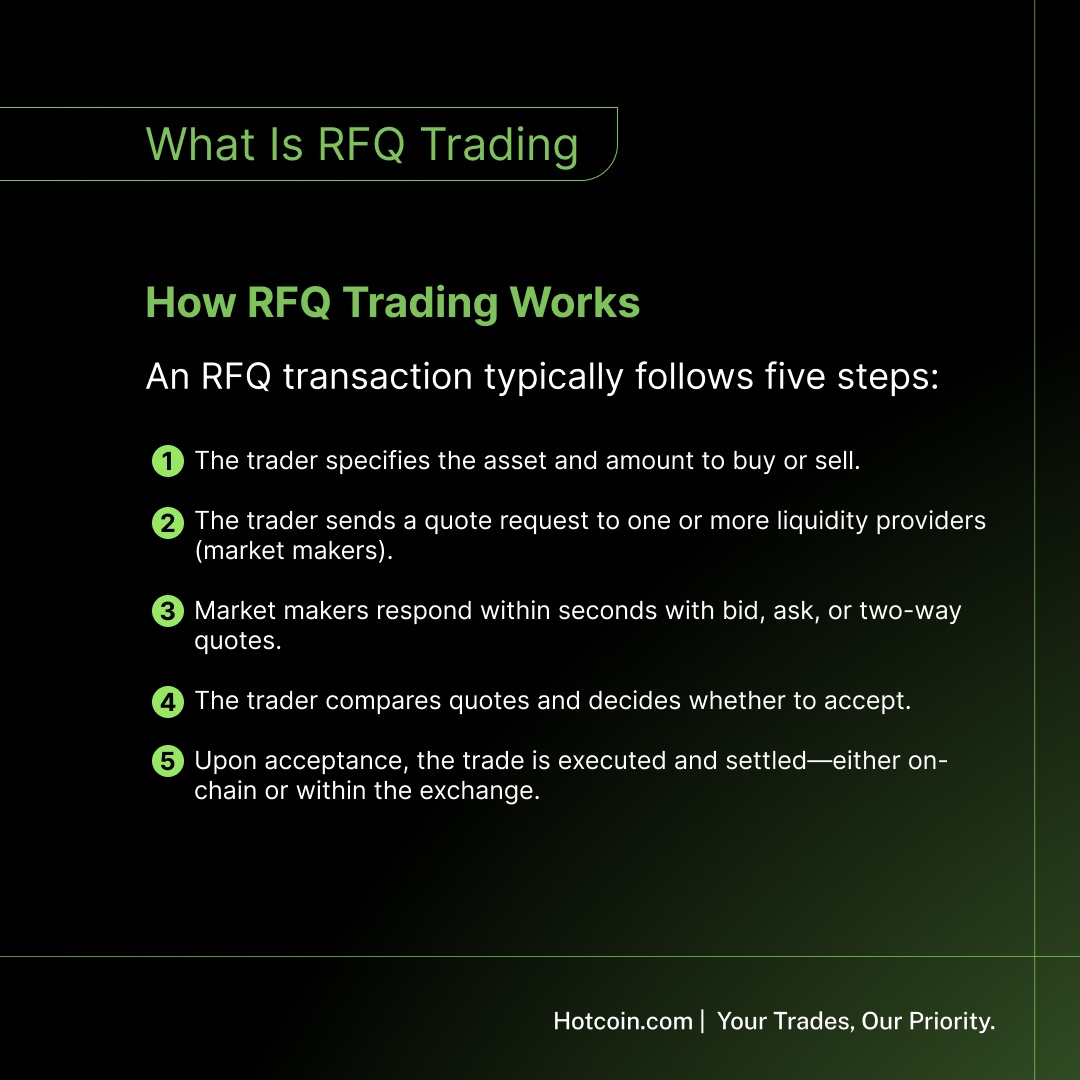
In crypto markets, RFQ (Request for Quote) is a trading mechanism that bridges OTC trading and traditional order-book models. In essence, it allows traders to request price quotes from liquidity providers before deciding whether to execute a trade.
Common in traditional finance—particularly in bond, commodity, and derivatives markets—the RFQ model is now gaining traction across both centralized and decentralized crypto platforms.
1.How RFQ Trading Works
An RFQ transaction typically follows five steps:
-
The trader specifies the asset and amount to buy or sell.
-
A quote request is sent to one or more liquidity providers (market makers).
-
Market makers respond within seconds with bid, ask, or two-way quotes.
-
The trader compares quotes and decides whether to accept.
-
Once accepted, the trade is executed and settled, either on-chain or within the exchange.
2. Difference from Order-Book Trading
In a traditional order book, all orders are public and automatically matched. RFQ, by contrast, is a private quote system—quotes are visible only between the requester and liquidity providers. This makes RFQ trading ideal for large trades or illiquid tokens, helping minimize price impact and slippage.
3. Advantages and Use Cases
The main advantage of RFQ trading is price certainty. Traders can lock in a firm price before execution, avoiding slippage during volatile market movements, while liquidity providers quote more efficiently based on inventory and risk exposure.
Common use cases include:
-
Institutional or whale-size block trades
-
New token launches and long-tail assets
-
DeFi aggregation protocols such as 0x, CowSwap, and UniswapX
4. Limitations
RFQ trades are less transparent than public order books, and regular users may have limited access to professional market makers. During high-volatility periods, providers may withdraw or delay quotes, causing execution lag or reduced liquidity.
Conclusion
RFQ trading brings greater flexibility and efficiency to crypto markets, merging the privacy of OTC with the execution reliability of exchanges.
As institutional adoption expands and liquidity networks mature, RFQ systems are poised to become a core component of the crypto market’s infrastructure.
Lectura recomendada
Ver más



Service@hotcoin.com
Product@hotcoin.com
Business@hotcoin.com
Casecn@hotcoin.com