
Quick Overview of DePIN Project Mechanism
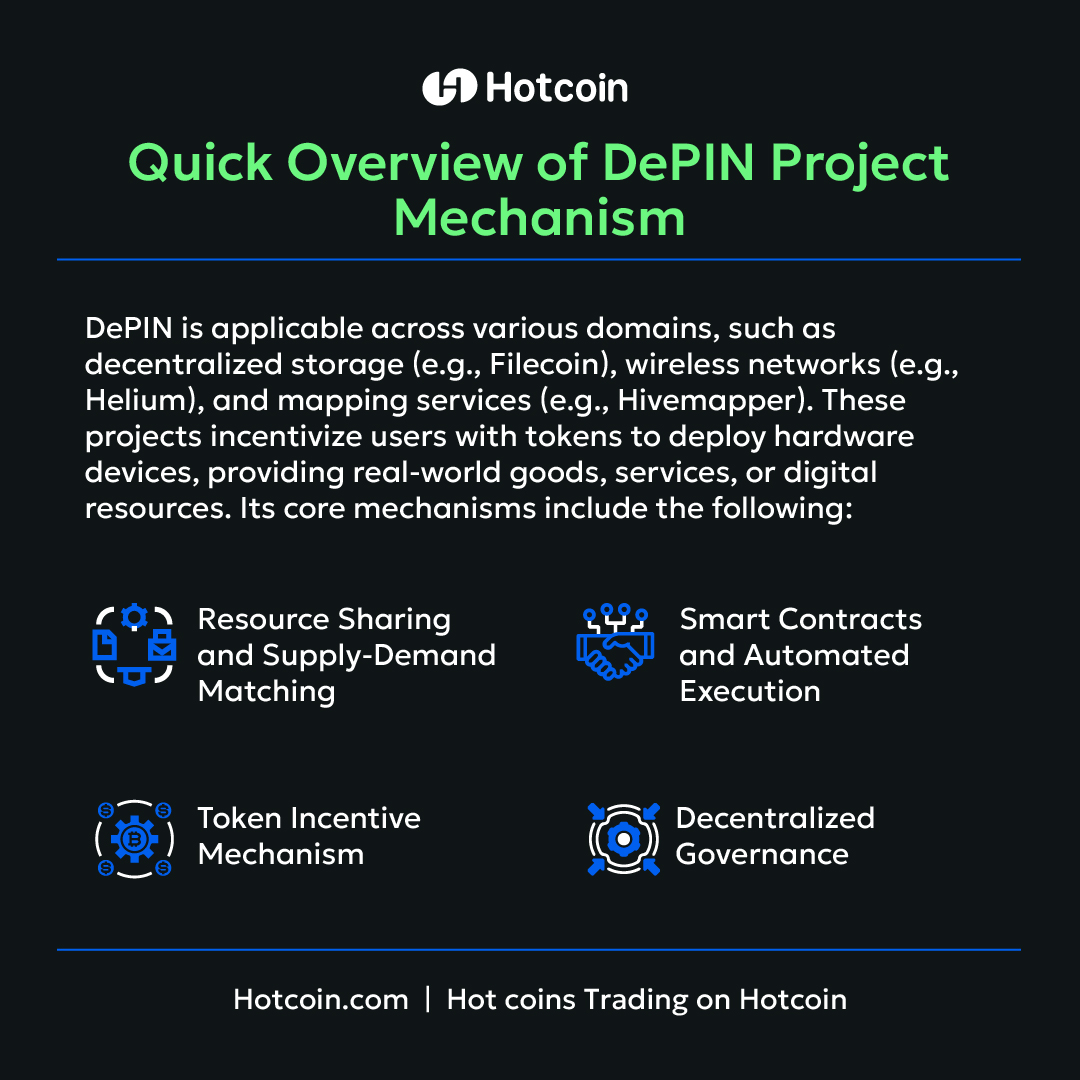
The Decentralized Physical Infrastructure Network (DePIN) leverages blockchain technology and token-based incentive mechanisms to coordinate distributed physical resources and services. DePIN has a wide range of applications, including decentralized storage (e.g., Filecoin), wireless networks (e.g., Helium), and mapping services (e.g., Hivemapper). These projects incentivize users with tokens to deploy hardware devices, providing real-world goods, services, or digital resources. Its core mechanisms include the following:
1. Resource Sharing and Supply-Demand Matching
DePIN aggregates distributed physical resources, such as storage, computing, and wireless networks, and directly matches them with users in need through the network, improving resource utilization efficiency.
2. Token Incentive Mechanism
To encourage users to contribute resources, DePIN projects typically design token reward systems. Resource providers earn token rewards based on the volume and quality of resources they contribute, while users pay tokens for the services they require. This mechanism fosters the healthy growth of the network.
3. Smart Contracts and Automated Execution
DePIN uses smart contracts to predefine rules, enabling the automated execution of resource allocation, reward calculation, and penalty enforcement. This minimizes manual intervention and ensures efficient network operations.
4. Decentralized Governance
DePIN generally adopts a decentralized governance model, where community members vote on network upgrades, parameter adjustments, or the introduction of new features. This enhances user participation and the network's resistance to censorship.
In summary, DePIN integrates blockchain technology, token economics, and physical resources to build an efficient, transparent, and secure network system, demonstrating significant innovation potential across various domains.
Lectura recomendada
Ver más


Service@hotcoin.com
Product@hotcoin.com
Business@hotcoin.com
Casecn@hotcoin.com