
Hotcoin Research | When Leveraged ETFs Meet Perpetual Futures: A Cross-Market Amplifier of Risk and Volatility
Introduction
In July 2026, the global AI trade faced its first true stress test. After peaking on June 22, SOXX, the leading semiconductor ETF, fell by about 20%. Over the same period, Intel and Micron declined by approximately 33% and 30%, respectively, while the Philadelphia Semiconductor Index retreated more than 20% from its peak. The triple-leveraged semiconductor ETF SOXL lost more than 50% at its lowest point. By comparison, the S&P 500 experienced a much smaller decline, suggesting that investors were not broadly abandoning risk assets, but were instead unwinding the crowded positions that had built up around AI, semiconductors, and momentum trades.
More importantly, this correction exposed a broader shift in the global leverage structure. The same stock can first be transformed into a two- or three-times leveraged ETF, and then be listed as a 24/7 perpetual futures contract on a crypto exchange. As a result, the same underlying risk can simultaneously exist across equities, funds, swaps, futures, perpetual contracts, and even on-chain collateral. In the past, investors mainly focused on a company's earnings and valuation. Today, they must also understand when the leveraged products built around that company are forced to buy or sell, and how those flows can, in turn, influence the underlying stock itself. This article explores a more specific question: when leveraged ETFs meet equity perpetual futures, do they create a more efficient risk management tool, or a volatility amplifier that bridges traditional finance and crypto markets?
I. From Stocks to Leveraged ETFs and Perpetual Futures: The Evolution of Leveraged Equity Products
To understand this latest wave of leveraged product expansion, it is not enough to focus on product names or leverage multiples. The more fundamental question is: what exactly are investors buying? Ordinary stocks, leveraged ETFs, equity perpetual futures, and leveraged ETF perpetual futures may all reference the same company or index, yet they represent fundamentally different legal rights, return objectives, cost structures, and risk profiles. While the market appears to be introducing more trading products, what it is really creating is additional layers through which the same underlying risk is replicated, amplified, and redistributed.
1.1 Four Risk Profiles of U.S. Equity Products
Ordinary stocks represent direct ownership in a publicly listed company, or beneficial ownership held through a brokerage account. Investors are generally entitled to economic benefits such as dividends and, depending on their account structure and shareholding arrangements, may also have voting rights. Unless purchased on margin, a decline in the stock price will not trigger automatic liquidation. Investors simply bear the risk of changes in the company's value and market price.
Leveraged ETFs are different. Investors hold shares of a fund rather than the underlying stocks tracked by the ETF. Through swaps, futures, options, financing, and cash management strategies, the fund seeks to deliver two-times, three-times, or inverse returns on the underlying asset's daily performance. Investors therefore gain exposure to the fund's daily-reset Net Asset Value (NAV) rather than additional ownership of the underlying companies.
Equity perpetual futures go a step further. Investors hold neither stocks nor fund shares, but instead trade derivative positions linked to a reference price with no fixed expiration date. Dividends, voting rights, and shareholder claims are generally absent, replaced by margin requirements, funding rates, mark prices, and liquidation mechanisms.
Leveraged ETF perpetual futures combine the two structures. Instead of referencing an ordinary stock, the contract tracks an ETF that already incorporates daily leverage. As a result, investors are not trading a perpetual contract on the underlying stock, but a perpetual contract on the price of a leveraged ETF. The fund itself contains the first layer of leverage, while the trading account introduces a second layer through margin. The comparison of these four U.S. equity products is shown below:
| Comparison Criteria | Common Stock | Leveraged ETF | Stock Perpetual Futures | Leveraged ETF Perpetual Futures |
| Underlying Exposure | Direct ownership of a publicly listed company or beneficial ownership through a brokerage account | Fund shares designed to deliver leveraged or inverse daily returns on the underlying asset | Non-expiring perpetual futures linked to the reference price of a stock or index | Non-expiring perpetual futures linked to the reference price of a leveraged ETF |
| Is the Leverage Adjustable? | No built-in leverage, although investors may use margin financing | Leverage is fixed by the fund, typically at 2×, 3×, or inverse exposure levels | Users can choose within the platform's maximum leverage ratio | Account leverage is adjustable, but the ETF's built-in leverage cannot be removed |
| Trading Hours | Regular trading hours, with limited pre-market and after-hours trading | Follows the trading hours of the underlying market | Usually 24/7 | Typically trades 24/7, although the underlying ETF does not |
| Holding Costs | Commissions, taxes, and margin interest | Management fees and derivative financing costs | Transaction fees, spreads, funding rates, and margin costs | ETF management costs, plus perpetual funding rates, spreads, and trading fees |
| Maximum Loss | Losses are generally limited to the invested principal in cash accounts | Losses are generally limited to the fund investment, but can approach 100% | The entire margin may be lost, with additional losses depending on platform rules | Liquidation may occur more quickly, with greater margin losses during periods of high volatility |
| Main Risks | Corporate fundamentals, valuation, and market risk | Compounding effects, volatility decay, and concentration risk | Liquidation risk, funding costs, oracle risk, platform risk, and basis risk | Layered leverage, path dependency, closed-market pricing risk, and liquidity risk |
1.2 Leveraged ETFs Have Evolved from Index Tools to Single-Stock Sentiment Vehicles
Traditional leveraged ETFs have primarily focused on broad-market and sector indices, including the S&P 500, Nasdaq-100, and semiconductor indices. Products such as TQQQ, SQQQ, and SOXL have been available for many years. Over the past two years, however, new product launches have shifted rapidly toward high-volatility single stocks, notably NVIDIA, Tesla, Micron, AMD, Palantir, and Strategy.
As of July 21, 2026, Direxion's official product lineup included 52 single-stock leveraged and inverse ETFs, covering a wide range of AI, semiconductor, and high-beta names, including NVDA, MU, AMD, TSM, AVGO, PLTR, and HOOD. Most of these products target either 200% daily long exposure or 100% inverse daily exposure. They are no longer traditional long-term asset allocation tools, but have instead become short-term trading instruments for expressing directional and volatility views within brokerage accounts.
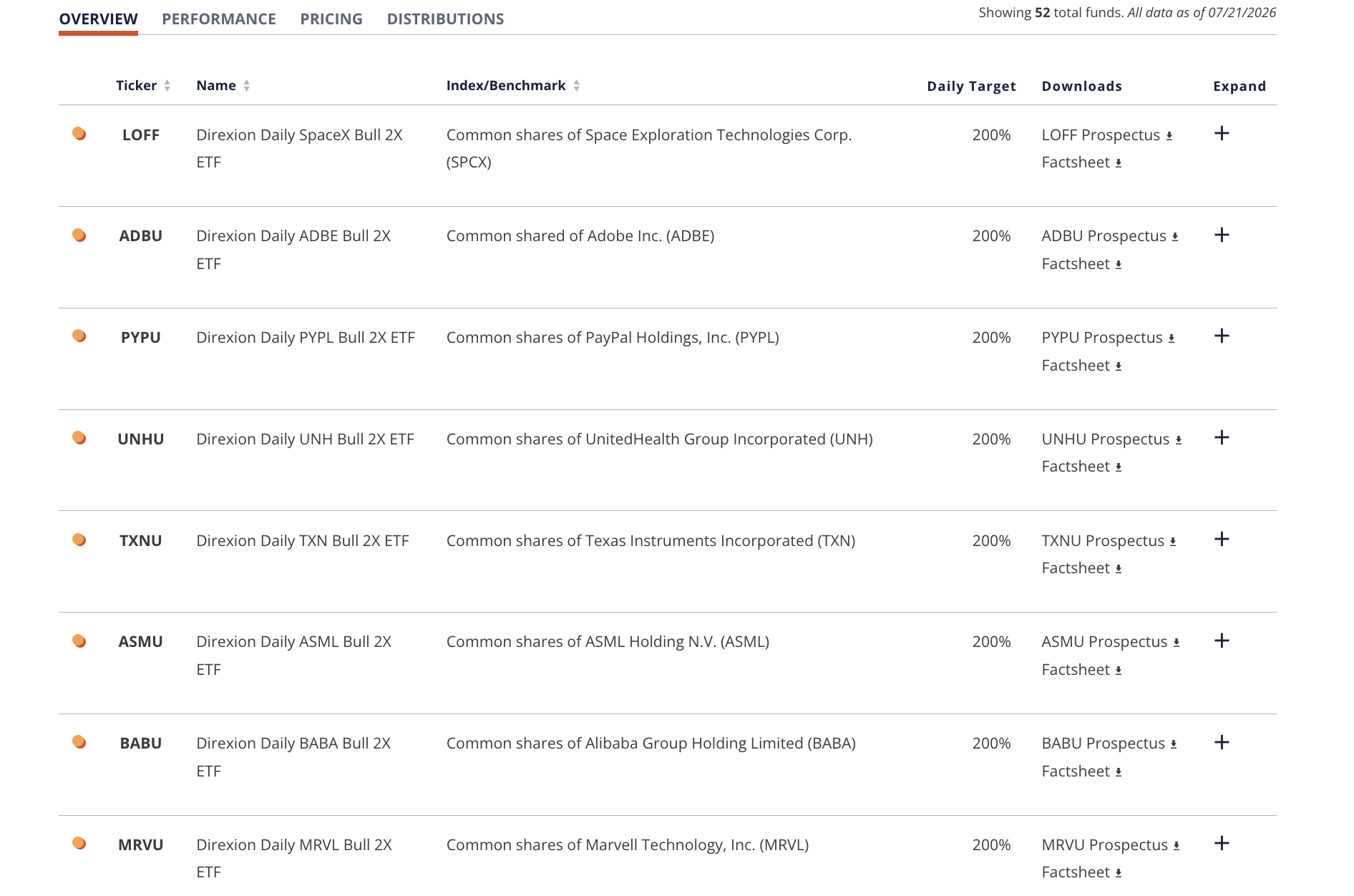
Source: https://www.direxion.com/single-stock-etfs
According to Mirae Asset Securities Research, as of June 30, 2026, net assets in U.S. and Asian leveraged ETFs had increased 82% year-over-year to approximately $249 billion. This figure excludes roughly $14 billion in inverse ETFs in the United States and another $4.8 billion in Asia. In other words, leveraged ETFs have evolved from niche products into a structural force in global financial markets, with aggregate assets exceeding $250 billion.
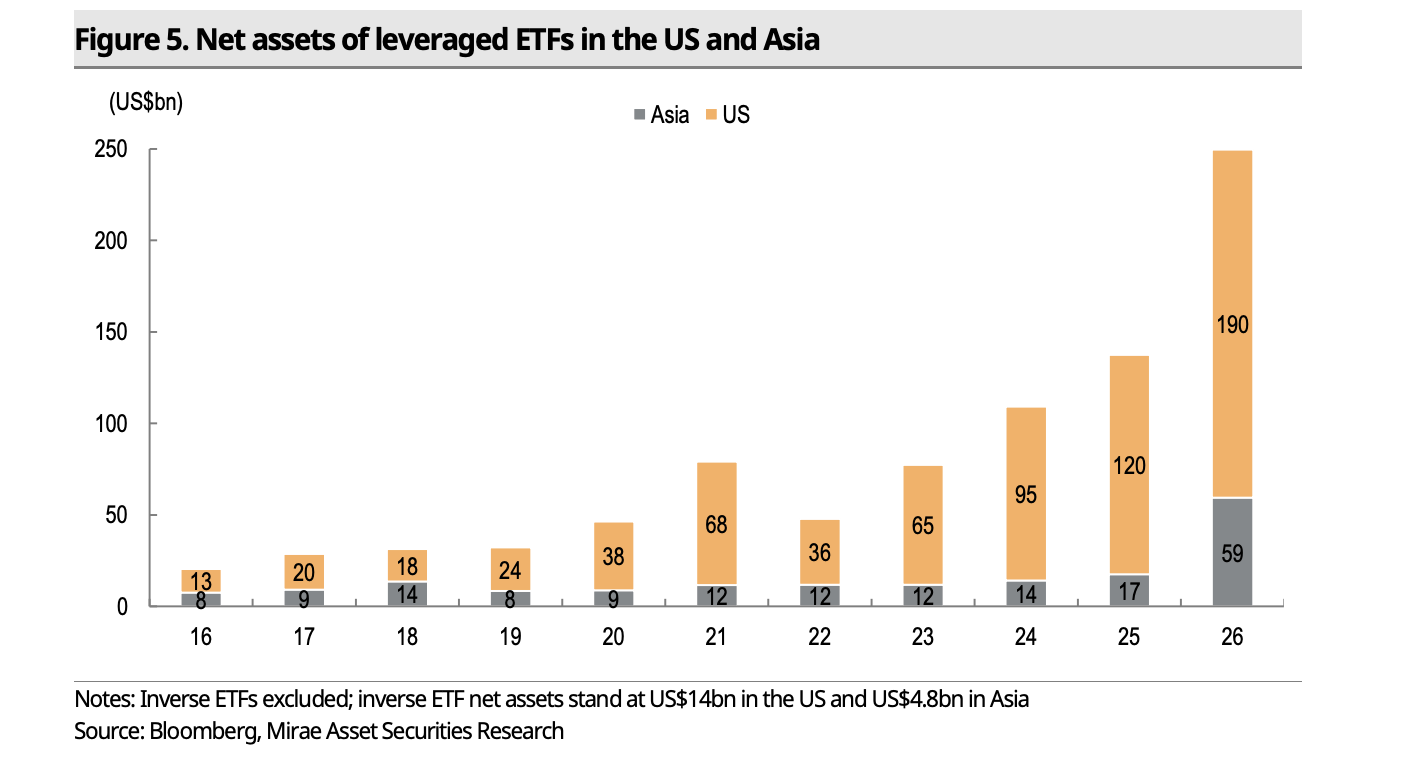
Source: https://securities.miraeasset.com/
1.3 AI and Semiconductors Have Become the Most Crowded Leveraged Trades
Leveraged products tend to concentrate around three characteristics: high volatility, compelling narratives, and deep liquidity—all three of which AI and semiconductor stocks exhibit.
On the one hand, expanding AI capital expenditure, growing demand for compute, and memory chip cycles have driven strong gains in stocks such as NVIDIA, Micron, SK Hynix, and Samsung Electronics. On the other hand, these companies are now represented across index ETFs, sector ETFs, single-stock leveraged ETFs, options, and perpetual futures. Investors are no longer simply buying individual stocks; they are expressing the same directional view across multiple layers of financial products.
This structure tends to reinforce market trends during rallies. Rising stock prices increase the net asset value of leveraged ETFs, prompting funds to add exposure to restore their target leverage. Strong performance attracts additional inflows, while market makers and derivative counterparties adjust their hedge positions accordingly. Rising prices, capital inflows, and mechanical rebalancing together create a self-reinforcing cycle.
During market corrections, however, the same mechanism operates in reverse. In mid-July 2026, the Philadelphia Semiconductor Index fell by around 10% in a single week, extending its decline to more than 20% from its June peak, while SOXL lost more than 50% from its peak. This does not necessarily indicate that the long-term AI investment thesis has broken down. Instead, it illustrates that when valuations, positioning, and leverage are all elevated, markets do not require a broad deterioration in fundamentals to trigger a sharp correction. A modest slowdown in incremental buying may be enough for the leverage structure itself to amplify profit-taking into a wave of concentrated deleveraging.
II. The Mechanics of Leveraged ETFs: How Daily Resets Shape Returns and Risk
One of the most widespread misconceptions about leveraged ETFs is that “2x or 3x daily exposure” means their long-term returns will always equal two or three times the cumulative return of the underlying asset. In reality, these products typically target a multiple of the underlying asset’s return for a single trading day only. Over longer holding periods, performance is also shaped by daily resets, the sequence of gains and losses, volatility, financing costs, and compounding. Leveraged ETFs are therefore not simply directional amplification tools. They not only magnify movements in the underlying asset, but also alter the way returns accumulate over time. Whether the market follows a sustained trend or moves back and forth, and whether the underlying exposure is diversified or concentrated, can materially affect the returns investors ultimately receive.
2.1 Daily Reset: 2x Leverage Does Not Equal 2x Returns
Consider a simplified scenario where an asset falls 20% on the first day and then rises 25% on the second. Its price declines from 100 to 80 before recovering to 100, resulting in a cumulative two-day return of zero. An idealized 2x leveraged ETF, however, would fall 40% on the first day, reducing its net asset value from 100 to 60. Although it would then gain 50% on the second day, its net asset value would recover only to 90. Even though the underlying asset returns to its starting point, the leveraged ETF still records a 10% loss.
In a steadily rising market, compounding can produce the opposite outcome. If the underlying asset gains 10% on two consecutive days, its cumulative return is 21%. If an idealized 2x leveraged ETF gains 20% on each of those days, its cumulative return reaches 44%, exceeding the simple multiple of 42%. This illustrates that the more persistent the trend, the more compounding tends to benefit returns. Conversely, the more volatile the price path, the greater the erosion of net asset value is likely to be.
Daily resets do not change the leverage multiple applied on any given day, but they fundamentally change how returns accumulate over multiple trading days. Even when investors correctly predict the long-term direction of the market, significant interim volatility may produce substantially different investment outcomes. Leveraged ETFs are therefore not simply tools that magnify market direction. Instead, they are path-dependent products whose returns are jointly determined by direction, volatility, and the sequence of price movements, rather than by a fixed leverage multiple over time.
2.2 Mechanical Rebalancing: Buying More as Prices Rise, Selling More as Prices Fall
Ordinary investors often regard buying at higher prices and selling at lower prices as emotional or behavioral mistakes. For leveraged ETFs, however, buying into strength and selling into weakness is a mechanical process required by the product's design. To maintain a predetermined leverage ratio each trading day, the fund must adjust its exposure to stocks, futures, swaps, or other derivatives as its net asset value changes.
Assume a fund has a net asset value of 100 and targets 2x exposure. It therefore holds approximately 200 of market exposure. If the underlying asset rises by 10%, the fund earns roughly 20%, increasing its net asset value to 120, while its existing exposure rises to 220. To restore its 2x target, the fund must increase its exposure to 240, requiring it to purchase an additional 20 of exposure. Conversely, if the underlying asset falls by 10%, the fund's net asset value declines to 80. Its target exposure falls to 160, meaning it must reduce its exposure by approximately 20 from the remaining 180.
As a result, leveraged long ETFs typically increase exposure after prices rise and reduce exposure after prices fall. The larger the fund, the more concentrated its holdings, and the lower the liquidity of the underlying market, the greater the impact this directional rebalancing can have on prices. During rising markets, it may reinforce the trend. During falling markets, mechanical selling may amplify an ordinary correction into a more concentrated wave of selling pressure.
2.3 The More Concentrated the Underlying, the More Fragile the Leverage Structure
Index leveraged ETFs hold a basket of assets, allowing company-specific negative events to be partially offset by the performance of other constituent stocks. Single-stock leveraged ETFs, by contrast, concentrate company-specific event risk, positioning density, and daily leverage on a single underlying asset. Earnings surprises, regulatory developments, industry news, or sudden liquidity shocks can all have a significant impact within a single trading day.
If a stock falls 20% in a single day, a 2x leveraged long ETF would theoretically decline by nearly 40%. If the stock drops by almost 50% in one session, the fund could lose most, if not nearly all, of its net asset value. Unlike margin accounts, these products generally do not require investors to post additional collateral. Instead, they continue operating by reducing derivative exposure, conducting reverse stock splits, or, in some cases, liquidating the fund.
Therefore, the absence of a margin call does not mean deleveraging has not occurred. Leveraged ETFs complete the deleveraging process within the fund itself, while investors experience it through a sharp decline in net asset value. The more concentrated the underlying asset, the more pronounced this risk becomes. Index declines are typically driven by multiple constituents, whereas a single stock may gap sharply following an unexpected event. The leverage mechanism does not distinguish whether price movements are driven by short-term sentiment or long-term fundamentals; it simply adjusts exposure based on daily price changes. This is precisely why single-stock leveraged ETFs are inherently more fragile than index-based products.
2.4 Crypto Leveraged ETFs: Expanding Beyond Bitcoin and Ethereum
The scope of leveraged ETFs has expanded from stock indices, sectors, and individual stocks to crypto assets. Investors using traditional brokerage accounts can gain leveraged exposure to crypto assets without directly holding tokens. The same mechanisms of daily resets, path dependence, and mechanical rebalancing have therefore been extended to the cryptocurrency market, where volatility is higher and trading hours are longer.
As of July 23, 2026, Volatility Shares' official product lineup included nine 2x leveraged crypto ETFs, including BITX, ETHU, SOLT, XRPT, CHNU, CRDX, STLU, SUIL, and AVAZ. In terms of asset coverage, leveraged crypto ETFs have expanded beyond Bitcoin and Ethereum to include a broader range of digital assets. However, in terms of assets under management, the vast majority of capital remains concentrated in Bitcoin- and Ethereum-related products.
III. From TQQQ to TQQQ Perpetual Futures: How a Second Layer of Leverage Is Created
If leveraged ETFs package the daily returns of indices or stocks into fund shares, leveraged ETF perpetual futures package the price movements of those ETF shares into margin-based derivatives. Rather than purchasing ETF shares outright, traders can establish a much larger position by posting only a fraction of the contract value as collateral. Although both layers of leverage track the same price path, they are created through entirely different mechanisms. The first layer is embedded within the ETF through derivatives and centered on daily resets, while the second is created by traders through margin trading and centered on mark prices and liquidation mechanisms.
3.1 Fund-Level Leverage and Account-Level Leverage: Two Independent Systems
The first layer of leverage exists within the fund. Products such as TQQQ and SOXL typically use swaps, futures, and other derivatives to deliver a fixed multiple of an underlying index's daily return. The fund adjusts its exposure based on its net asset value and target leverage ratio. As a result, investors gain exposure to a fund whose NAV is reset daily, rather than a fixed multiple of the underlying index over the long term.
The second layer of leverage comes from the perpetual futures account. By posting only a portion of the required collateral, traders can establish a larger TQQQ perpetual futures position. The exchange continuously calculates the position value, maintenance margin requirement, mark price, and liquidation price. If losses reduce the account margin below the required level, the position may be partially or fully liquidated.
The two systems also use different leverage bases. A fund's 2x or 3x leverage refers to its target daily exposure relative to the ETF's net asset value, whereas a perpetual futures account's 5x or 10x leverage refers to the ratio of the contract's notional value to the trader's margin. The former determines how the ETF responds to movements in the underlying asset, while the latter determines how those price movements translate into gains and losses in the trading account.
3.2 How Perpetual Futures Are Priced: Index Price, Mark Price, and Funding Rates
Perpetual futures have no fixed expiration date. Instead, exchanges typically use an index price, a mark price, and funding rates to keep contract prices aligned with the underlying reference asset. The index price determines what the contract tracks, while the mark price is primarily used to calculate unrealized PnL and determine whether a position should be liquidated. Funding rates, paid periodically between long and short positions, help prevent the contract price from deviating significantly from the reference price over time.
Exchanges such as Binance and Hotcoin have listed USDT-margined perpetual futures for products including TQQQ, MVLL, and MUU, enabling 24/7 trading. Funding rates for these contracts are typically settled every eight hours. Because the underlying ETFs already employ daily leverage, leverage applied through perpetual futures accounts further amplifies both profit and loss potential, as well as liquidation risk. During regular U.S. trading hours, the market price, NAV, and related derivatives of the leveraged ETF provide important pricing references for the perpetual futures contract. After the U.S. market closes, however, trading continues, and pricing relies more heavily on the exchange's index methodology and mark price mechanism.
In addition to price movements, traders must also account for funding payments and transaction costs. When long positions become crowded, funding rates may remain positive for extended periods, meaning long holders continue paying funding even if their directional view proves correct. Conversely, when funding rates are negative, short positions pay longs. As a result, returns from perpetual futures depend not only on movements in TQQQ, but also on the holding duration, account leverage, funding rates, and the exchange's liquidation rules.
3.3 Does a 3x ETF Combined with 10x Leverage Really Equal 30x?
Suppose an ETF seeks to deliver three times the Nasdaq-100's daily return. A trader then posts $100 of margin and uses 10x account leverage to open a $1,000 perpetual futures position on the ETF. Under ideal conditions, if the index rises 1% in a single day, the ETF may gain approximately 3%, generating a profit of about $30 on the perpetual futures position, or 30% of the trader's margin. In terms of short-term price sensitivity, the trader's notional exposure is therefore close to 30 times that of the underlying index.
This does not mean, however, that the market offers a permanent "30x Nasdaq product." The ETF's 3x target resets every trading day, meaning the calculation base changes with the previous day's gains or losses. Meanwhile, the effective leverage of a perpetual futures account also changes continuously with margin balances and unrealized PnL. Funding rates, trading fees, ETF premiums or discounts, and differences between the ETF price and the contract's reference price further cause actual returns to diverge from a simple multiple. For example, when the market moves in the trader's favor, account equity increases and effective leverage typically declines. When the market moves against the trader, account equity decreases and effective leverage rises. As a result, a trader may be liquidated long before the underlying index experiences a cumulative move equivalent to 30x. Therefore, "30x" is best understood as an idealized measure of price sensitivity at a particular point in time, rather than a leverage multiple that can be maintained over the long term.
The essence of layered leverage is that two independent mechanisms operate on different bases. The fund adjusts its internal exposure according to its daily leverage target, while the exchange manages the trader's position based on real-time margin requirements. Although the two layers can create very high notional price sensitivity over short periods, the actual return and risk profile remains dynamic.
IV. Leveraged ETFs and Perpetual Futures: Four New Contradictions in Market Structure
The interaction between leveraged ETFs and perpetual futures does more than simply increase leverage. More importantly, it connects the internal mechanics of traditional securities markets, including fund rebalancing, derivatives hedging, and NAV fluctuations, with the margin requirements, liquidation mechanisms, funding rates, and around-the-clock trading of crypto markets. As a result, the same underlying equity risk can be repackaged and transmitted repeatedly across different accounts, trading venues, and market sessions.
4.1 The Contradiction Between 24/7 Trading and Non-24/7 Liquidity
Equity perpetual futures transform assets that are traditionally constrained by U.S. market hours into products that can be traded 24/7, lowering barriers related to time zones and brokerage accounts. However, around-the-clock trading does not mean that the underlying market and its liquidity are available around the clock.
After the U.S. market closes, stock and ETF creations and redemptions cease, fund NAVs stop updating continuously, and liquidity in key hedging markets such as options and futures also declines. Although perpetual futures continue to trade, market makers cannot hedge their positions through the underlying assets in real time. Instead, they must rely on their own inventory, related assets, and expectations for the next market open. As a result, the available liquidity becomes closer to synthetic liquidity than true underlying market liquidity.
Under normal market conditions, this distinction may have little practical impact. During periods of market stress or concentrated selling, however, market makers may widen bid-ask spreads and reduce quoted depth, making prices more susceptible to relatively small trades. In this sense, 24/7 trading does not eliminate the risks associated with market closures. Instead, it replaces the inability to trade during closed hours with the ability to trade at prices that may no longer reflect robust underlying liquidity. Continuous trading expands market access, but it does not necessarily improve the market's capacity to absorb selling pressure during periods of stress.
4.2 The Contradiction Between Continuous Price Discovery and Fragile Pricing Anchors
Equity perpetual futures continue trading after the U.S. market closes, allowing markets to react to earnings releases, policy developments, and unexpected events before the next trading session begins. Rather than waiting for the U.S. market to reopen, investors can express their views on price movements immediately. From this perspective, perpetual futures extend the price discovery process for U.S. equities.
Continuous trading, however, does not necessarily produce reliable pricing. Once the U.S. market closes, key pricing anchors, including stocks, ETFs, options, and futures, either stop updating or become significantly less liquid. As a result, perpetual futures rely more heavily on the latest closing prices, index methodologies, related asset movements, and market makers' pricing models. When the reference asset is a leveraged ETF such as TQQQ or SOXL, daily rebalancing, derivative valuation, and financing costs further increase pricing complexity.
As a result, perpetual futures prices during non-trading hours are better viewed as market expectations for the next U.S. market open rather than the ETF's immediately arbitrageable fair value. Limited liquidity may widen the basis and increase price volatility, potentially triggering liquidations even when price deviations are only temporary. Price discovery becomes more continuous, while the spot market foundation supporting those prices may become less stable.
4.3 The Contradiction Between Fragmented Trading and Sequential Deleveraging
Leveraged ETFs and perpetual futures are traded in different markets, giving the appearance that risk is distributed among fund investors, perpetual futures traders, market makers, and exchanges. As long as these products reference the same underlying asset, however, they remain interconnected through prices, hedging activity, and margin requirements. Trading venues may be fragmented, but the underlying risk exposure ultimately remains concentrated in the same asset.
Perpetual futures positions are liquidated in real time based on margin requirements, whereas leveraged ETFs typically rebalance their exposure around the market close. During a market decline, long positions in perpetual futures may be liquidated first, followed by ETF rebalancing near the close. After the U.S. market closes, perpetual futures continue trading the remaining risk, while the underlying stocks absorb the accumulated overnight price adjustments when the market reopens the following day. Rather than being released all at once, deleveraging may unfold sequentially across markets and time zones.
According to a Seoul Economic Daily report published on July 21, 2026, citing JPMorgan research, assets under management in South Korea's related leveraged ETFs once reached approximately $50 billion before declining to around $26 billion. JPMorgan estimated that a more sustainable level would be approximately $18 billion, suggesting that roughly 75% of the adjustment had already taken place. This illustrates how, when markets shift from rising to falling, the combined effects of daily ETF rebalancing, investor redemptions, and deleveraging by other leveraged participants can reinforce one another, transforming what begins as a fundamentally driven or sector-specific correction into a broader liquidity-driven deleveraging process.
4.4 The Contradiction Between Global Product Distribution and Invisible Aggregate Leverage
The same stock may simultaneously be associated with margin trading, leveraged ETFs, options, swaps, centralized exchange (CEX) perpetual futures, and on-chain derivatives. While these products are distributed across different markets and jurisdictions, providing global investors with multiple avenues for gaining exposure, they also make the aggregate risk surrounding a single underlying asset increasingly difficult to measure.
Each fund discloses its investment objective and portions of its holdings, while each trading platform maintains its own margin framework and liquidation rules. However, each participant typically has visibility only into positions within its own system. Exchanges cannot determine whether users hold the same exposure elsewhere, and securities regulators have limited visibility into positions on offshore crypto trading platforms. Individual markets may appear transparent, but aggregate leverage across markets can remain largely invisible.
As a result, future risk monitoring should extend beyond the size of an individual ETF or the open interest (OI) on a single trading platform. Greater attention should instead be paid to the combined exposure of the same underlying asset across multiple products, the concentration of market makers' hedging activity, and the potential exit channels shared by multiple markets during periods of simultaneous deleveraging. As financial products become increasingly global, regulatory oversight will need to evolve from product-level supervision toward monitoring aggregate leverage across markets.
V. Outlook and Conclusion: Two Layers of Leverage Can Accelerate and Amplify Market Volatility
The combination of leveraged ETFs and perpetual futures is bringing traditional securities products into the around-the-clock crypto trading ecosystem. As more underlying assets and trading platforms adopt this model, a more important question emerges: does this structure merely expand market access, or does it fundamentally reshape how prices are formed, how liquidity is distributed, and how risk is transmitted across markets? Its long-term sustainability will depend on whether the pace of product expansion remains aligned with the market's carrying capacity.
5.1 Outlook: Crypto Platforms May Bring More Traditional Leveraged Products to 24/7 Trading
Leveraged ETFs and perpetual futures are unlikely to replace one another. Instead, they are more likely to form a layered market structure in which traditional financial institutions create standardized leveraged exposure, while crypto platforms repackage and distribute that exposure globally through stablecoin-based margin, cross-border market access, and around-the-clock trading. Over time, the coverage of equity perpetual futures may expand beyond major indices and large-cap technology stocks to include individual equities, sector ETFs, leveraged ETFs, and other high-volatility assets.
As this market continues to develop, crypto platforms may gradually evolve from simply following U.S. equity prices to becoming venues where market expectations are reflected during non-trading hours. Competition between centralized and decentralized exchanges will therefore extend beyond the breadth of listed products to the quality of pricing, the resilience of liquidity, and the effectiveness of risk management when the underlying market is closed or experiencing significant volatility.
Assessing market risk will require more than counting the number of available products. Greater attention should be paid to the relationship between leveraged ETF assets under management and underlying market liquidity, perpetual futures open interest, funding rates, basis levels, and market makers' hedging activity. Regulatory oversight may also need to evolve beyond approving individual products toward monitoring aggregate leverage across markets by identifying the combined exposure of the same underlying asset across ETFs, options, swaps, and perpetual futures.
5.2 Conclusion
Leveraged ETFs and perpetual futures create two distinct layers of risk amplification. The first layer exists within the fund, where leveraged ETFs amplify the underlying asset's daily returns through their daily leverage objective. The second layer exists within the trading account, where perpetual futures amplify ETF price movements through margin. As a result, fluctuations in the same underlying asset are first magnified into larger changes in the ETF's net asset value and then further translated into greater account-level gains and losses, as well as higher liquidation risk.
This amplification affects not only investment returns but also the way markets adjust. During rising markets, ETF exposure and leveraged long positions in perpetual futures may reinforce upward momentum. During market declines, liquidations in perpetual futures, ETF rebalancing, and market makers' hedging activity may combine to generate synchronized selling pressure. Risk therefore extends beyond price fluctuations in a single market and can propagate through a sequence of underlying price declines, ETF amplification, perpetual futures liquidations, liquidity contraction, and market repricing.
Fundamentals remain the primary driver of long-term market direction. Two layers of leverage are not, by themselves, the cause of market reversals. However, when positioning becomes crowded, liquidity deteriorates, or the underlying market is closed, they may determine both the speed of market adjustment and the extent to which prices temporarily diverge from fundamental value. As leveraged ETFs and perpetual futures become increasingly interconnected, markets gain not only another leveraged trading instrument but also a new mechanism through which risks can spread across traditional finance and crypto markets, potentially transforming ordinary price fluctuations into broader and more persistent deleveraging cycles.
About Us
Hotcoin Research is the research and insights arm of Hotcoin, dedicated to turning professional research into actionable investment insights.
Through Weekly Insights and In-Depth Research Reports, we help investors understand market trends, underlying dynamics, and emerging opportunities across the digital asset ecosystem. Our Elite Picks series combines AI-driven screening with analyst-driven research to identify promising assets and help investors evaluate opportunities more efficiently.
Through regular livestreams, our research team provides timely analysis of market developments and major industry trends. We believe that informed decision-making and a long-term perspective can help investors navigate market cycles and capture sustainable value in Web3.
Risk Disclaimer
The digital asset market is highly volatile, and all investments carry inherent risks. We strongly encourage investors to remain informed, assess risks thoroughly, and adhere to strict risk management practices to protect their assets.
Connect with Us
Website:https://www.hotcoin.com/en_US/learn/index/
X: x.com/HotcoinAcademy
Email: labs@hotcoin.com
Lectura recomendada
Ver más
Hotcoin Research | Play-to-Earn WEB3: Adot - The AI-Driven Revolution in Decentralized Search Engines
In-depth Research
Hotcoin Research | Market Bets on Over 80% Probability of a September Rate Cut: A Scenario Analysis of the Fed’s Q4 Easing Path and Its Implications
In-depth Research

Hotcoin Research | Ethereum's Decade of Ups and Downs: A Financial Reengineering Experiment from White Paper to Global Settlement Layer
In-depth Research

Contactos de servicio
Service@hotcoin.com
Comentarios sobre el producto
Product@hotcoin.com
Cooperación empresarial
Business@hotcoin.com
Contactos Legales
Casecn@hotcoin.com
Sobre nosotros
producto
Servir
soporte
©2017-2026