
Hotcoin Research | The Second Battlefield of the AI Supercycle: A 24/7 On-Chain Price Discovery Experiment
Introduction
On July 10, 2026, American depositary shares of SK hynix, a major global HBM supplier, began trading on Nasdaq. Over the past two years, market attention has centered largely on Nvidia and GPU shortages. As 2026 unfolded, investors began repricing bottlenecks across HBM, advanced packaging, networking equipment, power, and data centers. As a result, AI competition has expanded beyond model capabilities into capital spending, supply-chain buildout, and the global repricing of AI-related assets.
Meanwhile, the AI value chain is creating a “second battlefield” in crypto markets. According to CoinGecko, monthly trading volume in stock perpetuals across major crypto platforms increased from $831 million in July 2025 to $34 billion in May 2026, representing nearly a 40-fold increase. AI-related stocks such as Nvidia, Micron, and Microsoft are being repackaged into stablecoin-settled, 24/7, leveraged price exposures. This is neither a simple replication of the traditional stock market nor a genuine transfer of stock ownership on-chain. Rather, it is a new pricing experiment centered on price, liquidity, and trading hours. Traditional markets establish benchmark prices, while crypto markets continue to price industry expectations after those markets close.
This article examines how this “second battlefield” has emerged and whether it could eventually evolve into a second pricing layer for global technology assets. It does so by exploring the AI capital expenditure cycle, the structure of the AI value chain, the design of trading products, and the associated risk mechanisms.
I. The AI Supercycle: From a Technology Narrative to a Capital Expenditure Cycle
Whether AI has entered a supercycle cannot be judged solely by model parameters, user growth, or technology stock prices. What truly distinguishes a short-term narrative from a structural cycle is the scale of capital spending, capacity expansion, supply-chain orders, power demand, and balance-sheet dynamics. When leading companies are willing to invest hundreds of billions of dollars over multiple years in building data centers, purchasing chips, and securing long-term energy supply, AI is no longer merely another wave of software innovation. Instead, it is becoming an infrastructure cycle spanning semiconductors, manufacturing, communications, energy, and financial markets. A supercycle, however, does not imply uninterrupted industry growth, nor does it mean every company branded as an AI stock will generate returns. It describes the scale of investment, the duration of the build-out cycle, and the breadth of the value chain—not a prediction of future stock prices.
1.1 From the Race for Models to the Race for Balance Sheets
AI competition between 2023 and 2024 was primarily defined by model capabilities: parameter scale, training data, inference performance, and user growth determine market attention. From 2025 to 2026, the focus of competition gradually changes. Owning models is not enough to establish long-term advantages. Companies also need secure access to GPUs, custom ASICs, HBM, advanced packaging, network bandwidth, land for data centers, and grid access.
According to the forecast released by TrendForce in May 2026, the total capital expenditure of the nine major cloud providers, Google, AWS, Meta, Microsoft, Oracle, ByteDance, Tencent, Alibaba, and Baidu, may reach about $830 billion in 2026, a year-on-year increase of 79%. Using different samples and statistical methods, S&P Global Ratings estimates that the five large cloud providers, Alphabet, Amazon, Meta, Microsoft, and Oracle, will have capital expenditures of approximately $750 billion in 2026, equivalent to 38% of their combined revenue. Both sets of numbers point to the same trend: AI competition has become one of the largest capital allocation cycles in the history of global technology companies.
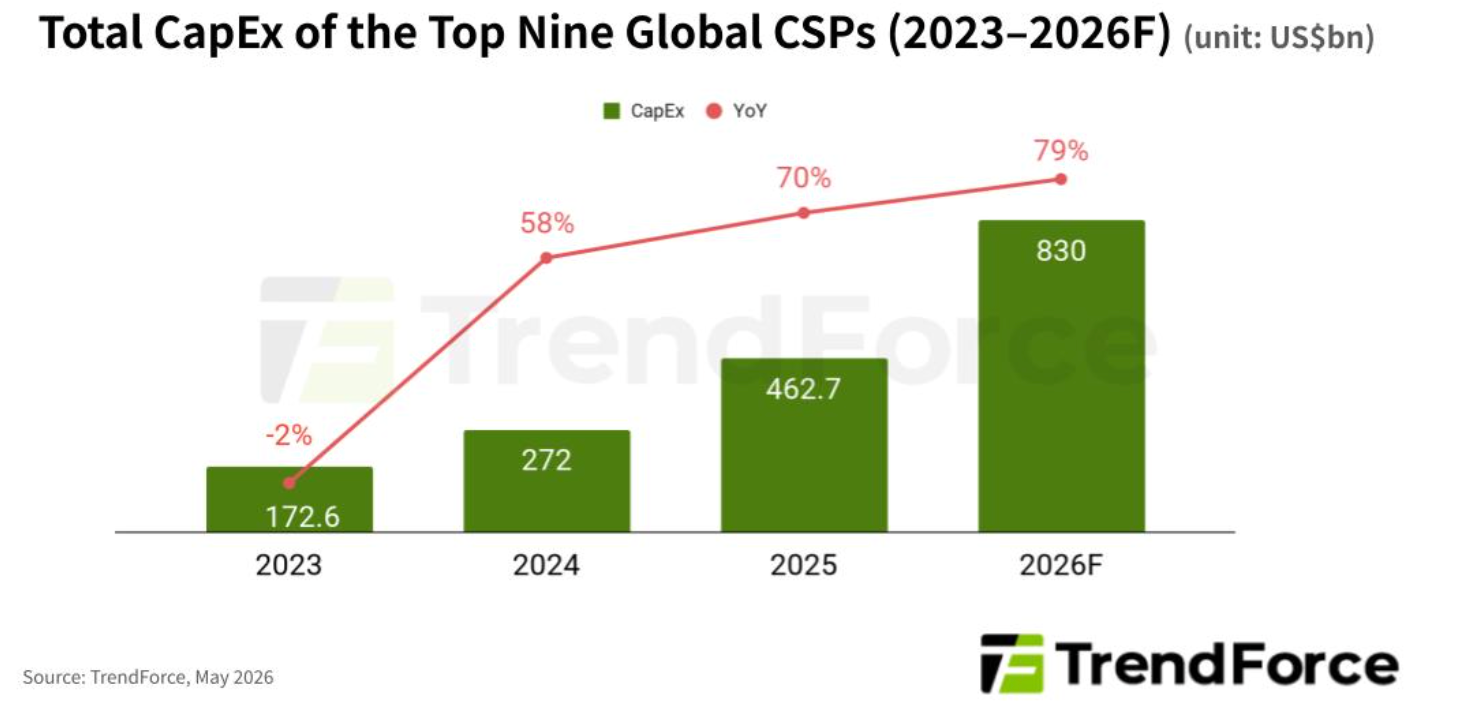
Source: https://www.trendforce.com/presscenter/news/20260506-13033.html
More fundamentally, AI competition has shifted from "who can train better models" to "who can continuously provide models with lower cost, larger scale, and more stable inference capabilities". Model capabilities are still important, but the factors that determine the upper limit of competition increasingly come from the balance sheet: access to capital, cash flow, procurement scale, supply chain control, and access to energy.
1.2 Semiconductor Growth Expands Beyond GPUs
The earliest demand for AI infrastructure was concentrated on GPUs, but GPUs do not operate in isolation. A system that can run large model training and inference requires collaborative operation of computing chips, HBM, advanced packaging, high-speed networks, storage, servers, power supply, and cooling systems. Insufficient supply at any link may delay deployment across the entire system.
Gartner predicts that global semiconductor revenue will reach $1.3202 trillion in 2026, a year-on-year increase of 64%, the highest growth rate in the past 20 years. Among them, memory chip revenue may increase from $216.30 billion in 2025 to $633.30 billion in 2026; AI semiconductors account for about 30% of global semiconductor revenue. Gartner also predicts that the annual prices of DRAM and NAND Flash may increase by 125% and 234%, respectively, in 2026, and meaningful price relief may not appear until after the second half of 2027.
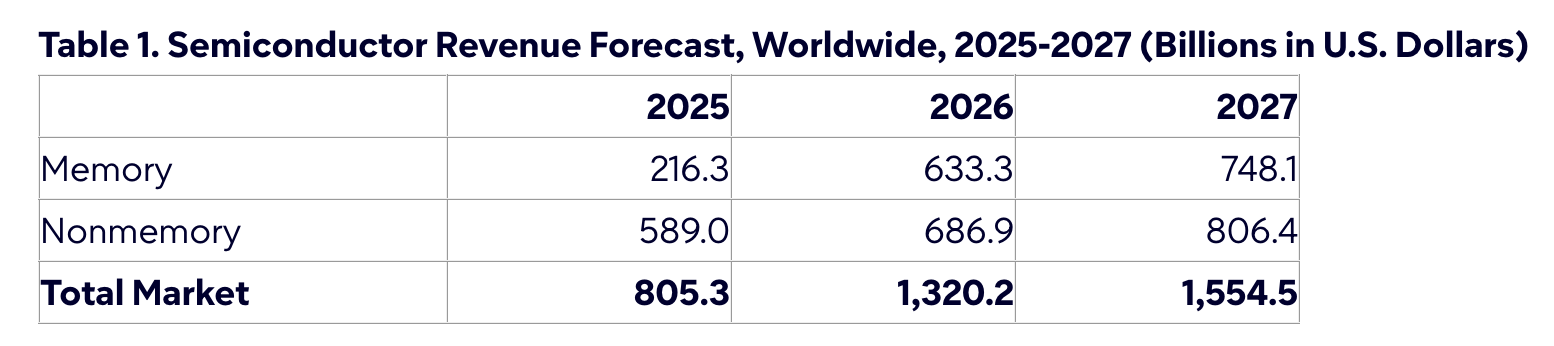
Source: https://www.gartner.com/en/newsroom/press-releases/2026-04-08-gartner-forecasts-worldwide-semiconductor-revenue-to-exceed-us-dollars-one-point-3-trillion-in-2026
These figures explain why Micron, SK hynix, and Samsung are gaining market attention. As the scale of large models expands, computing efficiency is constrained not only by the number of GPUs, but also by whether the processor can continuously and quickly access data. HBM has become an irreplaceable component of AI accelerators, alleviating the "memory wall" through higher bandwidth and lower per-bit power consumption.
TrendForce predicts that global AI server shipments will increase by over 28% YoY in 2026, with GPU servers still accounting for about 69.7%, but the proportion of ASIC-based AI servers may rise to 27.8%. This means that the AI chip market is not simply an Nvidia-only growth story. Google, Meta, Amazon, and Microsoft are accelerating the development of custom chips, which will continue to drive demand for wafer foundries, HBM, packaging, and network infrastructure, and shift the supply chain from a single-GPU route to GPU and custom ASIC coexistence.
1.3 The Bottleneck Is Shifting from Chips to Power Infrastructure
As GPU, HBM, and server supplies gradually increase, new bottlenecks are emerging in the physical infrastructure. Data centers need to obtain land, grid connection permits, transformers, backup power, cooling systems, and long-term power contracts. Chips can increase production in several quarters, but the construction timeline of large-scale power infrastructure and data center parks is often longer.
The International Energy Agency predicts that global data center electricity consumption may increase from about 485 terawatt-hours in 2025 to about 950 terawatt-hours in 2030, with AI data centers growing significantly faster than overall data centers. Gartner predicts that global data center electricity consumption will increase from 447 terawatt-hours in 2025 to 565 terawatt-hours in 2026, a year-on-year increase of 26%; AI-optimized servers will account for 31% of data center electricity consumption in 2026, and by 2027, their power consumption may exceed that of traditional servers.
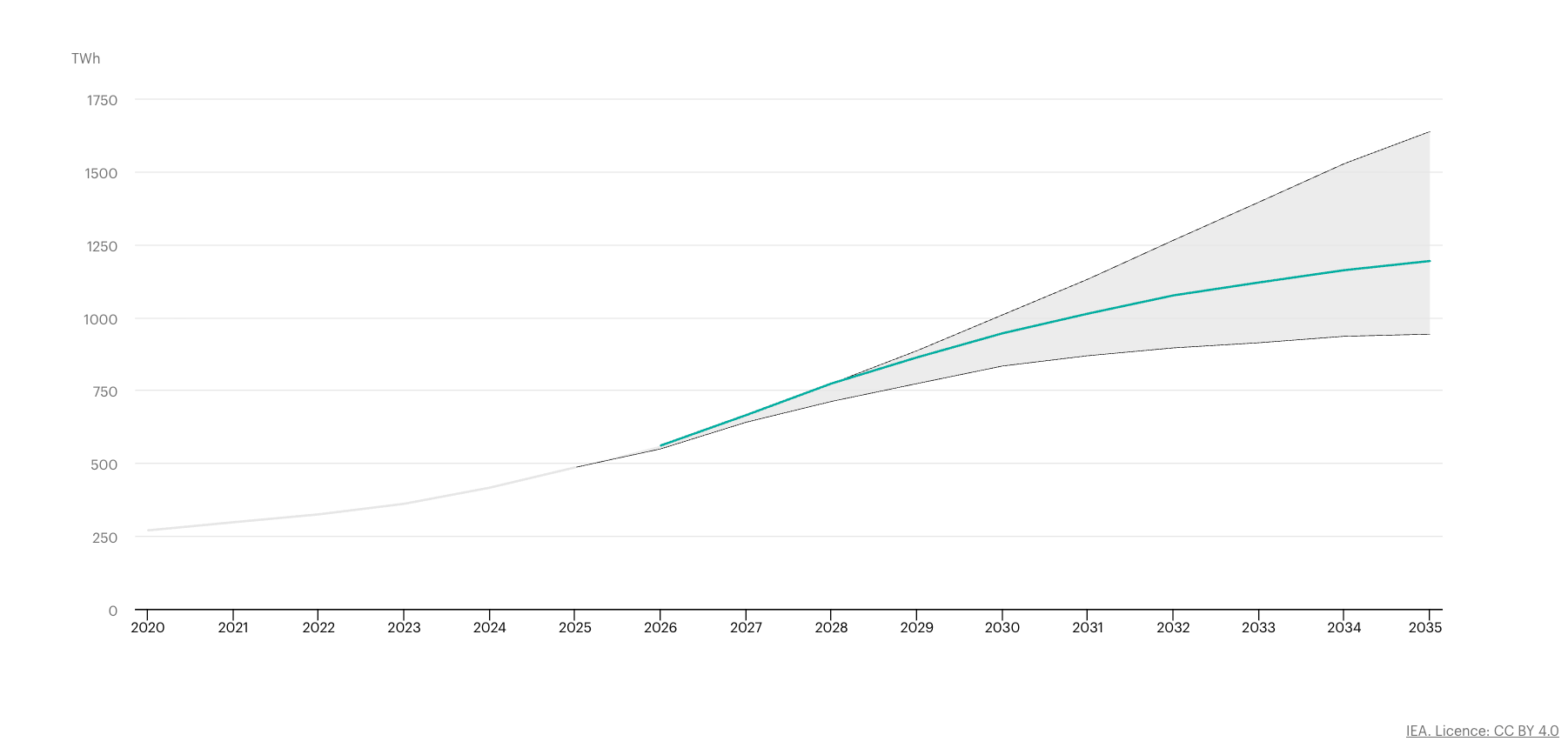
Source: https://www.iea.org/reports/key-questions-on-energy-and-ai/executive-summary
This means that the boundaries of the AI value chain are changing. In the past, the market regarded Nvidia as the main proxy asset for AI computing power. In the future, it may be necessary to include power generation, transmission, transformers, cooling, data center REITs, and energy management companies in the AI infrastructure framework. AI has not freed the digital economy from physical constraints; instead, it has placed electricity, land, and construction back at the center of technological growth.
1.4 Can Commercialization Catch Up with Investment?
AI capital expenditure growth has been verified by data, but the return on capital has not yet been fully verified. For supply chain companies such as Nvidia, Micron, and TSMC, increasing capital expenditure for cloud providers translates into orders and revenue; for Microsoft, Amazon, Alphabet, Meta, and Oracle, the same capital expenditure translates into cash flow expenditures, depreciation, and operating costs.
S&P Global Ratings believes that most leading cloud providers still have sufficient balance sheet capacity to support investment, but high capital expenditures are depressing free cash flow. It is worth noting that there are also circular capital flows, long-term procurement commitments, financing guarantees, and cross-dependence between model companies and cloud vendors in the AI ecosystem: cloud vendors invest in model companies, model companies use funds to purchase cloud services, and cloud vendors use revenue to purchase chips and build data centers. This structure can strengthen growth, but may also mask the true independence of final demand.
Alphabet disclosed that its cloud business order backlog reached about $462 billion at the end of Quarter 1, 2026, nearly doubling from the previous quarter and supporting future capital investment. Nvidia disclosed that its revenue for fiscal year 2026 reached $215.90 billion, a year-on-year increase of 65%, with data center network revenue increasing by 142%, indicating that AI demand has spread from computing chips to the interconnection and system levels.
Because the AI value chain has become one of the most-watched asset classes in the global capital markets, its price fluctuations and trading demand have also begun to transcend the time and geographical limitations of traditional stock markets. More and more cryptocurrency platforms are trying to transform listed companies in the AI value chain into price exposures that can be traded 24/7 via stablecoin settlement and perpetual contracts. Therefore, the AI supercycle is no longer only happening in traditional capital markets, but also entering the cryptocurrency market, forming a "second battlefield".
II. Analysis of the AI Value Chain: The Underlying Assets of the Second Battlefield Trading
The second battlefield transaction is not an abstract "AI concept", but the price exposure of different companies in the AI value chain. The AI value chain is not a static list of technology stocks but one driven by capital expenditures and constantly shifting supply bottlenecks. Whenever a new bottleneck appears, funds will reprice the corresponding listed companies, which is also the fundamental reason for the continuous evolution of the second battlefield transaction hotspots.
The companies listed in the table below are representative of the AI value chain and illustrate the correspondence between potential transaction stocks and industry links on the second battlefield. They do not represent that all companies have been listed on the encryption platform, nor do they constitute any investment advice.
|
AI industry link
|
Main functions
|
Representative Listed Companies
|
Core observed variable
|
|
Cloud Computing Platforms and Capital Expenditure
|
Provide funding, computing power procurement, and AI service entry
|
Microsoft、Amazon、Alphabet、Meta、Oracle
|
CapEx, Cloud Revenue, Order Reserve, Free Cash Flow
|
|
Chip design and accelerated computing
|
GPU, CPU, ASIC, and interconnect chips
|
Nvidia、AMD、Broadcom、Marvell
|
Shipments, product iteration, pricing power, customer concentration
|
|
Semiconductor manufacturing and equipment
|
Advanced process, lithography, etching, testing, packaging
|
TSMC、ASML、Applied Materials、Lam Research、KLA
|
Advanced process utilization, CapEx, yield, production cycle
|
|
HBM and Storage
|
Provide high-bandwidth memory and data storage for AI accelerators
|
SK hynix、Micron、Samsung、Western Digital
|
HBM share, contract price, capacity, inventory cycle
|
|
Network, server, and cooling
|
Connect GPU cluster and complete rack-level deployment
|
Arista、Coherent、Dell、HPE、Super Micro、Vertiv、Eaton
|
Network bandwidth, rack delivery, liquid cooling, power density
|
|
Data center and computing power leasing
|
Land, data center, GPU cloud and managed services
|
CoreWeave、Equinix、Digital Realty
|
Utilization, financing costs, customer concentration, contract duration
|
|
Power and energy infrastructure
|
Power generation, transmission, transformers, and stable energy supply
|
Constellation Energy、Vistra、GE Vernova、NextEra Energy
|
Electricity price, grid connection period, long-term power purchase agreement, construction progress
|
|
Software and AI applications
|
Convert infrastructure investment into corporate revenue
|
Palantir, ServiceNow, Salesforce, Adobe, etc
|
AI revenue, in-app purchase conversion rate, renewal rate, inference cost
|
2.1 Cloud Providers Are Both the Engine of the Supercycle and Its Cost Bearers
Microsoft, Amazon, Alphabet, Meta, and Oracle are the most important sources of capital expenditure in the AI value chain. They determine GPU procurement, data center construction speed, and customized chip investment, and also distribute computing power to model companies and enterprise users through Cloud Computing Platform. However, simply classifying these companies as "AI beneficiary stocks" will obscure their true position. Cloud providers are first and foremost the ones funding this wave of capital spending. The growth of capital expenditures can drive cloud revenue, but it will also reduce free cash flow and form depreciation in the future.Only when the newly added computing power is efficiently utilized and converted into continuous cloud services and software revenue, can investment form a positive cycle.
There are significant differences in the business models of different cloud providers. Amazon, Microsoft, and Alphabet have mature cloud businesses that can directly sell computing power to external customers. Meta mainly realizes AI value through advertising, recommendation algorithms, and consumer applications, lacking the same scale of external cloud revenue; Oracle relies on databases, cloud infrastructure, and large AI training contracts to expand, but its balance sheet may also be under higher pressure.Therefore, evaluating cloud service providers should not only focus on the absolute value of capital expenditures, but also pay attention to the ratio between capital expenditures and revenue, operating cash flow, and order reserves. More investment is not necessarily better, what really matters is how much sustainable revenue each dollar of capital expenditures can create.
2.2 Chips, Manufacturing, and Equipment Form the Strongest Order Fulfillment Layer
Nvidia, AMD, and Broadcom are in the AI chip design layer. Nvidia's advantage comes from the platform capabilities enabled by GPUs, CUDA, networks, and whole-machine systems; AMD is trying to expand its share through accelerators, CPUs, and software ecosystems; Broadcom benefits from custom ASICs, network chips, and high-speed interconnection needs.
After chip design, there are TSMC, ASML, and semiconductor equipment companies. Whether it is a GPU or a custom ASIC, advanced process and advanced packaging are required. TSMC said on the 2026 Quarter 1 conference call that, to meet AI demand, the company is increasing its investment in N3 capacity. The capital expenditure in 2026 is expected to approach the high end of the $56 billion guidance range. The management expects the annual compound growth rate of AI accelerator-related revenue to exceed 50% by 2029. At the same time, advanced packaging capacity is still tight.
Therefore, chip, wafer, and equipment companies are usually the first layer of capital expenditure to realize income, and they are also the first assets to be repriced by the market in the AI supercycle. When the second battlefield centers on the AI value chain, this layer is often the first to receive funding.
2.3 HBM, Networking, and Cooling Are Becoming the New Bottleneck Assets
Micron's rapid growth in trading volume on encrypted platforms is not an accidental single-stock event. It reflects the AI market's focus spreading from GPUs to HBM and storage. GPUs are responsible for computation, but model training and inference require constant access to parameters and data. When computing power grows faster than data transfer speed, memory bandwidth becomes a performance bottleneck. HBM improves bandwidth and energy efficiency by vertically stacking multiple layers of DRAM close to the processor. Therefore, SK Hynix, Micron, and Samsung are no longer just traditional storage-cycle enterprises but also core suppliers of AI computing systems.
The network is equally important. As AI systems expand from a single card to thousands or even tens of thousands of accelerators, system efficiency depends on the data transmission between chips. Nvidia's NVLink and InfiniBand, Arista's high-speed switching equipment, Broadcom and Marvell's network chips, and Coherent's optical communication products are all solving the problem of "how to make more chips work like a system".
Next is server power and cooling. With the increase in AI rack power density, traditional air cooling may not meet demand, underscoring the importance of liquid cooling, power management, and backup power. The AI capabilities of companies such as Vertiv and Eaton do not come from models but from helping data centers operate reliably.
The hot spot of the second battlefield transaction will not remain in the same company for long, but will continue to migrate as the new supply bottleneck in the AI value chain emerges. From GPU to HBM to network, power, and cooling systems, the real transaction is not between a single company but over the scarcest capacity in the industry chain.
2.4 The Real Downstream Is Commercialization, Not Models
OpenAI, Anthropic, and various basic model companies are at the model level, but the ultimate downstream of the industry chain is not the model itself; it is whether enterprises and consumers are willing to continue paying. Companies such as Palantir, ServiceNow, Salesforce, and Adobe are trying to embed AI into data analysis, workflows, customer management, and content production. Microsoft, Google, and Meta are incorporating AI into work, search, advertising, and social platforms. Infrastructure investment has a long-term economic basis only when AI can increase revenue, reduce costs, or improve retention.
The main contradiction at this level is the cost of inference and the ability to pay. Improving model capabilities may increase demand, but model compression, inference optimization, and open-source competition will also reduce unit call prices. If the computing resources consumed by each AI task decrease rapidly, social usage may increase, but the revenue of a single cloud vendor or model company may not necessarily increase year-on-year with the demand for computing power.
Because the AI value chain has a clear capital-flow path, transaction hotspots on the second battlefield will continue to migrate with the industry bottleneck. Capital expenditure on cloud services determines the flow of funds; supply constraints determine the market's focus; and price expectations shape trading flows on the second battlefield. In other words, what is traded on the second battlefield is not the concept of AI or enterprise ownership, but the price expectations formed by different links in the AI value chain at different stages.
III. Formation of the Second Battlefield: How the AI Value Chain Enters the Crypto Market
The AI value chain's entry into the crypto market is not about bringing stock ownership on-chain, but about bringing price exposure into the crypto ecosystem. The core of trading on the second battlefield is not corporate ownership, but price fluctuations driven by industry expectations. The expansion of capital expenditure across the AI value chain provides crypto trading platforms with a set of assets naturally suited for derivatives trading: they have high global visibility, frequent catalysts, sufficient volatility, relatively accessible price data, and strong alignment with the technology narratives familiar to crypto users. The growth of stock perpetual contracts, stock tokens, and Pre-IPO products is bringing the AI value chain from traditional securities accounts into stablecoin-based trading accounts.
3.1 Contract Precedes Ownership: The Second Battlefield Trades Price First
According to a CoinGecko report, the monthly trading volume of RWA/TradFi perpetual contracts increased from $230 million in early 2025 to $347.17 billion in May 2026. Among these products, the monthly trading volume of stock perpetual contracts on major platforms rose from $831 million in July 2025 to $34 billion in May 2026, representing a nearly 40-fold increase.
The growth of derivatives has outpaced that of spot tokens, reflecting a clear product logic. Stock token issuance requires the purchase and custody of underlying shares, as well as clearing, redemption, corporate action processing, and compliance with securities regulations. Stock perpetual contracts, by contrast, primarily require price indices, oracles, margin systems, and liquidation mechanisms. Platforms do not need to bring the underlying shares on-chain and can still provide users with price exposure.
This suggests that the first stage of TradFi's expansion into the crypto market is not the transfer of ownership, but the migration of trading demand. Users initially need tools that allow them to trade global asset prices with stablecoins, rather than a securities account that fully replicates traditional shareholder rights.
This also means that the AI value chain initially enters the crypto market through price exposure rather than the transfer of stock ownership. The second battlefield first addresses whether an asset can be traded and whether it can be traded around the clock. Questions such as whether users truly own the underlying shares, can redeem the underlying assets, or are entitled to dividends and voting rights are left to more complex stock token structures and securities infrastructure.
3.2 From Nvidia to Micron: Trading Hotspots Shift Along Industry Bottlenecks
Amid the rapid growth of stock perpetual contracts, AI- and technology-related stocks have emerged as some of the most active trading themes. According to CoinGecko data, Nvidia, Tesla, Micron, and Circle are among the most actively traded stocks. The trading volume of Micron-related contracts, for example, increased from $736 million in April 2026 to $13.16 billion in May.
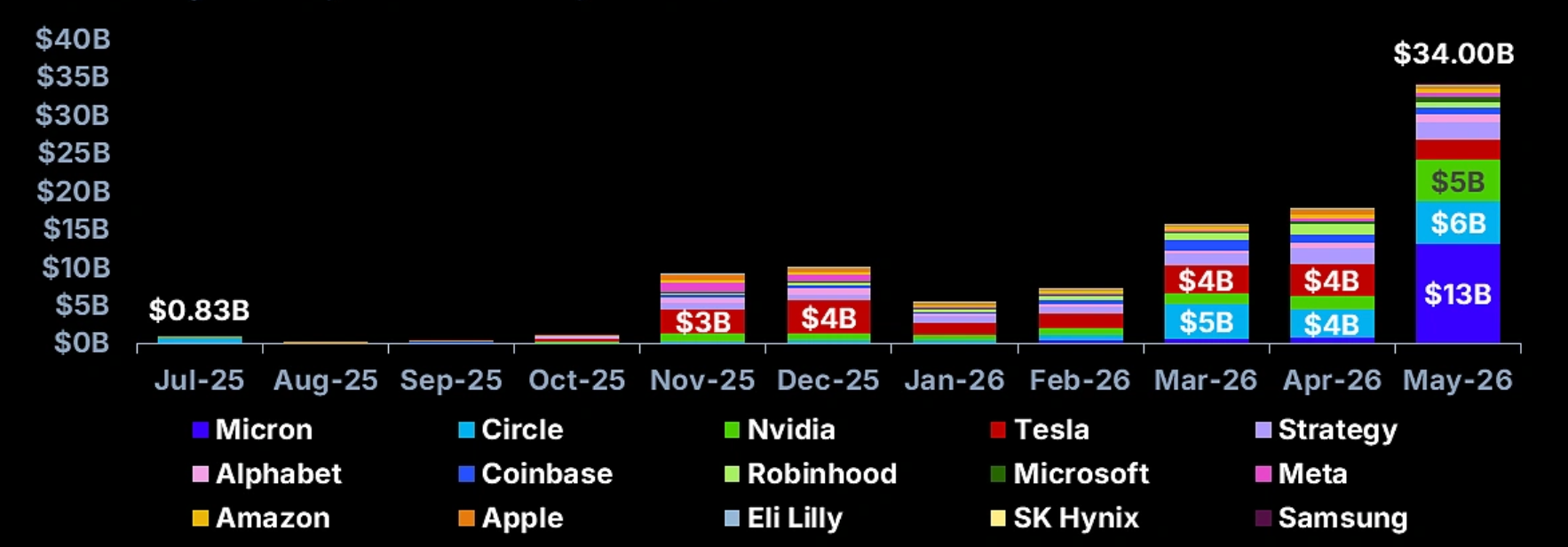
Source: https://www.coingecko.com/research/publications/tradfi-on-crypto-exchanges-report-2026
The significance of Micron's rising trading volume extends beyond the sudden popularity of a single stock. It may indicate that the crypto market's understanding of the AI value chain is beginning to shift from GPUs toward HBM, storage, and broader system bottlenecks. In the past, Nvidia was almost the sole proxy asset for AI trading. In the future, trading activity may rotate among chip design, semiconductor manufacturing, HBM, networking, servers, and power infrastructure.
3.3 CEXs Compete for Trading Access, DEXs Compete for Market Issuance
At the platform level, CEXs and DEXs are following different development paths. Binance, Hotcoin, and Hyperliquid have become leading platforms in the RWA/TradFi perpetual contract market.
Binance, Hotcoin, and other CEXs lower trading barriers through unified accounts, USDT settlement, shared margin, and internal market-making systems. Stock perpetual contracts can be traded 24/7 and settled in USDT, typically with leverage of 10x to 25x. Funding payments are generally settled every eight hours.
These platforms offer contracts linked to technology and semiconductor stocks, including Nvidia, Microsoft, Meta, Amazon, TSMC, and Broadcom. To address the closure of traditional stock markets, CEXs use multiple pricing mechanisms. During regular trading hours, third-party data sources are used to construct price indices. During extended-hours or low-liquidity periods, platforms may use index-weighted methods to smooth price movements. On weekends and holidays, the price index may remain at the last known price, while the mark price may gradually adjust based on contract trading activity within predefined limits.
Price indices, funding intervals, and market-closure mechanisms vary across platforms. Users should therefore refer to the relevant contract page for specific rules.
On the Perp DEX side, Hyperliquid's HIP-3 opens certain market creation capabilities to external deployers. Deployers can determine contract specifications, oracle configurations, leverage limits, and settlement mechanisms, while using the HyperCore order book and margin system.
The advantage of this model is that the speed of new listings and market innovation is no longer determined entirely by a single exchange. The risk is that responsibility for oracle design and market operations is distributed among different deployers. Hyperliquid requires HIP-3 deployers to stake a specified amount of HYPE and may impose penalties for market operation or oracle-related issues.
The core of CEX competition therefore lies in account infrastructure, liquidity, and distribution capabilities, while DEX competition is increasingly extending to the question of who has the right to create a market. Given the large number of stocks across the AI value chain and the rapid migration of trading hotspots, this open market creation mechanism may be better suited to covering long-tail assets. However, it also depends more heavily on deployer quality and reliable external price data.
3.4 The Second Battlefield Presents a Liquidity Map, Not an Industry Value Map
According to CoinGecko data, US-listed AI stocks such as Nvidia and Micron are actively traded, while non-US stocks record significantly lower trading volumes. This indicates that the AI stock landscape on crypto platforms is not a complete map of the industry, but a map of liquidity.
Whether an asset can become a popular contract depends on several factors:
-
whether it is familiar to global users;
-
whether continuous and reliable USD price feeds are available;
-
whether the underlying market has sufficient liquidity;
-
whether its price volatility is sufficient to generate trading demand; and
-
whether platforms can efficiently handle corporate actions and regulatory restrictions.
The second battlefield in the crypto market is therefore not a complete mirror of the first. It tends to exclude assets with low visibility, complex pricing data, insufficient volatility, or limited market-making feasibility, while concentrating liquidity in a small number of stocks that can most easily attract global trading interest.
Traditional indices are usually constructed based on market capitalization, free float, and industry classification. Crypto platforms, by contrast, tend to favor stocks that generate a steady flow of catalysts, volatility, and trading demand. Industry importance determines whether a company is worth studying, while liquidity and volatility determine whether it can become a popular contract. The two are not always aligned.
From a deeper perspective, the second battlefield presents a liquidity map shaped by user awareness, USD pricing, market-making capacity, and trading sentiment, rather than a complete map of value across the AI industry. This explains both its rapid expansion and the continued limitations of its price representativeness.
IV. Structural Tensions in the Second Battlefield: Around-the-Clock Trading, Price Discovery, and Leverage Risk
AI stocks and crypto assets share several trading characteristics: high growth expectations, wide valuation ranges, frequent catalysts, and strong global investor interest. Earnings reports, chip launches, model upgrades, export restrictions, capital expenditure adjustments, and energy contracts can all trigger rapid price movements. These features create sustained trading demand on the second battlefield and make AI stocks more suitable for perpetual contract products than many traditional assets.
However, 24/7 trading does not automatically produce reliable price discovery around the clock. Stock perpetual contracts connect two markets with different trading hours, clearing systems, and regulatory frameworks. When traditional stock markets are closed but crypto contracts continue trading, the second battlefield may absorb new information earlier, but it may also diverge from fundamentals because of limited spot arbitrage, lower liquidity, and concentrated leverage.
4.1 The Initial Competition Is for Volatility, Not Ownership
When crypto exchanges expand into TradFi products, they appear to be adding new asset classes. In practice, they are also seeking new sources of volatility. When overall crypto market activity declines, contracts linked to gold, crude oil, stocks, and ETFs can generate additional trading demand.
AI stocks are particularly well suited to this model because they produce more frequent catalysts than most traditional sectors. Quarterly earnings, capital expenditure guidance, new chip launches, data center orders, regulatory restrictions, and model partnerships can all become price-moving events.
The AI value chain also experiences clear narrative rotation. When GPUs are in short supply, Nvidia becomes the primary trading asset. When HBM prices rise, attention shifts toward Micron and SK hynix. When networking and optical communications become bottlenecks, Arista, Broadcom, Marvell, and Coherent may attract increased trading activity. When power supply becomes constrained, the market may rotate toward nuclear energy, power grids, and data center infrastructure.
This makes the AI value chain a group of assets capable of continuously generating new trading themes. For trading platforms, the value does not come only from the appreciation of a particular stock, but from the industry's ability to produce new tradable assets, funding activity, and market-making demand.
This logic also reveals an important reality: the primary criterion used by crypto platforms to select assets may not be long-term value, but volatility. Industry importance determines whether a company is worth studying, while volatility and liquidity determine whether it can become a popular contract. The two are not always aligned.
4.2 24/7 Trading Does Not Equal 24/7 Price Discovery
One of the main selling points of stock perpetual contracts is that they remain tradable after traditional stock markets close. This is also the product's most fundamental structural tension.
During regular US stock market hours, perpetual contract prices can remain close to spot prices through price indices, funding mechanisms, and arbitrage activity. During after-hours and overnight trading, however, liquidity in the underlying market declines and fewer pricing sources are available. On weekends and public holidays, the underlying exchanges are fully closed, and actual shares cannot be used for immediate arbitrage.
At that point, stock perpetual contracts no longer trade an immediately executable spot price. Instead, they trade the market's expectations for the next opening price. The product therefore combines characteristics of a stock derivative, a pre-market instrument, and a prediction market.
Suppose an AI company announces a major chip defect, regulatory investigation, or large customer order over the weekend. The price of its perpetual contract may respond immediately, but arbitrageurs cannot use the underlying stock to lock in the price difference. The contract price may reflect new information, but the effect may also be amplified by thin liquidity.
When the underlying stock market reopens on Monday, the spot market and the perpetual contract reconnect. Any accumulated price gap may need to converge rapidly, potentially leading to opening gaps, sharp repricing, and liquidations.
Platforms also handle market closures in different ways. Some freeze the price index and allow only limited movement in the mark price. Others use external after-hours data, while some rely on contract trades and moving averages. Users may see a 24/7 stock price on every platform, but the economic meaning behind that price can differ significantly.
The quality of a stock perpetual contract should therefore not be assessed solely by whether it can be traded around the clock. It should also be evaluated based on its oracle sources, market-closure rules, mark price methodology, price movement limits, abnormal-event procedures, and opening-price convergence mechanism.
4.3 Fundamental Cycles and Leverage Cycles May Reinforce Each Other
Traditional stock markets typically follow information cycles centered on quarterly earnings and annual capital expenditure plans. Stock perpetual contracts compress these cycles by using leverage, funding payments, and automatic liquidation to translate fundamental changes into much shorter trading cycles.
During an AI capital expenditure upcycle, cloud providers increase investment, chip companies receive more orders, suppliers expand capacity, and the market raises earnings expectations. Rising prices attract additional leveraged long positions. Higher funding rates may then draw in arbitrageurs and market makers, creating a reinforcing cycle.
If cloud providers reduce capital expenditure, the same chain can operate in reverse. Budget cuts first affect orders for GPUs and servers. Lower procurement by chip companies then affects foundries, semiconductor equipment manufacturers, and HBM suppliers. Delayed data center projects may further weaken demand for power equipment, cooling systems, and financing.
As stock prices fall, leveraged positions in perpetual contracts may be liquidated. Reduced liquidity can widen price deviations and trigger additional forced selling.
In traditional markets, changes in capital expenditure may take several quarters to move through the value chain. Perpetual contracts can reprice expectations within hours. The crypto market does not eliminate the industry cycle; it compresses the market's reaction time through leverage.
4.4 Trading AI Stocks Does Not Mean Owning AI Companies
Stock perpetual contracts provide price exposure, not stock ownership. Users generally do not receive voting rights, shareholder status, direct dividend rights, or claims in bankruptcy proceedings. Even when a contract tracks the price of Nvidia or Microsoft, holding the contract should not be understood as holding shares in the underlying company.
The rights attached to spot stock tokens are more complex. Some products are issued on a 1:1 basis against underlying shares purchased by the issuer. However, users typically hold a security certificate, structured note, or economic interest defined by the issuer, rather than ordinary shares registered directly in the company's shareholder register.
Dividends, stock splits, mergers, and redemptions must therefore be processed through the issuer, broker, and custodian.
AI stocks can enter the crypto market through at least three fundamentally different product structures:
-
Stock perpetual contracts, which provide price exposure without underlying ownership;
-
1:1-backed stock tokens, which may be supported by underlying assets, although user rights depend on the issuance structure; and
-
Pre-IPO contracts or tokens, which may provide only valuation exposure, economic interests in an SPV, or event-based exposure.
All three products may display a stock ticker on the front end, but their legal and economic substance can differ significantly. The more platforms emphasize a unified trading experience, the more important it becomes for users to identify the underlying structure of each product.
V. Outlook and Conclusion: From a Second Trading Venue to a Second Pricing Layer
The first battlefield of the AI supercycle is the competition among cloud providers, chip companies, data center operators, and energy suppliers around capital expenditure, capacity expansion, and commercialization. The second battlefield is emerging in the crypto market. By transforming leading AI value chain assets into stablecoin-settled, 24/7 tradable instruments with leverage, crypto platforms provide investors with a round-the-clock trading venue beyond traditional stock markets.
At present, however, the second battlefield represents more of a liquidity map than a complete map of industry value. The rapid growth in the trading volume of stock perpetual contracts demonstrates expanding trading demand, but it does not necessarily indicate that the market has developed mature price discovery.
The more important question is whether the crypto market can continue to produce meaningful reference prices while traditional stock markets are closed. Achieving this will require reliable oracle systems, deep liquidity, and robust liquidation mechanisms. If these conditions continue to improve, the crypto market could evolve from a complementary trading venue into a second pricing layer for global technology assets. During events such as earnings releases, product launches, or regulatory developments, it could aggregate global investor expectations more quickly and provide valuable price signals before traditional markets reopen.
If these conditions are not met, however, 24/7 pricing may remain little more than 24/7 trading without effective spot-market constraints. Prices may continue to be heavily influenced by limited liquidity, leveraged positioning, and market sentiment, making it difficult to establish an independent and reliable price discovery mechanism.
Whether the second battlefield ultimately remains a short-term speculative venue or develops into a new layer of global price discovery remains uncertain. What is clear, however, is that as more AI-related assets become tradable around the clock in the crypto market, traditional securities markets will, for the first time, face a continuously operating competitor in price formation.
Ultimately, the long-term success of the second battlefield will depend not on whether trading volume continues to grow, but on whether pricing mechanisms, liquidity, clearly defined product rights, and risk management can mature together. Only after these market foundations are fully established can today's 24/7 on-chain pricing experiment evolve into a genuine second pricing layer within the global financial system.
About Us
Hotcoin Research is the research and insights division of Hotcoin, dedicated to turning professional research into actionable market insights.
Through Weekly Insights and In-Depth Research Reports, we help investors understand market trends, underlying dynamics, and emerging opportunities across the digital asset ecosystem. Our Elite Picks series combines AI-assisted screening with analyst-driven research to identify assets worth monitoring and help investors evaluate opportunities more efficiently.
Through regular livestreams, our research team provides timely analysis of market developments and major industry trends. We believe that informed decision-making and a long-term perspective can help investors navigate market cycles and capture lasting value in Web3.
Risk Warning
The cryptocurrency market is highly volatile, and investment inherently carries risk. We strongly recommend that investors fully understand these risks and invest within a strict risk management framework to protect their capital.
Contact Us
Website:https://www.hotcoin.com/en_US/learn/index/
X: x.com/HotcoinAcademy
Email: labs@hotcoin.com
Lectura recomendada
Ver más
Hotcoin Research|Playing with Web3: A Comprehensive Analysis of Solana Blinks Ecosystem and How to Turn Twitter into a Crypto Haven
In-depth Research

Hotcoin Research | Whales Accumulate BTC in April: Has Bitcoin Bottomed?
In-depth Research

ETH Guardians Fight Back: Can Ethereum Community Foundation Ignite ETH's Value Recovery?
In-depth Research

Contactos de servicio
Service@hotcoin.com
Comentarios sobre el producto
Product@hotcoin.com
Cooperación empresarial
Business@hotcoin.com
Contactos Legales
Casecn@hotcoin.com
Sobre nosotros
producto
Servir
soporte
©2017-2026