

Hotcoin Research | The On-Chain Migration of Traditional Finance: A Structural Rewiring of Financial Infrastructure
TL;DR
Background: Traditional financial institutions are transitioning from pilot experimentation to infrastructure-level on-chain deployment. Evolution: Private chains → public chain integration | Experimentation → production deployment | Tech-driven → compliance-driven Framework: Full-stack on-chain transformation across tokenized deposits/funds, trading and settlement, corporate actions automation, collateral and custody systems Ecosystem: Banks, asset managers, clearinghouses, exchanges, custodians, and infrastructure providers are actively participating Risks: Fragmented interoperability | Regulatory uncertainty | High integration costs | Evolving security risks | Institutional inertia Opportunities: Significant market expansion potential | Clear efficiency gains | Emergence of new financial product structures | Lower investor access barriers Conclusion: The key question is no longer “whether to go on-chain,” but who will secure a central position within the new financial infrastructure
The on-chain transformation of traditional financial institutions has moved beyond pilot experimentation and entered the stage of infrastructure-level deployment. This shift is not merely a technological upgrade, but a structural rewiring of the global financial system: settlement cycles are compressing from T+2 to near real-time, capital is evolving from static deposits into programmable assets, and cross-border payments are shifting from multi-day processing to near-instant execution. While these changes may not yet be fully visible to retail participants, they are already reshaping the fundamental mechanics of wealth management, payment and clearing systems, and global asset allocation.
I. Background and Drivers: Why Are Traditional Financial Institutions Moving On-Chain?
The inefficiencies of the traditional financial system are widely acknowledged and structurally embedded. Equity settlement cycles remain at T+2, government bond transactions often require manual reconciliation, cross-border payments can take three to five days, and fees are layered across multiple intermediaries. According to a joint report by The Boston Consulting Group (BCG) and Ripple, the hidden costs associated with inefficient settlement amount to hundreds of billions of dollars annually. Blockchain introduces a fundamentally different paradigm—real-time, programmable, and transparent.
-
Real-time settlement: On-chain transactions enable T+0 or near-instant finality, reducing counterparty risk.
-
Programmability: Smart contracts automate corporate actions such as dividends, redemptions, and collateral management, reducing human error.
-
Enhanced liquidity: 24/7 trading enables global circulation of assets, including traditionally illiquid or fragmented assets.
-
Cost efficiency: By reducing intermediary layers, interbank payment costs could decline by over 80%, according to JPMorgan estimates.
-
New financial models: The integration of tokenized deposits and stablecoins enables the creation of bank-grade on-chain money, unlocking a trillion-dollar opportunity at the intersection of DeFi and TradFi.
-
Regulatory clarity and competitive pressure: The 2025 U.S. GENIUS Act provides a framework for stablecoins and tokenized assets, while Europe’s MiCA regulation and initiatives such as Hong Kong’s HKMA Ensemble and Singapore’s Project Guardian offer regulatory sandbox support. These developments are accelerating the shift from cautious observation to active deployment. BlackRock CEO Larry Fink noted in his 2026 outlook that tokenization represents a “turning point for global markets,” comparable to the early internet in 1996.
For investors, this transformation has tangible implications. Assets that were traditionally accessible only through bank-managed channels—such as money market funds—are increasingly available in tokenized form, offering comparable yields with real-time liquidity. At the same time, corporate treasury management is shifting from bank-centric systems to on-chain wallets, significantly improving capital efficiency.
II. The Evolution of On-Chain Adoption in Traditional Finance
The on-chain evolution of traditional financial institutions has not occurred as a sudden inflection point, but rather as a decade-long, gradual transformation. At its core, this process reflects a structural migration of financial infrastructure from closed, siloed systems to programmable and interoperable networks.
(1) Early Exploration and Validation Phase (2015-2020): "Can It Be Done?"
The defining characteristic of this phase was proof-of-concept validation, with financial institutions maintaining a cautious stance. In 2016, JPMorgan launched its consortium-chain-based Onyx platform (later evolved into Kinexys) to test the efficiency of interbank payments and clearing. Ripple collaborated with multiple banks to pilot cross-border settlement networks, validating the feasibility of distributed ledger technology in international remittances. Meanwhile, infrastructure providers such as Consensys and Chainlink supported enterprise-grade blockchain experimentation.
However, adoption during this period remained largely confined to private or consortium chain environments, with limited scale and no meaningful production deployment. The primary objective at this stage was not commercial viability, but technological feasibility.
(2) Early RWA Expansion Phase (2021-2023) - "Can It Scale?"
As the DeFi ecosystem matured and institutional awareness increased, on-chain adoption began extending into real-world asset (RWA) tokenization. Franklin Templeton launched its BENJI on-chain fund, marking one of the first instances of traditional fund shares being issued and transacted on public blockchains. Multi-chain deployment strategies also began to emerge, signaling a shift away from single-chain dependency. At the same time, institutions started exploring hybrid models that integrate on-chain infrastructure with regulatory compliance frameworks.
The key inflection point of this phase was that assets were no longer merely represented or simulated on-chain, but were instead natively issued and transacted on-chain.
(3) Accelerated Phase (2024-2025) - "Can It Become a Closed Loop?"
Entering 2024, on-chain finance experienced a critical acceleration, driven by two converging forces: increasing regulatory clarity (e.g., the U.S. GENIUS Act and Europe’s MiCA framework) and the maturation of technological infrastructure, including Layer 2 scaling solutions and cross-chain interoperability protocols. Under these conditions, on-chain finance began to evolve into a more integrated system, forming an increasingly complete financial stack:
-
Asset layer: Tokenized government bonds, funds, and deposits
-
Payment layer: Stablecoins and tokenized deposits
-
Infrastructure layer: On-chain clearing, custody, and collateral management
Representative developments during this phase include Société Générale issuing compliant stablecoins via SG-FORGE and integrating them into Deutsche Börse’s clearing infrastructure; the Hong Kong “Whale” platform enabling real-time enterprise fund transfers between institutions such as HSBC and Standard Chartered; and U.S. banks beginning to test stablecoins and tokenized deposits on public blockchain networks. The defining shift of this phase was the transition from isolated use cases to system-level integration.
(4) Infrastructure Deployment Phase (2026–present) - "Will it become the standard?"
By 2026, on-chain adoption has entered a true production-grade phase, with several defining characteristics:
-
Core financial infrastructure moving on-chain: DTCC is advancing tokenized U.S. Treasury systems
-
Multi-chain deployment as a standard: BlackRock’s BUIDL fund has expanded across multiple public blockchain ecosystems
-
Bank native participation on public chain: JPMorgan's tokenized deposit (JPMD) is deployed on Base and Canton Network
-
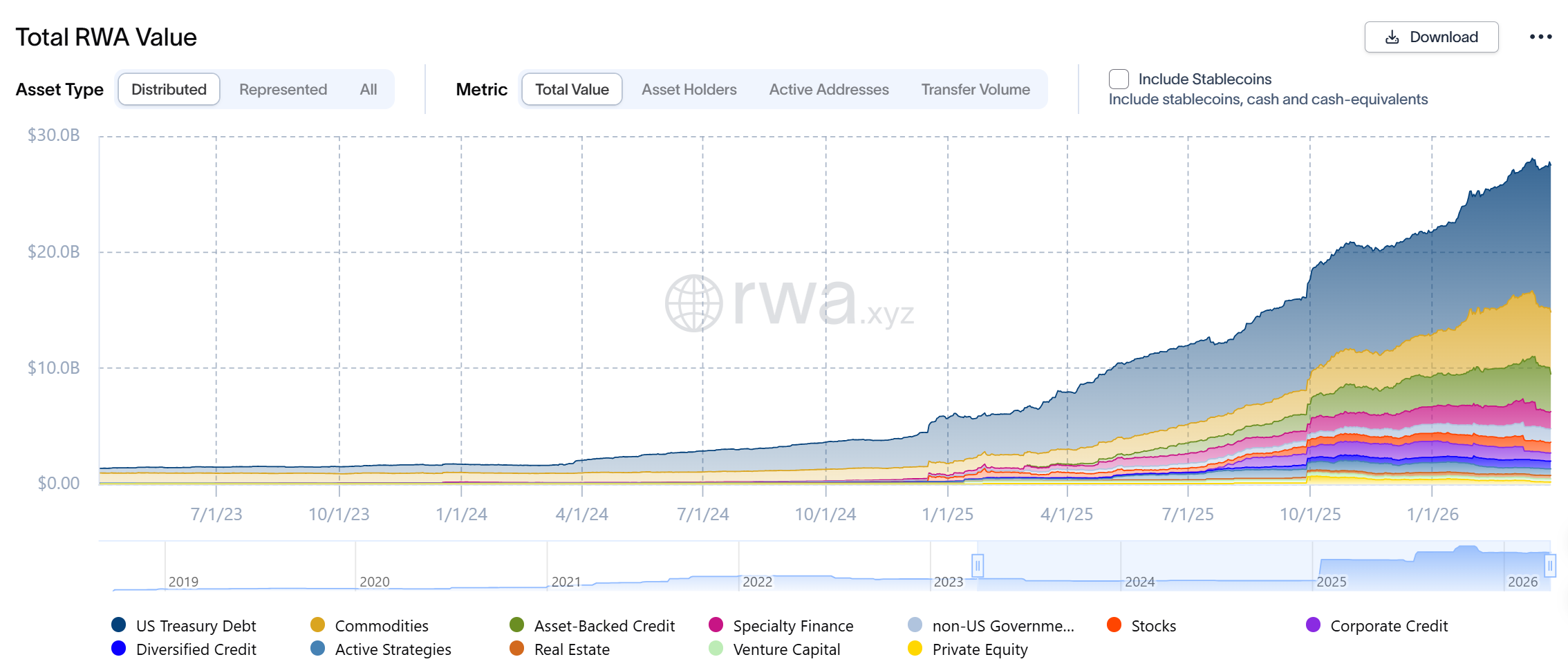
Rapid market expansion: The size of non-stablecoin RWA assets has grown from approximately $14 billion in early 2025 to around $27.50 billion, with institutional participation increasing significantly
At this stage, blockchain is no longer an external tool layered onto existing systems, but is becoming an integral component of the financial system itself.
Looking across the full trajectory of this evolution, three structural trends can be identified:
-
From private chain → public chain integration: Early emphasis on control and isolation is giving way to openness, interoperability, and shared liquidity
-
From experimentation → production-level deployment: The shift from proof-of-concept testing to real capital flows and mission-critical operations
-
From technology-driven → compliance-driven adoption: The integration of KYC/AML frameworks, regulatory sandboxes, and audit mechanisms is providing the institutional foundation for on-chain finance
III. On-Chain Migration: Current Landscape and Case Studies
The on-chain transformation of traditional financial institutions is not merely a layer of technological enhancement, but a fundamental rewiring of financial system architecture. While the tokenization of deposits and funds, as well as the on-chain transformation of trading and settlement, represent initial entry points, blockchain adoption is now extending across back-end operations, risk management frameworks, and custody infrastructure, forming an increasingly integrated financial stack.
1. Tokenized Deposits and Funds
This segment represents the foundational layer of on-chain finance. The core mechanism involves transforming traditional bank deposits and money market funds into blockchain-native tokens, typically backed 1:1, enabling real-time transferability, programmability, and continuous liquidity.
According to data from RWA.xyz, the total value of on-chain real-world assets has reached approximately $27.5 billion, with over 700,000 holders, nearly doubling since early 2025. Among these, tokenized U.S. Treasuries account for more than $12.86 billion, representing over 120% year-over-year growth. Initiatives such as BlackRock’s BUIDL fund, JPMorgan’s Kinexys platform, tokenized deposit systems under Hong Kong’s “Whale” project, and DTCC’s upcoming Treasury tokenization infrastructure have evolved from pilot programs into core components of institutional financial architecture.
Source: https://app.rwa.xyz/
Representative cases include:
-
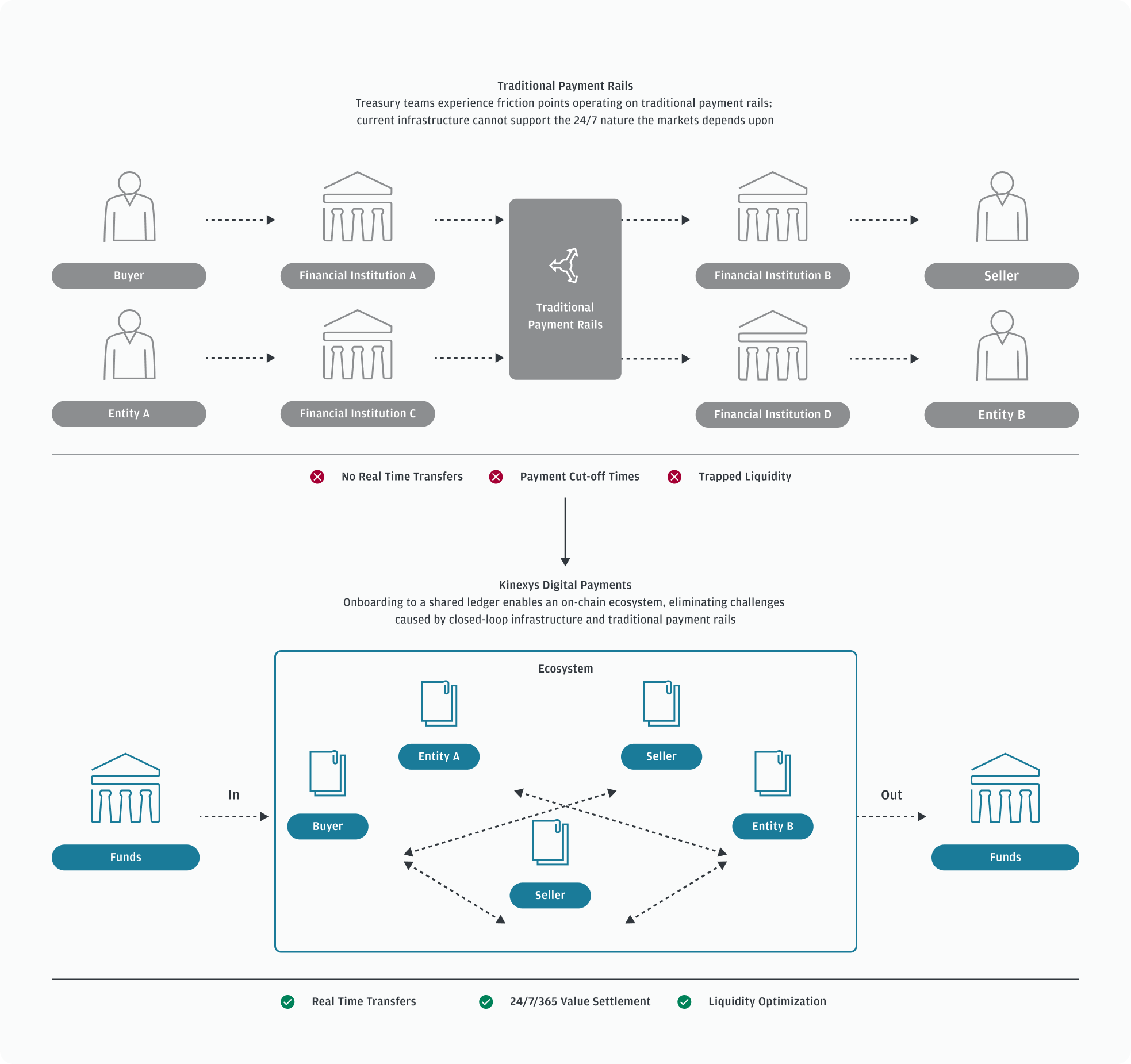
JPMorgan Kinexys/JPMD: JPMD represents tokenized deposits fully backed 1:1 by underlying balances, supporting issuance, transfer, and redemption while continuing to accrue interest at the base layer. As of 2026, JPMD has been natively deployed on Base and the Canton Network, enabling real-time, multi-currency settlement between institutions. Daily transaction volumes exceed $2 billion, with cumulative volume surpassing $1.5 trillion.
-
BlackRock BUIDL Fund: A tokenized money market fund backed by U.S. Treasuries and cash equivalents, offering an annualized yield of approximately 3.5% to 4%. As of early 2026, BUIDL has expanded across multiple public blockchains, including Polygon, Arbitrum, Avalanche, and Optimism, enabling 24/7 trading and collateral usage. Total AUM exceeds $2.2 billion, accounting for nearly 20% of the tokenized Treasury market.
-
Franklin Templeton BENJI Fund: Deployed across multiple chains including Stellar, Ethereum, Polygon, and Solana, with over $580 million in assets under management. The fund supports daily yield distribution and compliant on-chain transactions.
-
Hong Kong Whale platform: A joint initiative involving HSBC, Standard Chartered, and Ant International, enabling real-time cross-bank transfers of tokenized deposits across HKD, USD, offshore RMB, and SGD. By late 2025, the platform supported single transactions exceeding HKD 38 million, with 24/7 corporate treasury management via on-chain wallets.
-
France Societe Generale SG-FORGE CoinVertible: A MiCA-compliant EUR/USD stablecoin (effectively an extension of tokenized deposits), integrated with Deutsche Börse Clearstream for use in collateral management and securities settlement.
2. On-Chain Rewiring of Trading and Settlement
The transformation of trading and settlement infrastructure focuses on upgrading exchanges and clearing systems through blockchain integration, enabling continuous trading, real-time settlement (T+0), and stablecoin-based financing.
Source: https://developer.payments.jpmorgan.com/
Representative cases include:
-
New York Stock Exchange (NYSE) Digital Trading Platform: Announced on January 19, 2026, the NYSE is developing an independent tokenized securities platform supporting 24/7 trading of listed equities and ETFs, alongside instant on-chain settlement. In March 2026, it partnered with Securitize as a digital transfer agent responsible for native on-chain issuance of securities. Integration with institutions such as BNY Mellon and Citi enables tokenized deposits to be embedded into clearing workflows, facilitating atomic Delivery-versus-Payment (DvP).
-
DTCC Canton Network Treasury Tokenization: An MVP is scheduled for launch in the first half of 2026, providing tokenization services for U.S. Treasuries held within the DTC system. As the world’s largest securities depository, DTCC’s involvement effectively brings trillion-dollar-scale liquidity into programmable financial infrastructure.
-
Nasdaq Tokenized Stock Framework: Has received partial approval from the SEC to enable parallel trading of tokenized equities within existing exchange environments.
This transformation shifts institutional trading from “T+2, business hours” to “real-time, global, and continuous,” significantly reducing both counterparty risk and capital lock-up.
3. Corporate Actions and Asset Servicing Automation
According to data from the US Depository Trust and Clearing Corporation (DTCC), traditional corporate action processing, including dividends, voting, and mergers, incurs costs of up to $58 billion annually. The integration of blockchain and AI enables data standardization and real-time distribution.
Representative cases:
-
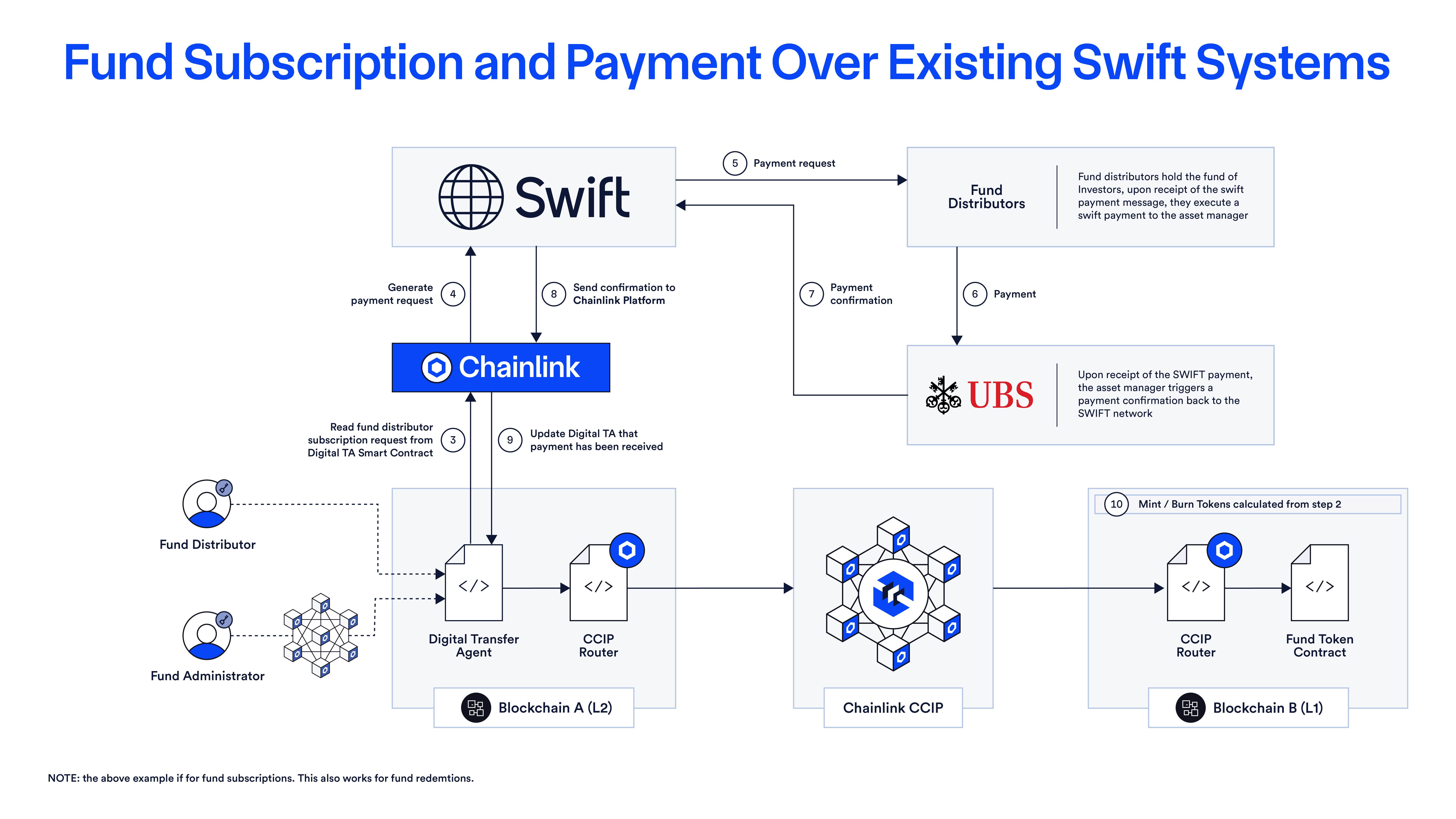
Chainlink Global Industry Initiative: Involves 24 institutions, including SWIFT, DTCC, Euroclear, UBS, DBS Bank, and BNP Paribas Securities Services. AI systems extract structured data from corporate announcements, which is then verified through Chainlink’s CRE framework and converted into ISO 20022-compliant formats. The data is distributed across both traditional systems and on-chain smart contracts via CCIP, enabling near real-time execution and settlement of corporate actions.
Source: https://blog.chain.link/
4. Collateral Management and Cross-Border Liquidity Optimization
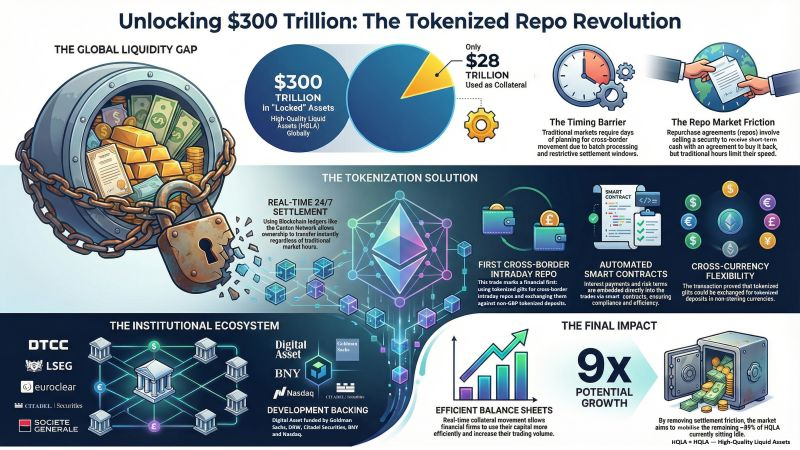
In traditional financial systems, high-quality liquid assets (HQLA), such as government bonds, often exhibit low utilization due to operational constraints. Blockchain-based infrastructure enables these assets to be mobilized in real time across jurisdictions, transforming collateral usage into a programmable, cross-border, and continuous process.
Representative cases:
-
Canton Network Industry Working Group: Participants include DTCC, LSEG, BNY Mellon, and Société Générale. The platform enables cross-border intraday repo transactions, including tokenized UK gilts versus non-GBP deposits. It supports multi-asset, multi-currency collateral reuse on a 24/7 basis, with the broader objective of unlocking approximately $300 trillion in global high-quality assets that remain underutilized within traditional financial systems, enabling faster, more flexible, and more cost-efficient capital and collateral flows.
5. Expansion of Digital Asset Custody: Institutional-Grade Crypto Custody
Traditional custodian banks are increasingly integrating digital assets such as Bitcoin into their existing platforms, enabling unified reporting, tax processing, and KYC across asset classes.
Representative cases include:
-
Citi: Plans to launch institutional-grade Bitcoin custody services within 2026, fully integrated into its existing custody infrastructure.
-
BNY Mellon: As the world’s largest custodian bank, BNY Mellon has already deployed Bitcoin custody services, providing secure storage and transfer capabilities for institutional clients.
These five dimensions, including tokenized deposits and funds, trading and settlement transformation, corporate action automation, collateral optimization, and digital asset custody, are converging to form a new blockchain-based financial infrastructure. By 2026, these developments have entered a phase of coordinated, production-level deployment. Looking ahead, they are expected to unlock an estimated $2 trillion to $10 trillion in efficiency gains by 2030.
IV. Challenges and Opportunities: Structural Constraints and Long-term Upside
As on-chain adoption in traditional finance enters the infrastructure phase, the key question is no longer feasibility, but whether it can scale and standardize across markets. At this stage, structural constraints and long-term opportunities coexist, shaping both the pace and direction of adoption.
1. Key Challenges: Structural Constraints
(1) Interoperability and liquidity fragmentation: The proliferation of multiple blockchain networks has led to fragmented asset distribution and siloed liquidity pools. While cross-chain solutions such as CCIP and LayerZero aim to address these challenges, they remain at an early stage in terms of security, standardization, and institutional adoption.
(2) Regulatory and compliance uncertainty: Regulatory approaches to stablecoins, tokenized assets, and on-chain settlement continue to diverge across jurisdictions. Key unresolved issues include:
-
Legal recognition and enforceability of on-chain assets
-
Transaction finality versus reversibility mechanisms
-
Integration of KYC/AML frameworks within on-chain environments
(3) High integration costs with legacy systems: Structural differences between traditional banking infrastructure (e.g., core banking systems, clearing networks) and blockchain architectures result in significant integration complexity, extended implementation timelines, and elevated requirements for both technical and compliance capabilities.
(4) Limited liquidity depth and evolving security risks: Compared to traditional financial markets, on-chain RWA markets still exhibit relatively limited liquidity. At the same time, vulnerabilities in smart contracts and risks associated with cross-chain bridges continue to represent key security concerns.
(5) Institutional inertia: Many traditional financial institutions continue to classify on-chain assets as higher-risk exposures within internal risk frameworks, and existing approval and risk management processes are not yet fully adapted to blockchain-based systems.
2. Key Opportunities: Long-Term Drivers
(1) Significant market expansion potential: Multiple institutions, including BCG and Standard Chartered, project that tokenized assets could reach a multi-trillion-dollar scale by 2030. Within the approximately $130 trillion global fixed income market, even a 1% on-chain penetration rate would translate into trillion-dollar incremental growth.
(2) Clear and measurable efficiency gains: On-chain settlement can significantly reduce the cost and latency of financial transactions:
-
Settlement costs: reduced by approximately 50%-80%, depending on the use case
-
Capital efficiency: improved by 20%–30% through faster turnover and reduced capital lock-up
(3) The emergence of new financial product structures: The convergence of tokenized deposits and stablecoins is giving rise to “on-chain bank money.” Tokenized funds enable continuous liquidity and collateral usage, while smart contracts support new models in trade finance and asset management.
(4) Lower barrier to investor access: On-chain RWA enables broader participation by allowing retail investors to access asset classes such as government bonds and money market instruments that were historically limited to institutional investors, thereby improving global capital allocation efficiency.
Ultimately, the core of this transformation lies not in simply moving assets on-chain, but in rearchitecting the clearing layer and capital flow mechanisms. At its essence, this represents a shift from fragmented, intermediary-driven systems toward programmable financial infrastructure.
V. Outlook and Conclusion: From Asset Tokenization to Programmable Finance
Looking ahead to 2026-2030, on-chain finance is expected to evolve from isolated applications into a systemic layer of financial infrastructure, with three key trends emerging:
-
Expansion of full-spectrum asset tokenization: Tokenization is expected to extend beyond government bonds and deposits into equities and ETFs, private credit, structured products, real estate, and commodities. With participation from institutions such as DTCC, exchanges, and custodians, on-chain representations of traditional assets are likely to become standard.
-
Deep integration of DeFi and TradFi: DeFi is evolving from a yield-driven model toward one anchored in asset quality. RWA will increasingly serve as core collateral, while stablecoins and tokenized deposits reshape payment systems. On-chain interest rates are also expected to converge with traditional rate environments. This suggests that DeFi will become embedded within the broader financial system, rather than operating as a parallel ecosystem.
-
Intensifying regulatory and financial center competition: Regional approaches to on-chain finance are diverging: US: Positioned as a potential leader, with significant scaling potential as regulatory clarity improves Europe: Advancing standardization through MiCA Hong Kong and Singapore: Leveraging regulatory sandboxes and strengths in cross-border finance These regional dynamics will directly shape the deployment and evolution of on-chain financial infrastructure.
Conclusion
The on-chain transformation of traditional financial institutions is progressing from pilot experimentation to production-level deployment. Its significance lies not in simply migrating financial activities onto blockchain, but in fundamentally reengineering clearing and settlement mechanisms, enhancing capital efficiency, and enabling programmable asset management. As regulatory clarity improves, the trust layer of traditional finance is increasingly converging with the efficiency advantages of blockchain technology, giving rise to a new form of financial infrastructure. This transition is best understood not as a short-term technological disruption, but as a long-term structural evolution. The competitive frontier is no longer defined by whether institutions adopt blockchain, but by who can secure a dominant position within the next-generation financial infrastructure.
About Us
Hotcoin Research, the core research and investment arm of Hotcoin Exchange, is dedicated to turning professional crypto analysis into actionable strategies. Our three-pillar framework—trend analysis, value discovery, and real-time tracking—combines deep research, multi-angle project evaluation, and continuous market monitoring.
Through our Weekly Insights and In-depth Research Reports, we analyze market dynamics and highlight emerging opportunities. With Hotcoin Selects—our exclusive dual-screening process powered by both AI and human expertise, we help identify high-potential assets while minimizing trial-and-error costs.
We also engage with the community through weekly livestreams, decoding market hot topics, and forecasting key trends. Our goal is to empower investors of all levels to navigate cycles with confidence and capture long-term value on Web3.
Risk Disclaimer
The cryptocurrency market is highly volatile, and all investments carry inherent risks. We strongly encourage investors to remain informed, assess risks thoroughly, and adhere to strict risk management practices to protect their assets.
Connect with Us
Website:https://www.hotcoin.com/en_US/learn/index/
X: x.com/HotcoinAcademy
Email: labs@hotcoin.com
Lectura recomendada
Ver más
How Blockchain Works?
In-depth Research
Hotcoin Research | Disrupting Traditional Token Unlocking Models: How Gabby World’s Fair Release Mechanism is Reshaping GameFi Token Economics
In-depth Research
Hotcoin Research | September Rate Cut Confirmed: Is Altcoin Season Counting Down as Uptober Ignites Q4?
In-depth Research

Contactos de servicio
Service@hotcoin.com
Comentarios sobre el producto
Product@hotcoin.com
Cooperación empresarial
Business@hotcoin.com
Contactos Legales
Casecn@hotcoin.com
Sobre nosotros
producto
Servir
soporte
©2017-2026