
Hotcoin Research | DeFi Yield Restructuring: From On-Chain Native Yield to TradFi Yield Distribution
Introduction
Over the past few years, DeFi yield has primarily been generated on-chain. Lending protocols generate revenue from borrowing demand; DEXes generate revenue from trading fees; derivatives protocols generate revenue from funding rates and liquidations; and liquidity mining revenue comes from token subsidies. The advantages of this system are transparency, openness, and composability, but the disadvantages are also obvious: These revenue streams are highly dependent on market trends, leverage, and trading activity. Once the market enters a low-volatility, low-leverage, and low-trading-volume environment, on-chain yields quickly compress.
Now, the DeFi yield structure is undergoing a deeper migration. Protocols are beginning to allocate reserve assets, stablecoin liabilities, and user idle funds to tokenized Treasury, money market funds, CLOs, private credits, on-chain credit vaults, and institutional-grade yield products. DeFi is no longer just seeking yield from on-chain activity; it is moving TradFi's cash flow, credit spreads, and interest rate curves onto the chain and then distributing them to users through stablecoins, vaults, sTokens, or yield-bearing assets.
I. The DeFi Yield System Enters a Restructuring Cycle
If the first stage of DeFi solved the problem of "whether a financial market could emerge on-chain", then the industry is now facing another, more realistic problem: when trading, leverage, and token incentives cannot sustain high yields, what should the next round of DeFi growth rely on?
1.1 Native Yield Is No Longer Sufficient to Support DeFi's Next Stage of Growth
The first wave of DeFi growth was built on on-chain native yield. Lending protocols such as Aave, Compound, and MakerDAO, DEXes such as Uniswap and Curve, and derivative protocols such as dYdX and GMX have shown that as long as on-chain demand for trading, lending, leverage, and liquidity persists, protocols can generate sustainable revenue from trading fees, borrowing interest, funding rates, and other revenue streams, without relying on the traditional financial system. However, as the market gradually matures, this model, which relies entirely on on-chain activities to generate yield, is beginning to reveal increasingly apparent limitations.
-
First, on-chain yield is inherently pro-cyclical. During the bull market, demand for leverage increases, lending activity expands, and trading activity improves, leading to rapid growth in protocol revenue. However, after entering a bear market, trading volume shrinks, funding rates decline, and lending demand weakens, leading to a synchronous contraction in protocol revenue. Therefore, it is difficult for on-chain yield to generate stable cash flows.
-
Second, DeFi yield often comes from recycling the same pool of funds. Users use ETH as collateral to borrow stablecoins and then participate in leveraged strategies, LP strategies, or yield vaults. Protocols become increasingly composable and layered, causing TVL to continue to grow, but the underlying assets have not really increased. This capital circulation can amplify yield when the market rises, and also amplify liquidation risks and liquidity shocks when the market falls.
-
Finally, token incentives are difficult to sustain over the long term. Early DeFi relied on liquidity mining to bootstrap growth, but subsidized yields were not a substitute for sustainable yield. When token prices rise, high APYs can quickly attract capital. When token prices fall, however, those same incentives often turn into selling pressure, forcing protocols to continually increase subsidy costs to retain liquidity. For stablecoins, savings products, and institutional capital, this incentive-driven yield model is ill-suited for long-term capital allocation.
As the industry matures, on-chain native yield alone is becoming increasingly insufficient to support DeFi’s continued growth. As a result, finding new sources of sustainable yield has become a strategic priority for the industry.
1.2 TradFi Yield Moves On-Chain, Opening a Second Growth Curve
Against this backdrop, TradFi yield has emerged as an important new source of yield within the DeFi ecosystem. Traditional financial assets such as U.S. Treasuries, money market funds (MMFs), structured credit products, and private credit are not new, but with the help of asset tokenization, regulated custody, and on-chain distribution mechanisms, they are beginning to enter the DeFi ecosystem as on-chain assets.
For protocols, yield sources are expanding beyond on-chain trading to include off-chain cash flows; for users, stablecoins are also evolving from a simple medium of exchange to an entry point for on-chain money market funds, savings accounts, and yield-bearing asset management products.
It should be emphasized that the migration of yield sources does not mean the disappearance of risks, but rather a change in risk structure. Traditional DeFi focuses more on smart contracts, oracles, and liquidation risks, whereas the introduction of TradFi revenue has made factors such as custody risk, credit risk, interest rate risk, redemption risk, term mismatch, and legal enforceability new core sources of risk.
The introduction of TradFi yield into DeFi is therefore not about accessing "risk-free" yield, but about reshaping both yield sources and the framework for risk pricing. Protocols that can more effectively allocate real-world assets, manage risk, and consistently deliver sustainable yield will be best positioned to lead the next phase of DeFi's evolution.
II. From Native DeFi Yield to Asset Management–Driven Yield
Faced with the trend of on-chain endogenous yield gradually peaking and TradFi yield increasingly moving on-chain, different protocols have evolved completely different yield models based on their own positioning and governance concepts. Some still adhere to the native lending logic of DeFi; some have begun to build a complete on-chain asset management system; and some directly use RWA, such as U.S. Treasuries, as underlying reserves.
2.1 Aave: Staying True to Native DeFi Yield
As one of the largest decentralized lending protocols, Aave's business model has always revolved around lending spreads. Users deposit ETH, BTC, stablecoins, and other assets into the protocol to earn yield, while borrowers pay interest on their loans. The protocol captures a portion of the interest spread through the Reserve Factor, thereby creating a recurring stream of protocol revenue.
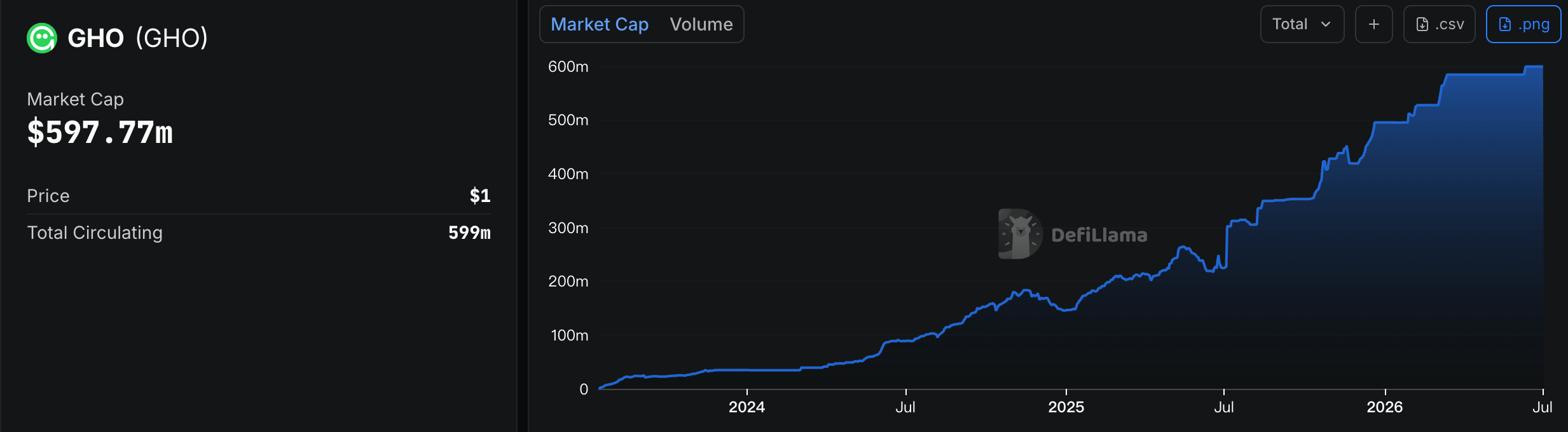
The launch of GHO further strengthens Aave's yield model. GHO is an over-collateralized stablecoin launched by Aave in 2023. Unlike stablecoins issued by centralized institutions such as USDT and USDC, GHO does not rely on fiat currency reserves to back its issuance; it is minted by users who pledge eligible collateral and borrow against it. Essentially, GHO is still an on-chain loan. Users mint GHO only when they need to borrow and continue paying interest on the loan; when the loan is repaid, GHO is burned. Therefore, the circulating supply of GHO directly reflects on-chain borrowing demand, while the protocol revenue comes from the interest paid by borrowers. According to DeFiLlama data, as of July 2, 2026, the total circulating supply of GHO is approximately $598 million.
https://defillama.com/stablecoin/gho
To further share protocol revenue with long-term holders, Aave introduced sGHO (Savings GHO), which currently offers a 4.5% APY. By depositing GHO into sGHO, users receive a share of the protocol revenue allocated through governance. Aave's revenue model is straightforward: borrowing demand generates protocol revenue, which is then distributed to sGHO holders through governance.
2.2 Sky: Evolving from a Stablecoin Protocol into an On-Chain Asset Management Platform
Following its 2024 rebrand, MakerDAO repositioned itself as a comprehensive On-Chain Asset Management Platform, moving beyond its original role as a standalone stablecoin protocol. Within this framework, USDS serves as the protocol's liability layer rather than merely a stablecoin, while sUSDS functions as the primary vehicle through which users earn protocol yield. Modules including Spark, Grove, PSM, and Legacy RWA collectively form the protocol's asset allocation framework. Rather than relying solely on lending markets to generate revenue, Sky allocates capital across multiple yield-bearing assets based on governance decisions and distributes the resulting yield to sUSDS holders through the Sky Savings Rate (SSR).
Compared with Aave, Sky's biggest distinction lies in the diversification of its yield sources. On one hand, lending protocols such as Spark continue to generate native on-chain lending revenue. On the other, the protocol has steadily increased its allocation to U.S. Treasuries, money market funds, and other real-world assets, expanding its yield sources beyond on-chain financial activity to include real-world cash flows. Meanwhile, the Peg Stability Module (PSM) continues to facilitate stablecoin conversions and liquidity management, resulting in an integrated balance sheet framework that links liabilities, asset allocation, and yield distribution.
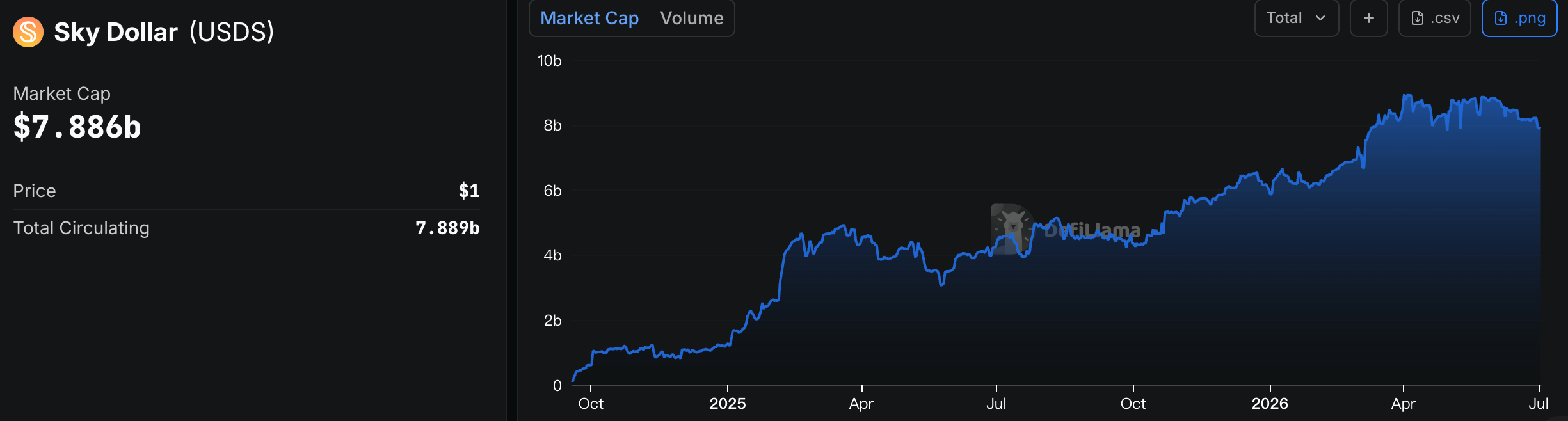
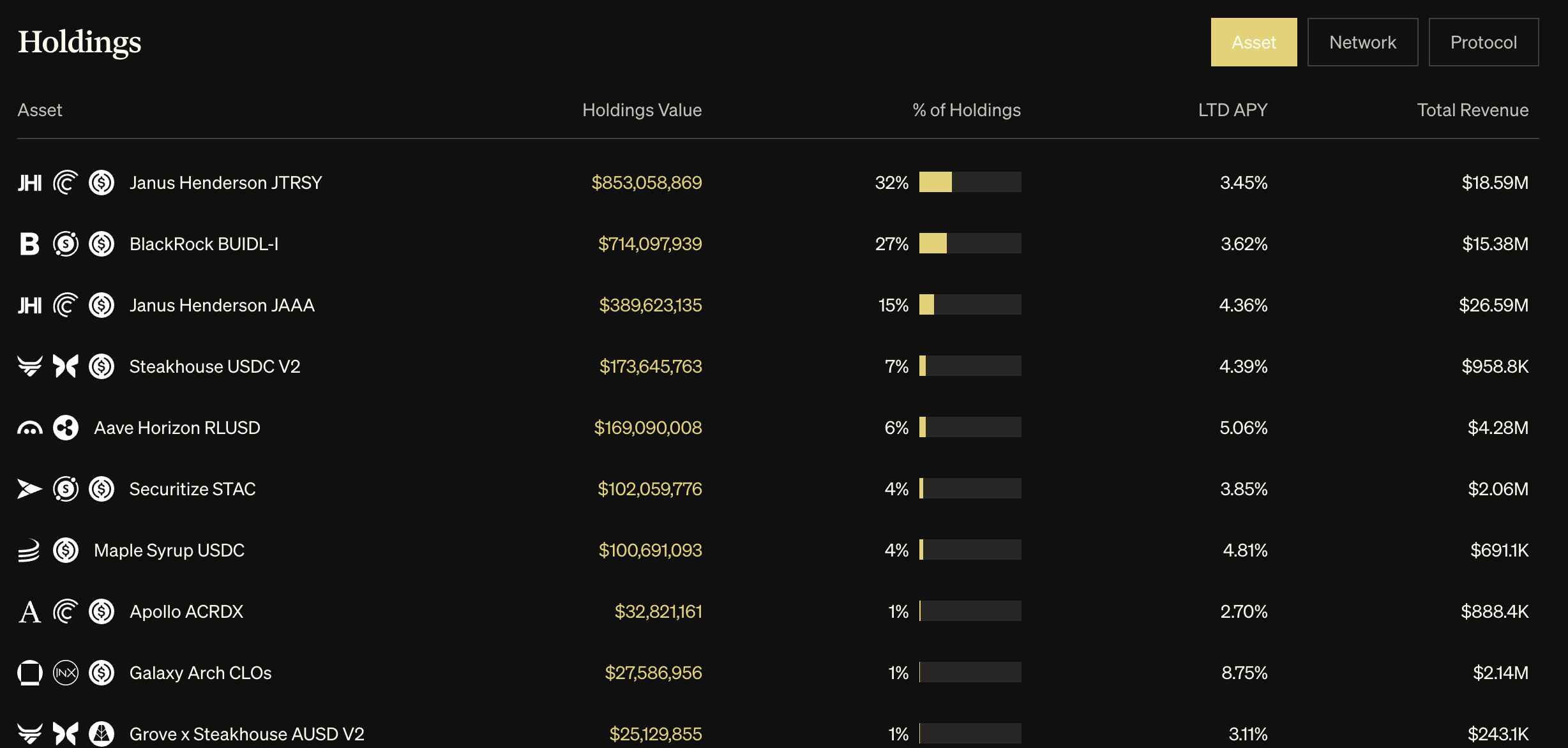
As of early July 2026, sUSDS had become one of the largest yield-bearing stablecoins in DeFi. According to official Sky data, the total supply of USDS stood at approximately $7.88 billion as of July 2, 2026, while sUSDS offered a 3.75% APY. At the same time, core modules such as Spark and Grove managed billions of dollars in assets, generating recurring cash flows for the protocol and making Sky one of the strongest asset allocators in DeFi. Grove alone managed approximately $2.645 billion in assets, of which roughly $1.567 billion was allocated to short-duration U.S. Treasuries, $492 million to investment-grade public credit, and $32.8 million to private credit. Together, these three categories accounted for approximately 79.1% of Grove's portfolio.
Source: https://defillama.com/stablecoin/sky-dollar
Source: https://data.grove.finance
This demonstrates that Sky has already built a diversified portfolio supported by a unified balance sheet management framework. Its operating model increasingly resembles that of a traditional asset manager, with the key difference being that asset allocation, yield distribution, and governance are all executed on-chain.
2.3 Ethena: Building a Dual-Yield Engine Across Crypto and TradFi
Unlike Aave, which remains focused on native DeFi yield, and Sky, which has evolved into an on-chain asset management platform, Ethena has built a diversified yield framework that adapts to different market environments. Ethena's initial breakthrough came with USDe. Rather than relying on on-chain lending, USDe generates yield through a delta-neutral strategy that combines spot asset holdings with offsetting perpetual futures positions. The defining feature of this model is that its yield comes not from lending interest, but from the trading dynamics of the crypto derivatives market. However, funding-based yield is inherently cyclical. During periods of market consolidation or bear markets, the funding rate decreases or even turns negative, and the protocol revenue declines accordingly.
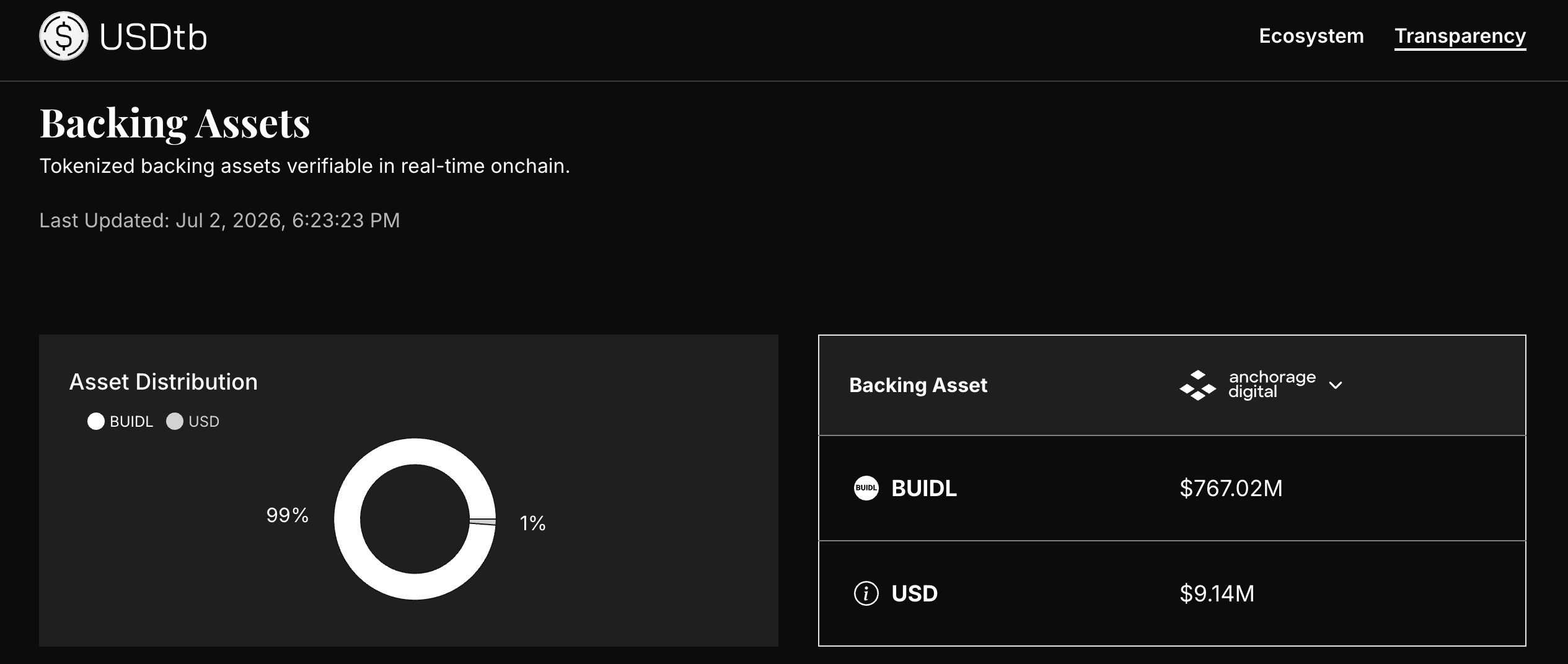
Against this backdrop, Ethena launched USDtb. Unlike USDe, USDtb does not rely on derivative strategies to generate yield; instead, it allocates underlying reserves to BlackRock's BUIDL fund and other U.S. Treasury-backed assets, thereby earning yield backed by U.S. Treasuries and other real-world assets. The launch of USDtb represents a new direction for DeFi: it is no longer just an on-chain financial protocol but also an on-chain distribution channel for real-world assets. According to DeFiLlama data, as of July 2, 2026, the circulating supply of USDtb is approximately $775 million, with BUIDL reserves accounting for about 98.97%.
Source: https://usdtb.money/transparency
By combining funding-based yield with Treasury-backed yield, Ethena has built two complementary yield engines: on one hand, during active market periods, the protocol can capture elevated funding yields in the derivatives market; on the other, when funding-based yield declines, it can rely on real-world assets to provide a more stable source of cash flow, thereby smoothing overall yield volatility and enhancing the protocol's resilience across market cycles. Ultimately, Ethena ultimately represents not a single source of yield but a flexible yield allocation framework: By integrating both crypto-native and TradFi yield sources, the protocol can continuously optimize its asset allocation as market conditions evolve, maintaining a more resilient and balanced yield structure across market cycles.
These three approaches represent distinct philosophies of asset allocation and yield generation: native DeFi yield, balance sheet expansion, and yield structure transformation. Together, they point to a broader trend: the focus of DeFi competition has gradually shifted from simple protocol design to competition between asset management and yield orchestration capabilities.
III. Yield Structure Shifts Are Reshaping DeFi
The current shift in DeFi's yield structure extends far beyond any single protocol or product. Instead, the entire industry is undergoing a systematic evolution. From yield sources to asset allocation, from protocol positioning to competitive logic, DeFi is gradually breaking away from the early development model of relying on on-chain native yield and evolving into a more mature asset management system.
3.1 Yield Sources Are Becoming More Diversified
Early DeFi yield came almost entirely from on-chain financial activity. Borrowing interest, trading fees, funding rates, and liquidity incentives together constitute the main sources of protocol revenue. This model has advantages such as high capital efficiency and complete on-chain integration, but it also means that yield generation is highly dependent on market activity levels. When the market enters a downward cycle, lending demand declines, trading volume shrinks, funding rates fall, and protocol revenue often declines in tandem.
In recent years, with the rapid development of RWA, DeFi's yield sources have gradually diversified. In addition to traditional lending yields, real-world assets such as U.S. Treasuries, money market funds (MMFs), investment-grade credit, and private credit have become new sources of yield. At the same time, on-chain yield strategies, such as funding rates, staking yields, and basis trading, have continually enriched the protocol's yield structure.
The diversification of yield sources not only improves protocols' resilience to market fluctuations but also enables DeFi to allocate yield-bearing assets across markets for the first time. For users, yield no longer comes only from the crypto market but also from sharing the cash flow generated by real-world assets. For protocols, how to continuously access sustainable yield sources from different markets is becoming a new competitive focus.
3.2 From Product-Driven to Asset-Driven Protocols
Behind the change in yield sources lies a bigger change in how protocols operate. After early DeFi protocols launched lending, DEX, or stablecoin functions, protocol revenue could be generated naturally as long as market activity remained strong. Therefore, protocol competition centers more on product features, user experience, and liquidity, with the importance of asset allocation capabilities relatively limited.
With the gradual expansion of yield sources into off-chain assets, more and more protocols are actively managing assets rather than passively relying on organically generated yield. Protocols need to continuously adjust asset allocations in response to market conditions, dynamically balancing on-chain lending, RWA, stablecoin reserves, credit assets, and liquidity to achieve the optimal combination of yield, risk, and liquidity.
This change is giving DeFi protocols many of the characteristics of asset management institutions. Asset allocation is no longer just a risk management tool, but a core capability for generating yield. In the future, differences between protocols will be reflected more in the ability to acquire and allocate assets, and to continuously generate cash flow, rather than just in the functional design of the protocols themselves.
3.3 DeFi Is Becoming the Distribution Layer for TradFi Yield
In addition to the evolution of yield sources and asset allocation methods, DeFi's role in the broader financial system is also evolving. In the past, DeFi played more of a role as on-chain financial infrastructure, with protocols providing financial services such as lending, trading, and derivatives, with protocol revenue primarily generated by internal capital flows. As more real-world assets move on-chain, DeFi is beginning to assume new responsibilities, becoming an important channel for distributing TradFi yield to global users.
In this process, the protocol is no longer just a generator of protocol revenue, but also an allocator and distributor of yield. On one hand, the protocol connects real-world yield sources such as U.S. Treasuries, money market funds, and credit assets; on the other, it connects users on the global chain, completing yield accounting, asset management, and yield distribution through smart contracts. The traditional financial market generates cash flow, while DeFi brings this yield on-chain in an open, transparent, and composable manner.
This change means that the relationship between DeFi and TradFi is moving from competition to integration. In the future, the two are more likely to form a division-of-labor and cooperative relationship: TradFi provides stable, yield-bearing underlying assets; DeFi provides a global, programmable distribution network; and together they build a new generation of on-chain financial ecosystem.
3.4 The Next Phase of Competition Will Center on Yield Orchestration
When yield sources, asset allocation methods, and protocol roles change, the competitive logic of DeFi shifts accordingly.
In the past, the success of a protocol depended more on TVL, APY, trading volume, and product features. High yields, high liquidity, and a rapidly growing user base often became the core advantages of protocol competition. However, as the industry gradually matures, these indicators have become increasingly difficult to form long-term barriers.
In the future, more important competitive advantages will come from yield orchestration capabilities. Yield orchestration capabilities not only include obtaining high-quality assets, designing yield products, and continuously generating cash flow, but also include establishing a strong partner ecosystem, a sound risk management system, and an efficient yield distribution mechanism. The focus of competition between protocols will also shift from simply competing on yield to comparing stability, sustainability, and risk-adjusted yield.
From this perspective, DeFi is undergoing a paradigm shift from "financial product competition" to "asset management competition". The protocols best positioned to lead the next phase of DeFi will be those that can consistently source high-quality assets, allocate capital efficiently across diverse yield sources, and build reliable yield distribution mechanisms.
IV. Yield Restructuring Is Redefining Risk Pricing
More and more DeFi protocols are incorporating real-world assets, such as U.S. Treasuries, money market funds, and private credit, into their yield frameworks. However, the migration of yield sources has not eliminated risks; it has changed their sources, transmission paths, and pricing methods. In the past, DeFi focused more on smart contracts, oracles, and liquidation mechanisms; today, protocols are beginning to face long-standing problems in traditional finance such as asset quality, credit risk, liquidity management, and compliance operations. While the yield structure is changing, the risk-pricing framework across the industry is also undergoing a profound restructuring.
4.1 From Code Risk to Asset Risk
Early DeFi risks were primarily technology-driven. Smart contract vulnerabilities, oracle anomalies, cross-chain bridge attacks, sharp movements in collateral prices, and liquidation failures are among the main sources of risk for the entire industry. Therefore, whether a protocol is trustworthy largely depends on whether the code has been fully audited, whether the liquidation mechanism is robust, and whether the protocol has experienced market cycles.
However, as more protocols introduce real-world assets, risks are gradually shifting from the code layer to the asset layer. For protocols that allocate assets such as U.S. Treasuries, money market funds, and private credit, smart contracts remain important, but yield stability is now determined by the underlying assets themselves. Whether the assets truly exist, whether the yield can continue to be generated, whether the issuer and custodian can fulfill their obligations, and whether the asset valuation is accurate have all become important factors affecting protocol stability.
This change means that DeFi's risk management framework has gradually expanded from on-chain infrastructure to the entire asset lifecycle. The protocol needs to ensure code security and continuously manage asset quality, partner institutions, and underlying investment portfolios.
4.2 Credit Risk Has Re-Emerged as a Core Variable
If asset-layer risk is a direct result of yield migration, then credit risk is the most fundamental change once TradFi yield enters DeFi.
Traditional DeFi mostly uses over-collateralization mechanisms. Whether it is ETH, BTC, or mainstream stablecoins, the risks stem more from price fluctuations than from credit defaults. Therefore, the protocol mainly relies on collateral rates and liquidation mechanisms to control risks, and almost does not need to judge the borrower's credit quality. However, when yields begin to come from U.S. Treasuries, money market funds, investment-grade bonds, private credit, and even other real-world assets, credit becomes an important component of the overall yield framework again. For example, Treasury yields reflect sovereign credit; money market funds rely on the operational capabilities of fund managers and custodians. Private credit requires continuous evaluation of borrowers' solvency and default probability. For protocols, higher yields often mean higher credit risks, rather than just market volatility risks.
In the future, DeFi protocols will need to establish not only a risk management framework but also a comprehensive credit assessment framework. From asset screening and partner selection to investment portfolio management, credit analysis will gradually become an important part of the protocol's asset management capabilities.
4.3 Liquidity Management Will Matter More Than Yield
Yield has always been the most closely watched indicator in DeFi, but for long-term funds, what often determines asset allocation decisions is not APY but liquidity.
Traditional DeFi products can usually achieve instant redemption because the underlying assets are highly liquid. However, when the protocol begins allocating real-world assets such as U.S. Treasuries and private credit, the underlying assets naturally have a term structure and redemption cycle, which means the protocol must strike a new balance between yield and liquidity. To meet users' demand for redemption at any time, the protocol typically needs to maintain an appropriate level of cash reserves or highly liquid assets and establish a liquidity buffer mechanism. When there is a large-scale redemption in the market, this part of the liquidity reserve can reduce the risk of forced asset sales and mitigate the impact of yield fluctuations on user experience.
Therefore, for future yield-based stablecoins, liquidity management may matter more than yield itself. Whoever can achieve more efficient capital allocation and liquidity management while maintaining stable yield has a better chance of gaining recognition from long-term institutional funds.
4.4 A New Risk Pricing Framework Is Emerging
Changes in yield sources, changes in asset allocation methods, and increased demand for liquidity management have jointly driven DeFi to develop a new risk-pricing framework.
In the past, protocol risks mainly revolved around the on-chain ecosystem. Risk assessment focused more on code security, protocol mechanisms, and market volatility. In the future, risk models need to incorporate multiple dimensions, including asset credit, custody arrangements, legal structures, liquidity management, regulatory environments, and counterparties. This means that DeFi and TradFi are forming an increasingly integrated relationship: TradFi provides underlying assets and stable yields, while DeFi provides global, programmable asset management and yield-distribution capabilities. For protocols, introducing TradFi yield is not simply adding an asset class, but means re-establishing a complete management framework covering assets, risk, liquidity, and governance.
Therefore, the real competition in the next stage of DeFi is not about delivering the highest yields but about establishing a long-term balance among yield, risk, liquidity, and transparency. Whoever can consistently source high-quality assets, accurately assess risks, allocate capital effectively, and establish a reliable yield distribution system is more likely to become the core platform for on-chain asset management in the next stage.
V. Asset Management Will Define DeFi's Next Competitive Frontier
Looking back, each major phase of DeFi's evolution has been defined by a new approach to value creation. In the era of liquidity mining, competition centered on attracting capital into protocols; after the rapid development of lending and derivatives, competition shifted toward capital efficiency and protocol yield; and as more and more real-world assets begin to enter the chain, the focus of competition in DeFi is also undergoing new changes.
5.1 Asset Management Will Become the Next Competitive Advantage
In the past, most DeFi protocols focused more on the liability side of the balance sheet, that is, how to attract more users to deposit assets, expand the scale of stablecoin issuance, or increase protocol TVL. However, as yield sources diversify, simply having large funds is no longer enough to sustain a long-term competitive advantage.
In the future, it is more important to have asset management capabilities. Asset management here is not just about allocating U.S. Treasuries or RWA, but about establishing systematic management capabilities across the entire asset life cycle, including acquiring high-quality assets, evaluating yield sources, assessing credit risk, managing liquidity, optimizing asset portfolios, and delivering sustainable yield distribution.
From this perspective, excellent DeFi protocols in the future will increasingly resemble digital asset managers with global asset allocation capabilities. The focus of protocol competition will also gradually shift from product design capabilities to asset management capabilities.
5.2 Competition Will Shift from Yield to Capabilities
In the past few years, the DeFi market has come to view APY as the primary measure of a protocol's attractiveness. However, as more institutional funds enter the chain, relying solely on yield is no longer sufficient to create a durable competitive advantage. For long-term capital, the key considerations extend well beyond headline APY. Stable yield, transparent assets, sufficient liquidity, and effective risk management matter far more than yield alone.
In the future, the competition between protocols will be less about yield and more about core capabilities. These general capabilities include at least four aspects.
-
First, asset sourcing capabilities. Whether the protocol can continue to access high-quality U.S. Treasuries, money market funds, credit assets, and other real-world yield sources will directly determine the quality of yield.
-
Second, yield orchestration capabilities. Different assets have different yield cycles, risk characteristics, and liquidity requirements. The protocol needs to continuously optimize asset allocation to achieve more stable cash flow.
-
Third, risk management capabilities. The protocol needs to establish a comprehensive management system that addresses credit, liquidity, custody, and governance risks, rather than relying solely on smart contract security.
-
Fourth, yield distribution capabilities. How to continuously distribute protocol revenue to users in a transparent, composable, and efficient manner will also become an important part of future product competition.
It can be foreseen that the truly leading protocol in the future may not necessarily have the highest APY, but it is likely to have the most resilient and sustainable yield framework.
Conclusion
Viewed over a longer time horizon, DeFi is undergoing a fundamental transformation. In its early stages, DeFi solved the problem of how to conduct financial transactions on-chain. It then evolved to explore how to generate sustainable yield on-chain. Today, an even more important question is emerging: how to manage assets continuously and distribute real-world yield to global users in an open, transparent, and programmable way. Overall, DeFi is evolving from on-chain financial infrastructure into an asset management layer that connects on-chain capital with TradFi cash flows.
In this sense, the end goal of DeFi's yield restructuring is not simply to bring U.S. Treasuries on-chain or attach yield to stablecoins. Rather, it is to redefine the relationship among asset management, yield creation, and risk management within an open financial system. The protocols that ultimately lead the next phase of DeFi will not necessarily be those offering the highest yields, but those capable of building more mature asset management capabilities, more robust risk management frameworks, and more transparent yield distribution mechanisms. This transition may ultimately mark the beginning of DeFi's evolution from on-chain financial infrastructure to a global, open asset management platform.
About Us
Hotcoin Research is the research and insights division of Hotcoin, dedicated to turning professional research into actionable investment insights.
Through Weekly Insights and In-Depth Research Reports, we help investors understand market trends, underlying dynamics, and emerging opportunities across the digital asset ecosystem. Our Elite Picks series combines AI-assisted screening with analyst-driven research to identify promising assets and help investors evaluate opportunities more efficiently.
Through regular livestreams, our research team provides timely analysis of market developments and major industry trends. We believe that informed decision-making and a long-term perspective can help investors navigate market cycles and capture lasting value in Web3.
Risk Disclaimer
The cryptocurrency market is highly volatile, and all investments carry inherent risks. We strongly encourage investors to remain informed, assess risks thoroughly, and adhere to strict risk management practices to protect their assets.
Connect with Us
Website:https://www.hotcoin.com/en_US/learn/index/
X: x.com/HotcoinAcademy
Email: labs@hotcoin.com
Lectura recomendada
Ver más
Hotcoin Research|WEB3 Earnings: In-Depth Analysis and User Guide to Vitalik’s Recommended Firefly
In-depth Research

Hotcoin Research | Disrupting Traditional Token Unlocking Models: How Gabby World’s Fair Release Mechanism is Reshaping GameFi Token Economics
In-depth Research

Hotcoin Research | Unveiling Pump.fun: The Frenzy Casino for One-Click Token Creation
In-depth Research

Contactos de servicio
Service@hotcoin.com
Comentarios sobre el producto
Product@hotcoin.com
Cooperación empresarial
Business@hotcoin.com
Contactos Legales
Casecn@hotcoin.com
Sobre nosotros
producto
Servir
soporte
©2017-2026