
Hotcoin Research | Behind TRON’s Independent Bull Run: “Zero Gas Fees,” the Energy System, and the Token Deflation Loop
TL;DR
Background: The core driver behind TRON’s independent market performance is its unique energy-based resource system Resource Model: Bandwidth + Energy — “stake first, burn TRX if insufficient,” near-zero transaction fees Energy Leasing: Providers stake TRX to lease out idle energy | Users rent energy directly without locking TRX Deflationary Flywheel: TRON’s energy system converts on-chain usage into TRX burning and JST/SUN buybacks & burns Risks: Centralization concerns | Narrow ecosystem structure | Complex resource model | Stablecoin dependency risk Opportunities: Financialization of resources | Stablecoin network effects | Layered yield opportunities | Low-cost scalability Conclusion: TRON’s energy system creates a closed loop: user activity → resource consumption → revenue distribution → token deflation
Since 2026, the overall crypto market has been sluggish and volatile, but the TRON ecosystem has charted an independent path: TRX has remained strong at elevated levels, and JST has risen against the trend. This is not merely sentiment-driven, but a structural change in the token economy model: TRX has entered a stage of sustained deflation, while JST is backed by JustLend’s real protocol revenue to continue buybacks and burns. The deeper driving force comes from TRON's unique energy system, where each on-chain transaction translates into TRX burning and JST buybacks and burns. While the industry is still immersed in the narrative of performance and scalability, TRON offers an alternative paradigm: the long-term value of blockchain may not be driven by technological narratives, but by real demand and sustainable cash flow.
I. TRON Resource System: Bandwidth + Energy
On Ethereum, users have to pay gas fees directly with ETH tokens for every transaction they initiate. On TRON, the TRON resource system consists of two core resources: bandwidth and energy. It adopts a closed-loop design of "staking priority, insufficient burning of TRX", which can achieve a "zero gas fee" experience.
1.1 Understanding the TRON Resource System: Bandwidth + Energy
TRON's resource system is mainly composed of two parts: bandwidth and energy.
Bandwidth: Write Transaction Data to the Chain
Bandwidth mainly corresponds to the storage and propagation costs of transaction data on the chain. Simply put, transactions take up space on the chain, which consumes bandwidth. As long as you initiate a transaction, whether it is a regular transfer or calling a contract, it will consume bandwidth first.
1 byte of transaction data ≈ 1 bandwidth unit. Ordinary transfers mainly consume bandwidth. The entire network has a fixed 43.20 billion bandwidth unit every day, and each account has a free 600 bandwidth per day (enough for 2-5 small transfers). If the bandwidth is not enough, the system will burn a small amount of TRX to make up for it.
For ordinary users, the most common usage scenarios for bandwidth include: transferring TRX, initiating basic account operations, completing some simple on-chain transactions, etc. Since TRON accounts receive a certain amount of free bandwidth every day, many simple transactions seem to have almost no cost.
Energy: Execute Smart Contracts
Energy corresponds to the computing resources consumed during the execution of smart contracts. As long as the transaction involves contract calls, energy will be consumed. If bandwidth solves the problem of "whether the transaction can be written into the block", then energy solves the problem of "whether the smart contract can be executed smoothly".
Officially, 1 Energy is defined as 1 microsecond of execution time. Currently, the entire network provides a fixed 180 billion energy units every day, and this total amount can be adjusted through governance by Super Representatives. The energy system is not isolated, but deeply bound to ecosystem products such as JustLend energy leasing, SunSwap trading, and SunPump meme publishing.
Typical scenarios include: transferring TRC-20 USDT, exchanging on DEX, operating on lending protocols (deposit, loan, repayment), participating in other DeFi or on-chain application interactions, etc.
1.2 TRON Resource System Operation Mechanism
The core logic of TRON is not to directly pay Gas for every transaction, but to use resources first, and then burn TRX to make up for the shortage of resources. This is also the reason why TRON is often considered to have "very low transaction fees" or even close to "zero gas fees".
After users stake TRX, they can choose to obtain bandwidth or energy, and they will also receive corresponding TRON Power for participating in super representative voting. The entire network is allocated 43.20 billion bandwidth and 180 billion energy every day. How much users can get depends on the proportion of their staked TRX to the total amount of stake on the entire network.
When a transaction occurs, the system will deduct resources in a fixed order.
-
Bandwidth: Priority deduction of staked bandwidth (including delegated bandwidth) → Free 600 bandwidth → Burn TRX when insufficient (rate 0.001 TRX/unit).
-
Energy: Priority deduction of staked or delegated energy → Burning TRX when insufficient (rate 0.0001 TRX/Energy)
Bandwidth and energy will be linearly replenished within 24 hours according to usage after consumption, and the used bandwidth will gradually return to zero, forming a recyclable resource quota system.
|
Project
|
Bandwidth
|
Energy
|
|
Purpose
|
Storage of transaction data
|
Only smart contract execution
|
|
Daily free
|
600 bandwidth per account
|
No free, must be staked or delegated
|
|
Total network volume
|
43.20 billion unit/day
|
180 billion unit/day
|
|
Acquisition
|
Stake TRX + Daily Free
|
Stake 2.0 Staking/Delegation
|
|
Burn rate
|
0.001 TRX/unit
|
0.0001 TRX/Energy
|
|
Typical scenario
|
Regular TRX transfers are almost free
|
USDT transfer, DeFi must have energy
|
II. TRON Energy Leasing: Marketization of Resources
In the TRON network, executing smart contracts such as USDT transfers and DeFi operations requires energy consumption, and there are only two sources of energy: staking TRX to obtain or directly burning TRX. In other words, users need to either lock assets for a long time or bear uncertain burning costs in order to obtain sufficient energy. The emergence of energy leasing is equivalent to establishing a market between the two, allowing resources to flow freely between users, greatly improving the availability and capital efficiency of the network.
2.1 JustLend Energy Leasing Mechanism
JustLend DAO is the core carrier platform of the energy rental market. JustLend encapsulates the complex Stake 2.0 + resource delegation mechanism into a standardized product, allowing ordinary users to participate with just one click.
JustLend energy leasing turns the originally low-level resource delegation mechanism into a one-stop service that is more suitable for ordinary users to use directly.
-
Energy Providers: Users can delegate idle resources to others, stake TRX through JustLend, and JustLend automatically executes: Stake 2.0 stake + automatic voting + automatic rental energy, and issues sTRX to users as a voucher. sTRX can be used for DEX transactions, lending, borrowing, collateralization, and can even be combined with USDD minting to generate additional yield. The staked TRX needs to wait for 14 days to be withdrawn after unstaking.
-
Energy Users: Users who prefer not to lock up TRX for long-term staking can rent energy directly on JustLend, selecting the desired amount and duration with real-time allocation. This enables low-cost USDT transfers and on-chain interactions without committing capital.
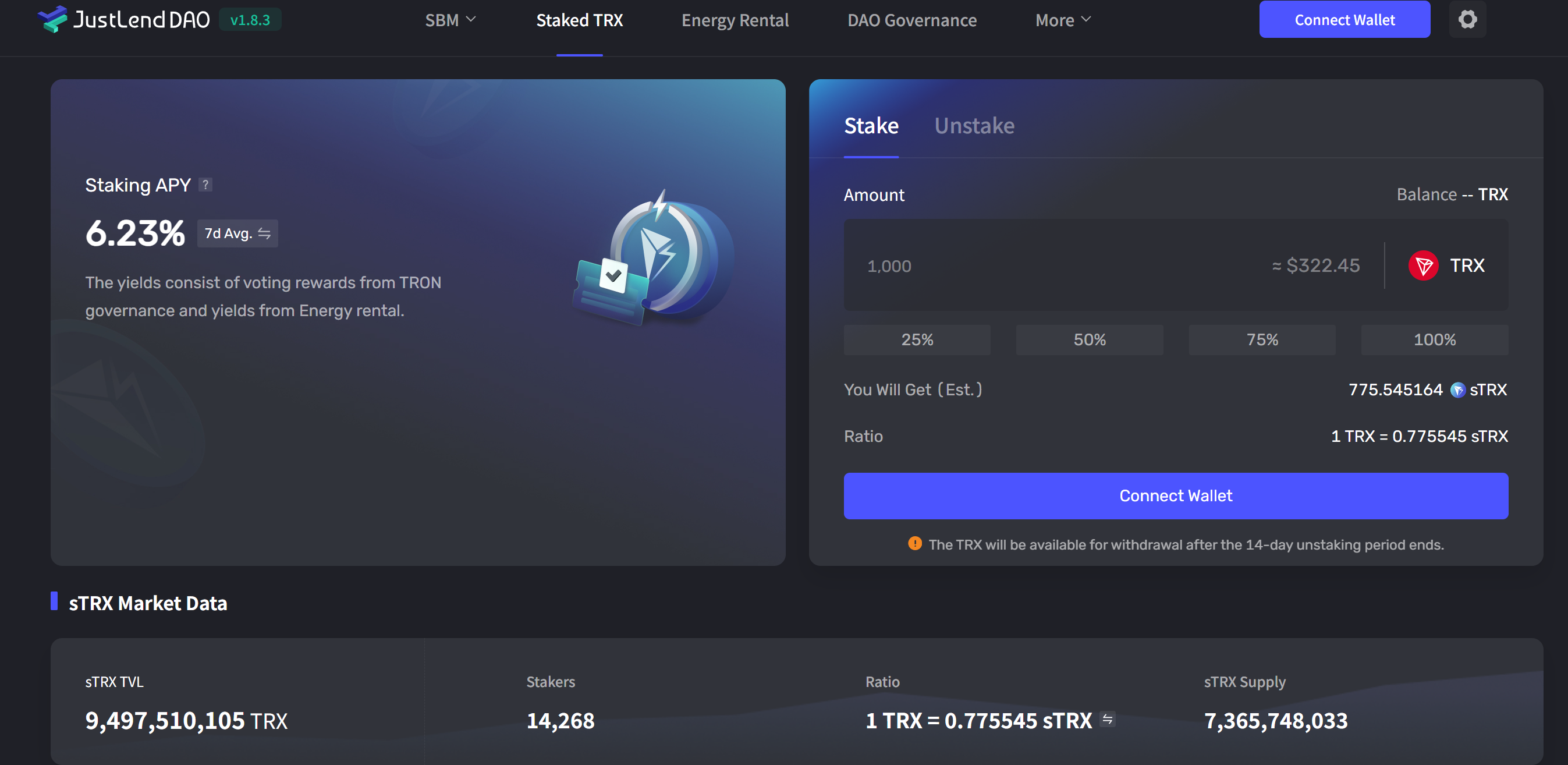
Source: https://app.justlend.or g/
90% of the rent for energy leasing belongs to the lessor, and 10% is included in JustLend DAO's income as a platform fee, becoming an important source of funds for JST's deflation. According to the official website of JustLend DAO, the current annualized return on staked TRX for 7 days is about 6.23% (income sources include voting rewards and energy leasing), the total market lock-up volume is about 9.498 billion TRX, and there are about 14,268 participating staking addresses.
2.2 Core Advantages of Energy Leasing
The greatest value of the TRON energy leasing mechanism lies in transforming the originally low-level "resource acquisition problem" into a "cost optimization tool" and "revenue tool" that is friendly to ordinary users.
-
Lower On-Chain Usage Costs: In the traditional mode, if users have no energy, they can only complete transactions by burning TRX, which is more expensive in high-frequency operation scenarios. Through energy leasing, users can obtain the required resources at a lower price, and the overall cost is significantly lower than directly burning TRX.
-
Reduced Barriers to Entry and Greater Flexibility: Users do not need to stake TRX for a long time or bear a 14-day unlocking cycle. They only need to rent energy on demand to complete the operation, supporting "pay-per-use" or "short-term use". This model is particularly suitable for small and medium-sized users, arbitrage traders, and high-frequency strategy users, making on-chain operations more flexible and efficient.
-
Improved Capital Efficiency of TRX: Through the sTRX mechanism of JustLend, users can not only obtain voting income after staking TRX, but also obtain additional income by renting energy, achieving "dual yield". At the same time, sTRX, as interest-bearing assets, can still participate in DeFi (such as collateral, trading, etc.), breaking the limitation of traditional staking "locking and losing liquidity".
-
Increased Ecosystem Activity and Positive Feedback Loop: Energy leasing reduces usage costs → users trade and interact more frequently → energy demand increases → leasing revenue increases → more users stake TRX to provide resources. This "usage-driven income, income-fed supply" structure enables TRON to form a continuously growing flywheel effect in stablecoins and DeFi scenarios.
III. How the Energy System Drives the Deflation of the TRON Ecosystem Tokens
The TRON energy system is essentially an underlying mechanism that converts "on-chain usage" into "token consumption and value return", becoming the "engine" of TRX, JST, and SUN deflation. The more frequently users transfer money, call contracts, participate in lending and trading, the more obvious the impact of this system on the token economy.
3.1 For TRX: When Resources Are Insufficient, the Usage Will Be Directly Converted into Burning Pressure
In the TRON network, as long as the account resources are insufficient, whether it is bandwidth or energy, the system will automatically burn TRX to make up for the cost. In other words, the more on-chain activities, the greater the resource consumption, and the higher the probability of TRX being consumed.
Stake 2.0 makes this mechanism smoother. Users can not only gain energy by staking TRX, but also delegate resources to others. As a result, more users are willing to lock TRX into the resource system. This results in a dual effect:
-
Part of TRX is staked, reducing the available circulating supply.
-
Another part of users continue to burn TRX when resources are insufficient, resulting in continuous consumption.
From the perspective of issuance, TRX adds about 336 million new tokens every year. In 2026, the monthly burning will be stable at 1-1.2 billion TRX. The amount of TRX burned has exceeded that of new issuance, and it is in a deflationary state. The annualized inflation rate is -3.44%, which effectively enhances the scarcity of tokens and supports price performance.
3.2 For JST: Energy Leasing and Protocol Revenue, Beginning to Form a Closed Loop of Buyback and Burn
JustLend approved a proposal in October 2025 to implement a JST buyback-and-burn mechanism. The primary funding sources include protocol net income, as well as revenue from the USDD multi-chain ecosystem above the $10 million threshold. Stake 2.0 has made resource delegation more flexible, while resource delegation itself serves as the foundation of the JustLend energy leasing market. As resource trading activity increases, the JustLend ecosystem expands, supporting the growth of protocol revenue. In turn, this revenue is fed back into JST buybacks and burns.
Therefore, the logic of the energy system driving JST deflation can be summarized as follows: the resource system first activates on-chain demand, which is then monetized into protocol revenue, and finally the protocol revenue flows back into JST burns.
According to official data from JustLend, the current JST has cumulatively burned about 1.085 billion, accounting for about 10.96% of the total supply, entering a clear quarterly deflation mechanism.
3.3 For SUN: Higher Activity Supports Token Burns
Since late 2021, part of SunSwap's trading volume revenue will continue to be used for SUN buybacks and burns. In 2024 and 2025, SunPump's revenue will also be included in the scope of buybacks and burns. According to the official announcement, SUN tokens have completed 49 buyback and burn phases, with a total buyback and burn of about 651 million tokens, accounting for 3.38% of the current liquidity.
The driving effect of the energy system on SUN deflation is reflected in the fact that TRON's resource system reduces the cost of on-chain interaction. The easier it is for users to conduct transactions, token issuance, exchange and participate in platform activities, the easier it is to amplify the transaction volume and income within the SUN.io ecosystem. And a part of these revenues will continue to flow to SUN for buybacks and burns. In other words, the energy system reduces the usage threshold, but ultimately benefits from the platform activity and token buyback capacity.
In summary, the relationship between the TRON energy system and the ecosystem token can be summarized into three lines.
-
TRX: direct burning when resources are insufficient, is the most direct deflation undertaker;
-
JST: The resource system drives borrowing, leasing and protocol revenue, and the revenue is allocated to buybacks and burns;
-
SUN: Low-cost on-chain transactions drive platform activity, and platform revenue then feeds back into token burns.
Therefore, the significance of the TRON energy system is not just about "saving transaction fees". Its more important value lies in gradually converting the real usage on the chain into burning of TRX, JST buybacks, and SUN burns. From this perspective, the energy system is not just a technical infrastructure, but more like the underlying engine of the TRON ecosystem token economy.
IV. Risks and Opportunities of the TRON Energy System
4.1 Structural Risks: Implicit Constraints Behind Efficiency Advantages
Although the TRON energy system has significant advantages in cost and efficiency, its underlying design also brings some significant risks that cannot be ignored.
-
Centralized Control Has High Risks: TRON adopts the DPoS mechanism, with a few super representatives responsible for block generation and centralized governance. At the same time, the development and resource scheduling of the ecosystem are largely influenced by Justin Sun. This "strongly dominant ecosystem" is helpful for rapid decision-making and execution in the early stage, but in the long run, there are also problems such as relatively weak governance transparency and decentralization, dependence on core figures for ecosystem direction judgment, and doubts about its anti-censorship and neutrality from external institutions.
-
The DeFi Ecosystem Structure Is Relatively Simple: Currently, the on-chain activity of TRON is highly dependent on the usage scenarios of USDT transfer, JustLend lending, and SUN ecosystem transactions. Compared to Ethereum's rich DeFi ecosystem, TRON's protocol diversity and innovation density are still insufficient. The ecosystem has weak risk resistance, and once the growth of core protocols slows down, the overall activity may decline synchronously.
-
Complexity of Resource Model: TRON introduces a three-layer structure of bandwidth + energy + leasing, which improves efficiency but has a higher understanding cost for new users. Especially in high-frequency usage scenarios, users need to manage resource balance, leasing cost, and burning mechanism, which increases operational complexity. Compared with the "direct gas payment" model, the path is more complex.
-
Ecosystem Dependence Risk: TRON's current on-chain demand is highly dependent on stablecoin (especially USDT) transfers. Once the stablecoin market undergoes structural changes (such as regulation, migration to other chains), TRON's resource demand and burning logic may be directly impacted.
4.2 Core Opportunities: Resource Financialization and Stablecoin Network Effects
Despite certain structural risks, the TRON energy system still has a clear and sustainable growth logic, and its core advantages are reflected in the dual drivers of "resource financialization" and "stablecoin network effect".
-
Financialization of Resources to Build a Differentiated Competitive Edge: TRON splits the on-chain resources into: collateral assets (TRX), tradable resources (Energy), and income-generating financial products (sTRX), essentially building an on-chain resource market. Compared with Ethereum's single fee model with Gas as the core, TRON realizes the leap from "fee consumption" to "resource financialization", so that resources can not only be used, but also held and invested, thus forming a long-term value precipitation mechanism.
-
Network Effect of Stablecoin Infrastructure: TRON has become one of the most important stablecoin circulation networks in the world. Its low cost and high throughput characteristics enable it to have continuous demand support in scenarios such as cross-border transfer and fund settlement, OTC and over the counter, high-frequency small transfers, etc. The energy system is the underlying mechanism that carries these demands: the more frequent on-chain use, the more stable resource consumption, the more active TRX burning and the resource leasing market, thus forming "usage-driven" endogenous growth.
-
Layered Income Structure and Improved Capital Efficiency: Based on the combination of protocols such as JustLend and USDD, TRON is gradually building a multi-layer yield structure: staking yield + energy leasing revenue + DeFi strategy income, enabling the same asset to generate income at multiple levels. Compared with the traditional PoS chain's single staking yield model, it is closer to an "on-chain yield aggregator" and more attractive to professional funds and institutions.
-
Low-Cost Model Driving User Growth: TRON's resource mechanism essentially advances and shares the user's usage cost, making the cost of a single transaction approach zero. Essentially, low cost is not only a technical advantage, but also a user growth strategy. Compared with high-gas chains, TRON is more likely to undertake the real trading needs of users in emerging markets, small high-frequency users, and Web2 to Web3 users, rather than relying solely on capital-driven short-term liquidity.
V. Outlook and Conclusion
From a more macro perspective, TRON, Ethereum, and Solana are not simply competitors, but represent three different paradigms of public chain development.
-
Ethereum has chosen the "security and decentralization first" path, reducing costs while ensuring security through the Gas mechanism and Layer2 expansion, making it suitable for carrying high-value assets and complex DeFi structures.
-
Solana chooses the "performance-first" path, adapting to high-frequency trading, blockchain games and other scenarios through high throughput and low cost, but with higher requirements for system stability and hardware dependency.
-
TRON has taken a more unique path - the "resource optimization and cost control" route. Through energy systems and leasing markets, it achieves a near-zero gas user experience and converts on-chain resources into tradable and profitable assets.
From a long-term perspective, these three paths are more likely to form a structural division of labor.
-
Ethereum will continue to carry high-value assets and complex financial activities, becoming the "value settlement layer".
-
Solana will rely on its performance advantages to serve high-frequency interaction scenarios and become the "application execution layer".
-
TRON is expected to consolidate its position in stablecoins and payment networks, becoming the "on-chain fund circulation infrastructure".
Conclusion
The core value of the TRON energy system is not only to reduce transaction fees, but also to establish a more direct mapping relationship between on-chain behavior and token economy, ultimately forming a complete closed loop: user transactions → resource consumption → profit distribution → token deflation. This mechanism of converting real demand into value capture is the core difference between it and other public chains.
However, TRON’s long-term potential still depends on whether it can break through the current structural constraints: on the one hand, it is necessary to enhance ecosystem diversity and innovation capabilities while maintaining low-cost advantages; on the other hand, it is also necessary to further weaken centralized dependence in governance and infrastructure. Only by achieving a balance between "efficiency advantage" and "ecosystem depth" can the energy system evolve from an efficient resource model to a bottom-level economic system with long-term competitiveness.
About Us
Hotcoin Research, the core research and investment arm of Hotcoin Exchange, is dedicated to turning professional crypto analysis into actionable strategies. Our three-pillar framework—trend analysis, value discovery, and real-time tracking—combines deep research, multi-angle project evaluation, and continuous market monitoring.
Through our Weekly Insights and In-depth Research Reports, we analyze market dynamics and highlight emerging opportunities. With Hotcoin Selects—our exclusive dual-screening process powered by both AI and human expertise, we help identify high-potential assets while minimizing trial-and-error costs.
We also engage with the community through weekly livestreams, decoding market hot topics, and forecasting key trends. Our goal is to empower investors of all levels to navigate cycles with confidence and capture long-term value on Web3.
Risk Disclaimer
The cryptocurrency market is highly volatile, and all investments carry inherent risks. We strongly encourage investors to remain informed, assess risks thoroughly, and adhere to strict risk management practices to protect their assets.
Connect with Us
Website:https://www.hotcoin.com/en_US/learn/index/
X: x.com/HotcoinAcademy
Email: labs@hotcoin.com
Lectura recomendada
Ver más
Hotcoin Research | Who is the King of Staking Returns? A Comparison of ETH and BTC Staking Protocols and Yields
In-depth Research
Hotcoin Research | Will SOL ETF Be the Third Approved Crypto Asset ETF? A Hype or a Sure Win?
In-depth Research
Hotcoin Research | A Wave or Prelude to an Outbreak: Insights and Future Development of AI Meme
In-depth Research

Contactos de servicio
Service@hotcoin.com
Comentarios sobre el producto
Product@hotcoin.com
Cooperación empresarial
Business@hotcoin.com
Contactos Legales
Casecn@hotcoin.com
Sobre nosotros
producto
Servir
soporte
©2017-2026