
The UST Collapse: Risks and Lessons from an Algorithmic Stablecoin
The collapse of UST was a death spiral driven by an endogenous shock-absorbing asset, concentrated exits, and vanishing liquidity. It showed that algorithms can create arbitrage incentives, but cannot replace redeemable reserves or liquidity during a crisis.
Before May 2022, TerraUSD (UST) targeted a price of US$1 and adjusted its supply through the minting and burning of LUNA. The mechanism could narrow deviations while markets were calm and arbitrageurs remained willing to take the other side. Once UST and LUNA were sold at the same time, however, the conversion path intended to restore the peg accelerated the issuance of LUNA.
How Were UST and LUNA Supposed to Maintain the Peg?
UST was not backed one-for-one by bank deposits or short-term government debt. Instead, LUNA served as the volatile asset intended to absorb changes in UST supply and demand. Terra's market module offered protocol conversions between UST and LUNA at oracle prices, using arbitrage to guide UST toward US$1.
The mechanism can be reduced to two cases:
- When UST traded above US$1, a user could burn US$1 worth of LUNA, mint 1 UST, and sell that UST in the external market. The added UST supply helped push its market price down.
- When UST traded below US$1, a user could buy discounted UST, burn 1 UST, and mint US$1 worth of LUNA. Removing UST from circulation was intended to reduce supply while the arbitrageur sold the received LUNA for a profit.
The second path contained an often-overlooked step. Holders did not receive US$1 in a bank account. They first received newly minted LUNA and then relied on LUNA's market price and available buy-side liquidity to exit. A protocol quote, an on-chain transaction, and the eventual conversion into another asset were therefore not the same thing.
Why Did Arbitrage Fail to Defend US$1?
Arbitrage occurs only when the full execution path remains profitable. Terra's protocol conversion included spread fees and liquidity parameters, while selling LUNA outside the protocol exposed traders to price changes, market depth, fees, and execution delays. As pressure increased, apparent arbitrage profit on paper diverged from what could actually be realized.
The larger problem was the mutual dependence between UST and LUNA. Burning UST increased the supply of LUNA. As LUNA's price fell, redeeming the same value of UST required minting more LUNA, and the new LUNA created still more selling pressure. Once the market began to doubt whether LUNA could absorb the remaining UST, the discount encouraged even more holders to exit together.
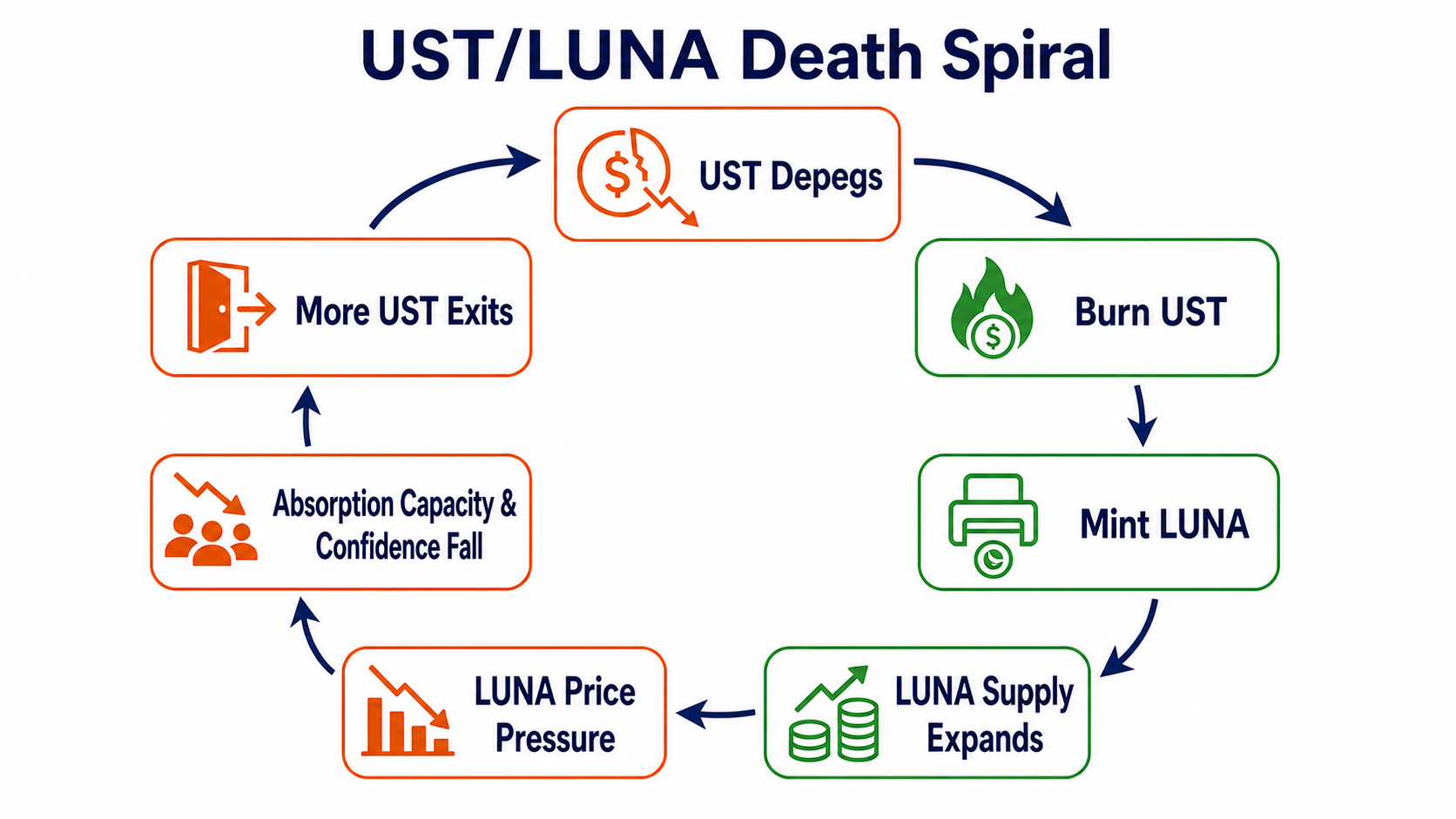
This was the UST/LUNA death spiral:
UST trades at a discount → UST is burned and LUNA is minted → LUNA selling pressure and price decline → each conversion requires more LUNA → confidence in the exit path falls further
The algorithm did not stop working; it continued to execute its predefined minting rules. Those rules could not guarantee enough buyers for newly minted LUNA or ensure that all UST holders could exit near US$1 at the same time.
How Did the Collapse Unfold in May 2022?
UST had a market capitalization of roughly US$18 billion before the collapse. On May 7–8, withdrawals from Anchor became concentrated and liquidity in decentralized UST trading pools became noticeably imbalanced. UST then moved away from US$1, and redemptions and market selling began to reinforce each other.
| Stage | What happened in the market | Feedback created by the mechanism |
|---|---|---|
| Liquidity contraction | Large amounts of UST left Anchor and entered trading or conversion routes | UST selling increased and trading pools became more vulnerable to price deviations |
| Peg weakened | UST fell below its target price in secondary markets | Arbitrageurs burned UST and the protocol minted LUNA |
| Absorption capacity declined | LUNA fell at the same time and newly minted LUNA was sold | The number of LUNA required for each UST rose rapidly |
| Confidence fled | More holders attempted to leave UST and LUNA together | Market depth fell, spreads widened, and the death spiral accelerated |
| System failed | UST did not regain its peg, and the Terra network later paused block production | Conversion and transfer routes were also affected by network conditions |
Public postmortems do not fully agree on who initiated the earliest transactions. What can be established is that large withdrawals, pool imbalances, and a broader market decline occurred during the same period of stress. Attributing the collapse solely to one attacker overlooks why the system could not absorb redemption demand that was visible in the open market.
Why Did Anchor Protocol Amplify the Risk?
Anchor once offered an annual yield close to 20% on UST deposits. An International Monetary Fund review noted that nearly three-quarters of UST was deposited in Anchor before the collapse. The high yield created demand for UST, but also concentrated that demand in one principal use case.
Anchor's deposit yield was funded by borrower interest, staking returns, and a yield reserve. When actual income did not cover the target deposit rate, the reserve made up the difference. This structure could maintain the headline rate while the reserve lasted, but it could not guarantee permanent demand for deposits.
Once users withdrew UST from Anchor, stablecoins previously held for yield re-entered the trading market. This was not merely a decline in application activity: a large amount of UST was simultaneously seeking an exit into other assets. The source of the yield, deposit concentration, and the stablecoin peg therefore formed a single chain of risk.
Why Did Bitcoin Reserves Not Stop the Collapse?
Before the collapse, the Luna Foundation Guard accumulated external reserves that included Bitcoin and attempted to use them to support the market after UST depegged. External assets can provide additional liquidity, but the arrangement at the time was not a reserve account that allowed every UST holder to redeem directly with the issuer for US$1.
The effectiveness of a reserve depends on its size, custody, authority to deploy it, speed of sale, and the depth counterparties are willing to provide. Selling volatile assets during a broad market decline can also crystallize losses. After confirming that a system holds reserves, investors must still determine whether those reserves can cover redemptions during the stress window and whether ordinary holders have a defined right to redeem them.
What Verifiable Lessons Did the UST Collapse Leave?
First, peg analysis must trace the entire redemption path. When a stablecoin claims that one token can be exchanged for US$1 worth of assets, the next question is what users ultimately receive. If they receive a newly minted volatile token, the outcome still depends on that token's price and market depth. An accounting value inside a protocol is not the same as cash that can be withdrawn.
Second, an endogenous asset cannot independently resolve a system-wide run. When a stablecoin and its absorbing asset belong to the same ecosystem, confidence in both can fall together. Relying on the absorbing asset's market capitalization creates reflexivity: stablecoin redemptions weaken the absorbing asset, and the decline of that asset reduces capacity for the next round of redemptions.
Third, high yield must be broken down by source and duration. Deposit returns may come from genuine borrowing demand, token incentives, or reserve subsidies. Analysis should separately track protocol revenue, subsidies, deposits, and borrowing. Subsidies can encourage adoption, but they do not prove that the peg can survive withdrawals after the subsidy ends.
Fourth, extreme conditions test a mechanism better than normal conditions. A stablecoin remaining close to US$1 for a long period shows only that past market conditions were sufficient for balance. A meaningful stress test should also simulate large redemptions, simultaneous declines in collateral, trading-pool imbalances, oracle delays, and network pauses to identify where the exit path fails.
How Do Algorithmic Stablecoin Risks Differ from Other Models?
| Model | Common stabilization method | Primary exit route | Key checks |
|---|---|---|---|
| Fiat-reserve-backed | Cash, deposits, or highly liquid assets | Redeem with the issuer or sell in a secondary market | Reserve quality, audits or attestations, redemption eligibility, and custody risk |
| Crypto overcollateralized | Collateral value exceeds stablecoin debt, with liquidation rules | Repay debt to recover collateral or sell in the market | Collateral ratio, oracles, liquidation capacity, and bad-debt handling |
| Dual-token algorithmic | Minting and burning a stablecoin and an absorbing token | Convert into the absorbing token and then sell it | Endogenous backing, minting limits, market depth, and demand concentration |
| Hybrid | Partial external reserves plus algorithmic adjustment | Depends on protocol design | Reserve coverage, replenishment order, and governance authority |
Every model can depeg, but its failure path is different. For the reserve and collateral differences among USDT, USDC, and DAI, read the in-depth guide to stablecoins. For a broader entry point to crypto-asset categories and analysis, see the beginner's guide to crypto assets.
How Can You Identify Weaknesses in an Algorithmic Stablecoin?
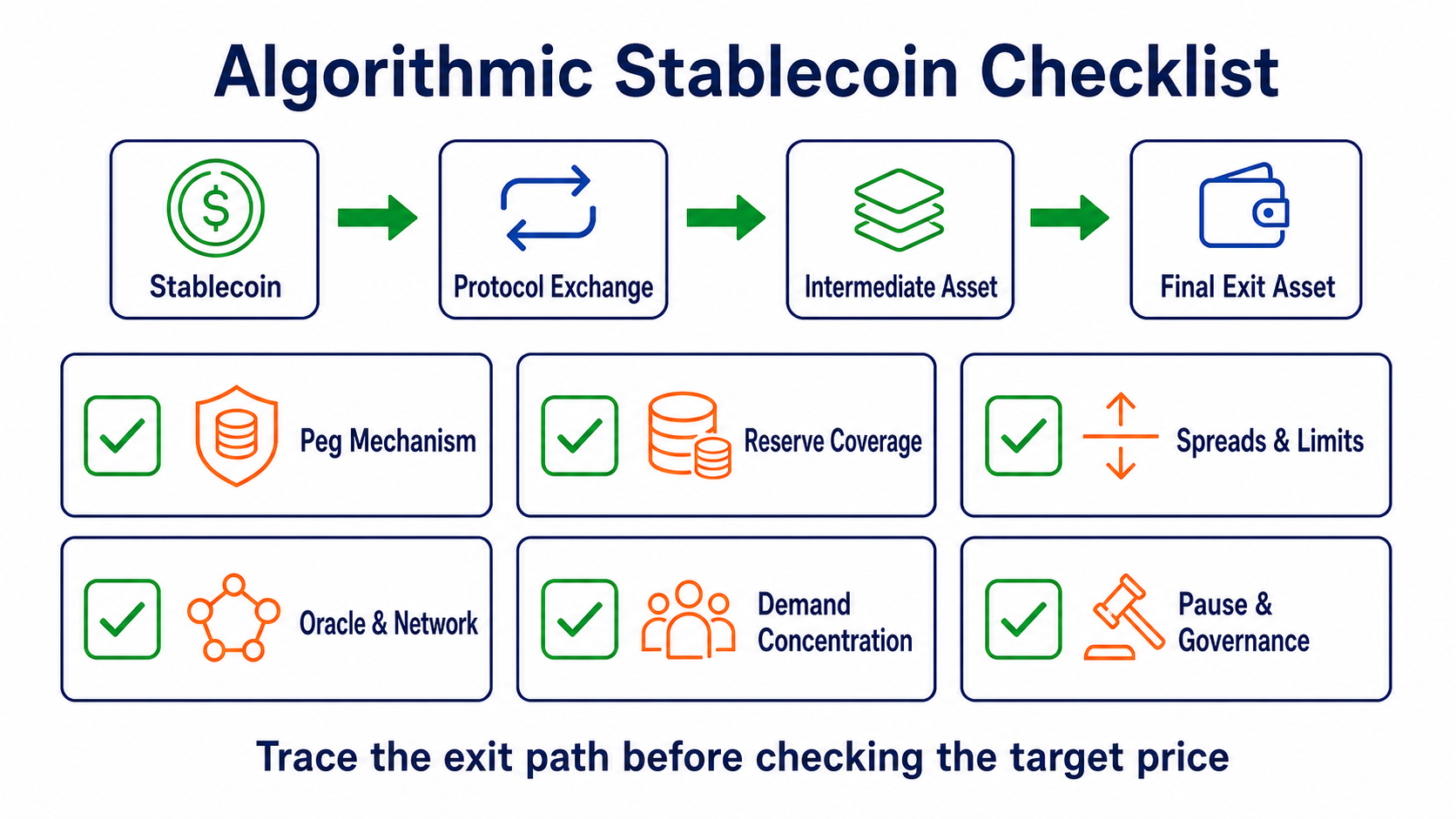
Assess the redemption path layer by layer instead of looking only at whether the price is temporarily near US$1.
- Write down every step from burning the stablecoin to receiving the final asset, and determine whether another volatile token is minted along the way.
- Compare stablecoin liabilities with external reserves, distinguishing assets owned by the protocol from redemption rights held by users.
- Review per-block conversion capacity, dynamic spreads, oracle updates, network congestion, and pause authority.
- Measure where stablecoin demand is concentrated and estimate how much capital could exit together if a yield program ends.
- Simulate simultaneous declines in the stablecoin and its absorbing asset, then examine whether minting, market depth, and governance responses create negative feedback.
- Verify exit routes across bridged versions, centralized exchanges, and decentralized trading pools rather than treating one market price as network-wide liquidity.
This checklist is intended to identify the conditions on which a peg depends and where market pressure may first appear. It should not be used to assign a permanent safety score to a stablecoin.
Frequently Asked Questions
Are USTC and LUNC the Same UST and LUNA from 2022?
They originate from the original Terra chain. After a new Terra chain was created, the old chain was renamed Terra Classic, while the original LUNA and UST became LUNC and USTC. LUNA on the new chain is not the same token as the old-chain assets, so users should verify both the network and contract identifier in a wallet or trading interface.
Does the UST Collapse Prove That Every Algorithmic Stablecoin Will Go to Zero?
That conclusion cannot be drawn directly. Algorithmic stablecoins do not all use the same collateral, minting, liquidation, or reserve designs. UST is a documented failure case that can help identify similar dependencies, but it does not replace a review of the parameters and asset rights of a particular protocol.
Did a Short-Selling Attack Cause UST to Collapse?
Public evidence confirms large withdrawals and trading-pool imbalances, but there is no single agreed conclusion about the intent of the earliest traders. Whether deliberate short selling occurred or not, the system still had to withstand legitimate withdrawals and open-market sales. Its inability to absorb the scale of exits is the part directly relevant to risk assessment.
Can a Governance Vote Automatically Restore the Peg?
Governance can change fees, minting limits, or other system parameters, but it cannot automatically replace lost market liquidity or force traders to buy at the target price. Restoring a peg also depends on available assets, redemption arrangements, market demand, and execution capacity.
Recommended
View more


Service@hotcoin.com
Product@hotcoin.com
Business@hotcoin.com
Casecn@hotcoin.com