
Stablecoins Explained: Differences and Risks of USDT, USDC, and DAI
USDT, USDC, and DAI all target a value close to one US dollar, but they maintain that price in different ways. USDT and USDC rely on issuers that manage off-chain reserves, while DAI relies on protocol-controlled collateral, liquidations, stability modules, and governance parameters. Stablecoins are therefore low-volatility tools, not risk-free digital dollars.
Comparing the three requires examining who can mint and burn tokens, where reserves or collateral are held, who qualifies for redemption, and which network a token circulates on. The price shown on a trading page reflects only the market's current trades. To first understand where stablecoins fit within the broader crypto asset landscape, read the Crypto Asset Guide.
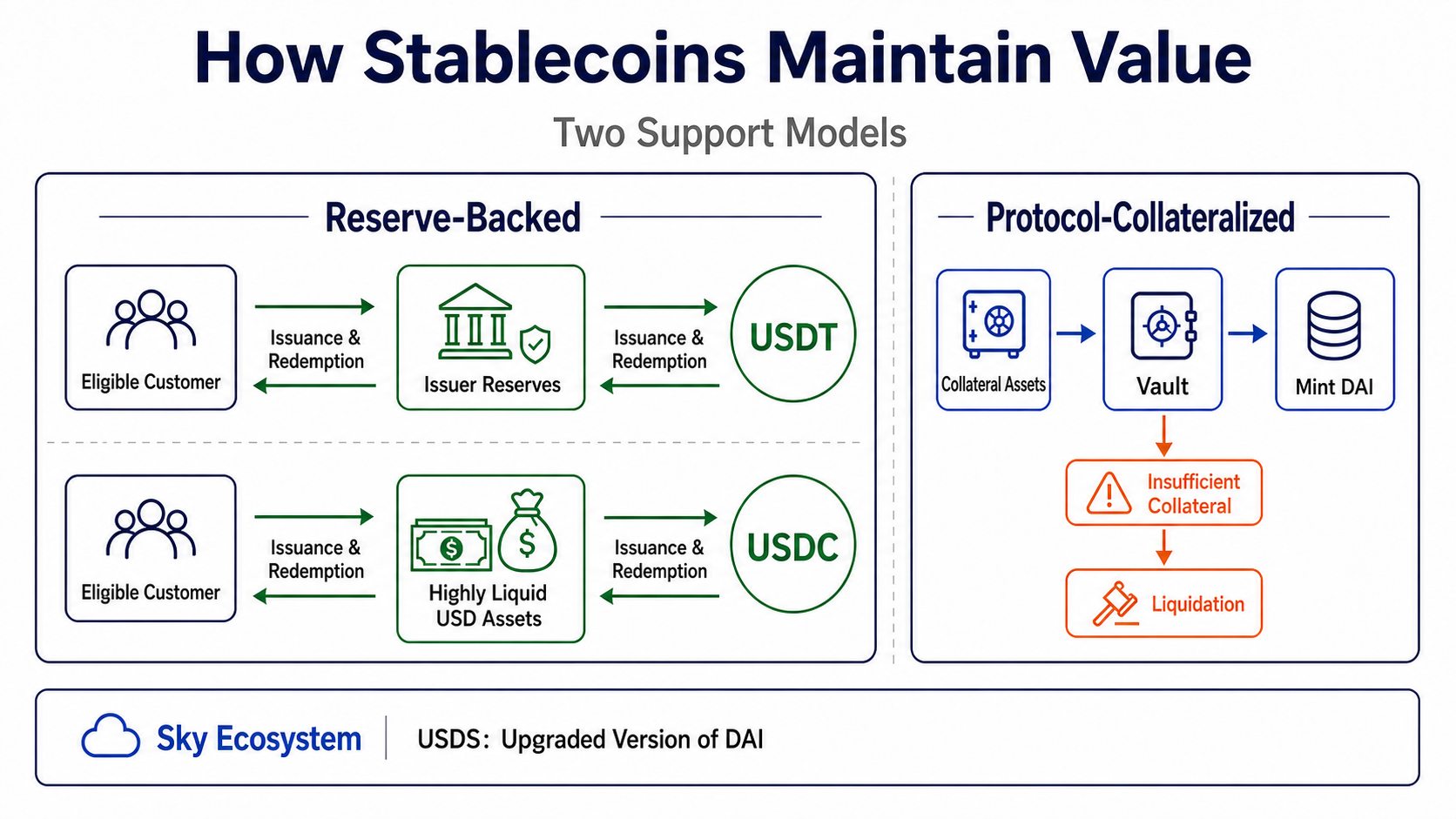
How Do Stablecoins Maintain Their Relationship With the US Dollar?
A stablecoin selects a reference value, such as one US dollar, and then uses minting, redemption, collateral, or arbitrage mechanisms to steer its market price toward that target. Trading near one dollar is the result of these mechanisms working; it is not a price permanently fixed by the blockchain.
With fiat-reserve stablecoins, eligible customers usually deliver dollars to the issuer, which mints an equivalent amount of tokens. When a customer redeems, the issuer burns the tokens and pays out dollars according to its terms. If the secondary-market price moves away from one dollar, participants with access to the redemption channel may trade and redeem to narrow the gap.
Crypto-collateralized stablecoins instead lock collateral in smart contracts and create stablecoins only when the collateral value exceeds the debt. If the collateral ratio falls below the required level, the protocol initiates liquidation. Some protocols also allow stablecoins to be exchanged for other approved assets according to predefined parameters, adding another price-stability mechanism.
Both models can lose their peg. Reserve-backed tokens are exposed to reserve liquidity, custodians, and redemption channels. Collateral-backed tokens also face oracle, liquidation, smart contract, and governance risks.
What Are the Differences Between USDT, USDC, and DAI?
The clearest difference is how each token supports its one-dollar target. USDT and USDC are backed by their issuers, reserve assets, and redemption arrangements. DAI is supported by protocol-held or protocol-controlled collateral, liquidation rules, and governance settings.
| Comparison | USDT | USDC | DAI |
|---|---|---|---|
| Primary manager | Tether manages issuance, redemption, and reserves | Circle and its regulated affiliated issuers manage issuance, redemption, and reserves | Maker rebranded as Sky in 2024; smart contracts execute the core logic while ecosystem governance maintains parameters |
| Price target | 1 USDT is intended to remain close to USD 1 | 1 USDC is intended to remain close to USD 1 | 1 DAI is intended to remain close to USD 1 |
| Backing model | Tether reserves, including cash, cash equivalents, and other assets | Highly liquid US dollar reserves, primarily cash, short-term US Treasuries, and overnight Treasury repurchase agreements | Multiple collateral types, Vault debt, liquidations, and stability modules work together |
| How new tokens are created | The issuer mints tokens for eligible customers after receiving subscriptions | The issuer mints tokens for eligible customers after receiving subscriptions | Users generate DAI against approved collateral, while protocol modules can also affect supply |
| Direct redemption | Subject to identity, jurisdiction, minimum amount, fee, and service-term requirements | Circle Mint mainly serves eligible institutions; rights elsewhere depend on local rules and service arrangements | It is not equivalent to submitting 1 DAI to a company for USD 1; exits usually depend on protocol swaps or market liquidity |
| Transparency channels | Daily circulation data plus quarterly reserve and assurance reports | Reserve composition disclosures, weekly issuance and redemption data, and monthly third-party assurance | Collateral positions, contracts, and governance parameters can be viewed on-chain, but analysis is more demanding |
| Control characteristics | The issuer controls minting, redemption, and certain contract administration permissions | The issuer controls minting and redemption and may restrict addresses under applicable rules | There is no conventional issuer reserve account, but governance, authorized contracts, and emergency powers still exist |
Tether discloses that USDT reserves are not limited to bank cash. Assessing USDT therefore requires looking at reserve asset classes, liquidity, valuation methods, and reporting dates. A quarterly attestation covers a specific point in time; it is not the same as a complete financial audit of every business process and every day's balance.
Circle manages USDC reserves separately from operating funds and continuously discloses their composition. USDC reserves are concentrated in cash and short-duration dollar assets, but holders must still consider banks, custodians, the issuer, business hours, and redemption eligibility. Buying USDC on the secondary market does not automatically make someone a Circle Mint customer eligible to redeem directly with Circle.
DAI has a different structure. Users can deposit approved collateral into a Vault and generate DAI within the applicable risk parameters; the protocol may liquidate a position if its collateral ratio falls below the requirement. Maker rebranded as Sky in 2024, and Sky defines USDS as an upgraded version of DAI, but DAI remains a distinct on-chain token that users must identify separately. DAI's current collateral composition, stability modules, and governance parameters can all affect it, so the earlier description of DAI as "fully overcollateralized by ETH" is no longer sufficiently accurate.
Why Can't Reserve Reports Alone Prove a Stablecoin Is Safe?
A reserve report answers questions such as which assets existed at a particular time and whether their reported value covered circulating tokens. On its own, it does not show whether ordinary users have direct redemption rights, whether reserves can be sold quickly during extreme conditions, how custodial accounts are legally protected, or whether on-chain contracts and trading platforms might fail.
When reviewing reserve disclosures, check the following in order:
- Whether the reporting entity is the same entity that issues the token. Similar group names do not mean every issuing entity has identical obligations.
- Whether the asset classes are sufficiently liquid. Cash, short-term government debt, loans, precious metals, and crypto assets differ in liquidation speed and price risk.
- Whether the data represents real-time balances, management disclosures, an assurance report, or full financial statements. Each form of evidence has a different verification scope.
- Whether reserves are segregated from the issuer's operating assets and which banks or custodians hold them.
- Whether the report date aligns with the current token supply. An old report cannot directly establish today's coverage.
Regulatory benchmarks proposed for dollar reserve-backed stablecoins focus on the same issues, including full reserves, a clear par-redemption policy, asset segregation, liquidity, and independent assurance. Meeting one condition does not automatically satisfy the others.
Where Does Stablecoin Depegging Usually Begin?
Depegging means that a stablecoin's traded price persistently deviates from its target value. A brief deviation may result from shallow order books or delays in moving funds between platforms. More serious deviations often involve blocked redemptions, doubts about reserve quality, rapidly falling collateral, or protocol failures.
When a reserve-backed stablecoin faces run-like pressure, the issuer must convert off-chain assets into cash and complete payments. Blockchains operate around the clock, but banks, bond markets, and traditional settlement systems have business hours and settlement cycles. The mismatch between these systems can amplify short-term price gaps.
When DAI's collateral falls in value, its liquidation mechanism must obtain reliable prices promptly and find market participants willing to acquire the collateral. If prices gap down, the network is congested, or liquidity is insufficient, collateral-sale proceeds may not fully cover the debt. DAI's exposure to other stablecoins and real-world assets also means risks from off-chain issuers can indirectly enter the protocol.
Algorithmic stablecoins face another problem. If price stability depends mainly on issuing more of a paired token and maintaining market confidence, redemption pressure can simultaneously depress the asset intended to absorb volatility or provide backing. To understand how this mechanism can fail, continue with Risks and Lessons From the UST Collapse.
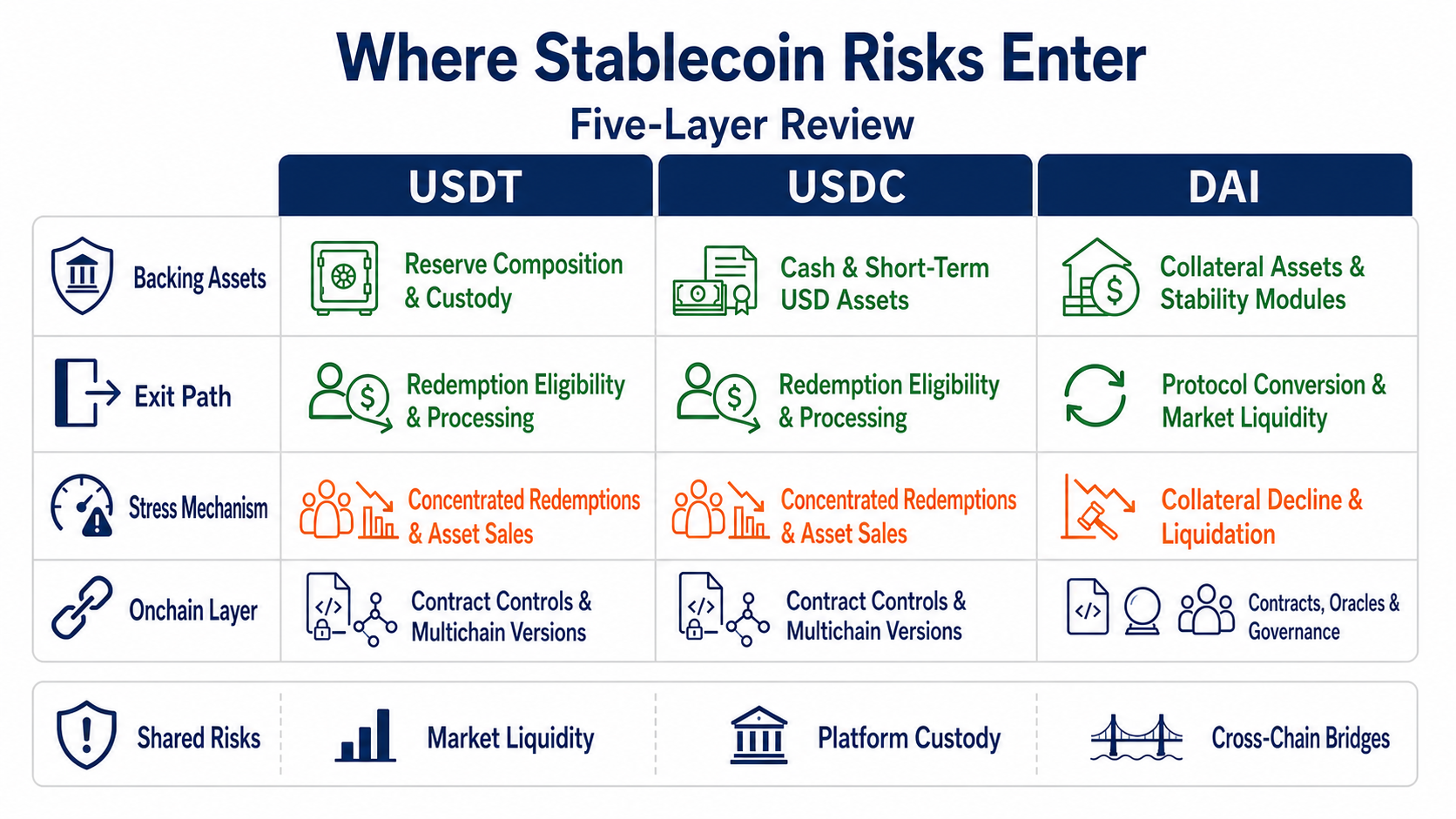
How Should You Evaluate a Stablecoin Before Using It?
Users do not interact with an abstract concept called "USDT" or "USDC." They interact with a specific contract on a particular network and with a wallet, trading platform, or DeFi protocol that supports that contract. Checking the following five layers helps avoid assuming that assets with the same name carry identical risks.
| Layer | What to verify | Common misconception |
|---|---|---|
| Token identity | Confirm the network, contract address, and token symbol through an official issuer or project page | Trusting only the name and icon and receiving a counterfeit token |
| Backing assets | Review the latest reserve report or on-chain collateral composition | Assuming "pegged to the dollar" means backed only by bank cash |
| Redemption route | Confirm eligibility, minimum amount, fees, payout method, and processing time | Treating a sale on an exchange as equivalent to issuer redemption |
| On-chain permissions | Check pause, upgrade, freeze, oracle, and governance powers | Assuming an on-chain token can never be managed or restricted |
| Holding venue | Distinguish self-custody, centralized platforms, and DeFi contracts | Ignoring platform insolvency, withdrawal suspension, or protocol vulnerabilities |
The same symbol can also refer to a natively issued token, an official cross-chain version, or a third-party bridged wrapper. A bridged token's value depends not only on the original stablecoin but also on the bridge's custody, validation, and exit mechanisms. Before depositing, verify both the network and contract instead of relying only on the asset name.
Depositing a stablecoin into a lending protocol changes the risk profile again. The holder then assumes not only stablecoin risk but also risks related to the lending pool, liquidations, oracles, and smart contracts. For more about these mechanisms, read the DeFi Lending Guide.
Frequently Asked Questions
Do USDT, USDC, or DAI Automatically Earn Interest When Held?
No. Stablecoins generally do not generate yield simply by sitting in an ordinary wallet. Returns displayed by a trading platform, lending protocol, or savings contract come from a separate use of funds and add platform, borrower, smart contract, or governance risks.
Are Stablecoins Bank Deposits?
Usually not. Holding an on-chain token is not the same as opening a deposit account at a commercial bank, and users should not assume bank-deposit protection applies. The holder's rights against an issuer, reserve, or protocol depend on the token's terms, issuing entity, and applicable jurisdiction.
Are Stablecoin Transfer Fees Paid With the Stablecoin Itself?
Most blockchains require their native asset for network fees, such as ETH on Ethereum. Some wallets and services can sponsor or convert fees, but that is an additional feature and should not be assumed to apply on every network.
Is Buying a Stablecoin Below USD 1 a Risk-Free Arbitrage Trade?
No. A buyer may lack access to the issuer's redemption channel and can face further price declines, withdrawal suspensions, redemption delays, fees, and platform failures. A price gap becomes executable only after the entire exit route and all associated costs have been verified.
Recommended
View more


Service@hotcoin.com
Product@hotcoin.com
Business@hotcoin.com
Casecn@hotcoin.com