
Red Flags of Crypto Scams – Protect Yourself Now
High returns, urgency, and pressure are classic crypto scam red flags
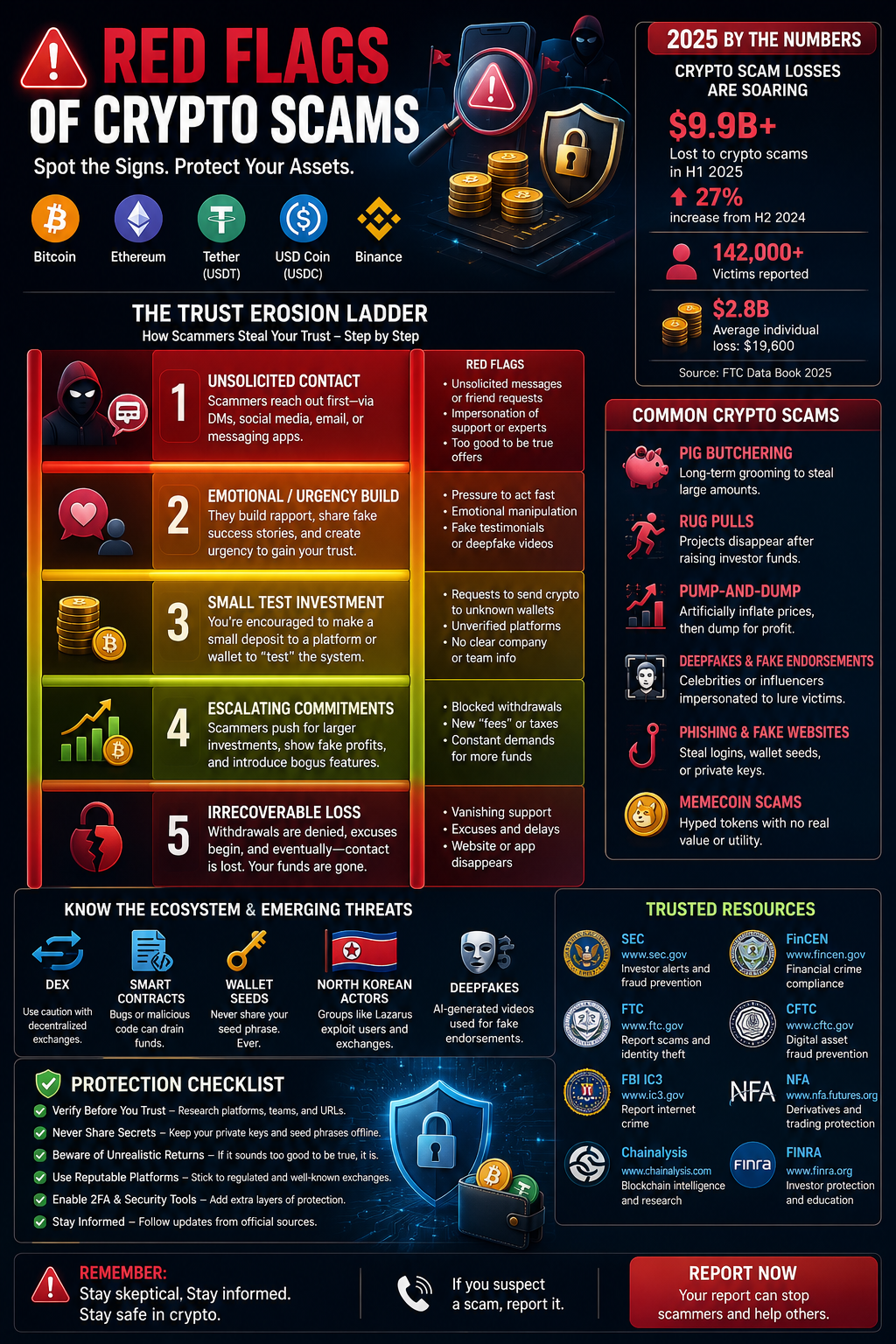
Crypto scams exploit the hype around digital assets by promising quick riches while using sophisticated tactics to steal funds. Scammers stole an estimated $17 billion globally in 2025 through crypto scams and fraud, with U.S. victims reporting over $11 billion in losses to the FBI's Internet Crime Complaint Center (IC3), accounting for more than half of all internet crime losses that year. Investment scams alone drove $7.2–8.6 billion in U.S. losses.
What Are the Primary Red Flags in Crypto Scams?
Guaranteed high returns without risk represent a core warning. Legitimate crypto investments carry high volatility; no credible platform promises fixed double-digit gains in days or weeks. Scammers lure victims with "risk-free" opportunities that defy market realities.
Unsolicited contacts via social media, dating apps, or messaging platforms often initiate scams. Strangers building rapid trust before pitching investments signal manipulation, common in pig butchering schemes where emotional bonds precede financial demands.
Pressure to act fast or deposit more to "unlock" funds creates artificial urgency. Victims face escalating fees, taxes, or "verification" costs that prevent withdrawals, a hallmark of fraudulent platforms.

How Do Celebrity Endorsements and Deepfakes Fuel Crypto Scams?
Fake celebrity endorsements exploit trust in public figures. Scammers use deepfake videos or impersonated accounts to promote tokens or platforms. McAfee research shows Americans encounter about 2.6 deepfake videos daily, rising among younger adults, many tied to crypto promotions.
Victims send crypto to QR codes or wallets falsely linked to stars. These endorsements lack verification and direct funds irreversibly to scammers.
Relevant article: Crypto Security Hacks Every Newbie Needs: Avoid These 7 Costly Mistakes
What Role Do Fake Investment Platforms Play?
Fraudulent trading sites mimic legitimate exchanges but only accept crypto deposits and display fake account balances. Users see illusory profits before withdrawal blocks trigger extra payments.
These platforms often lack physical addresses, verifiable registration with bodies like FinCEN or SEC, or legitimate customer service. Registration checks via official databases help verify legitimacy.
Why Are Romance and Pig Butchering Scams So Effective?
Romance scams, or pig butchering, combine emotional grooming with investment advice. Scammers build relationships online, then introduce "profitable" crypto trades managed on fake platforms. Losses mount as victims add funds for "higher tiers."
These scams thrive on prolonged trust-building, making victims reluctant to report. They represent a significant portion of global crypto fraud revenue.
How Can You Spot Rug Pulls and Pump-and-Dump Schemes?
Rug pulls involve new tokens or projects where developers hype a token, attract liquidity, then drain funds by selling holdings or removing liquidity pools. Anonymous teams, vague whitepapers, and unaudited smart contracts raise alarms.
Pump-and-dump schemes use social media hype to inflate prices before insiders sell. Rapid price surges followed by crashes, especially with memecoins, fit this pattern. Avoid decisions based solely on social buzz. Academic analysis of crypto-influencer activity on platforms like Twitter shows initial positive returns followed by significant long-horizon losses, consistent with manipulative tactics.
What Technical and Security Red Flags Indicate a Scam?
Requests for private keys, seed phrases, or wallet access are never legitimate. No reputable service needs them for transactions.
Unusual smart contract permissions, such as unlimited approvals, enable theft. Phishing sites with slight URL variations (typosquatting) mimic exchanges.
Forensic research on Ethereum has traced approximately $2 billion in illicit profits across numerous wallets through smart contract fraud since 2017, underscoring the scale detectable via blockchain analysis.
Table 1: Common Crypto Scam Types Comparison
| Scam Type | Typical Red Flags | Average Impact (Examples) | Entities Involved |
| Investment Platforms | Fake gains, withdrawal fees | Billions annually (FBI data) | Fraudulent exchanges, "managers" |
| Pig Butchering | Romance grooming, managed trading | $ billions (Chainalysis) | WhatsApp/Telegram groups |
| Celebrity Impersonation | Deepfakes, QR codes | Widespread individual losses | Social media accounts |
| Rug Pulls | Anonymous devs, unaudited contracts | Project-specific, up to millions | DEX liquidity pools |
| Job/Recruitment | Crypto-related remote work offers | Funds for "training" or equipment | Fake companies |
This comparison highlights how scams adapt but share patterns of deception and irreversibility. Conclusions from data show prevention outperforms recovery, as only about 10% of stolen crypto is typically recovered.
What Statistics Highlight the Scale of Crypto Scams?
In 2025, U.S. seniors faced heightened risks, with crypto-related losses contributing to broader elder fraud trends. Globally, Chainalysis estimates $17 billion stolen, with impersonation scams surging 1400% YoY.
FBI IC3 data for 2025 shows 181,565 crypto-related complaints totaling over $11 billion, with investment fraud dominant. These figures likely undercount actual losses due to shame and complexity.

How Do You Verify a Crypto Opportunity Safely?
Verify registration with SEC adviserinfo, FINRA BrokerCheck, or state regulators. Check smart contracts on explorers like Etherscan for known issues. Use tools for liquidity analysis and team background. Cross-reference claims against official sources rather than social proof. Test small withdrawals early. Consult independent financial advisors registered with legitimate bodies. These steps address layered due diligence.
Legal scholarship further contextualizes challenges in pursuing fraud claims in crypto markets, discussing the applicability of doctrines like fraud-on-the-market to decentralized assets.
What Are Effective Protection Strategies?
Use hardware wallets for large holdings and enable multi-factor authentication. Avoid clicking unsolicited links. Research via blockchain analytics. Report suspicions promptly to FTC, FBI IC3, or CFTC.
Education on blockchain basics reduces vulnerability. Communities and regulators stress that legitimate opportunities do not pressure or guarantee outcomes.
The "Trust Erosion Ladder" Framework
Consider a Trust Erosion Ladder: Level 1 (Unsolicited Contact) → Level 2 (Emotional/Urgency Build) → Level 3 (Small Test Investment) → Level 4 (Escalating Commitments) → Level 5 (Irrecoverable Loss). Each rung involves specific red flags; recognizing early halts progression. This model synthesizes patterns from reports into a practical cognitive tool for users.
Relevant entities covered include: Bitcoin, Ethereum, Tether (USDT), USD Coin (USDC), Binance, SEC, FTC, FBI IC3, Chainalysis, FinCEN, CFTC, NFA, FINRA, DEX, smart contracts, rug pulls, pig butchering, deepfakes, memecoins, wallet seeds, phishing, pump-and-dump, and North Korean actors (Lazarus Group).
FAQ
What are the red flags of crypto scams?
Unsolicited promises of high returns, pressure tactics, requests for private keys, fake platforms, and celebrity deepfakes top the list.
How much money is lost to crypto scams each year?
U.S. losses exceeded $11 billion in 2025 per FBI data, with global estimates at $17 billion.
How to avoid pig butchering crypto scams?
Never send funds to online romantic interests for investments; verify all platforms independently.
Can you recover money from crypto scams?
Recovery is rare (around 10%); focus on prevention and immediate reporting.
What should I do if I suspect a crypto scam?
Stop interactions, secure assets, document evidence, and report to FTC (reportfraud.ftc.gov), FBI IC3, or local authorities.
Relevant article: Crypto Regulations in 2026: A Complete Guide to Crypto Compliance, Laws, and Global Frameworks
In conclusion, awareness of these patterns—backed by data from FBI, Chainalysis, CFTC, and academic studies from institutions like Georgia Tech, Indiana University Kelley School of Business, and Harvard Journal of Law & Technology—empowers users to navigate crypto safely. Volatility is inherent, but fraud is avoidable through skepticism and verification. Stay informed as tactics evolve with AI and new technologies.
References:
Commodity Futures Trading Commission. "Curious About Crypto? Watch Out for Red Flags." PDF. 2022. https://www.cftc.gov/sites/default/files/2022-10/DigitalAssetRedFlags.pdf.
Chainalysis. "2026 Crypto Crime Report: Scams." January 13, 2026. https://www.chainalysis.com/blog/crypto-scams-2026/.
Federal Bureau of Investigation. Various Internet Crime Reports (2025–2026).
AARP. "What to Know About Cryptocurrency Scams." Updated June 25, 2026. https://www.aarp.org/money/scams-fraud/cryptocurrency/.
Merkley, Kenneth J., Joseph Pacelli, Mark Piorkowski, and Brian Williams. “Crypto-Influencers.” Review of Accounting Studies 29, no. 3 (2024): 2254–2297. https://doi.org/10.1007/s11142-024-09838-4.
Yao, Mingxuan, and Brendan Saltaformaggio. Georgia Tech CyFI Lab research on Ethereum smart contract fraud. Georgia Institute of Technology, 2024. https://www.cc.gatech.edu/news/follow-money-2-billion-crypto-scams-found-ethereum.
Patel, Menesh S. “Fraud on the Crypto Market.” Harvard Journal of Law & Technology 36 (2022). https://jolt.law.harvard.edu/assets/articlePDFs/v36/Patel-Fraud-on-the-Crypto-Market-1.pdf.
Recommended
View more
Quick Guide: Key Drivers of the Fed’s Interest Rate Policy and Its Impact on the Crypto Market
Basic Concepts

What is DID?
Basic Concepts
BitMart, BitMEX & AscendEX Closures: Three Exchanges Down in Seven Days
Basic Concepts

Service Contacts
Service@hotcoin.com
Product Feedback
Product@hotcoin.com
Business Cooperation
Business@hotcoin.com
Legal Contacts
Casecn@hotcoin.com
About us
Service
Support
©2017-2026