
Quick Overview of Smart Contract Permission Types
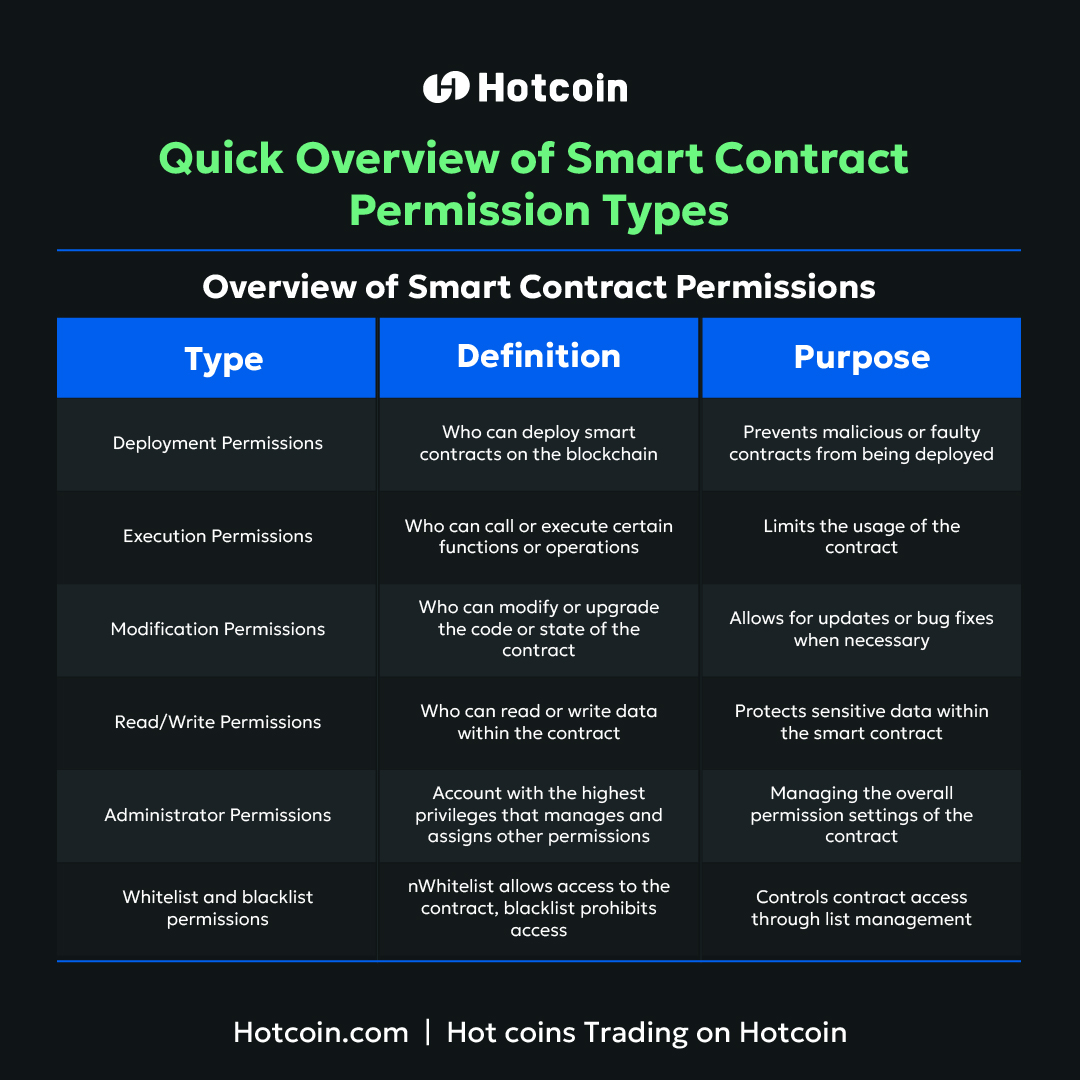
Smart contract permissions refer to the rules and mechanisms that control and manage access to and operations on smart contracts within a blockchain environment. These permissions ensure that only authorized users or entities can execute specific functions of a smart contract, preventing unauthorized operations and ensuring the security and reliability of the contract.
Types of Smart Contract Permissions
1. Deployment Permissions
- Definition: Controls who can deploy smart contracts to the blockchain.
- Purpose: Prevents unauthorized users from deploying malicious or incorrect contracts on the network.
2. Execution Permissions
- Definition: Controls who can call or execute specific functions or operations within a smart contract.
- Purpose: Limits the use of the contract to authorized users or entities, ensuring only specific functions are triggered by the right parties.
3. Modification Permissions
- Definition: Controls who can modify or upgrade the smart contract's code or state.
- Purpose: Allows for code updates or bug fixes when needed, while preventing unauthorized changes to the contract.
4. Read/Write Permissions
- Definition: Controls who can read or write data in the smart contract.
- Purpose: Protects sensitive data in the contract, ensuring only authorized parties can access or modify it.
5. Administrator Permissions
- Definition: Typically held by the highest-privileged account, which can manage and assign other permissions.
- Purpose: Manages the overall permission settings of the contract, ensuring that only trusted administrators can perform critical operations.
6. Whitelist and Blacklist Permissions
- Definition: A whitelist is a list of users allowed to access the contract, while a blacklist is a list of users prohibited from accessing it.
- Purpose: Enhances security by controlling access to the contract through list management.
These permission mechanisms are enforced by blockchain’s immutability and transparency, ensuring secure operation of smart contracts within a decentralized network.
Recommended
View more



Service@hotcoin.com
Product@hotcoin.com
Business@hotcoin.com
Casecn@hotcoin.com