
How to Choose the Right Leverage for Crypto Futures Trading (Professional Risk Management Guide)
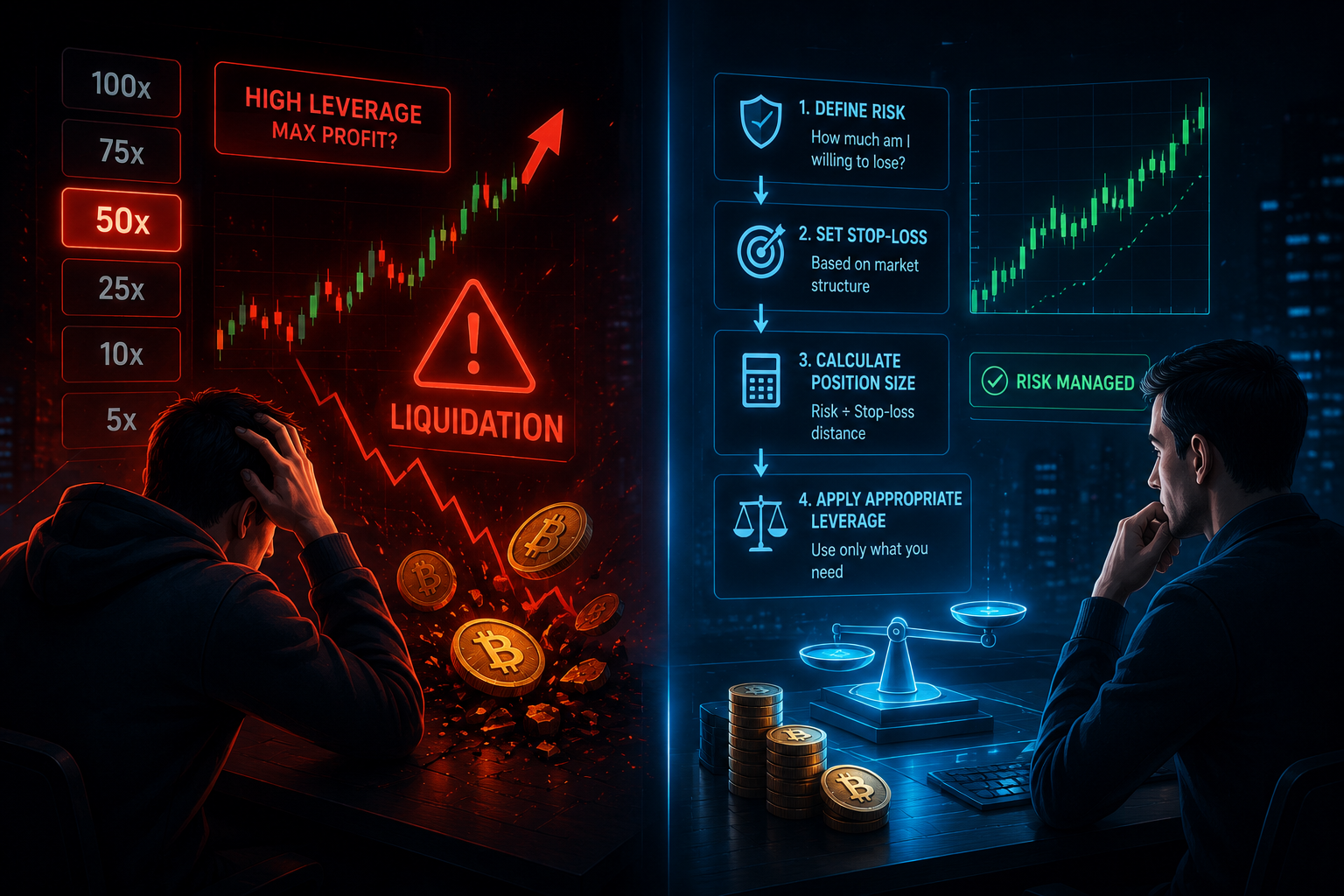
Choosing the right leverage for crypto futures trading is not about selecting the highest multiplier available—it's about selecting the amount of leverage that matches your risk tolerance, trading strategy, and market conditions. Professional traders don't decide to use 10x, 20x, or 50x leverage first. Instead, they determine how much they're willing to risk, identify where their trade becomes invalid, calculate the appropriate position size, and then use only enough leverage to execute the trade efficiently.
This approach helps reduce unnecessary liquidation risk while improving capital efficiency. It also allows traders to remain consistent through different market conditions instead of relying on aggressive leverage to generate larger returns.
If you're wondering what leverage you should use for Bitcoin, Ethereum, or other cryptocurrency futures, there isn't a single number that works for everyone. The right leverage depends on factors such as your account size, stop-loss distance, the asset's volatility, and your trading timeframe.
Most beginner traders believe the secret to bigger profits is choosing higher leverage. In reality, many experienced futures traders do the opposite. They often use lower leverage—not because they're being cautious, but because it gives them greater control over risk and long-term profitability. Before selecting your next leverage level, it's worth understanding why this approach has stood the test of time.
Why Most Traders Choose Leverage the Wrong Way
Many new traders begin by selecting a leverage level because it appears to maximize potential profits. They may decide to trade at 50x or 100x simply because the exchange allows it. After choosing the leverage, they adjust their position size around that decision.
Professional traders reverse this process.
Rather than asking, "How much leverage should I use?" They ask, "How much money am I willing to lose if this trade fails?"
Once the acceptable risk is determined, they calculate the position size based on the stop-loss distance. Only then do they apply enough leverage to open that position without committing unnecessary capital.
This approach transforms leverage from a speculative tool into a capital efficiency tool.
Understanding What Leverage Actually Changes
Leverage does not increase the quality of a trade. It simply reduces the amount of margin required to control a larger position.
For example, controlling a $10,000 Bitcoin futures position requires approximately $2,000 in margin at 5x leverage, $1,000 at 10x leverage, and only $500 at 20x leverage. The market movement remains identical regardless of the leverage selected. What changes is the amount of capital supporting the trade and how close the liquidation price moves toward the entry price.
Higher leverage creates less room for normal market fluctuations. Even a small price movement against the position can trigger liquidation before the market resumes the expected direction.
This is why experienced traders focus more on protecting their capital than maximizing leverage.
Related Article: What Is RFQ Trading
Step 1: Define Your Maximum Risk Per Trade
The first decision should never be leveraged.
Instead, determine how much of your trading account you are willing to lose if the trade reaches the stop loss.
Professional traders commonly risk between one and two percent of their account on a single position. This allows them to survive a series of losing trades without significantly damaging their capital.
For example, a trader with a $10,000 account who risks one percent is accepting a maximum loss of $100. If the stop loss is triggered, the loss remains controlled regardless of the leverage used.
This approach prevents emotional decision-making and creates consistency over hundreds of trades.
Step 2: Determine the Stop-Loss Based on Market Structure
The stop loss should never be determined by liquidation distance.
Instead, it should be placed where the original trading idea becomes invalid.
For example, if Bitcoin breaks below a major support level, the trade thesis may no longer be valid. The stop loss should be placed below that support rather than at an arbitrary percentage.
Using technical analysis, volatility indicators, or recent price swings helps traders identify logical stop-loss locations that reflect market behavior rather than personal preference.
The wider the stop loss, the smaller the position size should become.
Step 3: Calculate Position Size Before Selecting Leverage
After determining acceptable risk and stop-loss distance, calculate the appropriate position size.
Suppose a trader has a $5,000 account and risks one percent, or $50, on a trade. If the stop loss is two percent away from the entry price, the maximum position size would be approximately $2,500.
At this stage, leverage becomes a financing decision rather than a trading decision.
If the trader only wants to allocate $500 of margin, using 5x leverage would provide enough buying power to control the calculated position.
Notice that leverage was selected only after every other risk variable had already been determined.
By now, you've probably noticed that leverage isn't the starting point of a successful trade. It's the final piece of a larger risk management strategy. When you determine your acceptable loss, calculate your position size, and place your stop-loss before choosing leverage, you're following the same structured process used by disciplined traders rather than relying on guesswork.
Why Higher Leverage Increases Liquidation Risk
One of the biggest dangers of excessive leverage is that it significantly narrows the distance between the entry price and liquidation price.
A position using 3x leverage has much more room to withstand normal market volatility than one using 50x leverage.
Cryptocurrency markets frequently experience short-term price swings of several percentage points before continuing the primary trend. Traders using extreme leverage often find themselves liquidated during these temporary fluctuations, even when their overall market analysis proves correct.
Lower leverage allows positions to survive normal volatility while maintaining the original trading strategy.
Related Article: What Are Liquidators?
How Market Volatility Should Influence Your Leverage
Leverage should never remain constant across every cryptocurrency.
Bitcoin typically experiences lower daily volatility than many altcoins. Ethereum often moves more aggressively, while smaller-cap cryptocurrencies can experience double-digit percentage swings within hours.
As volatility increases, leverage should generally decrease.
Professional traders adjust their exposure based on the current market environment rather than relying on fixed leverage settings. During periods of unusually high volatility, many reduce leverage even further to account for wider price movements.
This dynamic approach helps maintain consistent risk despite changing market conditions.
Choosing Leverage Based on Trading Style
Trading style also influences appropriate leverage.
Scalpers often use moderately higher leverage because they aim to capture very small price movements while exiting positions quickly. Day traders usually reduce leverage slightly because positions remain open longer and face greater market uncertainty. Swing traders frequently use even lower leverage since trades may remain active for several days or weeks, increasing exposure to overnight volatility and unexpected market events.
Long-term position traders often find that minimal leverage provides sufficient capital efficiency without exposing themselves to unnecessary liquidation risk.
The objective is not to maximize returns on individual trades but to maximize long-term account survival.
Cross Margin vs. Isolated Margin
Margin mode also affects risk management.
Cross margin uses the available account balance to support open positions. While this reduces the likelihood of immediate liquidation, it exposes a larger portion of the account if a trade moves significantly against the trader.
Isolated margin limits the amount of capital assigned to a single position. If liquidation occurs, only the allocated margin is lost rather than the entire account balance.
Many professional traders prefer isolated margins because it provides greater control over individual trade risk and prevents one poor decision from affecting the entire portfolio.
Why Professional Traders Rarely Use Maximum Leverage
Professional traders understand that long-term success comes from consistency rather than spectacular individual trades.
Using moderate leverage allows them to remain active during periods of increased volatility, avoid unnecessary liquidations, and preserve capital for future opportunities.
They also recognize that profitable trading depends on strategy quality, disciplined execution, and risk management rather than aggressive leverage.
A trader using 3x leverage with a proven strategy will generally outperform a trader using 100x leverage without consistent discipline.
Common Mistakes When Choosing Leverage
Many traders mistakenly believe that increasing leverage automatically increases profitability. Others widen their stop loss after entering a trade to avoid liquidation, which often results in larger losses than originally planned. Some traders also increase leverage after a losing streak in an attempt to recover quickly, creating a cycle of emotional decision-making that frequently leads to significant account drawdowns.
Another common mistake is ignoring trading fees and funding payments. While these costs may appear small individually, they can accumulate over time and reduce the profitability of highly leveraged positions, particularly for trades held over multiple days.
Related Article: What is Crypto Trading Slippage
The Best Way to Choose Leverage
The correct leverage is the minimum amount necessary to open the desired position while maintaining proper risk management.
Instead of selecting 20x or 100x simply because it is available, calculate how much capital you are willing to risk, identify a logical stop-loss level, determine the correct position size, and then apply only enough leverage to execute the trade efficiently.
This process reflects how experienced traders approach leverage. It emphasizes capital preservation, disciplined execution, and consistent risk management over chasing the highest possible returns.
The next time you open a crypto futures position, resist the urge to choose the highest leverage available. Instead, calculate your risk first, determine your ideal position size, and select only the leverage required to execute your plan. Making this simple change can help you trade more consistently, protect your capital, and build better trading habits over the long term.
Leverage is not a shortcut to higher profits. It is a financial tool that allows traders to use capital more efficiently when combined with a well-defined trading plan. The traders who achieve consistent long-term success are not those using the highest leverage but those who understand when to increase exposure, when to reduce it, and when to avoid trading altogether.
By treating leverage as the final step in your risk management process rather than the starting point of every trade, you improve your ability to survive volatile markets, protect your capital, and build a sustainable crypto futures trading strategy over time.
References
Hull, John C. Options, Futures, and Other Derivatives. 11th ed. Hoboken, NJ: Pearson, 2022.
Murphy, John J. Technical Analysis of the Financial Markets: A Comprehensive Guide to Trading Methods and Applications. New York: New York Institute of Finance, 1999.
Tharp, Van K. Trade Your Way to Financial Freedom. 2nd ed. New York: McGraw-Hill Education, 2006.
Recommended
View more
What Is a Governance Token in Crypto Protocols?
Basic Concepts
What is DAO Governance?
Basic Concepts

What is DeFi?
Basic Concepts

Service Contacts
Service@hotcoin.com
Product Feedback
Product@hotcoin.com
Business Cooperation
Business@hotcoin.com
Legal Contacts
Casecn@hotcoin.com
About us
Service
Support
©2017-2026